
Hi.
Doing the 2nd of these “Dispatches from the Road” style articles… less crafted, more immediate….
Let me know if you like these… I’ll add them to the rotating menu of article-types you’ll be receiving. Also - thanks to the 2 new paid subscribers this week!
And, don’t forget… TUESDAY’S WORKSHOP (click the title image below):
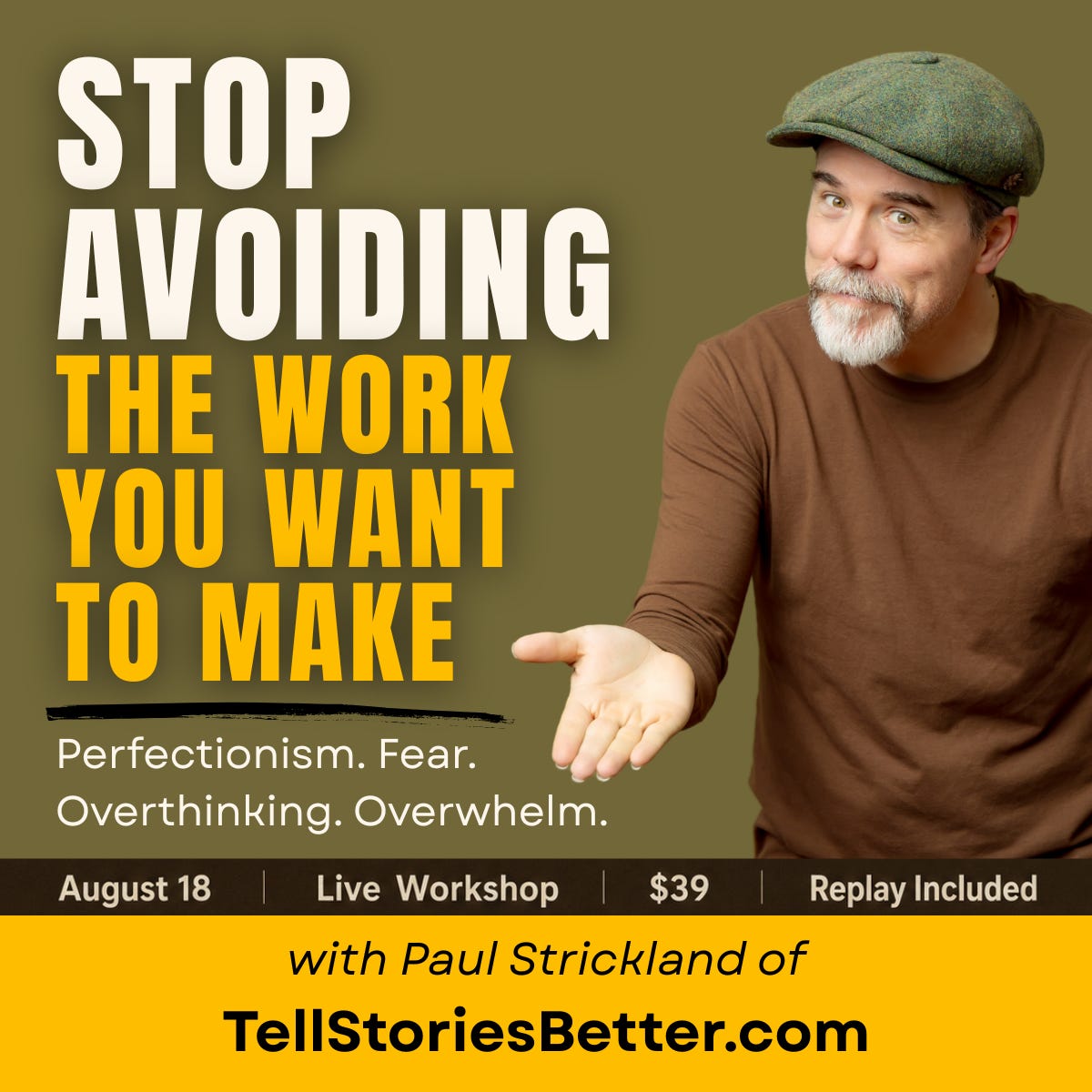
Now on to the article:
I’m writing this from Edmonton, Alberta, Canada, home of the largest Fringe theatre festival in North America, where there are currently 209 different productions happening all around the city at the same time... most of them are doing something like seven performances a piece... and that’s not even mentioning the outdoor performers who are juggling fire and riding 12 foot tall unicycles. What I mean to say is Edmonton currently feels less like a city and more like someone kicked over a gigantic box of creativity and decided not to clean it up.
It is... a lot. And I absolutely love it here. I always have loved it here… even on years that didn’t go as well.
Very happily can report that this year’s show - Bloody Fairytales - is going extremely well.
That’s just an enormous honor at a festival where there is so much good work competing for people’s time and attention. I’m just... honored. I’m so honored I’m repeating myself. I’m honored.
My very good friend Bil Lepp is here too. He sold out the opening performance of his wonderful show Bil and Skeeter Break the Ocean. (You should also check out his Substack, Appa-LEPP-chia, which I will enthusiastically point you toward because Bil is excellent and because apparently this paragraph is now also an advertisement for Bil.)
Anyway...
There wasn’t a Victorian collapse onto a chaise lounge or whatever… it wasn’t overly dramatic…
She was probably in her thirties, sitting next to her mother, and she just sort of... went over... onto her mom... right in the middle of a dramatic moment in a story… and for a little while, it looked like they were going to try to stay.
Which presented me with a problem...
because once something like that happens in a room, that is now what the room is about.
I guess I could have kept telling the story while every single person in the audience thought: Is that woman okay?
Neither of the above options seemed particularly useful... So I just... found a moment that felt like a memorable enough place in the story to “place a verbal bookmark” -
and I stopped and asked Erika, who was running the lights and sound, to pull up the house lights… and we stopped the show…
then I told the two patrons who were having the troubles they were absolutely ok to leave if needed and I’ll get them comps for another show later in the run…
They agreed that would be best… and as they left Erika went to let them out, get their email address for the comps I’d promised, etc…
which then immediately presented me with ANOTHER problem... because AS I STARTED THE STORY AGAIN from the BOOKMARKED MOMENT I realized…
RIGHT AFTER that moment there was an important sound cue.
And the person who fires the sound cues was currently outside the theatre making sure the two patrons were ok.
So... I changed the plan. I… improvised as best I could.
I expanded the section I was in. I stayed inside THAT moment of story for WAY longer than I would have had it been planned, but gave it a little more room to breathe... just making up an entire tiny little subplot for a moment until Erika could get back to the booth.
And somewhere in there I said something that had NEVER previously existed in the show:
Then Erika got back. Then sound cue happened. And the story continued.
And at the very end of the show, I reached a line I’ve said at the end of that story for a long time:
And now, for every seat in the theatre except the two that were empty,
that line felt like a callback
to the abnormal (and memorable) experience we’d had 40 minutes earlier.
Happy happy happy happy accident. Lucky break. Good times!
The problem had become... a feature. It had become part of the show.
I’ve been thinking about that ever since.
Most of us have a terrible habit of encountering an obstacle and then staring at the obstacle for so long the obstacle would be uncomfortable with it if obstacles had a sense of personal space. I know that’s true because I’ve spent a LOT of hours staring at blinking cursors on blank word documents…
You can either ignore the problem and keep pushing... (NOT RECOMMENDED) or we fixate on the problem until it becomes the entire project (HIGHLY NOT RECOMMENDED)
But there is another option.
Figure out what problem you are actually dealing with.
How do I continue as planned?
is not always a viable option or a useful question.
Here’s a useful question from Saturday’s show:
What do these people… and this show… need from me RIGHT NOW?
That’s a potentially successful approach. Those are both potentially answerable questions.
WHY DON’T I TRY HARDER? is... well... just not.
That is also the basic idea behind something I’ve been building called the Procrasti-Creation Decision Tree.
Creativity is not a one-size-fits-all situation no matter WHAT part of the creative process you’re talking about.
Maybe you don’t know what the next step is… that’s fine.
A lot of folks try to make something good before they’ve actualy made anything at all to even judge. That’s fixable.
But blindly forcing yourself to run forward is not the first job. (That’s how you end up breaking your metaphorical nose.)
The first job is diagnosing what’s actually in the way.
Then you can make a move. And then another one. And then another one.
And next thing you know you’re PAGES further up the road.
That’s what I’m teaching this Tuesday, August 18, in my live workshop:
We’ll use the Procrasti-Creation Decision Tree to figure out what kind of stuck you’re dealing with, what to do about it, and how to actually get moving again.
There’ll also be live coaching and Q&A.
$39. Replay included.
https://stan.store/tellstoriesbetter/p/stop-avoiding-the-work-you-want-to-make
Hopefully nobody faints… but if they do… we’ll handle it.
Comments
Nothing yet. Say the first thing.
Sign in to join the conversation.