
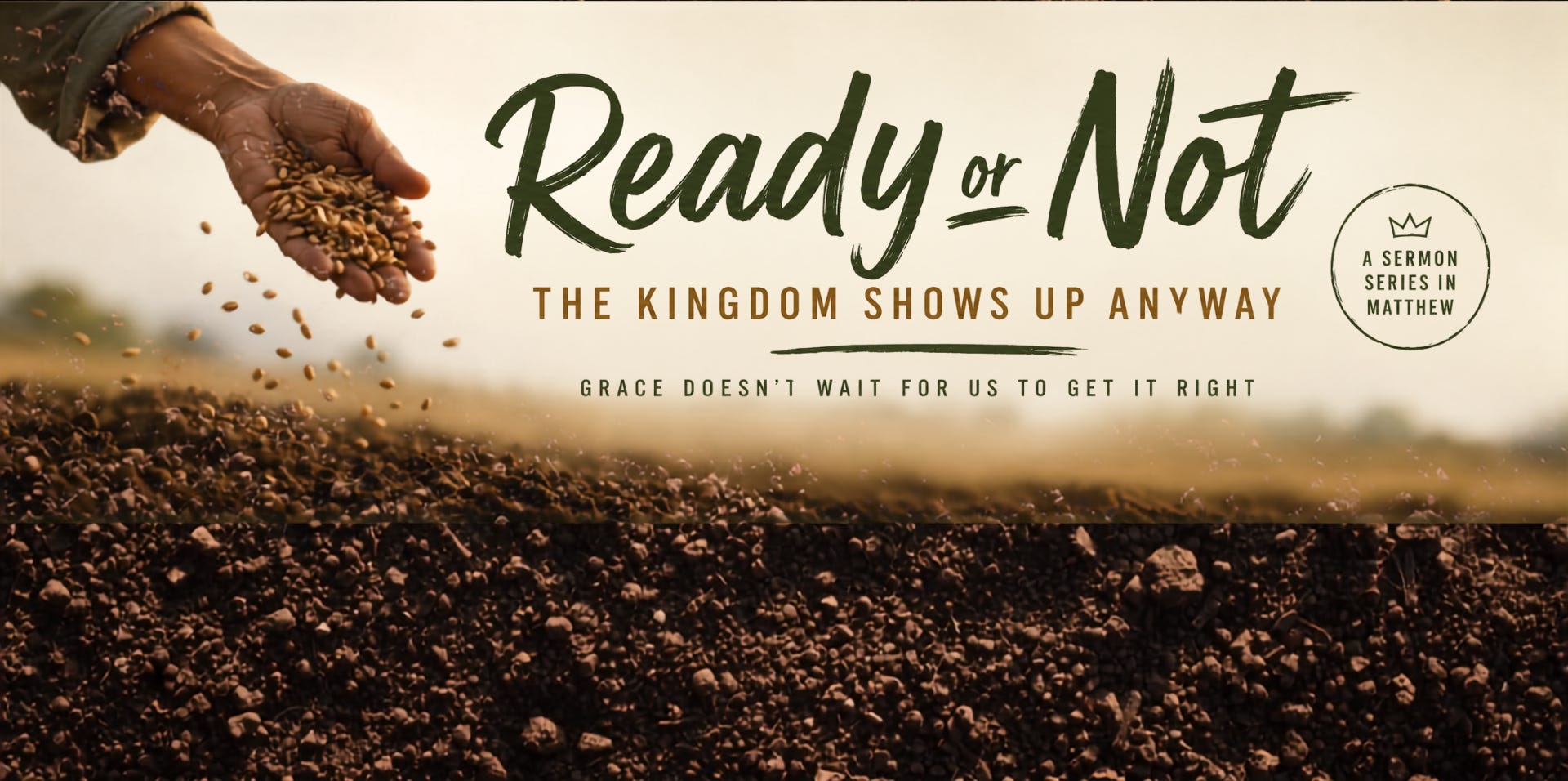
“A sower went out to sow.”
That is where Jesus begins.
Not with birds or soil or rocks or thorns. Not even the harvest. Jesus does not begin with any of the places we prefer to begin.
Jesus begins with the sower.
We almost always hear this parable and begin inspecting the dirt. We turn inward and take a spiritual inventory. “Am I?” becomes our question.
Am I the path?
Am I the rocky ground?
Am I full of thorns?
Am I good soil?
Am I a 30, 60, or 100-fold harvest?
Am I even sure what those numbers mean?
Jesus tells a parable about the Kingdom of God and within seconds we turn his words into a personality test.
I have been a pastor long enough to know that we are very good at turning grace into homework. We are very good at taking a parable that begins with divine generosity and twisting it into another occasion for religious self-diagnosis.
Am I faithful enough?
Am I productive enough?
Am I deep enough?
Am I fruitful enough?
Am I enough?
And because we are human, we make a competition out of it. We start wondering if we are better soil than the people sitting three rows over.
But Jesus does not begin with soil. He begins with the Sower.
“A sower went out to sow.”
Pay attention to Jesus’ words.
Before there is any response, before there is any failure, before any fruit or choking off or withering, there is a sower.[i]
Before there is our hearing, there is God speaking.
Before there is our receiving, there is God giving.
Before there is our fruitfulness, there is God’s abundance.
The first actor in this parable, or any parable for that matter, is not us. The first actor is God. Specifically, the first person of the Trinity, God the Father.

The late episcopal priest Robert Farrar Capon presses the point. God is the Sower. The seed is the Word. And, for the church, the Word is not merely a lesson, religious principle, or a scripture cross-stitched into a piece of wall art.[ii]
The Word is Jesus Christ.
The Eternal Word of God.
The Word through whom all things were made.
The Word who became flesh and lived among us.
The Word is Mary’s son and Pilate’s victim; crucified, risen, and ascended.
So, when the Sower goes out, God is not sending religious-flavored advice. God the Father is sowing the Son in places where no farmer in their right mind would waste seed or time.
And this is the scandal of the Parable of the Sower. The Sower is ridiculous.
You can almost hear someone from the cheap seats ask Jesus, “Lord, have you considered a more targeted seed distribution strategy?”
But Jesus says, “The sower went out to sow.”
On the paths.
On the rocks.
Among the thorns.
On good soil.
Everywhere.
The scandal of the parable is not that some soil is bad. Of course, some soil is bad. Humans are tired, shallow, anxious, distracted, overgrown, and exhausted. If you have been alive for more than 15 minutes you know this.
There are hard places where Word of God does not penetrate.
There are shallow places in us where faith springs up quickly and then wilts when life gets difficult.
There are thorny places in us where worry and money and resentment and control and fear wrap themselves around the gospel and choke the life out of us.
And, by grace, there are places in us where the Word of God takes root and bears fruit that we cannot explain.
So the scandal is not the bad soil. The scandal is that the Sower knows all of this and sows anyway.
God does not wait for ideal sowing conditions, or for the rocks to be cleared, or for the thorns to be pruned.
God sows into the world as it is.
God sows into the church as it is.
God sows into us as we are.
And what is sown does not always look impressive.
Robert Farrar Capon writes, “The coming of the Word doesn’t look like much.”[iii]
We want spectacle and certainty. We want the Kingdom of God to look like a mighty kingdom and a Jesus that looks like a WWF wrestler.[iv]
But Jesus says that the Kingdom of God is like a sower who went out to sow.
Tiny. Ordinary. Easy to miss.
The coming of the Word doesn’t look like much.
The Word arrives as a baby. Not in a palace and not wielding a sword.
The Word of God comes among fishermen and tax collectors, lepers and sinners, women and children, the sick and the hungry, and the forgotten and the furious.[v]
The Word is misunderstood by His disciples, rejected by religious leaders, and killed by the empire.
The Word comes to Peter, who confesses one minute and denies the next.
The Word comes to Judas who betrays for a purse full of silver.
The Word comes to the world, and the world does not know what to do with Him except to nail him to a tree.
And even then, God keeps sowing. The Word is sown all the way down into death and on the third day, the buried seed rises.
That is why the harvest in this parable is not about our productivity or ability to be model disciples. It is about resurrection.
Life is in the seed.
Agency is in the sower.
The fruit belongs to grace.
This is where the church needs to pay attention because we often use the language of fruitfulness as another way to make people anxious. Produce fruit. Show results. Prove your faith!
But that is not the gospel.
Fruitfulness is not about becoming impressive.
Capon puts it like this: “The goal it sets for us is not the amassing of deeds, good or bad, but simply the unimpeded experiencing of our own life as the Word abundantly bestows upon us.”[vi]
That sentence is worth sitting with.
“The goal it sets for us is not the amassing of deeds, good or bad.”
Not the stockpiling of religious accomplishments.
Not the polishing of our spiritual image.
Not our desperate attempts to become the kind of person who can finally hand God a respectable report card.
The goal is “the unimpeded experiencing of our own life as the Word abundantly bestows upon us.”
Howard Thurman,[vii] preaching on this parable, says something similar, but in his own key: “As [to] the kingdom of God, the only thing that I am responsible for doing, [Jesus] seems to suggest, is to be sure that to the limit of my power I do the elemental cooperation: I see that I do not block the process. That I lay bare my mind and will and heart to what seems to me to be the truth of God, and that I follow the light that I have.”[viii]
That is such a good phrase: “the elemental cooperation.”
Not heroic accomplishment.
Not religious résumé-building.
Not becoming the kind of spiritual overachiever who makes everyone else feel bad during coffee hour.
“Elemental cooperation.”
The soil does not create life in the seed. The soil does not manufacture the harvest. The soil does not sit underground muttering, “Thirtyfold, sixtyfold, hundredfold, come on, don’t embarrass yourself.”
The soil receives. The soil opens. The soil does not block the process.
Or, to say it with Thurman, we lay bare our mind and will and heart to the truth of God, and we follow the light we have.
In other words, fruitfulness is not about becoming impressive. It is about coming alive.
It is the life of the Word growing in us without being choked by fear, scorched by trouble, or snatched by the powers that prefer us hard, shallow, and distracted.
When we fail to bear fruit, the tragedy is not that we have failed to impress God. The tragedy is that we have failed to become ourselves.
We have failed to receive the life given to us.
We have mistaken anxiety for responsibility.
We have mistaken busyness for faithfulness.
We have mistaken control for wisdom.
We have mistaken religious productivity for a life in God.
And into all of that, God keeps sowing the Word.
That is grace.
Grace is God sowing Christ in places where no reasonable person would expect anything to grow.
And grace is permission to not stay the same. Grace is the only power that can truly make us alive.
If we hear this parable correctly, then the Church is not the Agency of Soil Inspection.
We do not determine who is worthy of the seed.
The Church exists because God has been reckless with us.
We are not here because we proven ourselves to be excellent dirt. We are here because the Sower keeps sowing. We are here because the Word has been given. We are here because the Seed was buried and did not stay dead.
So, ready or not, the Sower sows.
The Word is given.
Grace takes root.
And by the mercy of God, the fruit comes.
Amen.
Grace loves to travel please share this sermon with someone who needs to hear the good news of God’s love for them.
[i] Robert Farrar Capon is the patron saint of refusing to let Jesus’ parables become morality tales about our impressive religious performance. In his reading, the parables are not first about us and our spiritual competence, but about the strange, gracious, and often offensive action of God in Jesus Christ. That is why the sermon begins where Jesus begins: not with the soil, the birds, the rocks, the thorns, or the harvest, but with the Sower. See Kingdom, Grace, Judgment: Paradox, Outrage, and Vindication in the Parables of Jesus (Grand Rapids: Eerdmans, 2002).
[ii] Capon, Robert Farrar, Kingdom, Grace, Judgment: Paradox, Outrage, and Vindication in the Parables of Jesus (Grand Rapids: Eerdmans, 2002), 61.
[iii] Capon, Robert Farrar, The Parables of the Kingdom (Grand Rapids: Zondervan, 1985), 77–78.
[iv] This is admittedly shorthand, and not a complete account of first-century Jewish messianic hope. Jewish expectations were not monolithic. Some longed for priestly renewal, some for prophetic restoration, some for apocalyptic deliverance, and some for a Davidic king who would throw off Rome’s boot. But under Roman occupation, it is not hard to understand why many expected the kingdom of God to arrive with visible victory over the occupying empire.
[v] The Gospels consistently portray Jesus as moving toward those without obvious social, religious, or political power: the sick, the poor, sinners, tax collectors, women, children, Gentiles, the demon-possessed, and those pushed to the edges of communal life. This is not sentimental decoration around Jesus’ ministry; it reveals the character of the kingdom he proclaims. See, for example, Matthew 4:23-25; 8:1-17; 9:9-13; 11:4-6; 19:13-15; and 21:31-32. Joel B. Green makes this clear in his work on Luke, where Jesus’ ministry is narrated as good news that overturns the ordinary arrangements of status, purity, and power. See Joel B. Green, The Theology of the Gospel of Luke (Cambridge: Cambridge University Press, 1995).
[vi] Capon, Kingdom, Grace, Judgment, 72–74.
[vii] Howard Thurman (1899–1981) was a Baptist minister, theologian, mystic, preacher, and one of the most significant spiritual voices of the twentieth-century Black freedom struggle. His book Jesus and the Disinherited deeply shaped Martin Luther King Jr. and many other leaders of the Civil Rights Movement. Thurman’s preaching often moved between inward spiritual attentiveness and outward concern for justice, refusing to separate the life of the soul from the liberation of the neighbor. The quotation here comes from his sermon “Growth and the Kingdom of God,” preached as part of his 1951 series The Parables of Jesus at Fellowship Church in San Francisco. It is reprinted in Howard Thurman, “Growth and the Kingdom of God,” in Sermons on the Parables, ed. David B. Gowler and Kipton E. Jensen (Maryknoll, NY: Orbis Books, 2018).
[viii] Howard Thurman, “Growth and the Kingdom of God,” in The Parables of Jesus sermon series, 1951, Fellowship Church, San Francisco, transcription, Howard Thurman Digital Archive, Pitts Theology Library, Emory University, 2–3. The sermon is reprinted in Howard Thurman, Sermons on the Parables, ed. David B. Gowler and Kipton E. Jensen (Maryknoll, NY: Orbis Books, 2018).
Comments
Nothing yet. Say the first thing.
Sign in to join the conversation.