
This post continues our series seeking consonance between retroactive ontology within theology and three domains within natural science: (1) evolutionary emergence, (2) Big Bang cosmology, and (3) quantum mechanics. See a parallel treatment of God’s creation in “Learning from the Best: A Creation Primer” offered online by Science for the Church.
I worry that I could be labeled a daft theologian for proposing that God’s eschatological promise of a new creation has a causative effect on current processes and events in nature. Yet, I feel compelled to inquire honestly: might there be any sign within nature as scientists grasp it that opens physical reality to the kind of redemptive transformation Scripture promises?
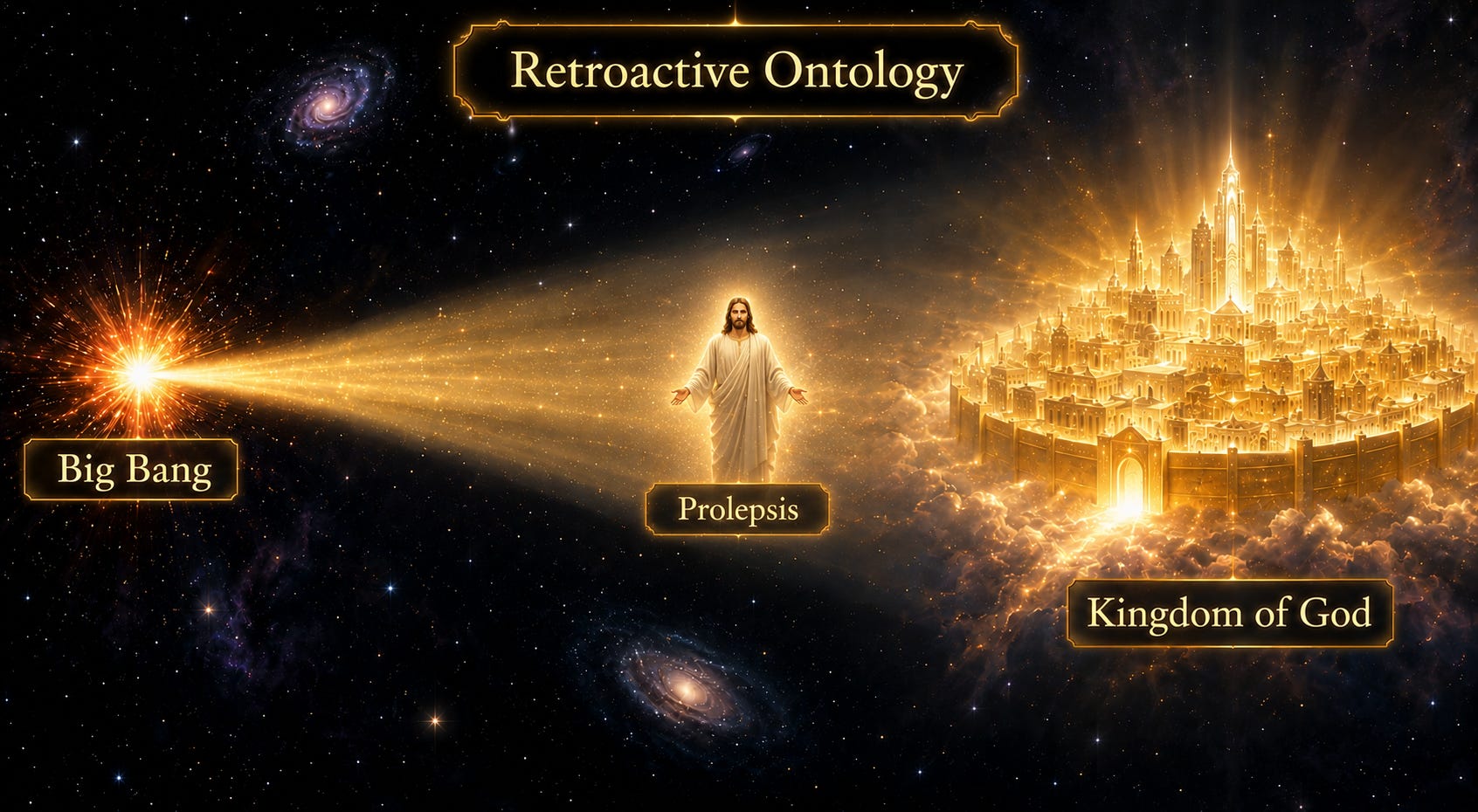
You may recall the worldview problem all modern theologians must confront. From the era of Sir Isaac Newton (1643-1727) to the present, we have come to believe that every effect we witness is the product of a past cause. And that past cause was the effect of a previous cause, reaching all the way back to a first cause, just as Thomas Aquinas (d. 1274) told us. In fact, the entire universe is made up of one grand cause-and-effect nexus. And if the laws of nature never go on a holiday, then there is no way out of this causal nexus. There are no miracles. So, Ted, your retroactive ontology cannot be made consonant with what scientists tell us about nature.
Really? Let’s ask about the acceleration of the expanding universe at the macro-level. Might Big Bang cosmology testify to an open window in Newton’s closed causal house? Might we find ontological newness that was not predetermined at the point of origin?
If so, this means the theologian can rightly ask the scientist to replace archonic thinking with epigenetic thinking. Instead of placing all the determinism of physical events in the archonic past, the epigenetically minded theologian and scientist can look toward a future that could be different from the past. On this point, I suggest we can find sufficient agreement to count it as consonance.
As I have already affirmed, here is the first principle of retroactive ontology: God creates from the future, not the past. To add an implication: God’s creation will not be complete until it has been redeemed. Right now, you and I are living in a creation that is under construction, so to speak. Once God’s construction has led to the fulfillment of all things, then the world will be both redeemed and created.
Big Bang cosmology seems to rely on a river of time that flows from a beginning 13.8 billion years ago through the present and toward the future. The original very hot singularity inflated, expanded, cooled, and gravitated. Oh yes, the specifics about that original singularity are obscured by early inflation. Yet, both inflation and the bang proceed in only one temporal direction. The idea of a universe expanding over time seems to align with our common sense. Did this point of origin predetermine its future? Not if you think epigenetically.
To think epigenetically within a framework of retroactive ontology, we may have to reverse what we take to be common sense. What passes for common sense is the river model of flowing time—that is, time flows relentlessly from the past toward the future. We find ourselves in the present moment, floating and bobbing on the ripples of temporal flow.
Now, the block universe theory in physics suggests that this temporal flow may be an illusion. Albert Einstein (1879-1955) did not describe the universe as flowing in a single river of time. There are many times and places—that is, there are many frames of inertial reference. Time is woven together with space into a four-dimensional structure called Spacetime. In short, the future is already in some sense present, even though we experience it as still open and yet to be determined. Regardless of this physical theory, our daily experience is that we are swimming within a river of time.
Einstein is remembered for having said: “For those of us who believe in physics, the distinction between past, present and future is only a stubbornly persistent illusion.”
In the Einsteinian picture, according to blogger Shriprasad Wagh in India, time behaves less like a river and more like a coordinate, like a location. Just as we can move left or right in space, events are arranged along time.
My point is different. I note that the river model of time is archonic. It presupposes that all the power of being comes from a reservoir in the past. When anxious, we worry about what will happen downstream. Will the river of time peter out into a sheet flow, slowing and stopping and evaporating? Will the once hot Big Bang run out of original steam and gradually slow into a cold equilibrium within which nothing happens anymore? Will we drop from hot into cold, from movement into inertness, from being into nonbeing? This is the freeze scenario built into the Big Bang cosmic model.
Actually, among our scientific cosmologists, there is a second possible future for the cosmos. Suppose the gravity within the cosmos is greater than estimated. Then, at some point in the future, temporal flow will reverse. The river of time will flow backward. Gravity will draw everything back into a new singularity. As the density of the universe increases, so will the heat. The universe will become immeasurably hot. This is the fry scenario. Or, to extend the river metaphor, will we boil?
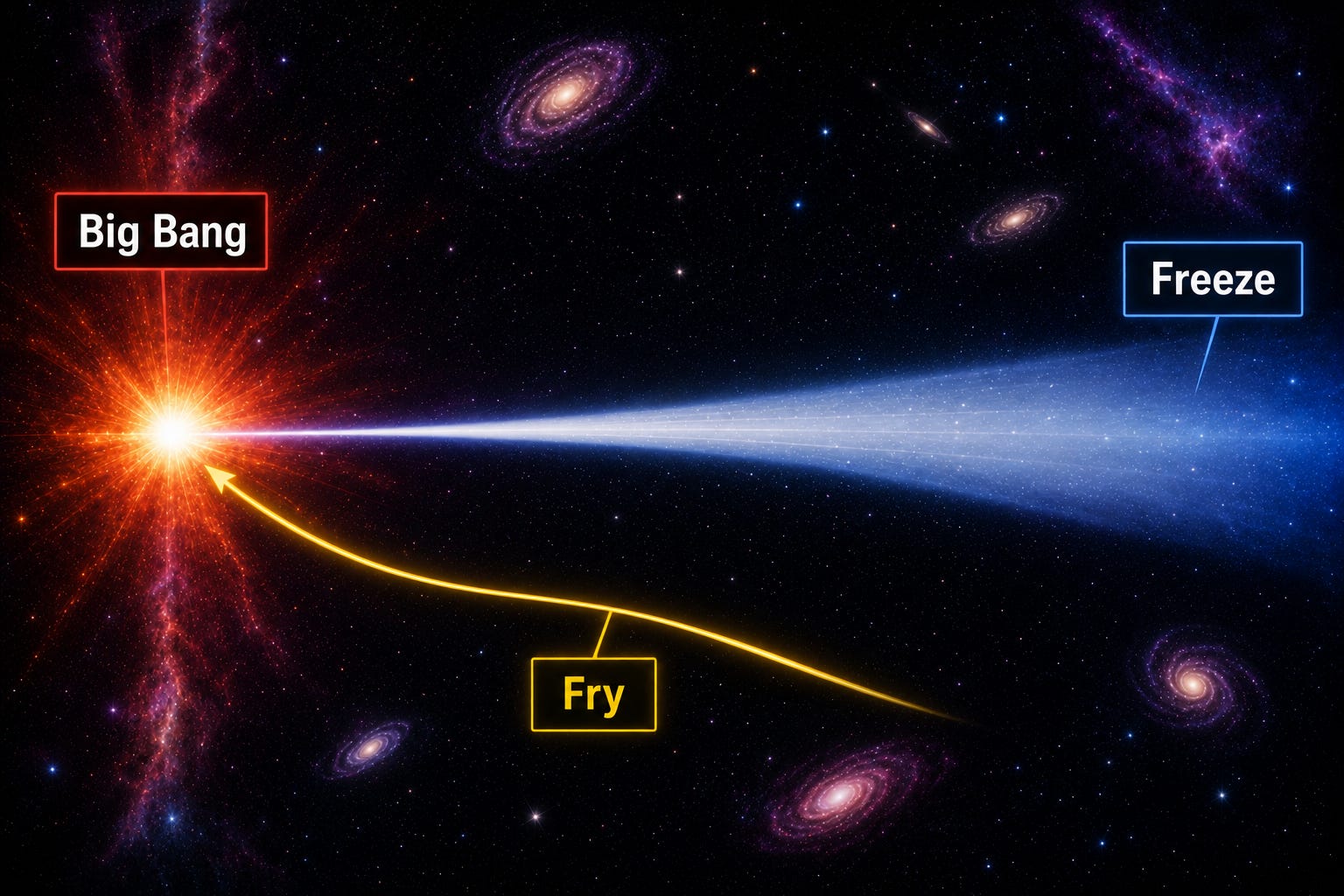
Whether it’s freeze or fry, the cosmic future as scientists imagine it does not look at all like the new creation promised in the New Testament. Even if Genesis Chapter One and Big Bang cosmology look consonant at the point of origin, they certainly do not converge at the end. There is dissonance between scientific and biblical eschatology. Or is there?
Suppose we replace the river model of time with retroactive ontology? Accordingly, the power of being comes to us from the future, God’s future. Retroactive ontology is epigenetic, not archonic.
This makes sense, I think. To be actually means: to have a future. If we have no future, we are dead. Without a future, we drop into the nonbeing of the past. The power of the future is the source of life, the renewal of life.
Every moment, God is creating us by liberating us from the past and opening a new future in which we partially co-create ourselves. It is the power of God’s future acting on the present moment that makes creatio continua possible.
With this in mind, let’s go back to the Genesis creation account. According to retroactive ontology, the first thing God did was to give the creation a future. The gift of the future is the very gift that permits being to emerge from nonbeing. As long as God continues to give you, me, and all of creation a future, we are.
In science, creation begins with the Big Bang. In Scripture, creation begins with God’s Word. God created by uttering, “Let there be…” Upon closer look, God’s Word is not limited to the beginning. God’s Word is eternal. God’s Word is also incarnate in time and space in Jesus Christ. You and I receive God’s Word in the form of promise. God plans to keep His Word.
Might we think of the opening account of creation in Genesis 1:1-2:4a as describing not merely a beginning but also the present time? Could we think of the creation week of seven days as inclusive of the entire history of creation from Big Bang to whatever will become of the universe in the future? Could evolutionary history constitute one small episode in the divine epic of creation, “Let the earth bring forth living creatures…” (Genesis 1:24)? (Peters and Hewlett, 2009)
This suggests that we see ourselves today standing between the initial moment when God opened his divine mouth to say, “Let there be…” and the final moment when God declares that, behold, it is “…very good”? Could we still be looking forward to the Sabbath day, to God’s first day of rest, yet in the future?
As we have already acknowledged, the Big Bang theory risks succumbing to archonic thinking. So, if the standard model of Big Bang cosmology were to hold, one would expect the rate of expansion to gradually slow down like a river running out of water. But the opposite is true, according to a 1998 discovery. The rate of acceleration of distant galaxies is actually increasing, not decreasing.
How do we explain this? Vacuum energy? Dark energy? The geometry of spacetime that overcomes gravity? “Dark energy is real,” says physicist Ethan R. Siegel. “It dominates the energy density of the Universe today, and it behaves as an accelerating component of the Universe.” What a tantalizing mystery to keep our scientists up late at night thinking and thinking!
The theologian will immediately notice one implication, namely, the future of the universe was not already decided back at its Big Bang origin. The laws of physics are open to new things happening.

Recall from an earlier post in Science for the Church, “God’s Creation and Big Bang Cosmology,” we referenced Korean Professor Hyung-Joo Lee’s groundbreaking article in Theology and Science.
“In contrast to the assumption commonly held by both scientists and theologians that our physical universe is destined to a permanent [heat] death, I suggest that the ontological unpredictability from the infinite degrees of freedom embedded in our universe could yield scenarios that allow it to overcome such a death. This means that the fate of our universe is no longer determined to be a single freeze scenario but becomes unpredictable even with observational data….I further claim that this, by making the future of our universe open through the onto-logical unpredictability, vitalizes both Pannenberg’s idea of the power of the future and Peters’ idea of retroactive causality, and Moltmann’s idea of Adventus” (Lee 2026, 171-172).
This is good news, exclaims Robert John Russell (Russell 2026). The laws of physics do not preclude the possibility of significant newness in cosmology. There is an opening within the natural world for the kind of transformatory, if not redemptive, future that God is promising.
Now, of course, it would be too much too fast to equate dark energy with the saving power of God’s redemption. For a satisfactory degree of consonance, all we need to gain from this interaction with Big Bang theory is an opening within nature for newness. The future is not exhaustively determined by past causes, scientifically speaking. This should add a note of felicity in the song the theologian hums.
The future God gives us comes in two forms: first, the eschatological consummation of all things and, second, the moment-to-moment liberation from selected past causes that opens up an array of potentials upon which we act and affect the course of future events. These two futures are actually the same, even though they feel quite different. The eschatological healing of all things is as close to you and me right now as the next moment. The current effect on the present moment is one of liberation from total determinism and the opportunity to contribute to the ongoing history of God’s creative work. The consummated future will be one of fulfillment that includes our contribution, not its denial or replacement.
Might Jesus have meant something like this when telling his disciples that the Kingdom of God is among us? (Luke 17:21)
Patheos ST 2002 . What is creation?
Patheos ST 2022. What is Scandinavian Creation Theology?
Patheos ST 4147. The proleptic power of new creation. Miracles 7
Substack SR 1056. Retroactive Ontology and Creation Consonance. Part One. From Archonic to Epigenetic Thinking
Substack SR 1057. Retroactive Ontology and Creation Consonance. Part Two. Evolutionary Emergence
Substack SR 1058. Retroactive Ontology and Creation Consonance. Part Three. Big Bang Cosmology.
Substack SR 1059. Retroactive Ontology and Creation Consonance. Part Three. Quantum Physics
▓
Meet Ted Peters. For Substack, Ted Peters posts articles and notices in the field of Public Theology. He is a pastor in the Evangelical Lutheran Church in America and an emeritus professor at Pacific Lutheran Theological Seminary and the Graduate Theological Union. His single-volume systematic theology, God—The World’s Future, is now in the 3rd edition. He has also authored God as Trinity plus Sin: Radical Evil in Soul and Society, as well as Sin Boldly: Justifying Faith for Fragile and Broken Souls. In 2023 he published, The Voice of Public Theology, with ATF Press. More recently, he has published an edited volume, Promise and Peril of AI and IA: New Technology Meets Religion, Theology, and Ethics (ATF 2025), and, along with Arvin Gouw, an edited collection, The CRISPR Revolution in Science, Religion, and Ethics (Bloomsbury 2025). Soon to be released is a volume of essays, A Handbook on Astrobiology, Astrotheology, and Astroanthropology, co-edited with Carolina Azucena Sanz de la Fuente and Arvin Gouw, with Amsterdam Univeristy Press.
See his website: TedsTimelyTake.com and Patheos blog site.
▓
Bohm, David. 1990. “A New Theory of the Relationship of Mind and Matter.” Philosophical Psychology 3 (2): 271-286.
Bohm, David. 1980, 1995. Wholeness and the Implicate Order. London: Routledge.
Clayton, Philip. 2006. “The Emergence of Spirit From Complexity to Anthropology to Theology.” Theology and Science 4:3 291-307.
Crysdale, Cynthia. 2003. “Playing God? Moral Agency in an Emergent World.” Journal of the Society of Christian Ethics 354:6317 243-259.
Dhelonga, Williams. 2026. Temporal Symmetry and Divine Providence: Theological Reflection on the Two-State Vector Formalism and Weak Measurement. STM Thesis, Jesuit School of Theology at Santa Clara University.
Goodenough, Ursula, and Terrence W Deacon. 2006. “The Sacred Emergence of Nature.” In The Oxford Handbook of Religion and Science, eds., Philip Clayton and Zachery Simpson, 853-871. Oxford: Oxford University Press.
Haught, John F. 2020. “The Unfinished Sacrament of Creation: Christian Faith and the Promise of Nature,” Ecotheology: A Christian Conversation, eds., Kiara A. Jorgenson and Alan G. Padgett. Grand Rapids: Eerdmans; 165-189.
Lee, Hyung-Joo. 2026. “A New Hope for Christian Eschatology in Cosmic Perspective: Beyond the Predictions of Standard Big Bang Cosmology.” Theology and Science 24:1 159-178.
Peacocke, Arthur. 2007. All That Is: A Naturalistic Faith for the Twenty-First Century. Minneapolis: Fortress.
Peters, Ted, Ed. 1998. Science and Theology: The New Consonance. New York: Harper/Westview.
Peters, Ted. 2015. God--The World’s Future: Systematic Theology for a New Era. 3rd. Minneapolis, MN: Fortress Press.
Peters, Ted, and Carl Peterson. 2026. “Holistic Determinism and God’s Action in Nature’s World: David Bohm and Quantum Theology.” Theology and Science 24:1 1-29.
Peters, Ted, and Martinez Hewlett. 2009. Can You Believe in God and Evolution? Nashville TN: Abingdon.
Russell, Robert John. 2026. “Editorial Introduction to A New Hope for Christian Eschatology in Cosmic Perspective.” Theology and Science 24:1 157-158.
Smuts, Jan C. 1926, 1987. Holism and Evolution. New York: Macmillan.
Comments
Nothing yet. Say the first thing.
Sign in to join the conversation.