
“It is important to develop a philosophy for how we can best use superintelligence to ensure it improves all of our lives, work, communities, freedom and safety,” says META CEO Mark Zuckerberg in his essay, The Future is for Everyone. “As intelligence becomes abundant, the most important question will be how we direct it.” By putting advanced AI in the pockets of consumers, this tech prophet will himself profit. Singularity Monthly reports that the large investment in AI just might pay off bigly.
This Substack series on debating AI takes up the question: how should we direct it? Pope Leo XIV says we should “disarm” it. Economist Robert Reich says we should “stop” it before it’s too late. Hybrid geneticist and theologian Arvin Gouw says we should direct AI toward wholesome ends. The ELCA (Evangelical Lutheran Church in America) says we should “limit harm from the use and development of AI even while seeking its potential goods that strive to respect and promote the flourishing of the community of life and its inhabitants.”
Let’s bring Calvin Mercer into this debate. Calvin is one of the early pioneers monitoring AI technology from the perspective of public theology. Calvin’s own allegiance is to the humanistic emphasis, rendering him sympathetic to Pope Leo’s commitment to protect human dignity. Yet, Calvin also insouciantly greets the wondrous newness coming from advancing technology.
Calvin Mercer is Professor of Religious Studies at East Carolina University. He has authored eleven books. Professor Mercer is also trained in clinical psychology, practiced professionally part-time for about a decade, and has utilized insights from this discipline in his published work on religion, especially his Slaves to Faith: A Therapist Looks Inside the Fundamentalist Mind. Relevant to the topic at hand, Calvin is a founding chair of the American Academy of Religion’s “Human Enhancement and Transhumanism Group.”
Along with Steve Fuller, Calvin Mercer co-edits the Palgrave Studies in the Future of Humanity and Its Successors series, the longest-running series on human enhancement across disciplines and viewpoints. This includes Technologies of the Future Self, noted below. Fourteen volumes are in print, and the co-editors welcome inquiries about new proposals.
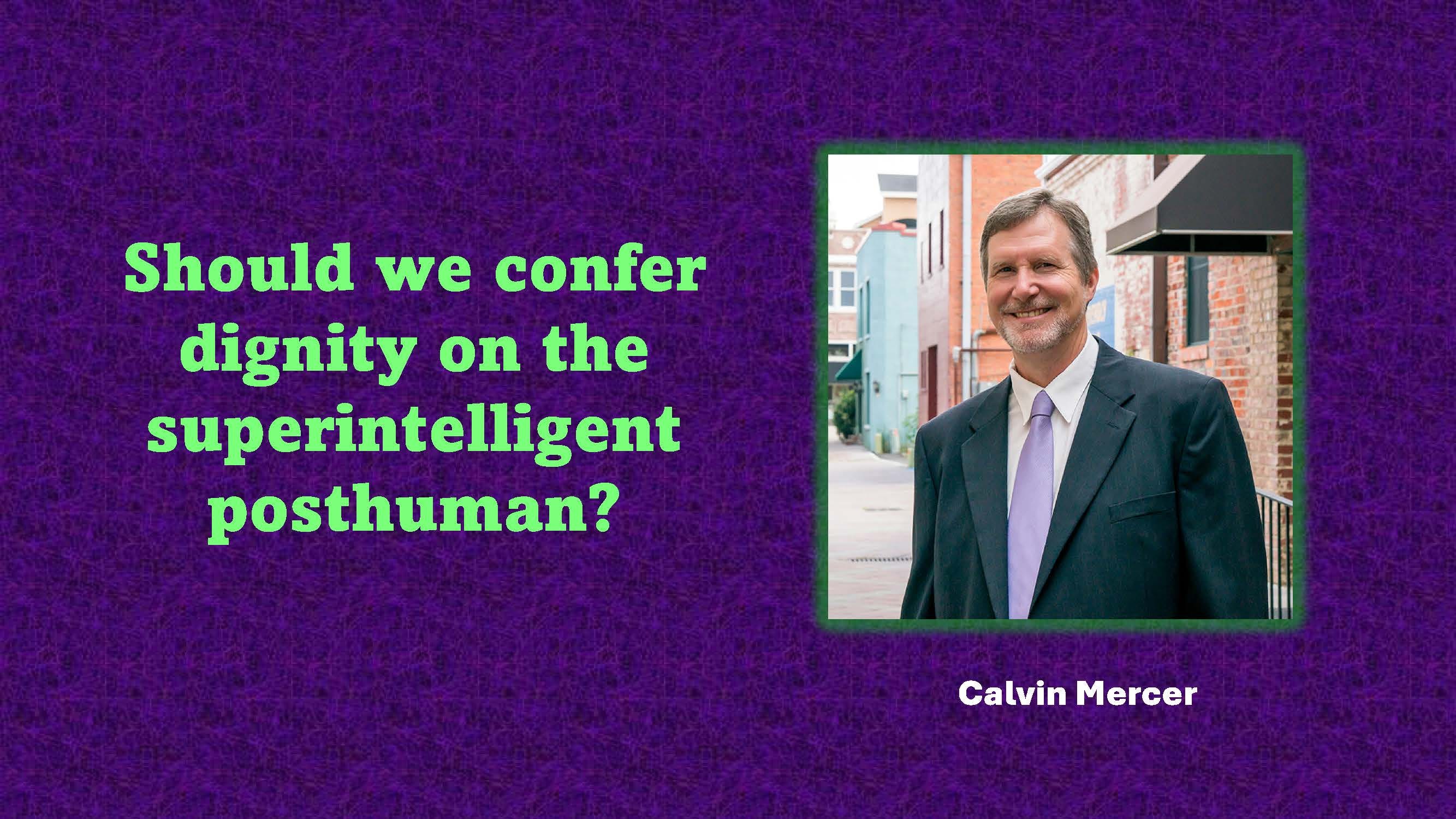
Calvin Mercer writes. I uphold the affirmative on our debate thesis: Our global society should support the advance of AI technology for enhancing humanity and even generating a posthuman species. I answer yes to this thesis, although with qualifications.
A promising theological starting point for Ted’s question is the doctrine of the imago Dei, which has yielded a broad range of interpretations across the centuries. I do not claim a single definitive reading. Within that tradition, the image of God points to two ideas that can help guide us in the AI world: the dignity of human beings and our vocation as co-creators and stewards.
We human persons are not valuable because of our intelligence, productivity, utility, or technological power. We possess a dignity grounded in God. That conviction aligns with a central theme of Pope Leo XIV’s Magnifica Humanitas: AI must be judged by whether it safeguards the human person rather than deforms or diminishes persons in the name of efficiency, control, power, or exclusion. I welcome the pope’s warning. The humanistic tradition, including the Christian humanistic tradition, has rightly insisted that human beings bear a peculiar worth and should never be reduced to instruments or data points.
However, a strong account of human dignity does not necessarily entail a defensive posture against technological enhancement, even radical enhancement. Rather, such an account commits us as image bearers and responsible agents to participate in God’s ongoing creative work through science and technology. Enhancement serves as an expression of responsible care, healing, and expanded human possibility.
One caution has to do with human pride. In these debates, concern for the human can harden into anthropocentrism—that is, a species-centered exceptionalism shaped by egoism and self-aggrandizement. This echoes the Tower of Babel (Genesis 11). It is one thing to affirm the unique worth of embodied human beings before God. It is quite another to assume that only beings within our present human form of personhood could count as spiritually or morally significant. The first claim fits comfortably within the humanistic tradition. Humanists can comfortably recognize that the possibility of posthuman beings does not require human obsolescence. The second claim risks becoming an attachment to our own form of life grounded in fear, ego, or self-preservation.
On the thesis under debate, the first part—the affirmation of AI technology as a means of enhancing humanity—is easier to embrace theologically and ethically. Without going into detail here, the transformational character of biblical resurrection is one example of Christian theology opening space for technological enhancement, even radical, without loss of personal identity. The Apostle Paul’s “spiritual body” (I Corinthians 15) described as “imperishable, glorious, and powerful,” was not written with modern technologies in view. Nonetheless, it may be read as offering a theological suggestion that makes radical enhancement theologically thinkable.
Posthuman beings could emerge through radical human transformation. Our human species could evolve into a posthuman species facilitated by AI’s development toward AGI. AGI might include consciousness and perhaps even superintelligence. Recent discussions of Claude highlight some of the difficulties involved in assessing the status of such beings, especially with respect to personhood, intelligence, and consciousness, all of which bear on questions of moral status, legal rights, and theological anthropology.
Christian theology should not be too quick to deny to posthumans their personhood created by God, even if this unsettles familiar anthropological boundaries. Perhaps instructive here is the valuable work in astrotheology and the possibility that intelligent alien life may already exist in the universe. If Christian theology can make conceptual room for such life without assuming that it would diminish God’s glory or human worth, then perhaps it can show the same generosity toward posthuman or nonhuman intelligence emerging within our history.
My approach is more embracing and proactionary than that of some of my colleagues, but that does not mean human dignity must be compromised. Just as an oak, a sparrow, and a human being are each precious within God’s created order, so I can imagine a future in which the human and the posthuman coexist in harmony. Dignity does not rely on superiority of intelligence, but rather value before God. According to Ted, it is God who confers dignity upon us. Then we claim it for ourselves.
So, I offer my qualifications for the position I take. Some transhumanist visions construe technological advance as addressing questions of meaning, dignity, and hope on its own. In extreme forms, transhumanism risks turning technology into an idol. Christian theology resists this tendency by insisting that human beings are not to be treated as mere instruments or reduced to functional utility, and that technological power remains accountable to creaturely dignity, moral truth, and the common good.
Radically enhanced humans and posthuman possibilities do not guarantee a better future. Their moral direction will depend on careful discernment, responsible governance, and good-faith input from diverse stakeholders, including religious and ethical voices. The dangers posed by increasingly powerful technologies are real.
In a world marked by war, greed, political ambition, and other threats, the struggle to protect human dignity reminds us that social justice remains a pressing responsibility. Posthuman life would not reduce that burden.
The same is true of community. Human beings are interdependent and relational, and that basic need for a shared life would not disappear in a posthuman future. The continuing necessity of work for social justice and community is not a reason to deny God’s ongoing creative activity in bringing these futures about.
I do not claim that Christian theology requires an embrace of these future possibilities. My more modest contention is that an affirmative response to Ted’s question is a legitimate theological and ethical stance, worthy of serious consideration. As the theological and ethical work unfolds, there is room for nuance, especially as the technologies develop in uncertain ways.
I continue to see new forms of intelligence, agency, and posthuman life, whether continuous with or distinct from present humanity, as expressions of God’s ongoing creativity within a theological vision in which God is creator, dignity is morally primary, and the future of creation exceeds our present self-understanding, even as I remain open to further conversation about how best to understand them.
Ted Peters writes. We must ask: is the evolution of posthuman superintelligence theoretically possible? Public Theology in Forum founder Paul S. Chung would answer in the affirmative. With Large Language Models, we are almost there. “In the discussion of semantic modernity and homo technicus, world‑modelling can be understood as any informational structure through which a system cognizes the world. Large Language Models (LLMs) clearly meet this criterion insofar as they compute statistical probabilities for the next best world.” In short, it is realistic to speculate about the implications of transhumanism and posthumanism.
For nearly two decades, Calvin Mercer, as I mentioned above, has been engaging AI technology with special attention to transhumanism and posthumanism (Maher and Mercer, 2009). On the one hand, Calvin celebrates the genius of our AI techies who propose positive enhancements to human well-being and could contribute to the common good. On the other hand, Calvin cautions us to refrain from expecting too much. Technological enhancements will not bring anything that looks like salvation. We must dodge the temptation to idolize AI or any similar technology. Technological progress cannot save us from our sinful condition.
Calvin Mercer is right about this. Need I say more?
Thanks, Calvin.
Substack PT 1021. Debating AI, Post-Humanity, and Magnifica Humanitas. Should we confer dignity on the superintelligent posthuman? Episode 1
Substack PT 1022. Debating AI, Post-Humanity, and Arvin Gouw. Should we confer dignity on the superintelligent posthuman? Episode 2
Substack PT 1023. Debating AI, Post-Humanity, and Augustine Pamplany. Should we confer dignity on the superintelligent posthuman? Episode 3
Substack PT 1024. Debating AI, Post-Humanity, and Ilia Delio. Should we confer dignity on the superintelligent posthuman? Episode 4
Substack PT 1025. Debating AI: Rebuttal to Ilia Delio by Michael E Zimmerman. Should we confer dignity on the superintelligent posthuman? Episode 5
Substack PT 1026. Debating AI. Noreen Herzfeld asks: Is Claude Conscious? Should we confer dignity on the superintelligent posthuman? Episode 6
Substack PT 1027. Debating AI, Post-Humanity, and Ahmed Khater. Should we confer dignity on the superintelligent posthuman? Episode 7
Substack PT 1028. Debating AI, Post-Humanity, and Hava Tirosch-Samuelson. Should we confer dignity on the superintelligent posthuman? Episode 8
Substack H+ 2029. Epstein, Pope Leo XIV, and Christian Transhumanism. Michael West and Micah Redding on Technological Salvation. Part 8.
Substack PT 1029. Debating AI, Post-Humanity, and Carolina Sanz de la Fuente. Should we confer dignity on the superintelligent posthuman? Episode 9
▓
Meet Ted Peters. For Substack, Ted Peters posts articles and notices in the field of Public Theology. He is a pastor in the Evangelical Lutheran Church in America and an emeritus professor at Pacific Lutheran Theological Seminary and the Graduate Theological Union. His single-volume systematic theology, God—The World’s Future, is now in its 3rd edition. He has also authored God as Trinity plus Sin: Radical Evil in Soul and Society as well as Sin Boldly: Justifying Faith for Fragile and Broken Souls. Peters edited The Promise and Peril of AI and IA: New Technology Meets Religion, Theology, and Ethics (ATF 2024), and he recently published The Voice of Public Theology, with ATF Press. Soon to be released is a volume of essays, A Handbook on Astrobiology, Astrotheology, and Astroanthropology, co-edited with Carolina Azucena Sanz de la Fuente and Arvin Gouw, with Amsterdam University Press.
See his website: TedsTimelyTake.com and Patheos blog site.
▓
Bostrom, Nick. 2026. “Dignity and Enhancement”. In Human Dignity and Bioethics: Essays Commissioned by the President’s Council on Bioethics. United States Govt Printing Office, 2008.
Checketts, Levi. 2022. “Homo Gubernator as a Teilhardian-Catholic Response to Transhumanism.” Religious Transhumanism and Its Critics, eds., Arvin M. Gouw, Brian Patrick Green, and Ted Peters, 341-354. Lanham, MD: Lexington.
Checketts, Levi. 2024. Poor Technology: Artificial Intelligence and the Experience of Poverty. Minneapolis, MN: Fortress.
Delio, Ilia. 2026. “Teilhard de Chardin on Technology and Human Evolution.” In Technologies of the Future Self: An Ethics for Transhuman Flourishing, eds., Georg Theiner and Alcibiades Malapi-Nelson, 335-362. New York: Palgrave Macmillan.
Gouw, Arvin. 2022. “Epilogue: Introducing a New Transhumanist Theology.” In Religious Transhumanism and Its Critics, eds., Arvin M. Gouw, Brian Patrick Green, and Ted Peters, 409-424. Lanham, MD: Lexington.
Herzfeld, Noreen. 2024. “The Eschatological Future of Artificial Intelligence: Savior or Apocalypse?” Eds., Beth Singler and Fraser Watts. Cambridge Companion to Religion and Artificial Intelligence. Cambridge UK: Cambridge University Press, 148-164.
Hughes, James. 2022. “Unitarian Universalists as Critical Transhumanists.” In Religious Transhumanism and Its Critics, eds, Arvin M. Gouw, Brian Patrick Green, and Ted Peters, 87-100. Lanham, MD: Lexington.
Krüger, Oliver, 2024. “Posthumanism and Digital Religion,” in Oxford Handbook of Digital Religion, eds., Heidi A. Campbell and Pauline Hope Cheong. Oxford: Oxford University Press, 544-561.
Kurzweil, Ray. 2024. The Singularity is Nearer. London: Penguin Random House.
Kurzweil, Ray. 2018. The Singularity is Near. London: Duckworth.
Maher, Derek F. and Calvin Mercer, eds. 2009. Religion and the Implications of Radical Life Extension. New York: Macmillan Palgrave.
More, Max. et al. 2013. “Transhumanist Declaration (2012)”. In The Transhumanist Reader, ed. Max More and Natasha Vita-More, 54–55. Newark: Wiley-Blackwell.
More, Max. 2024. “H+: True Transhumanism”.
Peters, Ted, 2026. “Our Future Self: Cyber Enhancement and Spiritual Transformation,” eds., Georg Thiener and Alcibiades Malapi-Nelson, Technologis of the Future Self: An Ethic for Transhuman Flourishing. New York: Macmillan Praeger, 271-294.
Peters, Ted, ed. 2024. The Promise and Peril of AI and IA: New Technology Meets Religion, Theology, and Ethics. Adelaide: ATF.
Peters, Ted. 2019. “The Ebullient Transhumanist and the Sober Theologian.” Scientia et Fides 7:2: 97–117.
Peters, Ted. 2005. “Dignity.” Encyclopedia of Science, Technology, and Ethics, ed. by Carl Mitcham. New York: Macmillan, Thomson, Gale, 2:528-530.
Peters, Ted, and Gaymon Bennett. 2003. “Defining Human Life: Cloning, Embryos, and the Origins of Human Dignity.” Beyond Determinism and Reductionism, ed. by Mark L.Y. Chan and Roland Chia. Adelaide, Australia: ATF Press, 56-73.
Pope Francis. September 25, 2020. “Address of His Holiness Pope Francis to the 75th Session of the United Nations General Assembly.”
Pope Leo XIV. 2026. “Magnificata Humanitas.”
Reichel, Hanna. 2022. “Worldmaking knowledge: What the Doctrine of Omniscience Can Help us Understand about Digitization.” Cursor: Zeitschrift für Explorative Theologie; 87-120. OI.ORG/10.17885/HEIUP.CZETH.2022.3.24528.
Tirosch-Samuelson, Hava. 2022. “The Transhumanist Pied Pipers: A Jewish Caution against False Messiahism.” In Religious Transhumanism and Its Critics, eds., Arvin M. Gouw, Brian Patrick Green, and Ted Peters, 183-214. Lanham, MD: Lexington.
Comments
Nothing yet. Say the first thing.
Sign in to join the conversation.