

These days, it is harder than ever to differentiate fact from fiction. Reality from fantasy. Truth from falsehood.
Look no further than the picture above of a “whale’s tail and a harvest moon” that I saw online recently with the headline:
“National Geographic’s 2025 Picture of the Year”
Now prior to artificial intelligence (“AI”), I suspect my reaction would have been,
“Whoa, that is incredible!”
However, in this new A.I.-dominated world, my first reaction was,
“This has to be too good to be true.”
So, how did I determine if it was, in fact, “too good to be true?”
In what has to be the ultimate definition of irony, I used artificial intelligence.
And, what did Grok and ChatGPT tell me?
The picture was absolutely produced by AI.
Think about that for a minute. In order to authenticate whether something was created by AI, I turned to…AI.
Now, consider how fraught this is with problems and unforeseen risks. Think about the long-term consequences of this level of dependency, and why it matters.
It matters because due to AI’s rise, we are living in a world in which people are increasingly craving things they can trust.
And it matters because if we become too reliant on authentication technologies to determine the truth, will we ever really know what the truth looks like?
The answer is we won’t.
But, this begs the question — is there a better option?
There is. The good old-fashioned way — by relying on those who have earned your trust.
Let me explain.
Two years ago, I wrote a Substack titled, “Fill the Bathtub,” which was about a lesson my parents imparted on my brother and me growing up.
In short, if we did something trustworthy, we would receive a single “drop of water” in our “trust bathtub.” If we did something else to earn their trust, we might get two drops. Another and we might get four. You can see the compounding effect at work here.
However, if we did something untrustworthy, they would pull the plug and we would start over with an empty tub. There were no shortcuts. No magical buckets of water that could fill the tub instantaneously. No technologies to accelerate the process.
Four decades removed from this lesson, I still think about it often, especially these days given the rise of artificial intelligence.
The reality is that AI has enabled scammers and charlatans to be materially more sophisticated and aggressive, while the average person is more vulnerable than ever, older folks in particular.
As you would expect, in order to combat this problem, countless companies want to sell us the technological version of a “magic water bucket” that can fill the trust tub instantaneously. A technology that ensures trust by “authenticating” it.
To win your trust, these companies will tell you their technology “utilizes the blockchain,” has “watermarking capabilities,” or that it is “proprietary.” All certainly possible, but what does this mean exactly? More importantly, what is it worth?
For me, not a whole lot.
Why?
Because trust and authenticity don’t work with shortcuts.
So, where does this leave us?
Ironically, I think we are on the verge of a massive spike in demand for personal interaction and a collapse in demand for virtual ones. If so, this means a significant opportunity for those willing to take the time to build businesses based around more connectivity, as opposed to less. Businesses that are willing to invest the time, money, and effort in earning people’s trust.
The financial services sector is the first that comes to mind because it is an industry that was originally built on trust. On handshake agreements and good faith. Yet, it is also an industry that has seen what can happen when an overreliance on technology replaces trust.
As Christopher Varelas wrote in his book How Money Became Dangerous,
“In the 1980s, the introduction of the computer spreadsheet unleashed the creative energy of the financial industry, while helping to eliminate human subjectivity and biases. And yet, the computer spreadsheet led to the erosion of analytical integrity and the loss of character. Before the computer spreadsheet, you had to know your borrower — your customer. But on a computer spreadsheet, there’s no column for character.”
In place of character, lenders placed a greater emphasis on factors that were more easily measured quantitatively (e.g., debt-to-equity ratios, coverage ratios, etc.). In doing so, they stopped relying on those that couldn’t be — qualities like trust, loyalty, resilience, and judgement.
Is the system better off as a result?
Things like the savings & loans crisis, the GFC, and Silicon Valley Bank’s failure make you wonder.
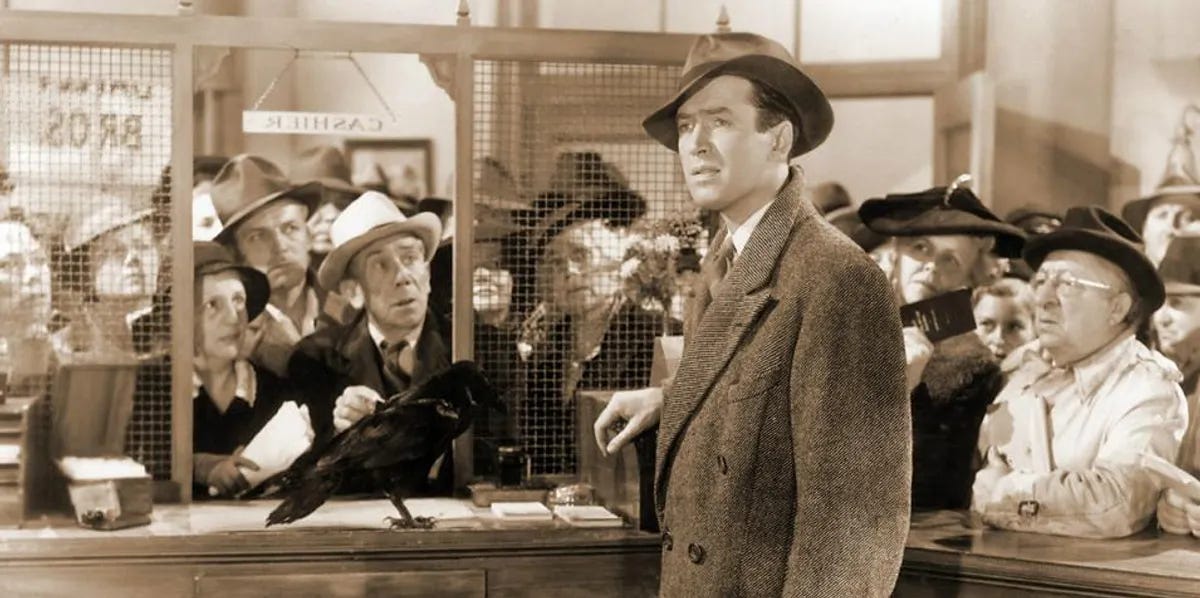
While I don’t expect a return to banking that looks like George Bailey from It’s a Wonderful Life, I do expect that people will increasingly reward those who have earned their trust.
Look no further than J.P. Morgan, which has a market cap ($800 billion) more than twice the size of the next largest U.S. bank (Bank of America at ~$360 billion), as well as a higher multiple. The reason is in large part due to the fact that JP Morgan and its CEO Jamie Dimon have earned investors and customers’ trust.
Trust is also the reason why Berkshire Hathaway investors allowed Warren Buffett to carry hundreds of billions of dollars uninvested for long periods of time — they had faith that when the time came, Buffett would deploy it prudently and opportunistically into great opportunities. Now that he has stepped aside and turned over the reins to Greg Abel, it will be interesting to see if that level of trust remains. Given Berkshire’s stock has trailed the S&P 500 by a whopping 30% since Buffett announced his retirement, it appears this trust must be re-earned.
Financial services are not alone though.
Just look at the legal and medical professions.
There is little doubt that AI has the potential to enhance lawyers and doctors’ abilities, enable them to manage caseloads or diagnose an illness more effectively, and increase overall productivity. Yet, do I anticipate wanting to turn over all of my legal or medical needs over to AI?
Don’t count on it.
Look no further than Jensen Huang’s recent comments on Joe Rogan’s podcast disputing AI pioneer Geoffrey Hinton’s claim that in five years’ time the world won’t need any radiologists because AI. Huang pointed out something I hadn’t considered, saying,
“While AI has swept the radiology world, thirty million radiologists didn’t get wiped out. Instead, we actually needed more radiologists. In fact, the number of radiologists has actually grown. But why? Because the purpose of a radiologist is to diagnose disease, not to study the image. Studying the image is simply a task in service of diagnosing the disease. Now, the fact that you can study the images more quickly and precisely without making a mistake, you can study more images. You can study in 3D or 4D instead of 2D, so the number of tests radiologists are able to do increases, which leads to servicing more patients, which benefits the hospital, which enables the hospital to hire more radiologists to service patients.”
So, this begs the question – how does a lender, investor, lawyer, doctor, or anyone else differentiate themselves in this AI-driven new world?
Not by completely turning things over to this new technology, but rather by being authentic. By being consistent. By showing an unwavering pattern of doing the right thing. By earning their customers’ and client’s trust, all while leveraging artificial intelligence along the way.
The trouble is that this path is not the easy one because building trust takes time. Or, as the obituary for former Jet Blue Chairman, Joel Peterson, recently stated,
“Trust is built slowly – one conversation, one moment of truth, one promise delivered at a time.”
Said another way, in a world racing to authenticate everything, the rarest advantage will be people who don’t need to be authenticated at all.
Comments
Nothing yet. Say the first thing.
Sign in to join the conversation.