
Only the Realized Is Fully Real
by Ted Cleary
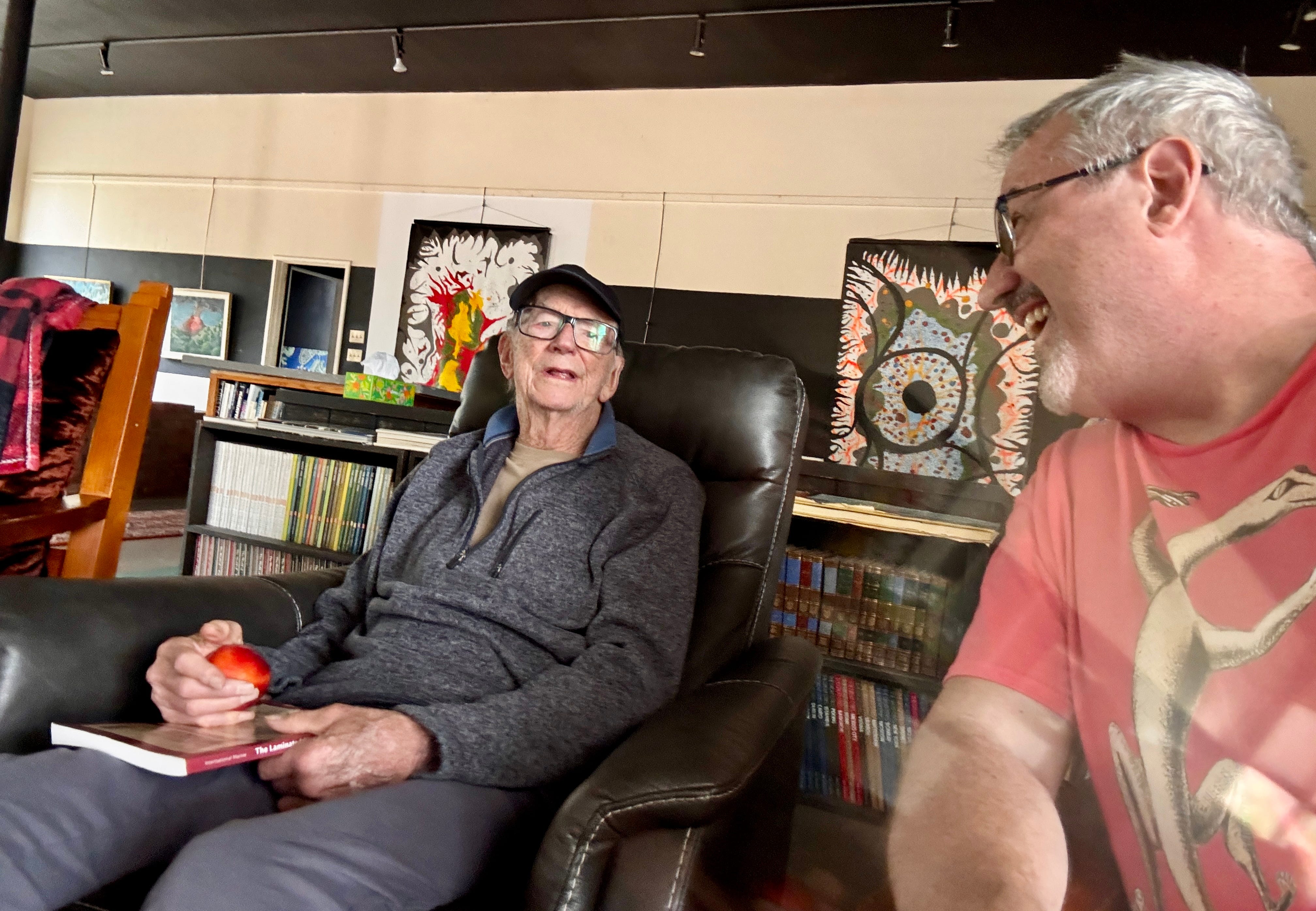
Recently I spent several days with 90-year-old American artist and architect Hub Miller, and reacquainted myself with just a sampling of the thousands of artworks on site at his Mountain House Gallery in Glorieta, NM.
Glorieta lies at about 8000 feet in the high pass between Santa Fe in the west and Pecos and Rowe in the East. It is the historic declivity of ancient trade routes and the legendary 19th c. Santa Fe Trail and the 20th c. Route 66.
When you walk out the back of Hub’s property through the junipers and pines, you will almost immediately enter Glorieta Battlefield National Historic Park. In March 1862, a little-known but decisive Civil War battle was fought in the upper part of the pass. The Union won after a surprise over-the-mesa raid destroyed the Texas Confederate wagon train of gunpowder, supplies, and mules. The Texans had been winning some battles, but with their support gone, their New Mexico campaign collapsed. Like artists, armies march on their stomachs. A perpetual truth.
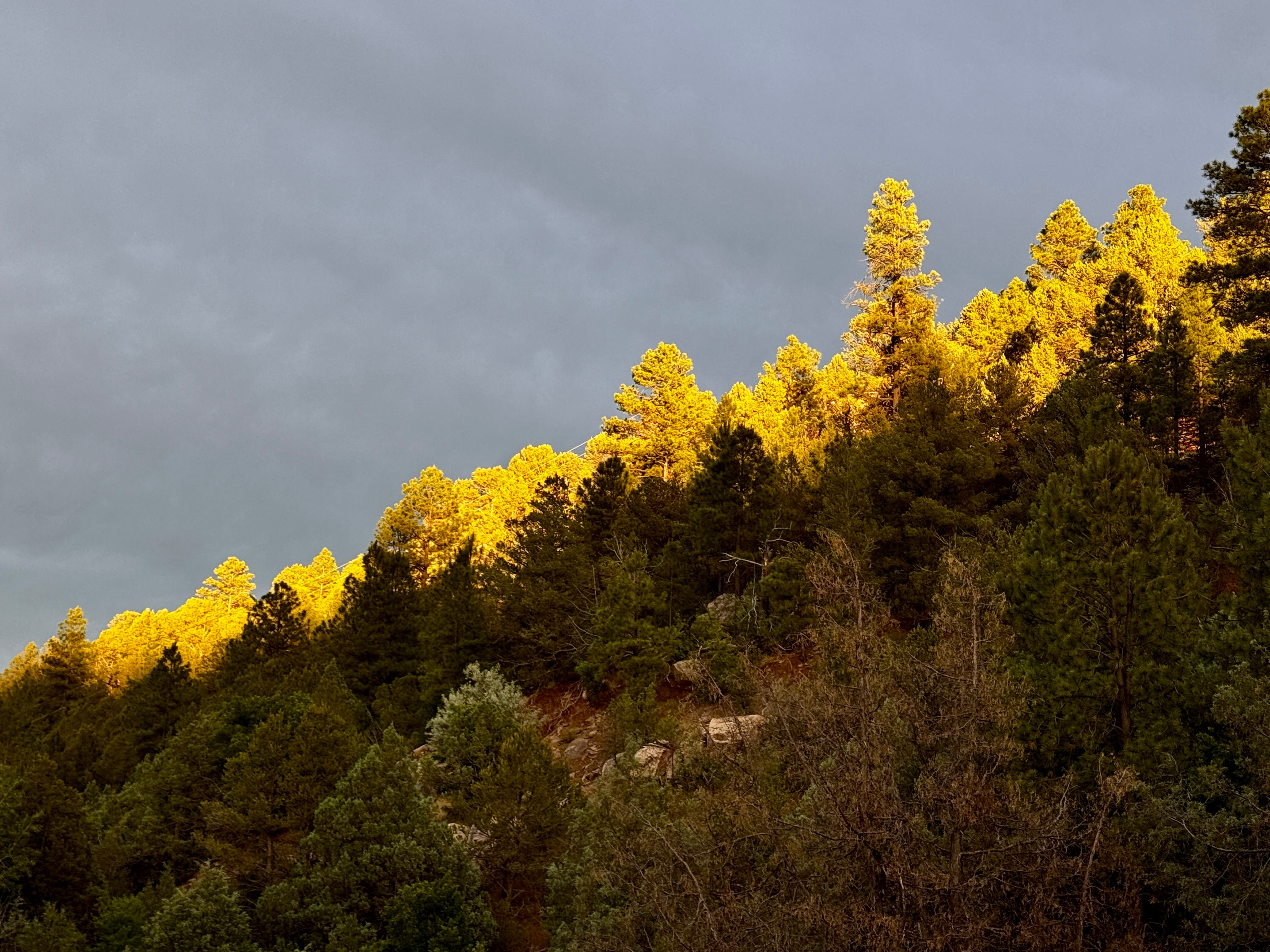
Sunset over Glorieta Pass, New Mexico, June 2026
I first met Hub back in 1999, when I was traveling cross-country and paused in the Sangre de Cristo Mountains for an unexpected sojourn—and I have seen him several times since. Hub was born in 1936 to a military family in the Panama Canal Zone and spent his late childhood and adolescence in post-WWII Austria, where he learned mountain climbing.
In 1999, Hub was 63 and had already retired from architecture and had built his studio-gallery where he would continue to produce art at an astonishing pace for the next thirty years. He has slowed down a bit—time catches us all (…I too am not the whippersnapper I was in Y2K)—but the lanky 6’3” artist still has plenty of wit and fire and humor.
Here are some thoughts that arise when I consider the life and work of Hub Miller. Extreme indeed are both his fecundity and high level of finish. The sheer amount of excellent and fully realized work is far beyond the usual of even very productive artists. And that is just the work that remains: that hasn’t been sold, lost, or destroyed.
On human potential and realization. How do we measure potential? How do we know how deep the sea of our potential is (or was)? Ultimately, only by achievement. The rest must unfortunately remain speculation. There is no way to know what has been potentially there unless something emerges from the alluring fog of promise. Anything unmade, undone, unmanifest—while perhaps portending wonders to the person inspired—cannot be shared, communicated, proven. As a final matter, only the realized is real—hence the word realization. That’s how potential becomes publicly knowable. Spend a day in Miller’s Mountain House Gallery, poking into corners and looking into drawers, and you will see overwhelming evidence of realized potential.
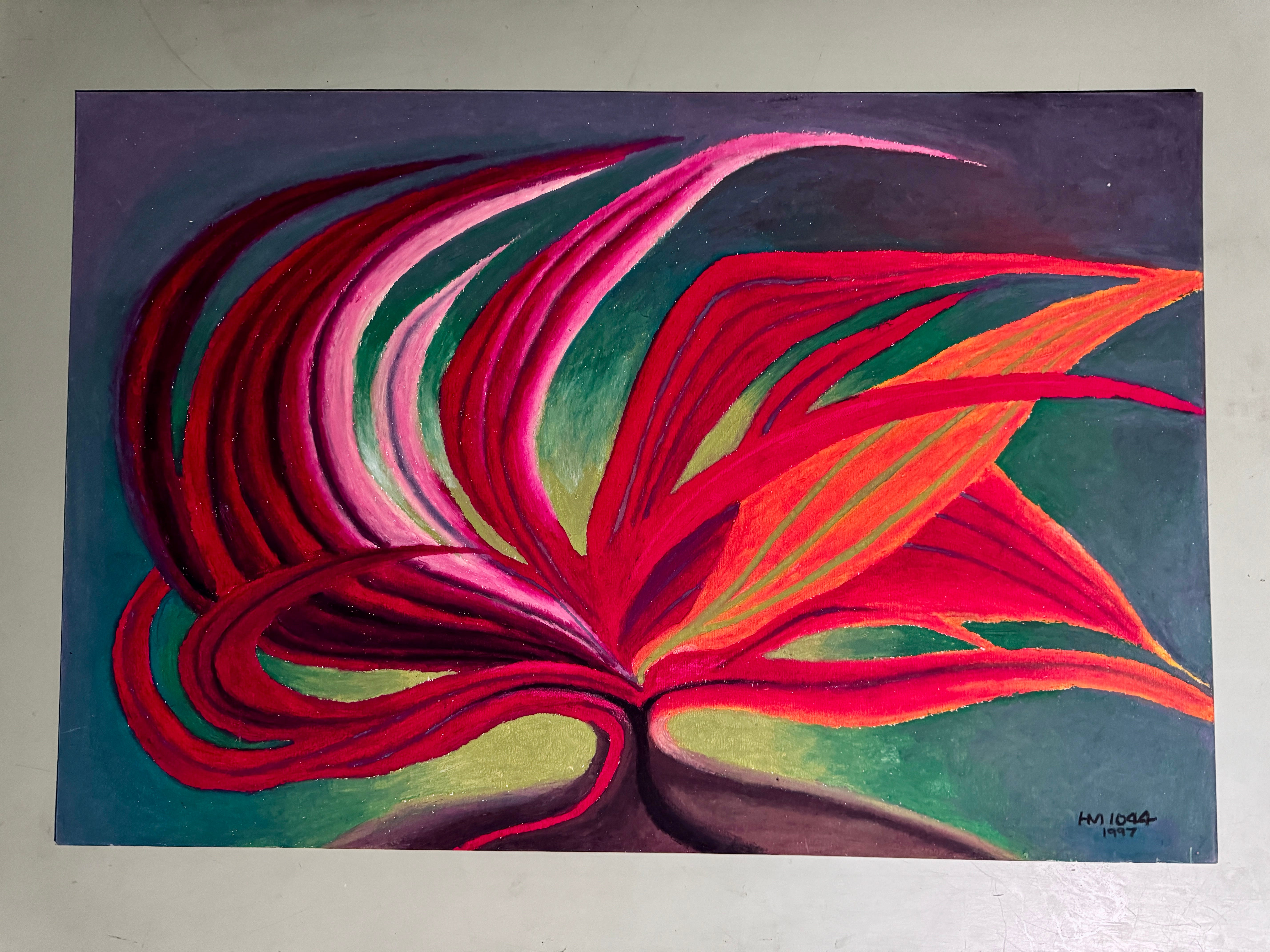
ROYGBIV Tree, pastel on paper, 1997.
An early start. Miller was born in the Panama Canal Zone, and then, as with many military children, moved whenever his career military father was reassigned. His father, Hubert Miller, born around 1900, had served as a soldier in WWI and as a colonel in the Army Corps of Engineers during and after WWII. He was geographically reassigned every three years, so the family was almost always in motion. Hub was an only child, and the frequent moves pulled him out of schools and towns and friendships, and this uprootedness may have accentuated a tendency to retreat into, and be enraptured by, his private world. Of his childhood, Hub often tells this origin story: “I was the last hope of my parents, who were getting in in years. I credit my birth to the long Panamanian nights, and when they had me, they didn’t know what to do with thr little iguana.” This photo depicts the 9-year-old Hub painting before the family moved from California to Austria.
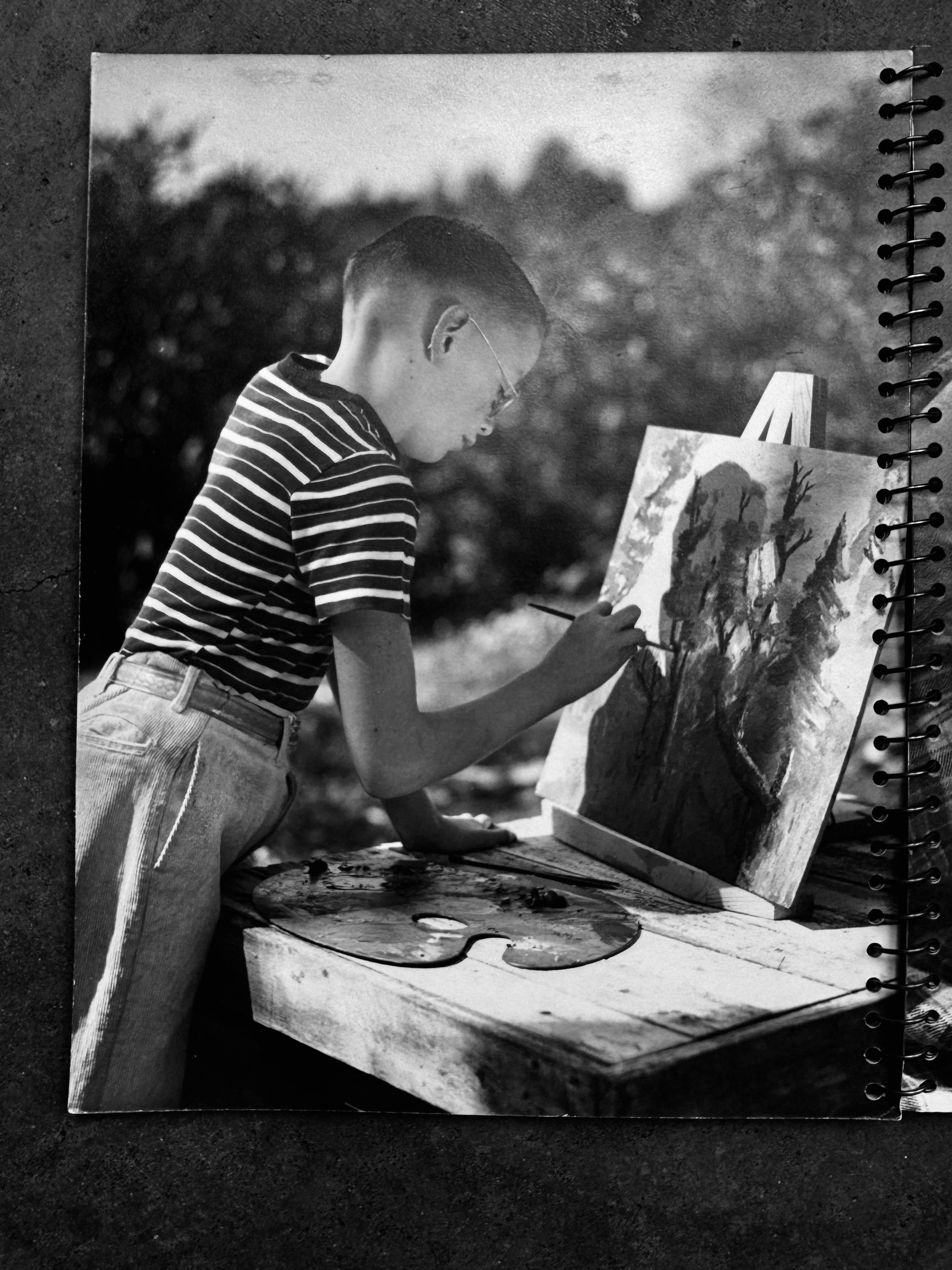
Photo from a 1946 booklet made by Hub’s mother, Amy Hillborn, California.
Febrile mind, volcanic mind: constant profusion of ideas. No doubt Miller visualized far more ideas than he could possibly get down on paper or canvas. Nonetheless, it’s safe to say he also realized far more ideas than do most people, who, when they have ideas at all—have neither the time, inclination, nor skill to get much of it down. For most of us, the torrent of ideas and sensations rush over us like the current of a stream over smooth and huddled stones. We are often oblivious—because nature is superabundant and the barest act of noticing demands attention. Miller saw an idea bright and clear and then committed to its execution—which might have taken him an hour, a day, a week, a month, or, as in the case of a deep and developed series like Cities of the Mind, a number of years.
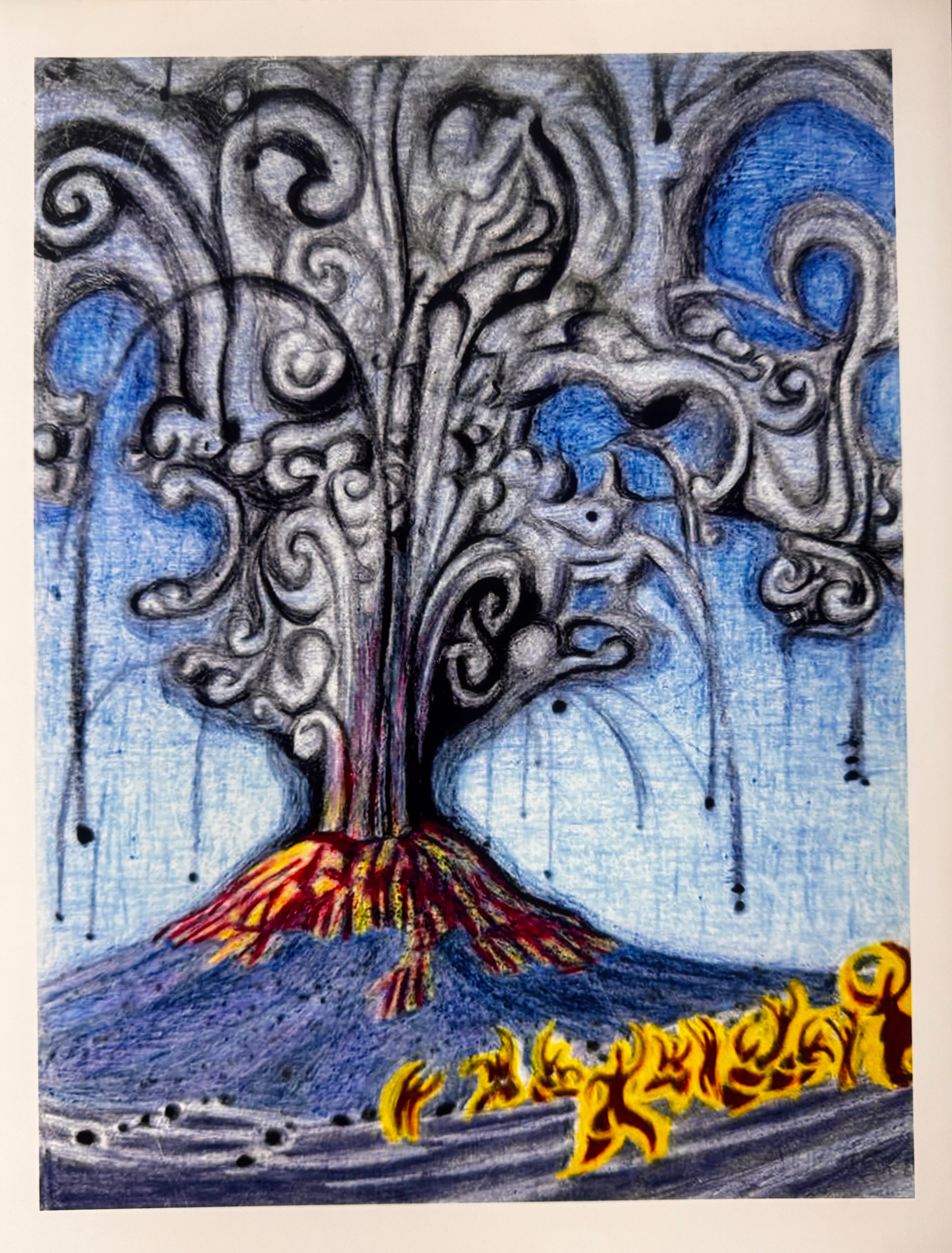
Volcano and Dancers, oil pastel on paper, appx 1993.
Variety of style, media, subjects. Oils, acrylic, pastel, ink, pencil, charcoal, collage. He has worked within the traditional rectangle and square of canvas and paper, but also in the looser shapes of collage and organic “assemblages” with irregular shapes. Within the same large overarching project there are also sub-varieties of style and form—as in The Cities of the Mind, with both its meticulous architectural renderings and blueprints, and its loosey-goosey free sketches with pastel and colored pencil. Some frequent motifs are trees, volcanoes, dancers—and in his more technical work—buildings, airplanes, boats, often fanciful but meticulously rendered.
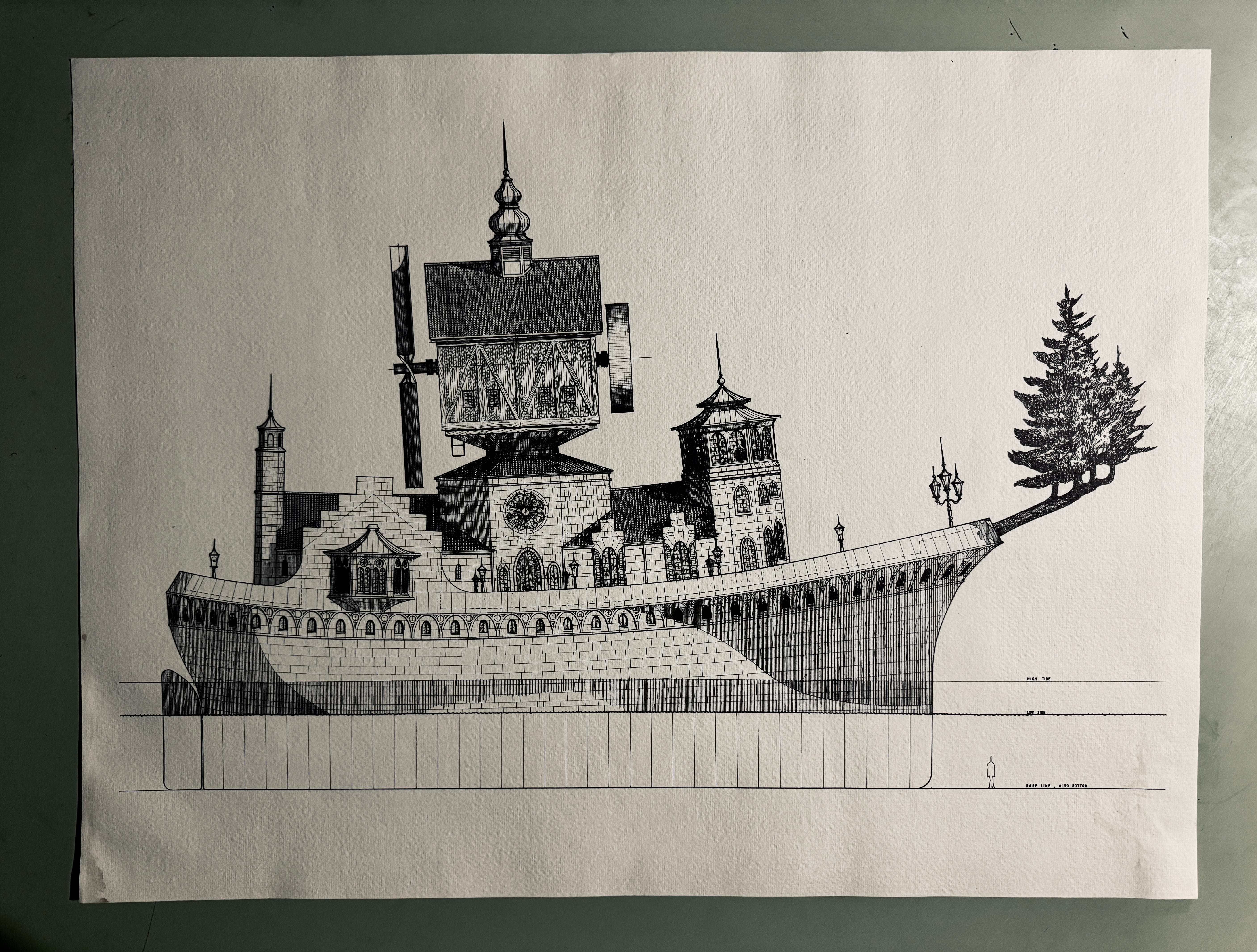
Ship in Surrealist Mode, pen and ink on paper.
The challenge of supporting oneself as an artist. This theme has come up every time I’ve met with Hub—and it is indeed a perennial theme for artists not born into money or anointed with well-lubricated connections. He’s recited this dialogue many times: Hub’s Father: So son, have you considered what you will do for a living? Hub: I think I’d like to be a painter. Father: All well and good, yet I repeat: What will you do for a living? Hub (years later): Aha, so I wouldn’t be able to make a living as an artist. I’d have to do something else while I also worked on the art. That thing became architecture. I did them both—and I did manage to support myself—even to get rich.
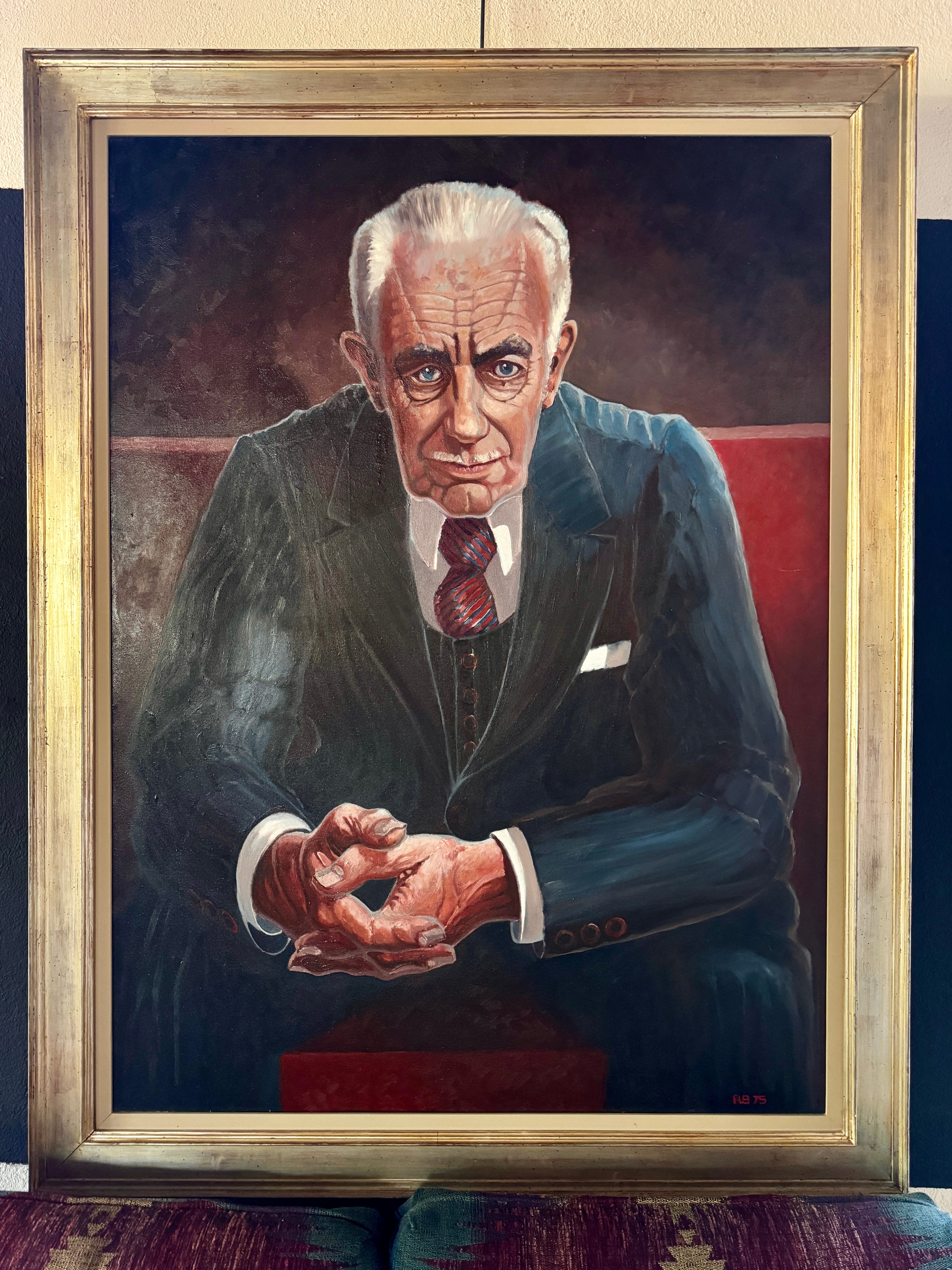
Col. Hubert Miller, Hub’s father, in civilian clothes. Oil on canvas, 1975.
Life among the peaks. Hub has been a mountain climber, literally. From an early age, twelve or thirteen, he was scrambling up challenging slopes in the Alps. Later the Himalayas, the Rockies, the Sangre de Cristo Mountains. Physical challenge, mental challenge. Effort, concentration, in for the long haul. The shifting perspectives upon attaining various heights and switchbacks; the view from the top. the view from over the top: the bird, the airplane, the space satellite. Geological layers, rusted seabeds thrust up into the sun. As noted, his property abuts on the Santa Fe Trail and a Civil War battlefield. Hiking in history among the junipers and pines.
The view from Long Time. Hub envisioned things—cities in particular—not just from differing heights and angles in physical space, but in time. His NYC series, which envisions NYC as seen from about 110th Street looking south, does not shift its place in geographic point of view, but it does shift its place in time—thousands, hundreds of thousands, perhaps millions of years. These pictures were accomplished in the late 1970s when Hub was in full stride in his architectural practice—making this theme a long-standing one of over half a century.
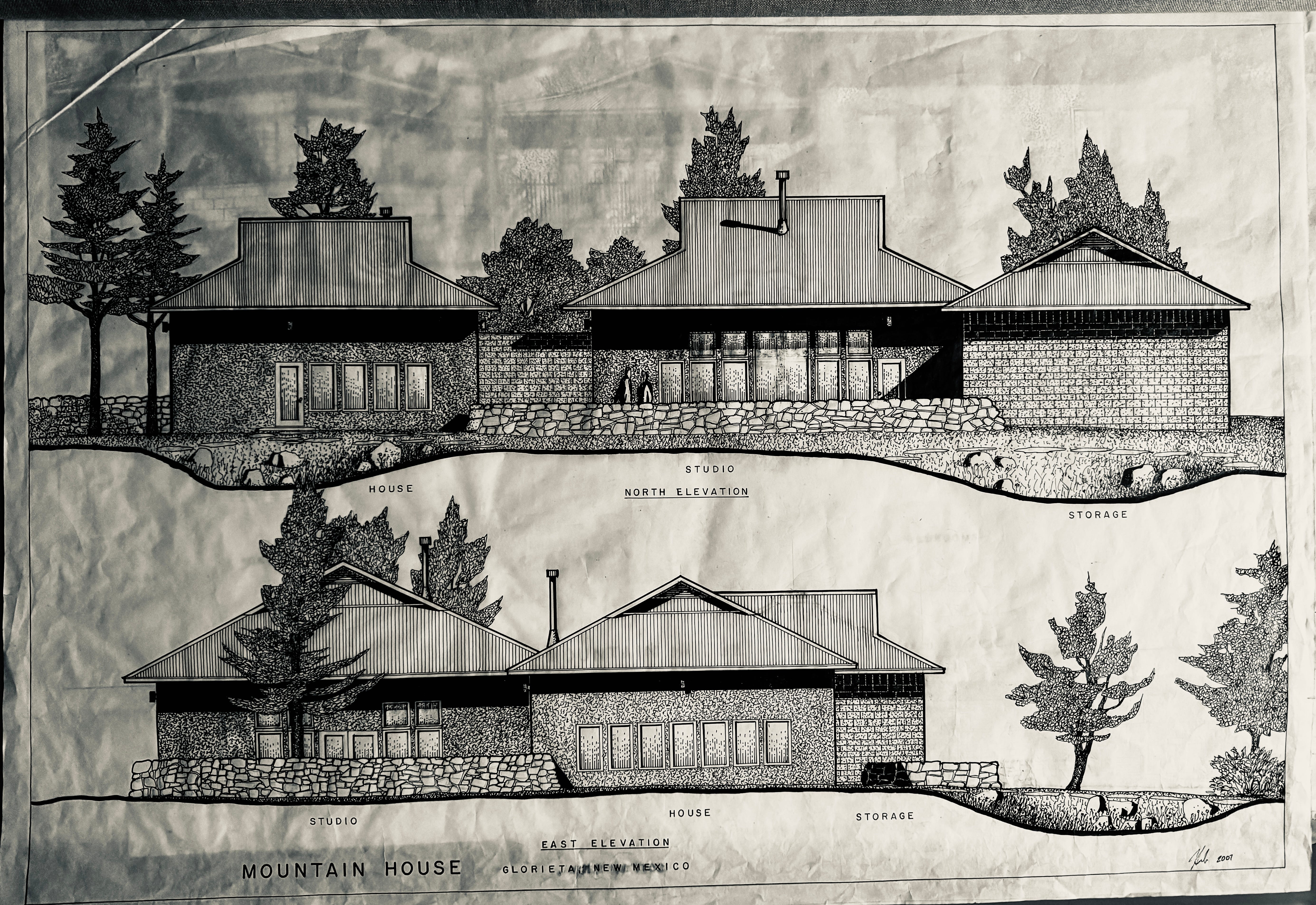
Robbing Peter to pay Paul. It appears Hub’s energy was not infinite nor infinitely indivisible. His very longtime friend Renate Cornell said that Hub’s architectural practice was languishing by the 1990s because he was spending so much time on his art. Yet finally, between his savings, investments, and inheritance, he was able to leave architecture completely, and beyond designing his own studio and home in Glorieta, NM, did not have to involve himself in the logistical time-suck of architecture any more. It was a great profession and he had been licensed and in demand in dozens of states, but something had to give. He told me himself in 2017 that it is almost impossible to do both art and architecture on a high level because each demands so much time and will struggle for dominance. The winner will take all. In Hub’s case, the art eventually prevailed—but only because the architecture had helped pay much of the way forward. The artist’s life does not support itself by magical thinking.
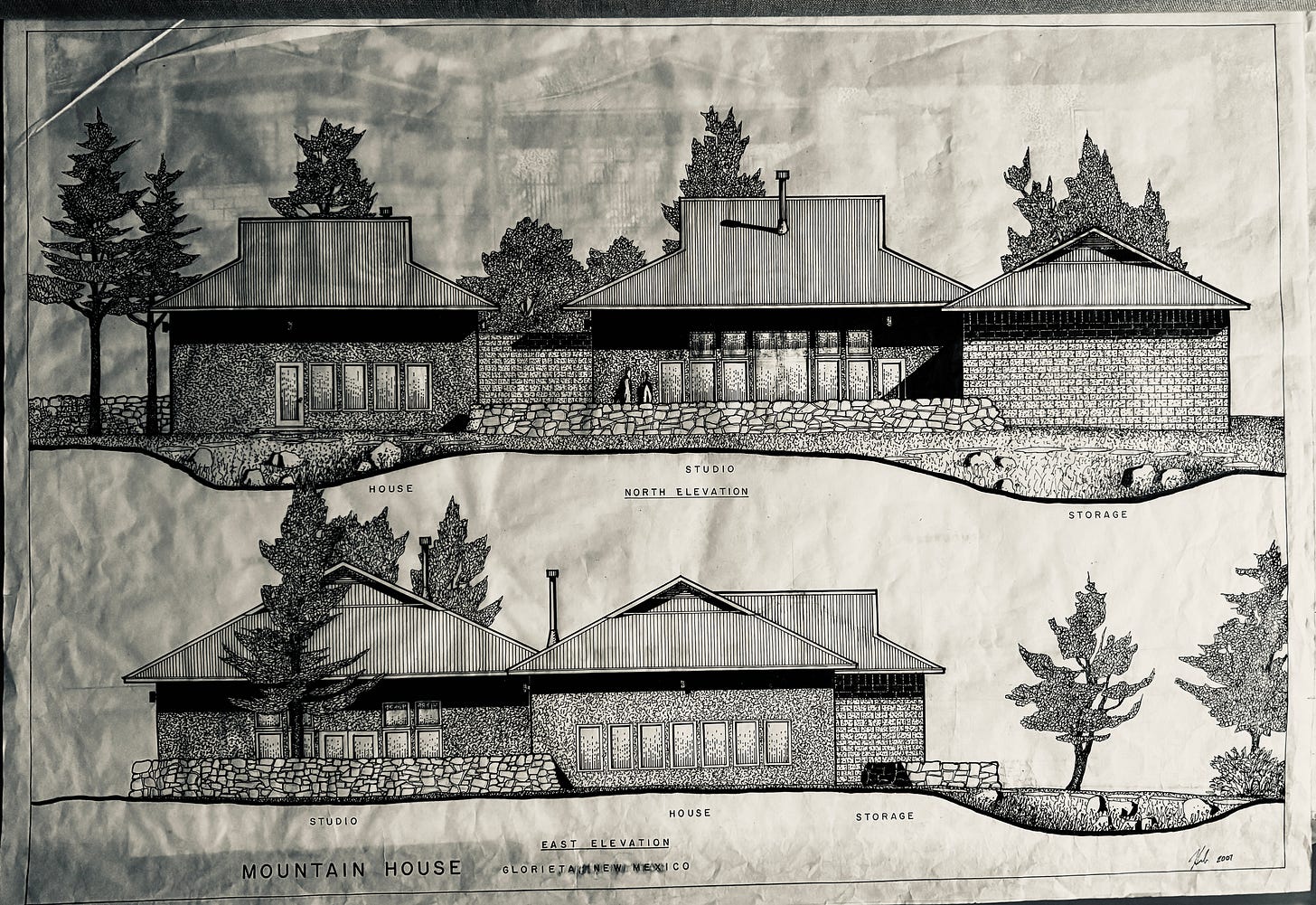
Architectural Drawing for Mountain House Expansion, 2007
The Jiggle made manifest. (A jiggle, as used here, is an ecstatic mental riff.) Everyone has ideas at the speed of thought that they might not even be aware of. The ideas pass quickly, and get buried so quickly in our thought-streams that they might not even surface sufficiently long for anyone to even properly examine them. They manifest and disappear like evanescent weather effects or birds flitting black across a pale evening sky. Art and literature are made of these fugitive impressions recorded and dramatized. It’s fair to say that most people never surface their ideas sufficiently long for examination—and even if they do glimpse them, they usually have neither the time, talent, nor inclination to render them in any compelling form. Hub Miller gives the impression of a man who has surfaced several million thoughts and articulated thousands of them into thoroughly rendered form. If Miller were an ocean-going fisherman, his would be the boat that always came back with full nets and a full hold.
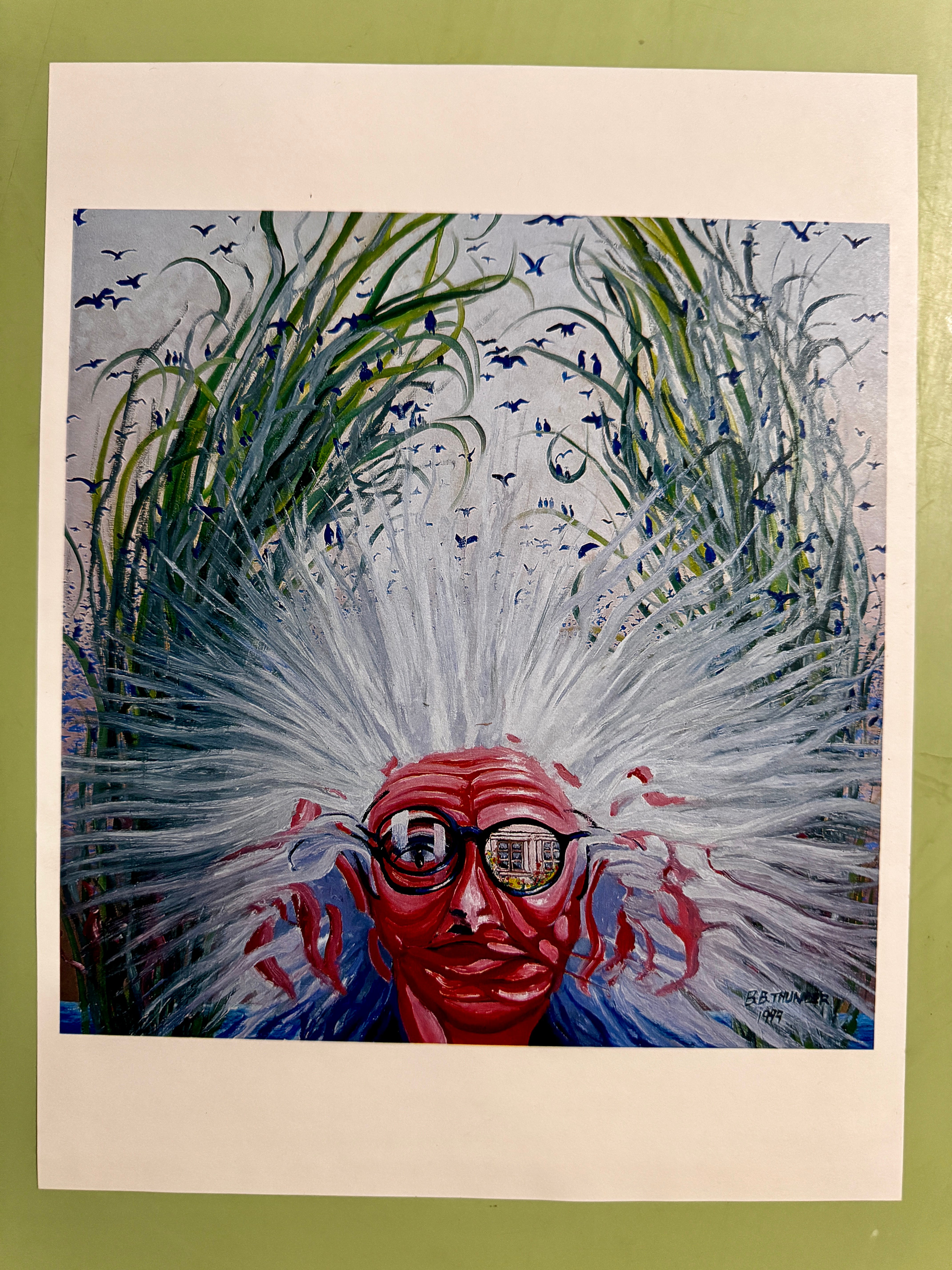
An Explosion of Ideas (in persona of BB Thunder), 1997
Always working. The vast majority of unmade art becomes so because the impulse is interrupted, ignored, deferred, or otherwise not able to be embraced at the moment of ripeness. With an artist like Miller, nearly always receptive, and ready to work 12 hours per day, the ideas kept moving—hot, fluid. Ideas are not deferred, are not straight-armed like opposing players in a football game. They are received, imagined, adumbrated, rendered, finished. And the more that an artist becomes a finisher, like a baseball pitcher who has thrown many complete games, the psychology of the whole work from reception to completion becomes a well-traveled and reasonably predictable arc. And the more you finish, the more you continue to finish. Do that for fifty years straight, on top of another thirty years’ apprenticeship, and you will have a mighty substantial oeuvre.
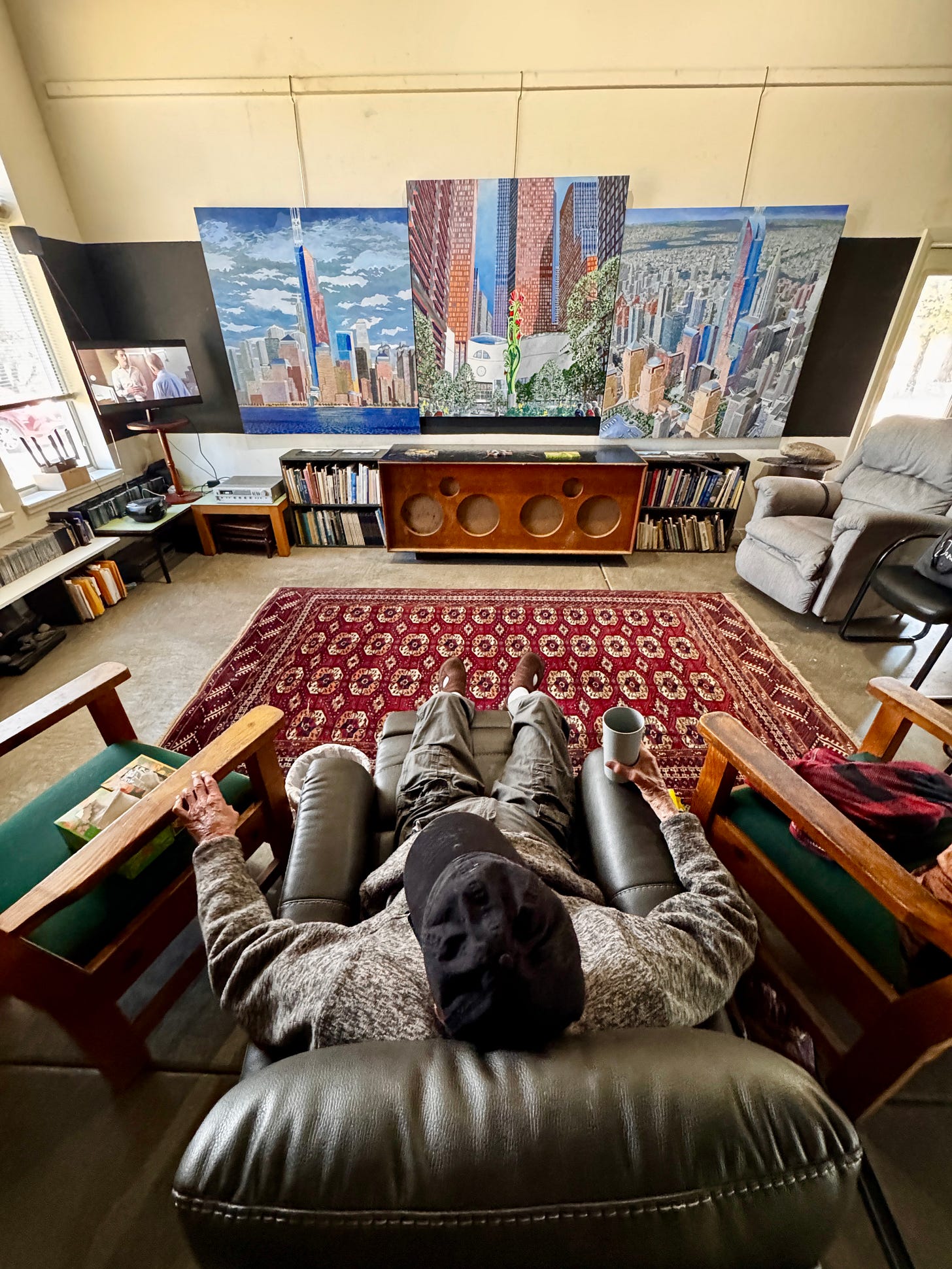
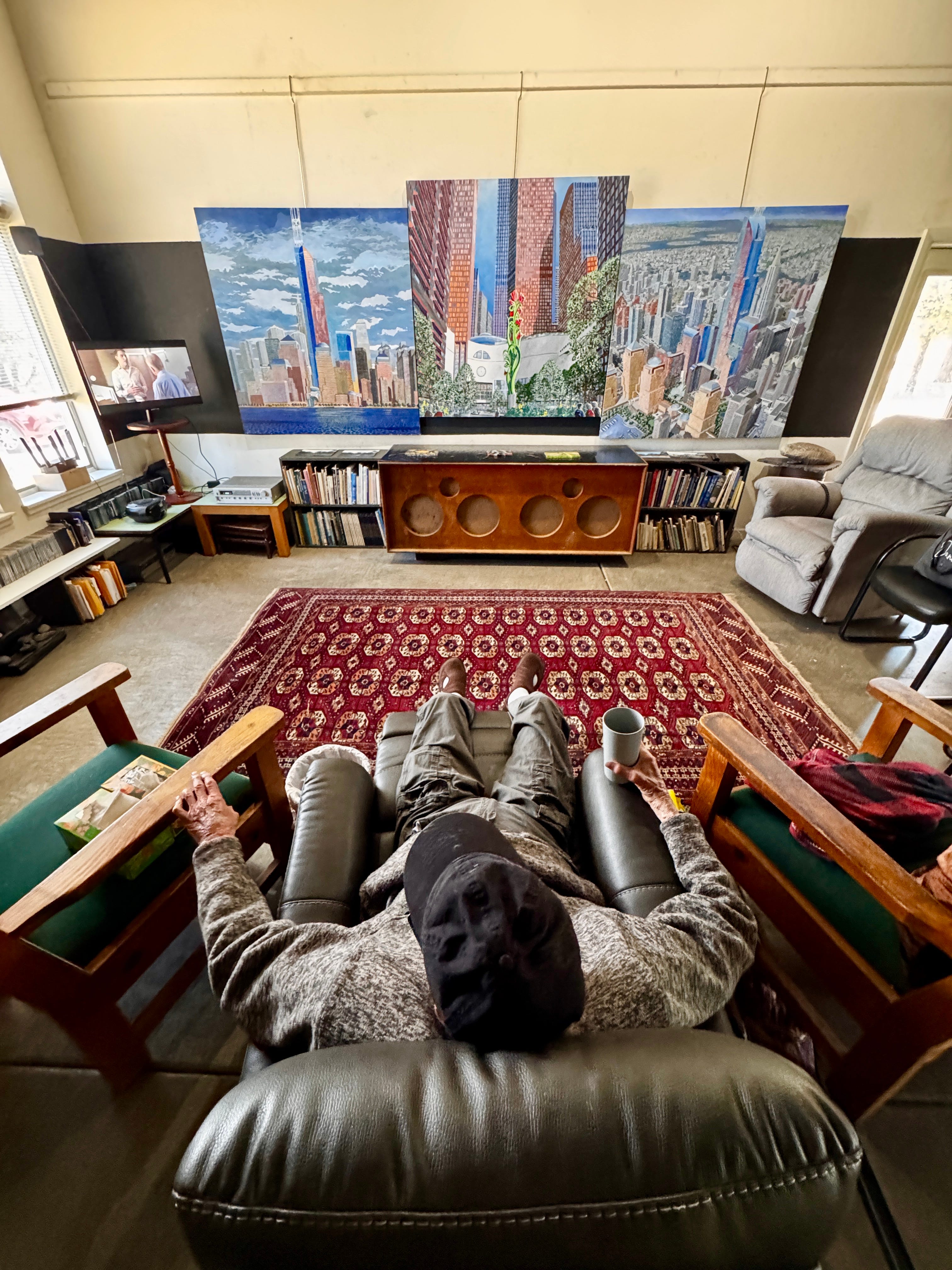
Hub Miller in Mountain House, listening to jazz, with Cities of the Mind paintings.
.
A visit to Mountain House and a perusal of some of its many treasures is quite likely to make one impressed not just with the output of one singular man, but with the astonishing potential of the human being. What can we accomplish when we commit to a practice and a vision and keep at it with sustained vigor and cheer? Almost anything, perhaps. In Part Two, coming up, we will explore the challenges of preserving and perpetuating the work of a lifetime.
.
Q. Who is a quietly extraordinary dynamo you have met or heard of? I’d be interested to hear their story.
Text and field photos © 2026 Ted Cleary. Artwork © Hub Miller & Hub Miller Trust. All rights reserved. Writing and art made entirely with the human mind and hands of either Ted Cleary or Hub Miller. Spanish translation ex machina with supervision.
Recientemente pasé varios días con el artista y arquitecto estadounidense Hub Miller, de 90 años, y volví a familiarizarme con apenas una pequeña muestra de las miles de obras de arte que se encuentran en su Mountain House Gallery, en Glorieta, Nuevo México.
Glorieta se encuentra a unos 2.400 metros de altura, en el alto paso montañoso entre Santa Fe, al oeste, y Pecos y Rowe, al este. Es una zona marcada por antiguas rutas comerciales y por la legendaria ruta del siglo XIX conocida como el Camino de Santa Fe, así como por la Ruta 66 del siglo XX.
Cuando uno sale por la parte trasera de la propiedad de Hub, atravesando los enebros y los pinos, casi inmediatamente entra en el Parque Histórico Nacional del Campo de Batalla de Glorieta. En marzo de 1862 se libró allí, en la parte alta del paso, una batalla poco conocida pero decisiva de la Guerra Civil estadounidense. La Unión venció después de una incursión sorpresa a través de la Mesa de Glorieta que destruyó el tren de suministros confederado de Texas: su pólvora, provisiones y mulas. Los texanos habían ganado algunas batallas, pero con sus suministros destruidos, su campaña de Nuevo México se derrumbó. Como los artistas, los ejércitos marchan con el estómago. Una verdad permanente.
Conocí a Hub por primera vez en 1999, cuando viajaba por el país y me detuve en las montañas Sangre de Cristo para una estancia inesperada; desde entonces lo he visto varias veces. Hub nació en 1936 en la Zona del Canal de Panamá, en una familia militar, y pasó su niñez tardía y adolescencia en la Austria de la posguerra, donde aprendió alpinismo.
En 1999, Hub tenía 63 años y ya se había retirado de la arquitectura. Había construido su estudio-galería, donde continuaría produciendo arte a un ritmo asombroso durante los siguientes treinta años. Ha disminuido un poco el ritmo —el tiempo nos alcanza a todos (yo tampoco soy ya el joven impetuoso que era en el año 2000)—, pero el artista alto y delgado, de casi 1,90 metros, todavía conserva mucho ingenio, energía y sentido del humor.
Aquí presento algunas ideas que surgen cuando considero la vida y la obra de Hub Miller. Extraordinarios son tanto su fecundidad creativa como su elevado nivel de acabado. La cantidad pura de obra excelente y plenamente realizada supera con creces lo habitual incluso entre artistas muy productivos. Y eso es solamente la obra que permanece: la que no fue vendida, perdida o destruida.
¿Cómo medimos el potencial? ¿Cómo sabemos qué tan profundo es (o era) el mar de nuestro potencial? En última instancia, sólo mediante los logros. Todo lo demás, lamentablemente, debe permanecer en el terreno de la especulación. No existe manera de saber qué estaba potencialmente allí a menos que algo emerja de la atractiva niebla de la promesa.
Todo aquello que no se ha hecho, que no se ha llevado a cabo, que no se ha manifestado —aunque quizá anuncie maravillas para la persona inspirada— no puede compartirse, comunicarse ni demostrarse. Como cuestión final, sólo lo realizado es real; de ahí viene la palabra realización. Así es como el potencial se vuelve conocido públicamente.
Pase un día en la Mountain House Gallery de Miller, explorando rincones y mirando dentro de los cajones, y verá una evidencia abrumadora del potencial humano realizado.
Miller nació en la Zona del Canal de Panamá y, como muchos hijos de militares, se mudó cada vez que su padre, militar de carrera, era destinado a un nuevo lugar. Su padre, Hubert Miller, nacido alrededor de 1900, había servido como soldado en la Primera Guerra Mundial y como coronel del Cuerpo de Ingenieros del Ejército durante y después de la Segunda Guerra Mundial. Era reasignado geográficamente cada tres años, por lo que la familia estaba casi siempre en movimiento.
Hub era hijo único, y esos frecuentes traslados lo alejaron repetidamente de escuelas, pueblos y amistades. Ese desarraigo quizá acentuó una tendencia a retirarse hacia su mundo interior y quedar fascinado por él.
Esta fotografía muestra a Hub, de 9 años, pintando poco antes de que la familia se mudara de California a Austria. [foto del folleto realizado por la madre de Hub, Amy Hillborn, en 1946.]
Sin duda Miller imaginó muchas más ideas de las que jamás podría plasmar en papel o en un lienzo. Aun así, es razonable decir que también llevó a la realidad muchas más ideas que la mayoría de las personas, quienes, cuando tienen ideas —si es que llegan a tenerlas—, generalmente no disponen del tiempo, la inclinación o la habilidad para darles forma.
Para la mayoría de nosotros, el torrente de ideas y sensaciones pasa por encima como la corriente de un arroyo sobre piedras lisas y amontonadas. Muchas veces no prestamos atención, porque la naturaleza es extraordinariamente abundante y hasta el simple acto de notar algo exige concentración.
Miller veía una idea con claridad y luego se comprometía con su ejecución; una tarea que podía tomarle una hora, un día, una semana, un mes o, como en el caso de una serie profunda y desarrollada como Cities of the Mind (Ciudades de la mente), varios años. [imagen del volcán]
Óleo, acrílico, pastel, tinta, lápiz, carbón, collage. Miller ha trabajado dentro del tradicional rectángulo y cuadrado del lienzo y el papel, pero también con formas más libres de collage y “ensamblajes” orgánicos de formas irregulares.
Dentro de un mismo gran proyecto existen además diferentes estilos y formas, como ocurre en Cities of the Mind, que contiene tanto representaciones arquitectónicas meticulosas y planos técnicos como dibujos libres y espontáneos realizados con pastel y lápices de colores.
Algunos motivos aparecen con frecuencia: árboles, volcanes, bailarines; y en sus obras más técnicas, edificios, aviones y barcos, a menudo imaginarios pero representados con una precisión extraordinaria.
Este tema ha surgido cada vez que me he reunido con Hub, y es un tema permanente para los artistas que no nacen con dinero ni cuentan con conexiones privilegiadas.
Hub ha repetido muchas veces este diálogo:
Padre de Hub: Hijo, ¿has pensado en qué harás para ganarte la vida?
Hub: Creo que me gustaría ser pintor.
Padre: Muy bien, pero repito la pregunta: ¿qué harás para ganarte la vida?
Hub (años después): Ah, entonces no podría ganarme la vida como artista. Tendría que hacer otra cosa mientras también trabajaba en mi arte.
Esa otra cosa fue la arquitectura. Hizo ambas cosas y logró mantenerse económicamente; incluso llegó a enriquecerse.
Hub fue literalmente un escalador de montañas. Desde muy joven, a los doce o trece años, ya ascendía pendientes difíciles en los Alpes. Más adelante vendrían el Himalaya, las Montañas Rocosas y las montañas Sangre de Cristo.
Desafío físico, desafío mental. Esfuerzo, concentración, perseverancia a largo plazo.
Las perspectivas cambian al alcanzar diferentes alturas y curvas del camino; la vista desde la cima. La vista desde más allá de la cima: el pájaro, el avión, el satélite espacial.
Capas geológicas, antiguos fondos marinos oxidados elevados hacia la luz del sol. Como ya mencioné, su propiedad limita con el Camino de Santa Fe y con un campo de batalla de la Guerra Civil. Caminar por la historia entre los enebros y los pinos.
Hub imaginaba cosas —especialmente ciudades— no sólo desde diferentes alturas y ángulos en el espacio físico, sino también en el tiempo.
Su serie de Nueva York, que imagina la ciudad vista desde aproximadamente la calle 110 mirando hacia el sur, no cambia el punto de vista geográfico, pero sí cambia el punto de vista temporal: miles, cientos de miles, quizá millones de años.
Estas obras fueron realizadas a finales de la década de 1970, cuando Hub estaba en plena actividad dentro de su práctica arquitectónica. Esto convierte el tema en una preocupación artística de más de medio siglo.
Parece que la energía de Hub no era infinita ni podía dividirse infinitamente.
Su amiga de muchos años, Renate, me contó que la práctica arquitectónica de Hub comenzó a decaer en los 1990s porque él dedicaba muchísimo tiempo a su arte.
Finalmente, entre sus ahorros, inversiones y herencia, pudo abandonar completamente la arquitectura. Más allá de diseñar su propio estudio y casa en Glorieta, Nuevo México, ya no tuvo que involucrarse en el enorme desgaste logístico que implica la arquitectura.
Fue una gran profesión y había estado licenciado y solicitado en numerosos estados, pero algo tenía que ceder. Él mismo me dijo en 2017 que es casi imposible hacer arte y arquitectura a un nivel elevado al mismo tiempo, porque cada una exige enorme cantidad de tiempo y voluntad, y ambas competirán por dominar. La ganadora se queda con todo.
En el caso de Hub, el arte finalmente venció, pero sólo porque la arquitectura había ayudado a financiar gran parte del camino. La vida del artista no se sostiene mediante pensamientos mágicos.
(Un jiggle, según la definición de E.N. Nospone, es un riff mental extático.)
Todos tenemos ideas a la velocidad del pensamiento que quizá ni siquiera llegamos a reconocer. Las ideas pasan rápidamente y quedan enterradas tan pronto en nuestra corriente mental que quizá nunca permanecen el tiempo suficiente para ser examinadas adecuadamente.
Aparecen y desaparecen como efectos meteorológicos fugaces o como pájaros oscuros cruzando un cielo pálido al atardecer.
El arte y la literatura están hechos de estas impresiones fugitivas, registradas y transformadas en forma.
Es justo decir que la mayoría de las personas nunca hacen emerger sus ideas durante el tiempo suficiente para examinarlas; e incluso cuando llegan a vislumbrarlas, normalmente no tienen ni el tiempo, ni el talento, ni la inclinación para convertirlas en una forma convincente.
Hub Miller da la impresión de ser un hombre que ha hecho emerger millones de pensamientos y ha convertido miles de ellos en obras completamente desarrolladas.
Si Miller fuera un pescador del océano, su barco sería aquel que siempre regresara con las redes llenas y la bodega repleta.
La gran mayoría del arte que nunca llega a existir desaparece porque el impulso se interrumpe, se ignora, se posterga o simplemente no puede ser atendido en el momento preciso.
Con un artista como Miller, casi siempre receptivo y dispuesto a trabajar doce horas al día, las ideas seguían avanzando, calientes y vibrantes.
Las ideas no se posponen ni se rechazan, como un jugador de fútbol que extiende el brazo para contener a un rival. Son recibidas, imaginadas, desarrolladas, plasmadas y terminadas.
Y cuanto más un artista se convierte en alguien que termina obras —como un lanzador de béisbol que ha completado muchos partidos—, más la psicología del proceso entero, desde la recepción de la idea hasta la finalización, se convierte en un camino conocido y transitado.
Cuanto más terminas, más continúas terminando.
Hacer eso durante cincuenta años seguidos, después de otros treinta años de aprendizaje y práctica, produce una obra verdaderamente considerable.
Una visita a Mountain House y una mirada a algunos de sus muchos tesoros probablemente impresionará a cualquiera no sólo por la producción de un hombre extraordinario, sino por el asombroso potencial del ser humano.
¿Qué podemos lograr cuando nos comprometemos con una práctica y una visión, y seguimos adelante con energía sostenida y buen ánimo?
Quizá casi cualquier cosa.
En la Parte Dos exploraremos los desafíos de preservar y perpetuar la obra de toda una vida.
P. ¿Quién es una de esas personas extraordinarias que trabajan en silencio y que hayas conocido o de la que hayas oído hablar? Me encantaría conocer su historia.
No posts
Comments
Nothing yet. Say the first thing.
Sign in to join the conversation.