

Mandatory bundles at scale are here, and they are NOT going away.
In April I wrote that CMS was serious about getting every Medicare beneficiary into an accountable care relationship by 2030, and that the proposed CJR-X model would be a seismic shift on the way to that goal. On August 1, 2026, CMS transitioned from “proposed” to final. The FY 2027 IPPS Final Rule (CMS-1849-F) finalizes the Comprehensive Care for Joint Replacement Expanded Model (CR-X): mandatory, nationwide, and, for the first time in the Innovation Center’s history, permanent. There is no end date cited. This is not a “wait and see” program. It is standing Medicare payment policy, codified at 42 CFR §§ 512.600–512.695.
I tracked fifteen contested provisions from the comment letters including AAHKS’s, AHA’s, and the rest through to the final rule. Thirteen were finalized without modification. One was mildly softened: the start date moved from October 1, 2027 to January 1, 2028, with performance years now running on calendar years. One was restructured: unlike the original CJR, there are no Stark or Anti-Kickback waivers; compliance runs through the CMS-sponsored-model safe harbor and existing value-based exceptions. Everything else…the discount, the risk structure, the regional pricing, the quality gates…remains unchanged. CMS’s recurring defense was that altering the tested design would break the Chief Actuary’s certification that the expansion reduces spending. Translation: the design is legally armored against negotiation. Time to prepare for a fundamental shift.
In this article we walk through the final rule section by section. Where the final rule changed something from the proposal, I’ve flagged it with [FINAL].

A note before we dive in: If your hospital is preparing for CJR-X, TEAM, or any CMS bundled payment model, RevelAi Health partners with health systems on advisory, clinical software, and AI-powered staffing to improve efficiency, strengthen patient experience, and expand margin under value-based contracts. Reach me directly at christian@revelaihealth.com.
Now Let’s Get Going…
Feel like listening rather than reading? I have a podcast generated from NotebookLM that I created by blending resources from the proposed rule document, and honestly it’s pretty fantastic. I have more resources like this below in the article, including a link to the notebookLM site I made and other assets. Take a listen
The episode length is 90 days from discharge. This is specified at § 512.630(d) and confirmed throughout the proposed rule text.
The choice to retain a 90-day window, rather than adopt TEAM’s 30-day design, reflects a clinical judgment about joint replacement recovery. A 30-day episode captures the immediate post-operative period. A 90-day episode captures the full post-acute care arc: the SNF stay, home health visits, outpatient physical therapy, the six-week follow-up, and complications that tend to manifest in weeks four through eight. This might include surgical site infections, periprosthetic fractures, medical complications from immobility. For LEJR, much of the cost variation between patients occurs in this window. CMS appears to have concluded that aligning financial accountability with the full clinical recovery period is worth the added complexity. There have been oscillating arguments about what the best post op window for these bundles is, but it seems 90 days will stick.
What’s included: All Medicare Part A and Part B services within the 90-day post-discharge window, beginning on the date of the inpatient anchor admission or the outpatient procedure. This encompasses the anchor event, physician services, post-acute care (SNF, HHA, IRF, LTCH), readmissions, outpatient follow-up, Part B drugs, DME, labs, and imaging.
What’s excluded: Unrelated inpatient admissions, clinical trial services, and certain high-cost drug HCPCS codes meeting volume or cost thresholds (a carve-out intended to prevent expensive drug costs from distorting episode spending). I think the high cost drug exclusion is important. Because many of these patients would benefit from bone health treatment, I will seek clarity on whether closing that gap within the 90 days will inadvertently bust the bundle when it should be incentivized. Beneficiaries enrolled in Medicare Advantage, those eligible on the basis of ESRD, and those with other primary payers are excluded from the episode population.
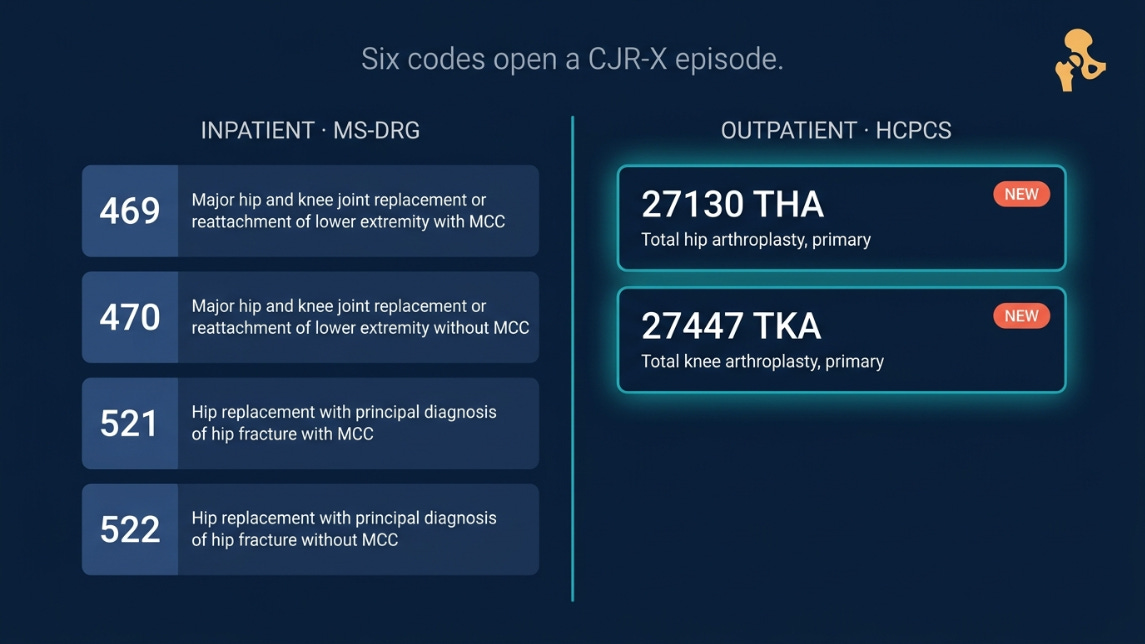
Six codes open a CJR-X episode — four inpatient MS-DRGs and two outpatient HCPCS codes, per § 512.2 and § 512.610.
Outpatient triggers:
HCPCS
27130 Total hip arthroplasty (HOPD setting)
27447 Total knee arthroplasty (HOPD setting)
MS-DRGs 521 and 522 — fracture-driven hip arthroplasty — ARE included. As I all too well know, these are not elective cases. A Medicare beneficiary who fractures a hip in a fall and receives an arthroplasty through the emergency department triggers a 90-day episode. The hospital bears financial accountability for a patient whose pre-operative optimization window was hours, not weeks.
Second, the outpatient HCPCS codes are new. The original CJR covered only inpatient admissions. As outpatient total joint volume has grown ( a migration driven by surgical technique, anesthesia advances, and payer incentives) excluding HOPD procedures would have created a straightforward arbitrage: shift patients to the outpatient setting to avoid the bundle. CJR-X closes that gap.
Per § 512.615, participation is mandatory for IPPS hospitals meeting eligibility criteria. This is nationwide program and not a subset of selected geographies, as in CJR (67 MSAs) or TEAM (selected CBSAs).
Excluded hospitals per § 512.610(b):
TEAM participants (§ 512.610(b)(1)): Hospitals already in TEAM for LEJR episodes are excluded. A hospital cannot be accountable for the same episode under two models.
Maryland hospitals (§ 512.610(b)(2)): Excluded under Maryland’s Total Cost of Care Model waiver. (But EQUIP incredibly relevant)
Concurrent participation with MSSP/ACOs is permitted. The models operate on different payment mechanics — episode-based versus total cost of care — so CMS allows overlap.
The target price is the benchmark against which actual episode spending is measured at reconciliation. It is built through five sequential adjustments.
In addition to a deeper dive below, I’ve constructed a NotebookLM Deep Dive Studio with full CMS-1849-P source sections with interactive Q&A against the primary document. This is a great resource in my opinion, it is how I created the deep dive podcast at the top of this article as well. I will create a tutorial on how I systematically create explainer resources in NotebookLM soon.
A Hospital Risk Explorer: Risk and opportunity analysis by hospital, region, and case mix
IPPS Proposed Rule Curated Document. If you don’t feel like poring over the 1500 page document I have the 230 pages extracted that apply to TEAM and CJR-X below as well. The final rule PDF is also below, though you can find it at this link.
All the Final Rule updates and operator considerations. This model has many implications for hospital operations.
CJR-X NotebookLM Deep-Dive Studio: Full CMS-1849-P source sections with interactive Q&A against the primary document. This is where I would spend time if you just want simple explanations of different aspects of the model. And I’ve prepopulated the site with numerous videos, audio files and more. Just click the link to “chat”with the model.
Here’s an audio sample from notebookLM that I thought did a great job reviewing the model and the NTAP consdierations.
0:00
-24:02
Hospital Explorer: Risk and opportunity analysis by hospital, region, and case mix
IPPS Proposed Rule Curated Document. If you don’t feel like poring over the 1500 page document I have the 230 pages extracted that apply to TEAM and CJR-X in this PDF
Here’s a also brief below that you can share freely with take home points on the model.
[FINAL: finalized without modification.] The episode length is 90 days from discharge, specified at § 512.630(d) and confirmed throughout the rule — in the home visit waiver provisions at § 512.695(c), the data sharing language, and the beneficiary incentive rules at § 512.685. Commenters pushed hard for TEAM’s 30-day window. CMS declined, and said the quiet part out loud: it wants to test both episode lengths concurrently and compare.
The choice reflects a clinical judgment about joint replacement recovery. A 30-day episode captures the immediate post-operative period. A 90-day episode captures the full post-acute care arc: the SNF stay, home health visits, outpatient physical therapy, the six-week follow-up, and complications that tend to manifest in weeks four through eight — surgical site infections, periprosthetic fractures, medical complications from immobility. For LEJR, much of the cost variation between patients occurs in this window. CMS concluded that aligning financial accountability with the full clinical recovery period is worth the added complexity.
What’s included: All Medicare Part A and Part B services within the 90-day post-discharge window, beginning on the date of the inpatient anchor admission or the outpatient procedure. This encompasses the anchor event, physician services, post-acute care (SNF, HHA, IRF, LTCH), readmissions, outpatient follow-up, Part B drugs, DME, labs, and imaging.
What’s excluded: Unrelated inpatient admissions (the final rule tightened the wording to “trauma unrelated to the CJR-X episode”), clinical trial services, and certain high-cost drug HCPCS codes meeting volume or cost thresholds. [FINAL] Beneficiary inclusion criteria were re-codified around the 180-day lookback: continuous Parts A and B enrollment through the lookback ending the day before the anchor, Medicare as primary payer, no ESRD-based entitlement, no managed care enrollment (§ 512.620(a)). [FINAL] One genuinely new provision: cyberattacks that corrupt a hospital’s data now qualify for episode cancellation under the extreme-and-uncontrollable-circumstances policy (§ 512.630(e)) — a first for a CMS episode model, and a sign of the operating environment we’re actually in.
Sources §I: CMS-1849-F §512.630(d), §512.695(c), §512.685, §512.620(a), §512.630(e).
Six codes open a CJR-X episode — four inpatient MS-DRGs and two outpatient HCPCS codes, finalized without modification at § 512.625(a).
Inpatient triggers: MS-DRG 469 (major hip and knee joint replacement with MCC, or total ankle replacement), 470 (without MCC), 521 (hip replacement with principal diagnosis of hip fracture, with MCC), 522 (without MCC).
Outpatient triggers: HCPCS 27130 (total hip arthroplasty, HOPD setting) and 27447 (total knee arthroplasty, HOPD setting).
Three details are worth flagging, and the first deserves more space than I gave it in April.
First: hip fractures are fully in — and that includes hemiarthroplasty. MS-DRGs 521 and 522 sweep in every hip replacement performed for a fracture, and because DRG assignment runs off the ICD-10-PCS code plus the principal diagnosis rather than the CPT code your biller sees, a hemiarthroplasty for a displaced femoral neck fracture (CPT 27236 on the professional side, femoral-surface replacement on the facility side) lands in 521/522 and triggers a full 90-day episode. The final rule confirms it structurally: “partial hip procedure” is an enumerated risk-adjustment flag at § 512.645. As I know all too well from the trauma bay, these are not elective cases. A Medicare beneficiary who fractures a hip in a fall and receives an arthroplasty through the emergency department triggers an episode for a patient whose pre-operative optimization window was hours, not weeks. And this is not a rounding error in the model: fracture-coded cases are roughly 46% of inpatient FFS LEJR volume, with MCC rates near 27%. The inpatient side of CJR-X is substantially a fracture model wearing an elective model’s name. What stays out: fixation. An ORIF or cephalomedullary nail groups to DRGs 480–482, which live in TEAM’s hip-fracture category, not CJR-X. At the margin, the arthroplasty-versus-fixation decision for a femoral neck fracture is now also a payment-model boundary (though it shouldn’t be).
Second, the outpatient HCPCS codes are new. The original CJR covered only inpatient admissions. As outpatient total joint volume has grown, excluding HOPD procedures would have created a straightforward arbitrage: shift patients to the outpatient setting to avoid the bundle. CJR-X closes that gap. (It does not close the ASC gap ( more on that in Section XV, because the incentive it creates is trickier than it looks.)
Third, the ankle question is settled. [FINAL] Inpatient total ankle arthroplasty is in the bundle. It’s nested within MS-DRG 469 by DRG title. Outpatient TAA (CPT 27702) is out; CMS said adding an untested trigger “would represent too great a departure from the CJR Model” to sustain the actuarial certification. Unicompartmental knee (27446) remains excluded. There aren’t many inpatient total ankle replacements, so I don’t anticipate the impact to be that significant.
Sources §II: CMS-1849-F §512.625(a); episode-scope preamble (”inpatient hip, knee, and ankle replacement”); FY2026 IPPS final rule public use files (Table 5, BOR v43) for the 46% fracture share; MS-DRG Definitions Manual (PCS-driven DRG assignment).
[FINAL: mandatory nationwide, finalized.] Participation is mandatory for acute care hospitals in the 50 states, DC, and the territories that initiate LEJR episodes and are eligible to be paid under both the IPPS and OPPS (§ 512.610(a)). Roughly 2,500 hospitals are in. Requests for voluntariness, phased geography, and delay pending TEAM results were all rejected.
Excluded: TEAM participants (§ 512.610(b)(1)), Maryland hospitals (§ 512.610(b)(2)); and, via the participant definition, critical access hospitals, rural emergency hospitals, IHS/Tribal hospitals, and Rural Community Hospital Demonstration participants.
The TEAM transition. [FINAL] With CJR-X on calendar years, TEAM hospitals roll into CJR-X on January 1, 2031, the day after TEAM ends: no gap, no election, no opt-out. Every LEJR investment a TEAM hospital makes today transfers.
Concurrent participation with MSSP/ACOs is permitted, and the final rule went further than late-era CJR: overlap with the MSSP ENHANCED track is now allowed. Both sides keep their savings; reconciliation dollars are excluded from ACO benchmarks in both directions.
Timing. [FINAL — the one real concession.] Performance Year 1 begins January 1, 2028 and runs on the calendar year (§ 512.630(a), § 512.605). CMS granted a three-month delay, framed as an implementation accommodation, and explicitly refused anything longer.
CMS posts the participant list by the end of 2026, the PY1 complications measure window opens April 1, 2027, and the PY1 pricing baseline (FY2024–FY2026) is already closed. The runway everyone thinks they have is the performance ramp. And because this is a §1115A(c) expansion rather than a time-limited test, there is no PY5 sunset. The RIA models five years ($725 million in projected Medicare savings) only because it had to model something.
Sources §III: CMS-1849-F §512.610(a)–(b), §512.605, §512.630(a); RIA participant estimate; Exec. Summary (POH RFI).
[FINAL: every step finalized without modification.] The target price is the benchmark against which actual episode spending is measured at reconciliation. It’s built through five sequential adjustments.
Step 1: Regional Benchmark (§ 512.640). Benchmarks are 100% regional from PY1, nine US Census divisions, calculated at the MS-DRG and HCPCS episode-type level, 36 benchmark prices in all. No hospital-specific component, no blended phase-in. The baseline is a three-year rolling window weighted 17% / 33% / 50%, rebased annually. Commenters asked for ten-year rebasing cycles and equal weights; CMS kept annual rebasing and attributed ratchet protection to regional pricing and the three-year smoothing.
Interpretation (unchanged from April, now with finality): The original CJR’s hospital-specific blend gave high-cost hospitals a cushion. CJR-X eliminates it. If your LEJR episode costs exceed the regional average, the gap is visible in your target price from day one.
Step 2: Risk Adjustment (§ 512.645). The TEAM-derived engine, detailed in Section VI. Multipliers are calculated from baseline claims, published before the performance year, and held constant through reconciliation.
Step 3: Trend Factor (§ 512.640). A prospective trend factor projects baseline spending forward; a retrospective correction at reconciliation is capped at ±3%. This cap is specific to the trend factor.
Step 4: Normalization Factor (§ 512.645). Ensures risk-adjusted target prices aggregate to the non-risk-adjusted average. Prospective, with a retrospective correction capped at ±5%. [FINAL] The prospective normalization factor is computed from the full three-year baseline (adopting TEAM’s FY2027 refinement).
Step 5: Discount Factor (§ 512.605; § 512.640(b)(8)). A 2.0% discount produces the preliminary target price — 98 cents on the dollar of the risk-adjusted, trended, normalized regional benchmark. AHA asked CMS to eliminate it; AAHKS called it too aggressive. CMS kept it, noting it already cut the discount from CJR’s 3.0% and that an undiscounted model has never been tested. The discount is modulated at reconciliation by the Composite Quality Score: Excellent zeroes it, Good halves it, Acceptable and below retain the full 2.0%. For what it’s worth, CMS’s own impact analysis assumes the average hospital lands at an effective 1.3% discount.
[FINAL] One addition worth knowing: the reconciliation target price also absorbs MS-DRG and APC payment-rule updates (§ 512.645(g)), so GROUPER changes (like this same rule’s revision-DRG restructure) no longer strand baseline episodes against dead codes.
Additional protections: the 99th-percentile high-cost outlier cap (AAHKS asked for the 90th; denied) and the low-volume threshold defined as fewer than 31 episodes in the baseline period means no target price, no episodes, and no reconciliation exposure for that year (§ 512.640(a)(4)), with status reassessed annually.
Sources §IV: CMS-1849-F §512.640(a)(4), §512.640(b), §512.645(f)–(h), §512.605; RIA (1.3% average effective discount).
[FINAL: measures, weights, and thresholds finalized as proposed; performance periods shifted three months with the new start date.]
Five measures, three domains (§ 512.635(a)(1)–(5)): the THA/TKA Risk-Standardized Complication Rate (CMIT #350, inpatient) and Hospital Visits within 7 Days of HOPD Surgery / OP-36 (#344, outpatient) anchor the complications domain at 50%; HCAHPS (#338, inpatient) and OAS CAHPS (#162, outpatient) make up patient experience at 40%; the THA/TKA PRO-PM (#1618) carries the PRO domain at 10%. (Correction from the April piece: OAS CAHPS is CMIT #162 — OP-46 is the Information Transfer PRO-PM, which CMS considered for CJR-X and dropped for lack of certifiable historical data.)
Each measure is scored against national percentiles; CMS computes an inpatient composite and an outpatient composite (each capped at 20 points), then volume-weights them by your actual inpatient-to-outpatient episode mix. Minimum thresholds: 25 cases for the complications and PRO measures, 100 completed surveys for the CAHPS measures; below threshold, you’re assigned the 50th percentile. No improvement points — achievement only.
[FINAL] PY1 measurement windows: complications, April 1, 2027 – March 31, 2029; the CAHPS measures and OP-36, calendar 2028; PRO-PM, July 1, 2027 – June 30, 2028. Read that first date again. Your PY1 quality clock starts eight months before PY1.
The Below Acceptable tier should be emphasized: a hospital scoring ≤6.0 retains the full 2.0% discount and full repayment obligations but is locked out of reconciliation payments. It is impacted to the the downside without access to the upside. On a $30M annual LEJR portfolio, the discount differential between Acceptable and Excellent is roughly $600,000 per year and that’s before any reconciliation savings.
(The OP-36 discussion, the CAHPS evidence base — Gleicher, Chen, Lavigne, Fitzgerald — and the PRO-PM operational analysis from the April piece carry over unchanged; the measures were finalized exactly as analyzed. One update: AAHKS asked CMS to run the PRO-PM as pay-for-reporting until FY2030. Denied. It is pay-for-performance, at 10% of CQS, from year one. The ≥50% postoperative PROM collection requirement via HIQR stands. If your PRO capture still runs on clipboards, this is the year that stops.)
Sources §V: CMS-1849-F §512.635(a)–(e), Tables X.C-02 through X.C-06; Gleicher et al. (bundled perioperative intervention, 30-day ED visits 12.9%→7.3%); Chen et al. (CJR care redesign, readmissions 17.7%→5.1%, CQS 4.4→17.6); Lavigne et al.; Fitzgerald et al. (co-management and HCAHPS).
[FINAL: finalized without modification] CJR-X adopts TEAM’s risk adjustment architecture (§ 512.645), applied over a 180-day lookback ending the day before the anchor.
Hospital-level factors: bed size (four tiers: ≤250, 251–500, 501–850, 851+) and binary safety-net status (top 25th percentile regionally for dual-eligible FFS LEJR inpatient share triggers safet. Commenters asked for a graduated threshold, TEAM-definition alignment, and a status hold-harmless. All denied. The cliff at the 25th percentile survived the comment period intact; if you’re at the 24th, you get nothing, and now that’s final.
Beneficiary-level factors: age bracket; total HCC count; 21 enumerated HCC flags (17, 36, 37, 48, 125, 126, 127, 151, 155, 199, 224, 225, 226, 238, 253, 267, 280, 326, 327, 383, 402 — dementia across three severity tiers, heart failure, diabetes with complications, CKD, morbid obesity, and the other conditions that actually complicate orthopedic recovery); beneficiary economic risk (dual-eligible, LIS, or high community-deprivation residence); five prior-procedure flags — ankle procedure or reattachment, partial hip procedure, partial knee arthroplasty, THA or hip resurfacing, and TKA. This replaces the single prior-LEJR flag from earlier drafts; prior post-acute care use; and disability as the original entitlement reason.
Multipliers are calculated at the MS-DRG level from baseline data, published before the performance year, and held constant at reconciliation. CMS is handing you the math equations in advance. The question is still whether hospitals will invest the analytic capacity to use it. The other question : whether your pre-anchor documentation captures those 21 HCCs. In a 180-day lookback, comorbidity capture on a fracture patient is target-price construction.
Sources §VI: CMS-1849-F §512.645(a)–(d) (finalized without modification); 21 HCC flags at 42 CFR 512.545(a)(6)(ii) lineage; TEAM methodology cross-reference 90 FR 37103.
[FINAL: finalized as proposed, with calendar-year timing.] Reconciliation is annual (§ 512.650), roughly six months after the performance year ends, with claims runout through July 1 following each PY. CMS calculates the Net Payment Reconciliation Amount by comparing capped actual episode spending against reconciliation target prices across all episodes.
Stop-loss / stop-gain (§ 512.650(c)(6)): ±20% for standard IPPS hospitals; 5% stop-loss (stop-gain still 20%) for rural, MDH, SCH, and safety-net hospitals. AHA asked for a five-year phase-in capped at 10% and 2.5%; AAHKS asked for TEAM-style transition tracks. Denied, on certification grounds. Full two-sided risk arrives on day one of PY1. The gap between corridors remains substantial: on a $30M portfolio, ±20% versus 5% is $4.5M of annual downside exposure.
Post-episode spending: the days 91–120 window is monitored; spending above three standard deviations over the regional average is repayable outside the stop-loss cap. Commenters noted safety-net hospitals were hit at twice the rate under CJR; CMS kept the policy and said it may consider protections later.
Appeals: 30-day window for a notice of calculation error; CMS responds within 30 days; further review through § 512.190.
Sources §VII: CMS-1849-F §512.650 (annual reconciliation, corridors, post-episode monitoring), §512.660 (appeals).
[FINAL: the hierarchy, caps, and worked math from the April piece all finalized without modification.] Sharing arrangements with collaborators (§ 512.670), distribution arrangements through collaboration agents (§ 512.675), downstream distribution (§ 512.680). Gains can flow down up to 100% of the reconciliation payment, with no cap on physician gainsharing; repayment can flow up only to 50% in aggregate, 25% per non-ACO collaborator. Fifteen collaborator types made the final list — physician groups, therapists and therapy groups, SNFs, HHAs, IRFs, LTCHs, ACOs among them.
AAHKS’s signature ask suggesting we mandate that hospitals share savings with surgeons was denied. Sharing remains voluntary, which means your gainsharing agreement is negotiated leverage, not a regulatory entitlement. Come to that negotiation with your case mix, your episode footprint, and your post-acute referral patterns quantified.
✓ Arithmetic and caps re-verified against CMS-1849-F (finalized without modification): gains may flow down up to 100% of the reconciliation payment with no physician percentage cap; repayment flows up capped at 50% in aggregate, 25% per non-ACO collaborator, 50% for an ACO collaborator.
Sharing arrangements with three collaborators: an orthopedic surgeon group practice (independent, non-ACO), a preferred SNF, and a home health agency. The surgeon group participates through a regional MSO, so a Layer 2 distribution arrangement sits beneath it.
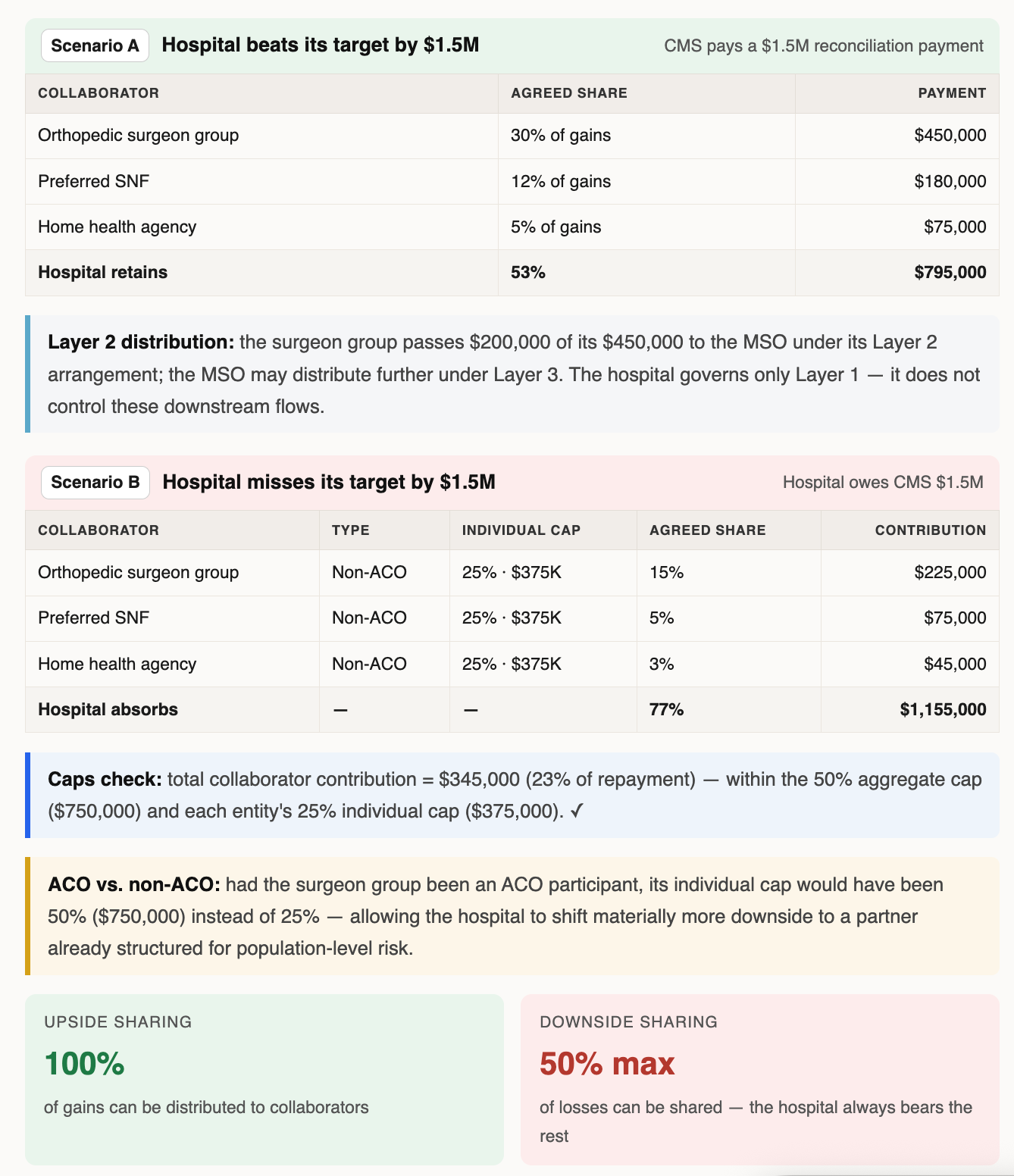
CMS designed the asymmetry deliberately: the hospital has the most direct control over episode spending and is the entity CMS holds accountable, so it cannot fully offload the downside regardless of its sharing arrangements.
[FINAL — the restructured provision: unlike the 2015 and 2017 CJR waiver packages, CMS issued no fraud-and-abuse waivers for CJR-X. Instead it determined that the Anti-Kickback safe harbor for CMS-sponsored model arrangements and patient incentives (42 CFR § 1001.952(ii)) is available (§ 512.690), and pointed Stark compliance to the existing value-based exceptions. Commenters objected that no parallel Stark exception cleanly fits; CMS disagreed. Practically: your gainsharing arrangements need real compliance architecture from the start, and your counsel should be in the room earlier than last time.]
Administrative load: quarterly Financial Arrangements List and Clinician Engagement List submissions — which CMS’s own burden analysis calls the model’s only meaningful new reporting requirement.
Sources §VIII: CMS-1849-F §§512.670–512.680 (sharing/distribution/downstream), §512.690 (AKS safe harbor determination, 42 CFR §1001.952(ii)); Stark value-based exceptions at 42 CFR §411.357(aa). Worked-example arithmetic verified against the finalized caps — see the verification note above.
[FINAL: all three finalized, one with modification.]
Post-discharge home visits (§ 512.695(c)): up to nine visits per 90-day episode, billed under a CJR-X G-code at roughly $50, general supervision. Notable: TEAM dropped its version of this waiver; CJR-X kept it. Nine visits at $50 is $450 per episode against a $15,000–$25,000 readmission.
SNF 3-day rule (§ 512.695(b)): waived within 30 days of discharge for SNFs rated three stars or better for at least 7 of the last 12 months — with hospital and CAH swing beds exempt from the star requirement, a rural-access adjustment borrowed from TEAM. The hospital carries beneficiary financial liability if it uses the waiver improperly.
Telehealth (§ 512.695(a)): geographic and originating-site flexibility with four new G-codes — and the final rule states these will keep working for CJR-X participants even if the broader Medicare telehealth extensions lapse. For 90-day episode management, that’s a durable virtual-care rail, not a temporary flexibility. Hold that thought for Section XV.
Sources §IX: CMS-1849-F §512.695(a)–(c); SNF star-rating and swing-bed provisions; telehealth G-code table.
Incentive limits finalized as proposed (§ 512.685): technology items to $1,000 per episode, retrieval above $75, documentation above $25, all tied to clinical goals. [FINAL] Beneficiary notification also survived, written notice before discharge from the anchor, collaborator lists included; CMS considered dropping it for burden and kept it.
Sources §X: CMS-1849-F §512.685, §512.622.
[FINAL] CJR-X is both an Advanced APM (annual CEHRT attestation required) and a MIPS APM (§ 512.615), with the participant hospital as the APM Entity and QP determinations built from the quarterly lists. A correction to the April piece’s math: the original 5% APM incentive era has lapsed; current-law QP benefits run through the differential conversion-factor update and MIPS exemption. The right way to size the AAPM decision now is your surgeons’ MIPS exposure plus the conversion-factor differential across your Part B book — smaller than the old 5% lump sum, still not nothing across a ten-surgeon service line. I anticipate most will just go the APM route for ease of reporting.
Sources §XI: CMS-1849-F §512.615; QP determinations via quarterly Financial Arrangements / Clinician Engagement Lists.
[FINAL: finalized as proposed — monthly, episode-scoped, no API.] Beneficiary-identifiable claims (three-year baseline plus monthly performance-year feeds with six months of runout) under an annual data sharing agreement; de-identified regional aggregates without one. Requests for FHIR/API delivery were declined for now. Two operational notes: baseline data and preliminary target prices arrive each November, and the identifiable-claims scope covers services in the episode. Hospitals that build the capacity to consume a monthly feed and flagg cost outliers, track PAC utilization, and identify high-risk episodes early can intervene during the episode rather than reading about it in the reconciliation statement.
Sources §XII: CMS-1849-F §512.665 and the data-sharing preamble.
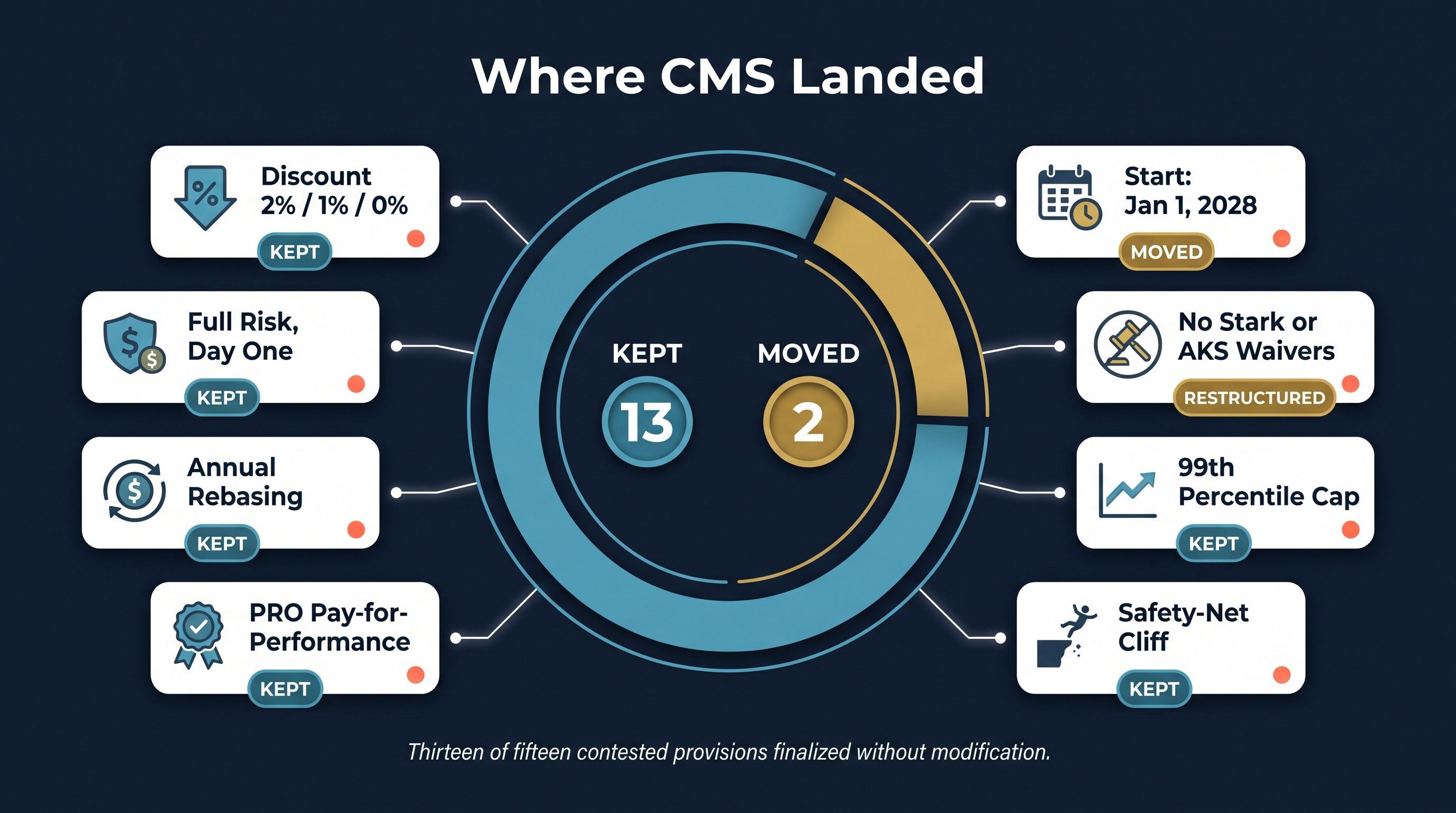
In April this section listed the design choices CMS had opened for comment. Here is how they landed:
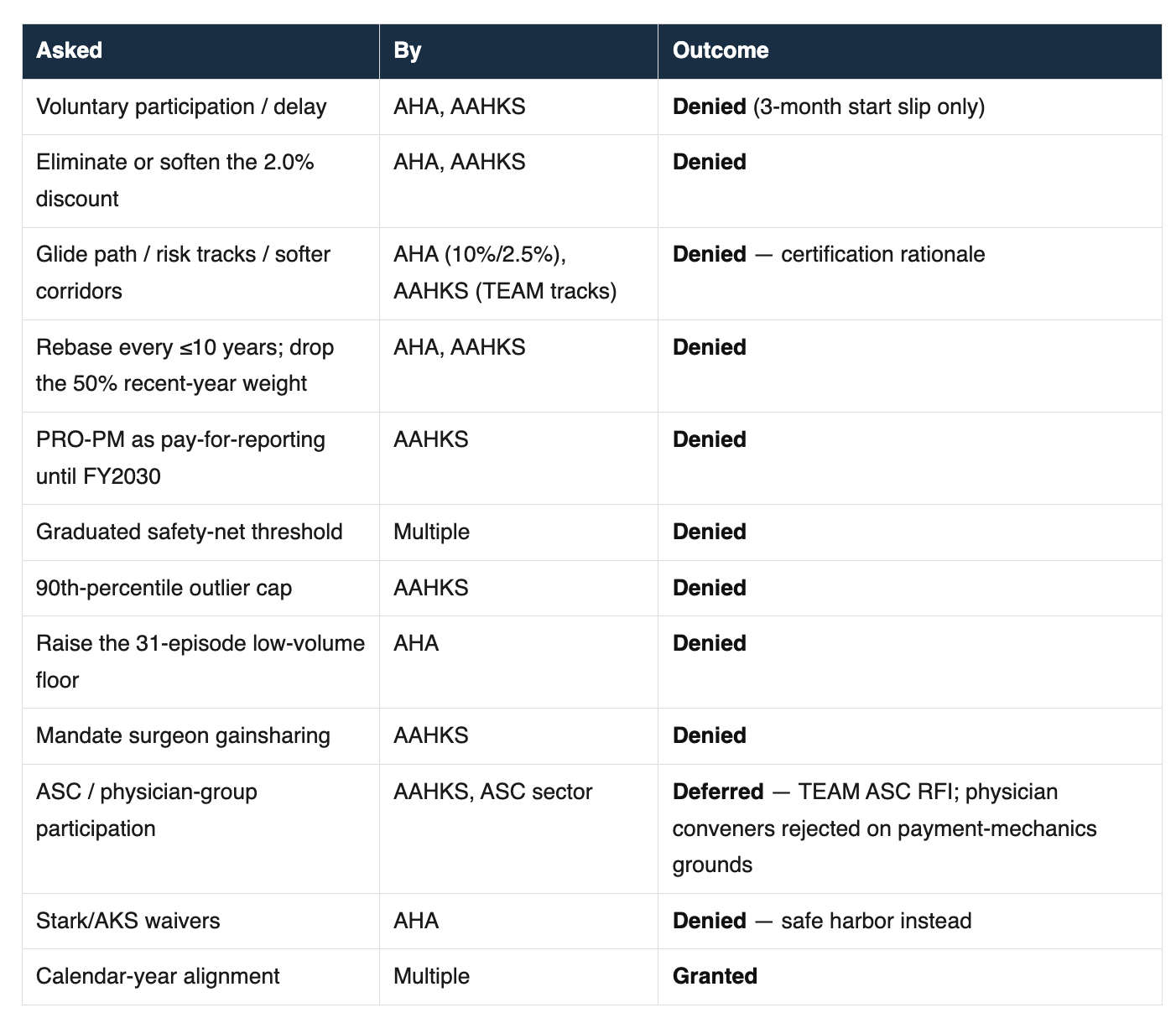
A few interesting notes. A possible short glide path for newly built hospitals and special-category facilities, and a possible voluntary opt-in for physician-owned hospitals into TEAM. CMS confirmed all TEAM participants, POHs included, flow into CJR-X afterward. If you lead a physician-owned MSK hospital, your on-ramp into episodes is being drawn right now.
Sources §XIII: proposed→final delta analysis of CMS-1849-F against CMS-1849-P and the June 9, 2026 AAHKS and AHA comment letters.
CJR was the test (inpatient, 67 MSAs, blended benchmarks, three risk adjusters, ended 2024, $112.7M in late-period savings). TEAM generalized more broadly (five surgical episodes, 30 days, ~741 hospitals, risk tracks, ends 2030). CJR-X takes TEAM’s underlying mechanics, restores CJR’s 90-day window, adds native outpatient triggers, goes nationwide, drops the training wheels, and never ends. [FINAL] Same rule, adjacent news: TEAM’s quality baselines are concurrent (you’re scored against same-year national distributions now), complex-spine DRGs 523–525 joined TEAM’s fusion category, and the PJI classification is completed — new MS-DRGs 403/404, with revision DRGs 466–468 deleted in favor of a single-severity DRG 449. If you run a revision service, your DRG economics change on October 1, 2026, a full year and change before CJR-X starts.
Sources §XIV: CMS-1849-F §512.547 (TEAM concurrent CQS baseline), MDC 08 final policies (MS-DRGs 403/404, 449, 400, 523–525); CJR results per the CMS CJR-X model page and Seventh Annual Evaluation Report ($112.7M PY6–7).

With elective TJA migrated to HOPD and ASC settings, the inpatient half of CJR-X is dominated by fractures: DRGs 521/522 ( including every hemiarthroplasty) are ~46% of inpatient episode volume, carrying triple the MCC rate of the elective cases, six-day median stays, and post-acute trajectories that run through SNFs, not group exercise classes. Every bundle playbook written between 2016 and 2024 was optimized for the healthy elective patient. The hospitals that win CJR-X will be the ones with fracture-specific infrastructure: ED-to-OR velocity, geriatric co-management, delirium prevention, disposition planning that starts at admission, and comorbidity documentation robust enough to earn the risk adjustment those patients deserve. The 21 HCC flags and the partial-hip procedure flag exist precisely so that fracture-heavy hospitals aren’t punished for their epidemiology, but risk adjustment only pays for what you document inside the 180-day window. I think this is an underappreciated wrinkle in the model.

Most CFOs will contemplate one thin within a month of reading this rule: ASC procedures don’t trigger CJR-X episodes! Only inpatient DRGs and HOPD codes do. So the apparent play is to “decant”, accelerate migration of joint replacement volume from the HOPD to the ASC and shrink your bundle exposure.
But consider the selection effect. The cases that can safely move to an ASC are, by definition, your youngest, healthiest, lowest-complication patients. These are exactly the episodes that beat a regional target price and generate reconciliation gains. Decant them and you export your winners while keeping the frail, fracture-heavy episodes you can’t move. Your average episode gets sicker, your CQS volume-weighting tilts toward the harder inpatients, and the reconciliation upside that was supposed to fund your care redesign walks out the door to a site of service that bears no episode risk at all. There are legitimate reasons to shift cases, patient preference, capacity, ASC economics on the facility-fee side. But as bundle strategy, indiscriminate decanting is shortchanging your high-margin, low-risk cases to feel lighter on paper. It’s tricky, and it deserves modeling. (CMS sees the seam too — the TEAM ASC request-for-information is the tell that ASC episode accountability is a matter of when, not whether. Build your strategy for the version of this model that eventually includes the ASC.)

A 90-day, permanently mandatory episode means care navigation is a non-negotiable. Under a demonstration, navigation was a project with a grant-shaped budget. Under CJR-X, it is infrastructure for a revenue line that never sunsets. The final rule effectively hands you the tools: telehealth codes constructed to outlive the national extensions, nine reimbursable home-touch slots per episode (not sure these are sufficiently reimbursed), monthly claims feeds, and a quality score where experience and early post-discharge visits carry 40-plus percent of the weight.
The part of the episode that decides reconciliation is still the part hospitals see least: the post-acute “black box” between discharge and the six-week visit, where the SNF days accumulate and the week-four-to-eight complications declare themselves. My strong view: physical therapists and advanced practice providers belong at the center of this conversation. Routine, structured virtual touchpoints can make a difference here. A PT-led pre-op check that sets expectations and screens the home environment, then scheduled post-op video contacts through the recovery arc, are the cheapest instrument we have for shining light into that box. They catch the swollen calf on day 12, the wound concern on day 19, the patient who stopped their DVT prophylaxis, and they route each one to a $50 home visit or a telehealth encounter instead of a $20,000 readmission. The evidence base for navigator-model savings was built on nurses and phone calls; the 2028 version is PT- and APP-led, virtual-first, and continuous.
This is what we have built at MSK ACCESS with our growing network of national physical therapy partners: longitudinal MSK journeys where virtual PT touchpoints run from pre-op optimization through the end of the episode, wrapped around RevelAi’s AI care-navigation layer. The longitudinal MSK journey is here. Skate to where the puck is going.

The clock:
participant list by end of 2026
→ PY1 quality window opens April 1, 2027
→ PY1 begins January 1, 2028
→ TEAM hospitals join January 1, 2031.
Episode analytics, monthly-claims consumption, automated PRO capture, patient engagement platforms, post-acute network management must be part of your strategy. Seventeen months, and the quality portion is due in eight.
Sources §XV: Haas et al., JAMA Internal Medicine 2019; Dundon et al.; Zhang et al., Postgraduate Medical Journal 2024; Ripollés-Melchor et al. (POWER2), JAMA Surgery 2020; Phillips et al.; Kelmer et al.; Kim et al., JAMA Network Open 2019; Thirukumaran et al., Health Affairs 2019; Shashikumar et al., JAMA Health Forum 2022; Edwards et al.; Lussiez et al., JAMA Network Open 2022; Schöner et al., PLoS Medicine 2024; Rosner et al. Literature citations carried from the April edition as published.

Risk adjustment coefficients. The framework is final; the multiplier values arrive with the November 2027 target prices. Precise financial modeling waits on their release.
Litigation. Commenters built a record challenging a permanent mandatory model under §1115A — nondelegation, the no-end-date question, the scope of Phase II authority. CMS answered every argument in the preamble, which is what you do before you get sued. Watch the docket; plan as if the model survives, because the certification-lock design was built to.
The ASC and POH frontiers. The TEAM ASC RFI and the signaled POH opt-in proposal are the two places the model’s perimeter moves next.
The final CJR evaluation report, due this fall, will either strengthen or complicate the expansion’s evidentiary foundation.
Christian Pean, MD, MS is an orthopedic trauma surgeon, health policy expert, and CEO of RevelAi Health. He is faculty at Duke University School of Medicine and the Duke Margolis Institute for Health Policy. Techy Surgeon is his platform for analysis of the policy infrastructure that shapes how medicine is practiced and paid for.
This article reflects analysis of CMS-1849-F (FY 2027 IPPS Final Rule, Section X.C — Comprehensive Care for Joint Replacement Expanded Model) as finalized August 4, 2026. All § references cite 42 CFR Part 512, §§ 512.600–512.695. The April analysis of the proposed rule (CMS-1849-P) remains available for lineage.
The best part of this newsletter isn’t the tips. It’s the people reading them. Subscribers here have teamed up on projects, swapped workflows, and pushed each other’s work forward. I’ve collaborated with several of you myself.
If something here has saved you time or sparked an idea, share it with one person who’d benefit. That’s it! One person. Group subscriptions get a discount, and the button below does the rest.
Comments
Nothing yet. Say the first thing.
Sign in to join the conversation.