
The ultimate AI tech stack for product-led growth in 2026 (Sponsor)

The best product teams don’t win based on how many tools they use, they win when they use tools that leverage product signals to accelerate user engagement.
Recently, Scott Strand, Knock’s agent-pilled growth lead, shared the AI marketing tech stack he uses to connect product signals, user data, and customer messaging as a one-person marketing team.
For product engagement specifically, the foundation looks like this:
Claude and Cursor to move from idea to execution faster.
PostHog and Hightouch to understand product behavior, run experiments, and activate warehouse and product data across your stack.
Knock to trigger relevant lifecycle messaging across email, in-app, push, chat, and more.
Check out the full post to see all 15 tools in Scott’s AI marketing stack and learn how he uses them together to improve activation, adoption, and retention.
For the past few years, the technology industry has treated artificial intelligence as both an inevitability and an emergency.
Companies have rushed to acquire chips, build data centers, develop large language models and attach AI features to nearly every product. Governments, meanwhile, have begun treating computing infrastructure as a strategic resource rather than simply another part of the private technology market.
The latest developments suggest that the AI boom is far from slowing down. However, they also reveal a more complicated reality: not every company positioned as an AI beneficiary will benefit equally, and not every dollar invested in the technology will necessarily produce a meaningful return.
Among the strongest signals came from TSMC and ASML, two companies positioned near the foundation of the global semiconductor industry.
TSMC reported a sharp increase in quarterly profit and raised its capital-spending plans, while ASML announced plans to expand its production capacity for the machines used to manufacture advanced chips.
These companies are benefiting from a relatively straightforward reality: regardless of which AI model eventually dominates, nearly all serious AI developers need advanced computing infrastructure.
OpenAI, Google, Anthropic, Meta and a growing list of startups may compete on models, products and developer platforms, but their systems ultimately depend on chips manufactured through an extremely concentrated global supply chain.
This makes TSMC and ASML something close to the picks-and-shovels suppliers of the AI gold rush.

The comparison is imperfect, of course. Gold-rush suppliers did not operate inside a geopolitical contest involving export restrictions, national-security policy and semiconductor manufacturing subsidies. Still, the basic idea holds: when companies are uncertain about which application will win, selling the infrastructure required by every competitor can be the safer position.
The scale of current spending also suggests that major AI companies do not expect demand to level off soon. Building more chip capacity is expensive, technically difficult and slow. Companies would not be making such large commitments unless they believed the need for computing power would continue growing.
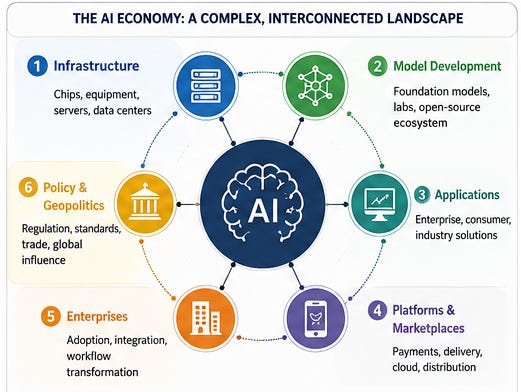
But strong demand for chips does not automatically mean the broader AI economy is healthy. It may simply mean that companies remain locked in an infrastructure race they cannot afford to abandon.
IBM’s dramatic stock decline offers a useful counterpoint.
The company suggested that customers were prioritizing spending on servers, storage and other AI infrastructure while delaying some software and consulting deals.
In other words, enterprise technology budgets may not be expanding enough to support every part of the AI ecosystem simultaneously. Money directed toward graphics processors, memory, cloud capacity and data-center construction may be money that is no longer available for traditional software contracts or consulting engagements.
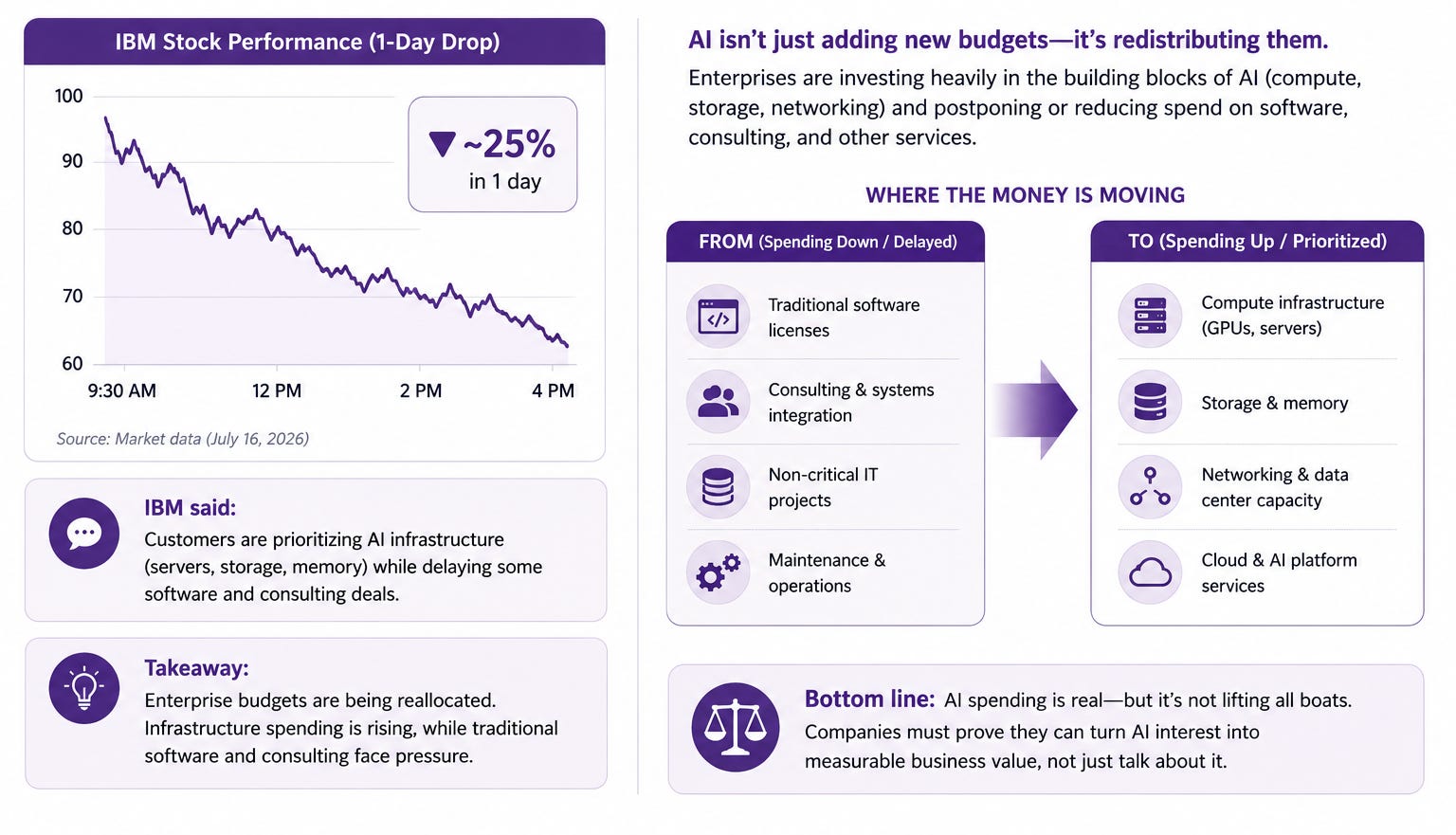
This is an important distinction because the technology industry often talks about AI spending as though it lifts all companies associated with enterprise technology.
It does not.
AI is redistributing spending rather than simply creating unlimited new budgets. Infrastructure suppliers may win while older software vendors face pricing pressure. Cloud providers may gain revenue while enterprises cut spending elsewhere. Consulting companies may promote AI-transformation services while their customers decide that purchasing computing capacity is the more immediate priority.
IBM’s experience does not necessarily mean that its long-term strategy has failed. It does suggest, however, that being an established technology company with an AI narrative is no longer enough.
Investors increasingly want evidence that a company can turn AI interest into revenue without damaging its existing business.
The release of Thinking Machines Lab’s open-weight model adds another dimension to the competition.
Founded by former OpenAI executive Mira Murati, the startup is entering a market already crowded with well-funded laboratories and increasingly capable open models.
Its decision to release an open-weight system is significant because it reflects a broader shift in the AI industry. Developers and enterprises do not always want to depend entirely on closed platforms controlled by a small number of US technology companies.
Open-weight models can offer greater flexibility, more control over deployment and potentially lower long-term costs. They can also help organizations keep sensitive information within their own infrastructure.
However, releasing a powerful model is no longer enough to guarantee influence.

The more important questions are whether developers can deploy it efficiently, whether companies can customize it safely and whether the model offers a clear advantage over alternatives already available from Meta, Chinese AI firms and the wider open-source community.
The AI model market increasingly resembles the cloud industry in its earlier years. Technical quality matters, but distribution, ecosystem support, enterprise trust and developer tooling may matter just as much.
Thinking Machines therefore faces a difficult challenge: it must prove not only that it can build an impressive model, but that it can give developers a reason to adopt it.
China’s upcoming AI diplomacy push shows that the competition extends well beyond companies.
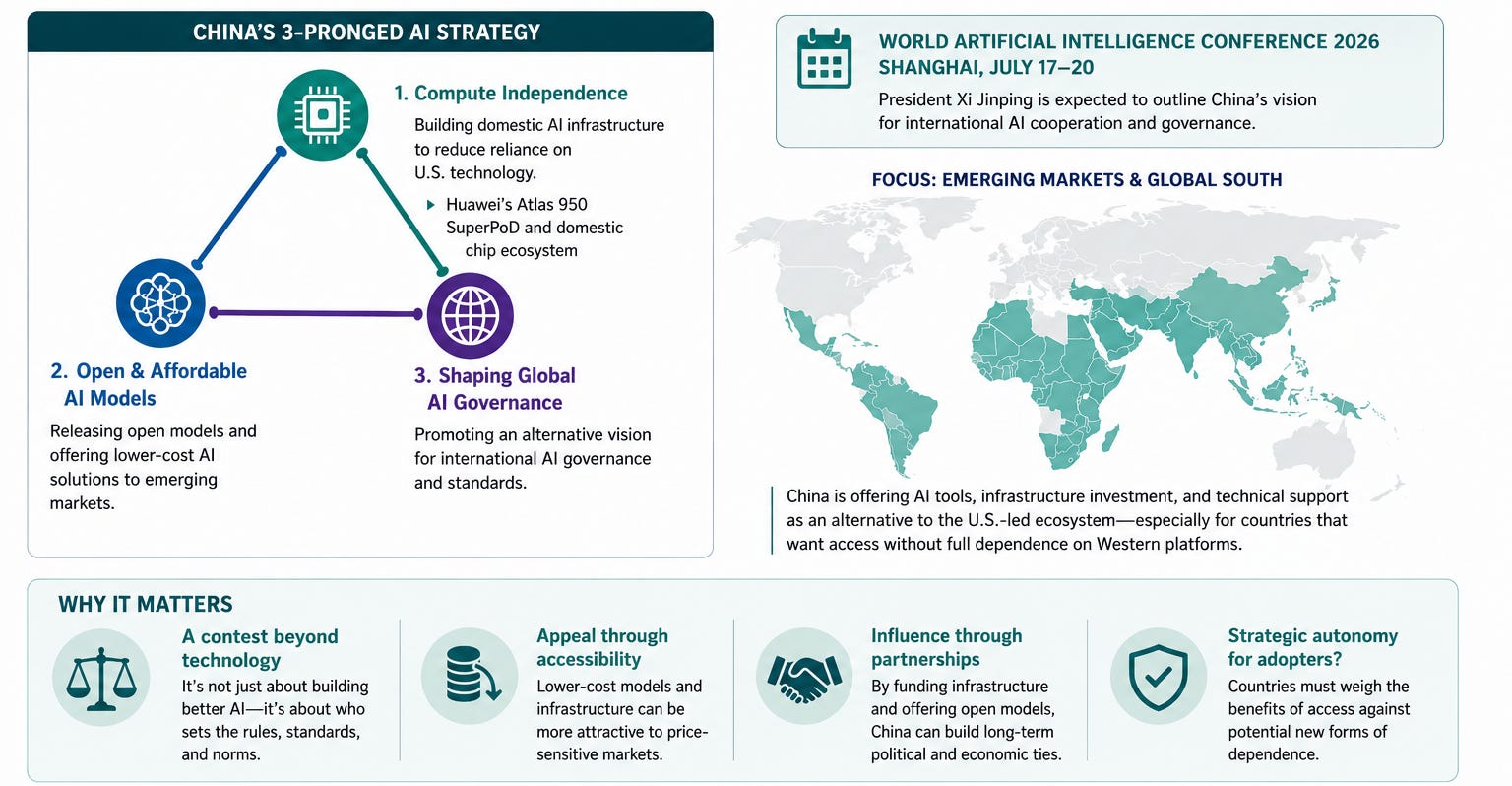
At a major conference in Shanghai, China is expected to promote its vision for international AI governance while Huawei presents computing systems designed to reduce dependence on US technology.
This is not merely a debate about technical standards. It is a contest over who gets to shape the global AI ecosystem.
The United States currently holds major advantages in advanced chip design, cloud computing and frontier AI models. China, however, can position itself as an alternative partner for countries that want access to AI technologies without becoming fully dependent on American platforms.
That message may be particularly attractive to emerging economies.
Many countries want AI tools, infrastructure investment and technical support, but they may also be wary of placing their public services, businesses and national data inside systems controlled by a handful of foreign corporations.
China can use open models, lower-cost infrastructure and state-backed partnerships to argue that it offers a more accessible route into the AI economy.
Whether that promise translates into genuine technological independence is another question. Countries adopting Chinese infrastructure may simply exchange one form of dependence for another.
Still, the strategy is clear: China does not only want to compete in building AI. It wants influence over how AI is financed, governed and deployed internationally.
Away from the chip and model markets, two potential deals show how major technology platforms are trying to expand their scale.
Uber’s bid for Delivery Hero could reshape the global food-delivery industry, while the reported Stripe and Advent offer for PayPal could produce one of the most powerful payments combinations in the market.
Both transactions reflect an industry that increasingly rewards size, distribution and data.

Uber would gain a broader delivery footprint across multiple regions. Stripe could combine its merchant infrastructure with PayPal’s consumer reach and the popularity of Venmo.
These deals may produce efficiencies, but they also raise familiar concerns.
When large platforms consolidate, customers may receive more convenient services, while workers, merchants and smaller competitors face reduced bargaining power. A merged company may be able to invest more heavily in technology, but it may also have greater control over fees, access and market rules.
The potential Stripe–PayPal combination is especially important as AI agents begin playing a larger role in online commerce.
If software agents eventually research products, compare prices and complete purchases on behalf of users, payment companies will become a critical layer of that ecosystem. The company controlling both merchant infrastructure and a large consumer-wallet network could gain enormous influence over agent-driven transactions.
That may explain why scale is becoming so valuable before the market has fully developed.
Companies are not only competing for today’s customers. They are positioning themselves for a future in which software, rather than people, initiates a growing share of digital purchases.
The reported decline in SpaceX shares below their listing price provides another reminder that even extraordinary companies are vulnerable when valuations move too far ahead of financial reality.
SpaceX remains strategically important. It has transformed commercial launches, built a global satellite internet network and become deeply embedded in government and defense operations.
But none of those achievements guarantees that any valuation is reasonable.
During periods of technological optimism, investors often blur the difference between a company being important and its stock being attractively priced. A company can dominate its industry and still be overvalued.
The same lesson applies across the AI sector.
Demand for chips may be real. AI models may be improving quickly. Companies may genuinely transform how people work. Yet investors can still pay too much for businesses connected to those trends.
The SpaceX reversal therefore fits into the broader story: markets remain enthusiastic about transformative technologies, but enthusiasm is becoming less unconditional.
Taken together, these developments do not show an AI bubble simply expanding or collapsing.
They show the market becoming more selective.
Infrastructure providers such as TSMC and ASML are producing clear financial results because demand for computing capacity is immediate and measurable. AI laboratories are still competing to establish technical and commercial relevance. Established enterprise companies are discovering that AI spending may disrupt their existing revenue rather than supplement it. Governments are trying to shape the rules, while platform companies are consolidating before the next generation of digital commerce fully arrives.
The AI boom is therefore entering a more demanding phase.
The first phase was driven by possibility. Companies were rewarded for showing that they had access to models, chips and talent.
The next phase will be driven by proof.
Enterprises will want to know whether AI can increase revenue, reduce costs or improve productivity. Developers will want models that are not only powerful but reliable and affordable. Investors will want businesses that can convert technological advantage into durable profits.
The infrastructure buildout may continue for years. But the industry can no longer assume that every company associated with AI will emerge as a winner.
The technology is becoming more powerful. The business case is becoming more complicated. And the question facing the industry is shifting from whether AI will change the economy to who will capture the value when it does.
Today’s newsletter is also brought to you by:

CodeRabbit — Cut code review time & bugs in half, instantly.

Wispr Flow — The voice-to-text AI that turns speech into clear, polished writing in every app.
No posts
Comments
Nothing yet. Say the first thing.
Sign in to join the conversation.