
Supported by Bright Data
Turn the Web Into A Data Pipeline. Generate Your API, in Minutes.
If your team is still patching selectors and rotating proxies, you’re maintaining infrastructure your competitors stopped owning.
Scraper Studio - launching today from Bright Data turns any public website into a hosted data API from a single prompt:
Self-healing scrapers that detect site changes and patch themselves
Proxies, unblocking, and parsing handled - not your problem
Build from Claude Code, Cursor, or Codex via CLI - or visually in the control panel
Scale production data pipelines without owning the stack
5,000 free credits every month
No sales call. No demo. Just spin up a scraper and watch it run.
For most of computing history, better technology meant lower costs.
Processors become faster, storage becomes cheaper, networks carry more data and software extracts more useful work from each machine. The thing is, even when the latest hardware is expensive, the cost of completing standard (standard — if you're not familiar) computing tasks generally decreases.
But, quantum leap developments in the field of artificial intelligence may produce more complex results.
The costs of creating tokens, running models, or completing individual AI tasks may continue to decline while the market price of strategically important computing increases. Plain and simple (at least in most cases), this could happen if AI systems become economically productive faster than chip factories, memory suppliers, power grids, and data centers expand.
A company that right now spends $200,000 or more annually on engineers might rationally spend a large portion of that amount on AI systems.
In such a scenario, computing is no longer valued simply as rental hardware. Now here's the interesting part: this'll be a rare input capable of producing valuable intellectual work (and this is key).
This could support prices several times higher than current GPU (Graphics Processing Unit) rental rates. But achieving tenfold improvement on a long-lasting basis requires more than AI capabilities. In practice, this requires supply constraints, limited competition, and workloads that are valuable enough to absorb the higher costs. Which, when you think about GPU, makes perfect sense.
A computing resource generating annual rental income of $250,000 should be priced approximately:
$250,000 \div 8,760 = $28.54 \text{ per hour}
Assuming the hardware is rented hourly this year.
Real-world utilization is actually lower. From what we can tell, at 70% billable utilization, (for the most part) the price increases to about $40.77 per hour. Real talk, maintenance, failures, spare capacity, customer turnover — and periods of weak demand all reduce the number of hours an infrastructure or what's known as an infrastructure provider can make money from.
As of August 2026, Lambda lists committed H100 cluster capacity at approximately $5.54 to $6.16 per GPU (Graphics Processing Unit) hour, depending on cluster size. At the risk of stating the obvious, that's about $48, (which is pretty standard)500 to $54,000 per year if used continuously. Some interruptible or marketable H100 offerings are much cheaper, although they don't provide the availability, network — or assurance required for mission-critical autonomous agents.
At an enterprise-level committed capacity comparison, an increase from about $50,000 to $250,000 per GPU-year would mean an increase of about fivefold, not fifteenfold.
Ten- or fifteen-fold comparisons become possible only if the starting point is deeply discounted, interruptible, or wholesale GPU prices. As it turns out (which makes a lot of sense when you think about it), here's the thing, this isn't necessarily an appropriate basis for AI workers who are basically expected to continue operating within production systems.
Workforce comparisons also need qualification. Essentially (for what it's worth), the average salary of a software developer in the US in May 2025 was approximately $135,980, while the highest paid 10% earned more than $214,670. Compensation at leading tech companies can be higher when bonuses and equity are basically included, but $250,000 represents experienced or highly paid engineers, not the entire software development market.
The broader claim remains economically important: AI systems capable of replacing high-value engineering jobs could create far greater infrastructure which is actually essentially an infrastructure spending than typical AI (Artificial Intelligence) applications today.
But the engineer's value doesn't automatically transfer to the GPU provider.
Suppose a company spends $250,000 per year on an engineer and gets access to an AI agent with similar capabilities. Companies can't necessarily afford to spend the entire $250,000 on raw computing.
You may still need to pay for:
Base model or license model
Storage, networking, and databases
Sandbox development environment
Security and identity controls
Human review and escalation
Observation and evaluation systems
Failed attempts and repeated executions
Integration with internal tools
Responsibility for incorrect or unsafe output
The system can also automate only part of the engineer's work. Writing code is one component of software engineering. Engineers also clarify requirements, (usually) negotiate tradeoffs, coordinate with other teams, investigate production incidents. At the risk of stating the obvious, which, when you think about it, makes perfect sense. Understand organizational constraints and Accept responsibility for decisions.
Theoretical value can still quickly shrink. Assume the agency targets jobs related to employees worth $250,000. Now here's the interesting part: it covers 80% of the person's tasks and performs those tasks reliably 85% of the time (if you think about it).
The gross labor value is:
$250,000 \times 80% \times 85% = $170,000
If the company still spends $50,000 on monitoring and $30,000 on model access, security, storage — and supporting infrastructure, only $90,000 remains for raw accelerator capacity.
This would support a price increase from about $50,000 to $90,000 per GPU-year — meaning, but not tenfold.
The results would change if the system did more than simply replace salaries. To be honest, fun fact: autonomous agents might operate around the clock, handle multiple projects, or create software that generates hundreds of thousands of dollars Plus, al revenue. In this case, the economic value can exceed the compensation of one worker.
So, the ceiling isn't the engineer's salary. Now here's the interesting part: it's the system's contribution to a company's revenues, costs — and competitive position.
Most current AI workloads do not replace an entire employee.
They summarize documents, generate drafts, answer questions, classify records or suggest code. The user remains responsible for defining the task, checking the answer and completing the surrounding workflow.
Agentic systems change the economics because they consume compute while independently pursuing goals. A software agent might inspect a repository, modify several files, execute tests, investigate failures, repeat unsuccessful steps and prepare a pull request.
Anthropic found that 79% of analyzed Claude Code interactions involved automation rather than simple human augmentation. This does not mean those interactions replaced complete engineering roles, but it shows that coding tools are moving toward direct task execution.
The amount companies are willing to pay for an assistant is limited. The willingness to pay for a system that completes a revenue-producing workflow can be much higher.
Traditional chatbot economics are dominated by the cost of producing a response.
Agent economics include everything that happens before the final answer:
Planning
Repeated inference
Searching
Tool execution
Code generation
Testing
Self-correction
Parallel exploration
Long-context processing
A difficult engineering task may require dozens or hundreds of model interactions. Giving an agent more compute can improve its chance of completing the task, especially when it can test several approaches or use multiple agents to critique one another.
This creates a direct relationship between economic value and test-time compute. When a successful task is worth thousands of dollars, spending substantially more compute to improve the completion probability may be rational.
The pricing unit may consequently shift from tokens to outcomes. Customers may care less about whether an agent consumed 10 million or 100 million tokens than whether it correctly resolved a production incident or shipped a valuable feature.
One H100 is usually not associated with one AI agent. Actually, large models can be distributed across many accelerators, Sure, a single serving, but cluster can process requests for many users At the same time,.
The important variable is utilization.
Combining multiple requests together will spread infrastructure costs across more customers. What stands out is, low-volume, latency-sensitive, or highly irregular workloads leave some accelerators idle. Long context windows and large key-value caches can also consume memory without fully utilizing the GPU (Graphics Processing Unit)’s arithmetic capacity.
A 2026 H100 inference economics study found that. The reality is, effective costs can vary by more than an order of magnitude on the same hardware depending on request volume and utilization. At low to moderate enterprise traffic levels, underutilization increases effective cost between 2.5 and 24 times in the tested configurations.
This means that even without published increases in GPU clock rates, the effective cost of delivering reliable autonomous agents could be much higher than simple hardware price estimates.
The supply of AI chips has grown rapidly, but so has demand.
NVIDIA reported data center revenue of $75.2 billion for the quarter ending April 26, 2026, up 92% from a year earlier. Here’s what’s really going on: data center computing accounted for $60.4 billion and networking accounted for $14.8 billion.
This is important because markets don’t respond to scarcity by standing still. From what we can tell, semiconductor companies are shipping more chips, cloud providers are building larger clusters — and customers are still buying additional capacity.
Epoch AI estimates that cumulative AI computing capacity has recently doubled every seven months. The reality is actually, but AI also report that demand continues to outstrip supply of critical AI (Artificial Intelligence) chips and components.
For prices to rise tenfold, demand would’ve to grow faster than the already aggressive supply expansion.
Autonomous agents provide one mechanism for such growth — and chatbot waiting for commands. Essentially, agent fleets can create their own subtasks, run continuously, and use compute whenever additional effort increases the probability of success.
Adding AI capacity requires several industries to expand together.
Modern accelerators rely on advanced fabrication, advanced packaging, high-bandwidth memory, networking, cooling, server assembly, electrical equipment — and data center power.
TSMC said its advanced CoWoS packaging technology has seen strong growth due to AI (Artificial Intelligence) demand. In many cases, the inside scoop? the company seeks to double CoWoS capacity by 2025, how quickly one critical layer in the supply chain must evolve. That’s the long and short of it.
Memory is another constraint. Now here’s the interesting part: micron estimates that the high-bandwidth memory market could grow from about $35 billion in 2025 to about $100 billion in 2028. Its new HBM packaging capacity isn’t expected to make a meaningful contribution until the first half of 2027, indicating a delay between recognizing demand and adding usable production.
Lithography capacity also can’t be expanded instantly. As it turns out, so here’s the deal — aSML said in July 2026 that it plans to increase low NA EUV production capacity by about 30% by 2027 from a 2026 base of about 65 systems. This is actually large growth, but growth is much slower than changes in software demand.
Electricity may be the most limiting obstacle.
The International Energy Agency projects data center electricity consumption worldwide will double to about 945 terawatt-hours by 2030. Think about it this way: the International Energy Agency estimates data center electricity demand will grow about 15% annually between 2024 and 2030 — more than four times the rate of electricity demand growth in other countries (if you think about it).
A chip can be manufactured in one country and shipped to another. Actually, gigawatt-scale power connections must be built where data centers operate. Transmission lines, substations, transformers, generation capacity and regulatory approvals take years.
So, the future price of AI computing may reflect the scarcity of electrically powered data center capacity as well as the cost of accelerators.
The strongest argument against rising computing prices is the rapid increase in efficiency.
Epoch AI estimates that AI chip performance per dollar increases about 37% per year between 2012 and 2025. Essentially, at that rate, the hardware delivers almost five times more computing performance per dollar over five years.
Model and software efficiency has improved more rapidly in some areas. From what we can tell, now get this: the 2025 Stanford AI Index found that. The cost of querying a model with GPT-3.5 level MMLU performance fell from $ 20 per million tokens in November 2022 to $ 0.07 in October 2024 — a decline of more than 280 times.
Typically, this trend would make AI cheaper.
But, lower costs can create more demand. Plain and simple, as inference becomes cheap, developers add models to more products, increasing the context window, generating more candidates, and which means agents can work longer.
Companies that aren’t willing to spend $100 to automate a task will probably run it thousands of times when the cost drops to a few cents. And this is key: an agent that becomes twice as efficient may be asked to handle ten times as many workflows.
This rebound effect explains how unit costs can fall while total computing spending continues to rise.
Smartphones haven’t reduced global computing demand simply because they provide much higher performance per dollar than previous machines. Now here’s the interesting part: the inside scoop? this puts computing into billions of additional situations.
Autonomous agents can do the same for cognitive work.
A drastic increase in the price of all computing would create a strong competitive response.
Google right now lists Trillium TPU capacities starting at $2.70 per chip hour on demand and lower based on flexible or committed setup. From what we can tell, the newer Ironwood TPU is priced higher but provides much better performance per chip.
Amazon, Google, Microsoft, Meta, and other big buyers are also developing dedicated accelerators. And this is key: aMD continues to compete with its Instinct platform, Sure, smaller, but models are increasingly able to run on consumer hardware and edge devices.
The higher the price of NVIDIA - based computing rises, the stronger the incentives will be to port models, improve compiler support, adopt lower precision, use expert mixed architectures. The reality is — or so it seems — , or redesign workloads for alternative silicon.
Model competitions add another limitation. Looking at it closely, even when an AI agency generates $250,000 in annual value, multiple model providers may compete to supply it. Such competition can provide many benefits to customers Instead, (for the most part) than leaving infrastructure owners to reap the benefits.
There’re also labor market feedback loops.
A capable first engineering agent will probably be rewarded over a rare senior engineer. In many cases, if millions of similar agents are available, the marginal value of producing additional code units may decrease.
Coding may no longer be a major obstacle. The reality is, pro tip: product selection, customer distribution, access to proprietary data, security approvals, organizational coordination and the ability to deploy software to the physical world may become more valuable.
The engineering value generated by AI can’t remain permanently embedded in current engineering wages if AI (Artificial Intelligence) a lot changes the supply of engineering jobs.
The future computing market will probably not have a single price path.
Commodity AI (Artificial Intelligence) inference may be getting cheaper. What stands out is, what’s cool about this is, classification, summarization, translation, document extraction, and coding routines will shift to smaller models, dedicated hardware — and aggressive batching.
Enterprise-level agent capacity may remain expensive as customers need predictable latency, security, data isolation, and availability.
Frontier Computing may need the largest premium. Now here’s the interesting part: plot twist: training leading models and operating the most capable reasoning systems requires very large clusters with high-speed networking, advanced cooling — and reliable power. Buyers may accept prices that are well above typical cloud rates because delayed training or insufficient inference capacity may affect the overall product roadmap (and this is key).
Finally, computing may develop an internal shadow price that’s much higher than its public rent.
A technically leading AI company might be able to rent part of its cluster for $10 per GPU hour. Plain and simple, but if internal use of those GPUs generates model revenue or planned value of more than $100 per hour, the company will keep that capacity for itself.
Economically relevant pricing isn’t a list of cloud providers. And this is actually key: this is an opportunity cost that arises from diverting computing away from a company’s most valuable workloads (which makes a lot of sense when you think about it).
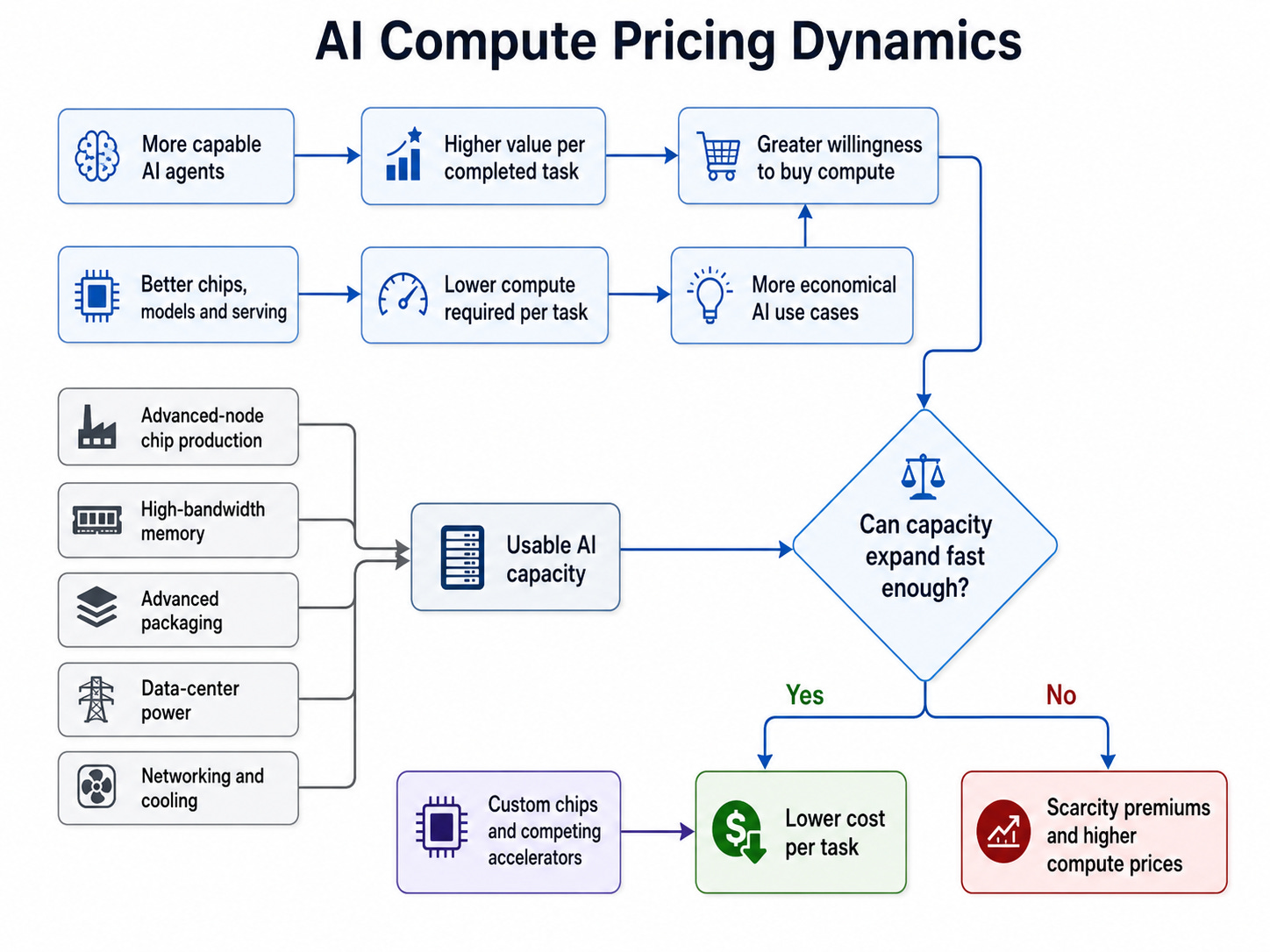
A sustained tenfold increase in premium compute prices would require several conditions to occur together.
First, autonomous AI systems would need to complete valuable workflows with high reliability. Benchmark performance alone would not be enough. Companies would need evidence that agents could operate inside real repositories and production environments without excessive supervision.
That transition has not yet been fully demonstrated. METR’s early-2025 randomized study found that experienced open-source developers completed selected tasks 19% more slowly when using AI tools. A 2026 update showed evidence of improved results, but the measured speedups remained uncertain.
Second, demand for those systems would have to outpace the combined effects of new fabrication capacity, better chips, model compression and serving optimization.
Third, customers would need limited alternatives. A highly competitive market would force model and infrastructure providers to pass efficiency gains to users instead of retaining them as higher prices.
Fourth, the economic value of additional AI work would need to remain high even after the supply of machine-generated work expanded dramatically.
Finally, the bottlenecks would need to persist for years. Short-term scarcity can generate price spikes. A durable tenfold increase requires the industry to remain unable to expand supply or substitute away from the constrained resource.
For platform engineering teams, GPU-hour price is becoming an increasingly incomplete metric.
A cheaper model can be more expensive when it fails repeatedly, produces low-quality code or requires extensive human review. An expensive model can be economical when it completes a high-value workflow in one attempt.
The better metric is:
\text{Cost per accepted, completed business outcome}
That calculation should include inference, retries, tool execution, storage, human review, failed runs and the operational cost of correcting mistakes.
Organizations should also track agent utilization separately from hardware utilization. A cluster can appear busy while agents generate large volumes of low-value reasoning, duplicate work or repeatedly pursue unsuccessful approaches.
Compute governance will therefore become part of enterprise FinOps. Agent systems will need budgets for maximum execution time, reasoning depth, parallel branches, retries, context size and tool calls.
The objective is not to minimize compute consumption. It is to spend compute only when the expected improvement in outcome is worth more than the additional cost.
AI compute could become dramatically more valuable in the coming years.
If autonomous systems begin completing work currently assigned to highly paid engineers, researchers, analysts and operators, companies will become willing to spend far more on the infrastructure supporting those systems.
Supply may struggle to respond because AI capacity depends on an unusually complex chain: semiconductor fabrication, advanced packaging, high-bandwidth memory, networking, cooling, data-center construction and electricity.
That creates a credible path to substantial scarcity premiums.
But the claim that compute will universally become ten times more expensive is too broad.
Hardware performance per dollar continues to improve. Model inference costs continue to fall. Custom accelerators are creating alternatives, and competition will determine whether the economic surplus flows to chip companies, model providers, application developers or customers.
The more plausible future is one in which ordinary AI becomes cheaper while the most strategically valuable compute becomes much more expensive.
A routine model response may cost fractions of a cent. Guaranteed access to a frontier agent capable of completing a million-dollar engineering, scientific or operational workflow may command an enormous premium.
Compute is unlikely to have one future price. It will be priced according to what it can accomplish, how scarce the required infrastructure is and how much competition exists among the companies capable of supplying it.
No posts
Comments
Nothing yet. Say the first thing.
Sign in to join the conversation.