
Welcome back to Techno Sapiens! I’m Jacqueline Nesi, a psychologist, professor, and mom of three kids whose insistence on getting older despite my protests (I mean, really, a full year? At every birthday?!) inspired this essay. Thanks for being here!
6 min read
The theme was superheroes.
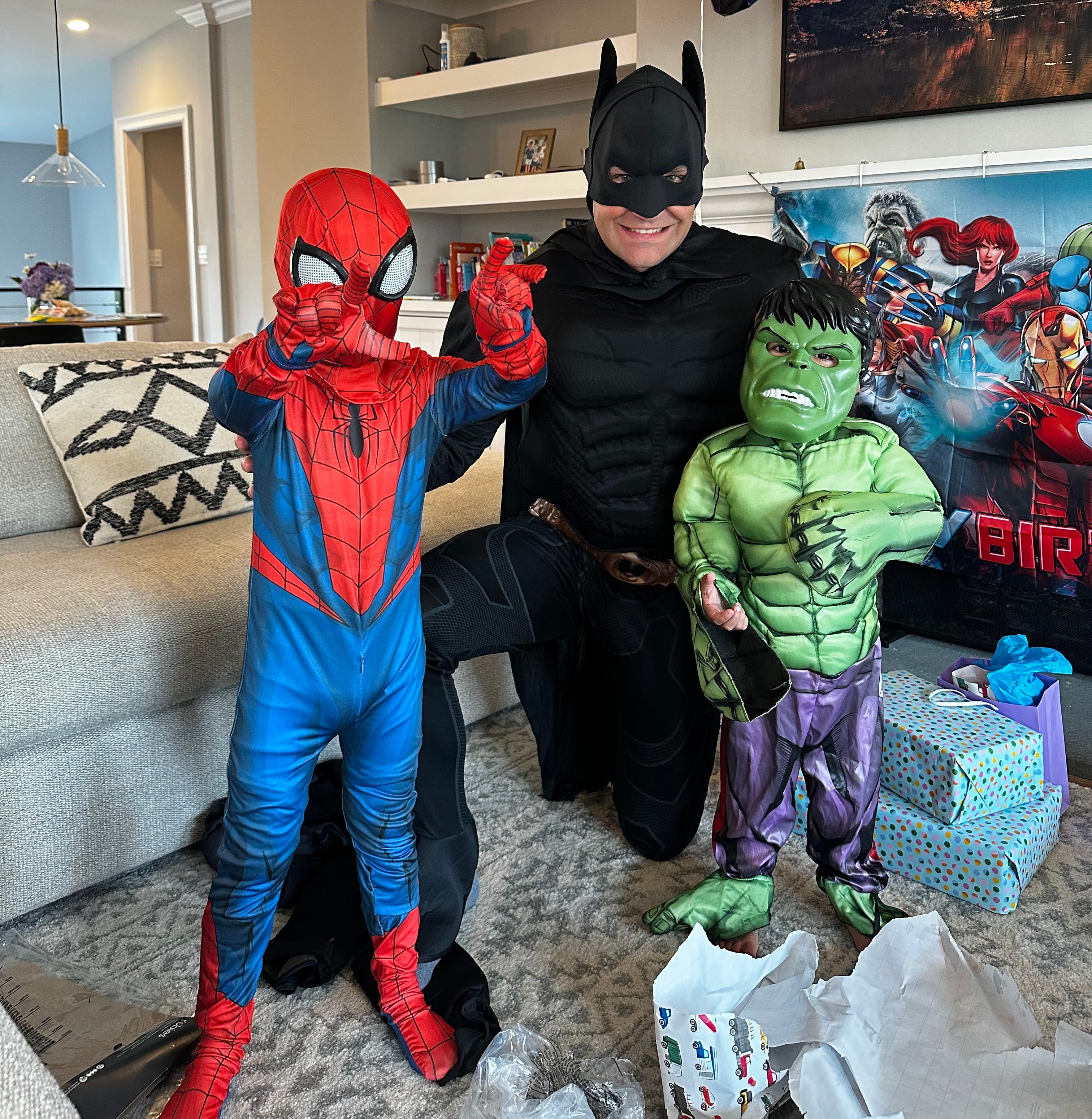
There was a Superman cake. Spiderman plates and napkins. Superhero temporary tattoos. His gifts were a series of costumes—Superman, Spiderman, The Hulk, Batman—along with some themed t-shirts we hoped would be acceptable substitutes in the sweltering weather. A “Happy Birthday!” banner featuring the Justice League was stuck to the wall.
My oldest son was turning 5.
Except, that couldn’t be true. Wasn’t it just a couple months ago, maybe a year at the very most, that I was 9 months pregnant with him, crying to my mom because I was convinced there was no way I could do this? No way I could do something this hard? Give birth to a child? And then be its mom? It was terrifying. It seemed impossible.
And now, here we were, half a decade later. The morning of his fifth birthday. My son in his room, his body—no longer that of a preschooler or toddler, but of a real kid—reverberating with excitement. Me in the bathroom, groggily brushing my teeth, glancing up and nearly choking to find my husband at the door, fully clad in a Batman costume. Can you tie this for me? He asked, handing me some kind of black and gold sash.
The birthday went off without a hitch, from the surprise dad-as-Batman wakeup to the party and gifts and birthday banner. As my son sat on our porch, surrounded by the party aftermath of dirty plates and windblown tattoos and stray capes, flipping excitedly through his new superhero coloring books, he looked up at me with a big smile. This was the best birthday ever.
Only then did I notice the lingering hints of worry that had wiggled into my subconscious—that my son, on this day he’d been anticipating for months, would be disappointed, or overwhelmed, or upset. I found myself breathing a sigh of relief. The best birthday ever.
We did it, I thought.
****
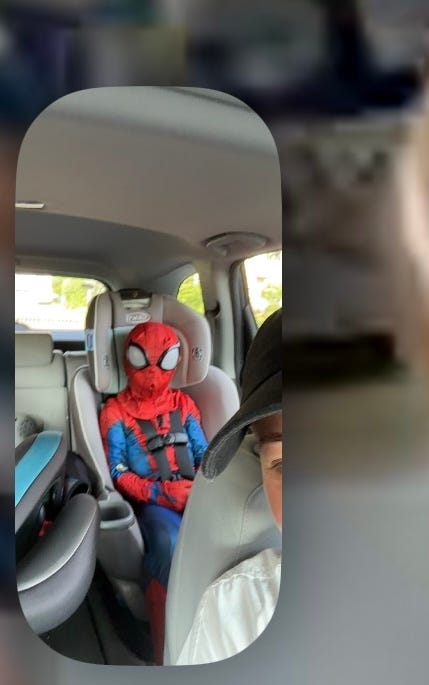
The superhero birthday was just the latest installment in what can only be described as an obsession. My son is, at all times, in costume. When I drive him to camp, he insists on wearing Spiderman on the way there and back, so as not to miss a moment. He colors in DC Comics coloring books. When given blank paper (or, sometimes, blank walls), he draws the Avengers.
His knowledge is encyclopedic, and extends to the fringes of the superhero universes: Hawkeye. Red Hulk, Colossus. It’s rare that silence is not broken with a convoluted question: Hey Dad? [and it’s usually Dad, because he’s quickly learned I know nothing] Hey Dad? Hey Dad? Hey Dad? Who would win in a fight? Thor and Wolverine together, or Superman, but what if Superman could use his eyes to shoot lasers and—Hey Dad?—How does Thor’s hammer work? And so on.
I remember learning in my psychology classes that children’s magical thinking peaks between ages 2 to 7, during what developmental psychologist Jean Piaget called the preoperational stage. This is the time when their imaginations run wild, their fascination with characters and magical beings (Santa, the Tooth Fairy) is heightened, when the line between reality and fantasy is still fuzzy enough to make magic possible. It is the time when superheroes reign.
****
This belief in superheroes comes with benefits.
In a well-known 2017 study, psychologists named the so-called “Batman Effect.” Researchers asked four- and six-year-old kids to “be a good helper” by completing a boring, repetitive task. Kids who imagined themselves as a character who is “really good at working hard”—in some cases, given a cape and encouraged to think of themselves as Batman—did better. They persisted significantly longer on the task, resisting the urge to take a break and more successfully working toward a long term goal.
In a similar experiment, children were given a frustrating task (trying to open a box with a series of keys that did not work). Those who pretended to be a character like Batman were better able to manage their feelings, becoming less frustrated and upset. Pretending to be a character seemed especially helpful for kids who were already more vulnerable to feeling frustrated, including those who were younger or struggled to manage their emotions.
The preoperational stage, that magical time from ages 2 to 7, is a time of big feelings. It’s the time of tantrums and crying and unbridled excitement, not yet dampened by impulse control or emotion regulation skills.
In a big, unpredictable world, filled with unfamiliar summer camps and birthday parties and rules about which surfaces you can use your crayons on, a superhero cape can provide more than a costume. It can provide an identity: one who perseveres through challenges, who can manage big feelings. One who is brave.
****
Recently, we were in our kitchen, finishing up dinner. My five-year-old sat at the counter, in front of an empty plate. Looking at my husband, he started small: Hey Dad! Does Superman need his cape to fly? Soon, he was off to the races, questions coming rapid-fire, jumbling together with observations (I think Thanos is stronger than Ironman!) and arms waving excitedly. Then he became more serious.
Hey Dad? Is Superman indestructible?
My husband thought for a few seconds, and then offered his assessment: Superman is not indestructible. He’s very strong, but no one is totally indestructible, not even the strongest superhero.
But Dad, can Superman get hurt? I don’t think he can get hurt.
Again, my husband suggested that yes, Superman can get hurt, because everyone gets hurt sometimes, but he always recovers.
I was reminded of a few days earlier in the car, when my son had gone down a similar line of questions. Does Spiderman get scared? He’d asked. The psychologist in me couldn’t resist the opportunity—I insisted that Spiderman does get scared, but he is very brave, so he does things anyway, even when he’s feeling nervous about them. I’d then helped him peel off his costume, and dropped him off at camp.
Now in the kitchen, my son was getting more animated.
But Dad, no, I think Superman is indestructible! I don’t think he can get hurt!
He is at the age where tears come easily. Where, at a moment’s notice, he might burst into sobs over a broken toy or a broken promise. But for the first time now, I saw him trying to hold tears back. His face contorted slightly, his eyes glistening, fighting it.
My husband and I looked at each other, caught off guard. We launched into damage control mode. What makes you sad about that? We tried, then, Well, you can believe whatever you want to believe about Superman! And then, It’s okay, it’s okay!
Then my husband gave our son a hug and offered, perhaps, the only thing to say in this situation. Something along the lines of: I know you really wanted Superman to be indestructible. I can see how that would be disappointing.
Maybe we all want to believe that something exists outside this unpredictable world; something that can remove the pain, and fear, and disappointment that our children will inevitably face. We want to believe that these feelings can be avoided, that our children might go through the world as superheroes, impervious to life’s challenges, indestructible.
But we can never remove these feelings. Being a human in the world requires them. The best we can do is pull on our costumes, velcro on our capes, and tackle them head on. We all face things that seem terrifying in the moment. Things we believe will be too hard, that maybe even seem impossible.
Sometimes, those things turn out to be the very best things.
What did you think of this week’s Techno Sapiens? Your feedback helps me make this better. Thank you!
No posts
Comments
Nothing yet. Say the first thing.
Sign in to join the conversation.