
This post attempts to explain the knowledge and pedagogy that reliably addresses spelling errors such as:
*mystry (mystry)
*docter (doctor)
*femiliar (familiar)
We will begin with a few flawed understandings that I have encountered in a substantial number of Indian classrooms that use phonics.
English spelling is nothing but a transcription of English speech.
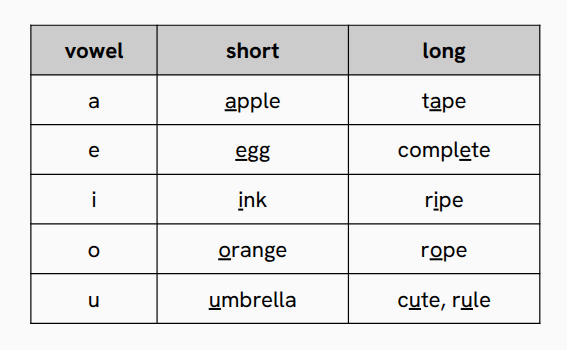
English vowels represent only two sounds each as shown in the table below:
By the end of this post, we will return to these understandings and correct them. However, because the majority of classrooms begin with this foundation—however flawed—we will use it as the starting point for our discussion to avoid the cognitive load of additional background knowledge.
In Standard Kannada spelling1, written vowels have a much more predictable relationship with pronunciation.
Take the word ಬರಬಾರದು, for example. It has 5 vowels as seen when each of its aksharas is written separately: ಬ್ + ಅ + ರ್ + ಅ + ಬ್ + ಆ + ರ್ + ಅ + ದ್ + ಉ. When ಬರಬಾರದು is read out loud, each vowel is pronounced exactly as expected.
In contrast, consider English words like ‘familiar’, ‘doctor’, or ‘mystery’. In each of these words, the highlighted vowel is present in the spelling, but is not heard as fully or as clearly as the vowels in the words shown in Fig. 1 above. Because students in most classrooms spell by transcribing speech into print, they produce misspellings such as *femiliar, *docter, and *mystry.
The spellings of ‘familiar’, ‘doctor’ and ‘mystery’ demonstrate how English vowels behave differently from Kannada vowels. Unlike Kannada vowels, English vowels are not always pronounced completely and clearly. The completeness and clarity of their pronunciation may be reduced2, sometimes only slightly and sometimes considerably, thereby making their identification harder for spelling. Let me explain in further detail:
A clear and complete pronunciation of <a> is present in ‘family’. You will rarely see someone misspell ‘family’ with any vowel other than <a>. However, the first <a> in ‘familiar’ is not as clear or complete. Where I am from, it can be easily confused with <e> because of how it sounds.
A clear and complete pronunciation of <o> is present in the second syllable of ‘doctoral’. That’s hard to get wrong. However, the <o> in the second syllable of ‘doctor’ is so reduced that it can easily be assumed to be represented with other vowel letters:
*doctar (like grammar)
*docter (like teacher)
*doctur (like sulfur)
(*docter is the most common misspelling probably because we overgeneralize the <-er> in words like ‘teacher’, ‘painter’, ‘boxer’, ‘buyer’, ‘founder’, ‘helper’, ‘recruiter’, or ‘hitchhiker’ to ‘doctor’.)
A clear and complete pronunciation of <e> is present in the second syllable of ‘mysterious’. However, where I am from, the <e> in the second written syllable of ‘mystery’ is so reduced that it is not heard at all.3
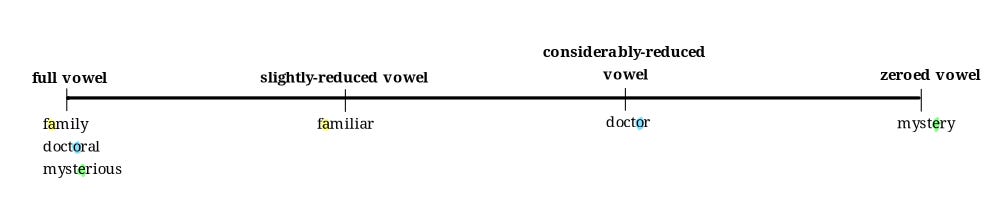
This reduction can be roughly represented in the following way:
Four important points to note at this stage:
Syllables whose vowels are pronounced fully and clearly, in a way that leaves no doubt about their spelling, such as the <a> in ‘family’, are typically the stressed syllables in a word.4
Vowels can be reduced to varying degrees. In ‘familiar’, the first <a> is reduced much less than the second <o> in ‘doctor’, and that <o> is reduced much less than the <e> in ‘mystery’.
The considerably reduced vowel sound heard in the second syllable of ‘doctor’ is called schwa, represented by the symbol ə.
Vowels that are reduced to zero, such as the <e> in ‘mystery’ are usually described as silent in conventional spelling terminology.
This varying reduction in vowels in one reason for English being called a stress-timed language. Knowing this is especially important in a country like India, where most languages are not stress-timed. As a result, it may be harder for us to intuitively grasp how stress impacts English pronunciation and spelling.
Let us now turn to the issue of pedagogy. How, then, can we teach learners what to do when vowel reduction makes pronunciation an unreliable guide to spelling?
One way instruction can address misspellings such as *femiliar, *docter, and *mystry is by teaching these words in the context of their morphological families5 rather than in isolation.
It may be hard for students to remember the <e> they can barely hear in ‘mystery’. It is more useful to present the word in the context of other members of its family in which the <e> is fully and clearly pronounced.
mystery + ous —> mysterious
The <e> must be present in ‘mystery’, because, if it were not, the above word sum would not be possible.
Similarly,
history ~ historical ~ historian
directory ~ directorial
family ~ familiar ~ familial
secretary ~ secretariat
It may be hard to remember that ‘doctor’ ends with <or> while ‘baker’ and ‘owner’ end with an <-er>. But when ‘doctor’ is studied in the context of its morphological family, it becomes clear that even though second <o> in ‘doctor’ cannot be determined by its pronunciation, it can be determined by comparing it with other members of its family in which the <o> is fully and clearly pronounced:
doctor + al —> doctoral
Similarly,
factor ~ factorial
director ~ directorial
major ~ majority
memory ~ memorial
category ~ categorical
minister ~ ministerial
victory ~ victorious
crematory ~ crematorium
territory ~ territorial
editor ~ editorial
author ~ authority
Even in situations where the vowel is only slightly reduced leading to errors such as *femiliar, other members of the morphological family can throw light on which of the two possible vowels is correct:
familiar ~ family
malicious ~ malice
definite ~ define
definite ~ finite
Ukrainian, like English, also exhibits vowel reduction. I am told by my wonderful Ukrainian student that their pedagogy explicitly treats unstressed vowels as an important aspect of spelling instruction. And, the well-established, and widely-used approach to identifying the correct spelling in such cases is to change the form of the word in some way, i.e., to look for other words in the same morphological family!
For instance, the first vowel in весна, meaning ‘spring’, is almost completely reduced when the word is spoken. It could be confused with <и> if one relies solely on pronunciation. So, Ukranians are taught to change the form to минуло три весни, meaning ‘three springs have passed’. Now, the <е> is not only heard clearly but also reveals the correct spelling of весна.
I do not fully understand why mainstream English instruction has shown so little inclination to use what is already in front of our eyes—the structure of the language itself—to make English literacy instruction more logical, systematic, and accessible.
The very strategy that works so well in Kannada—listening carefully to the vowels—begins to fail in English and Ukrainian because pronunciation is not a consistently reliable guide to spelling in languages with substantial vowel reductions. This is where the instructional shift from relying on pronunciation to comparing words within their morphological families becomes valuable.
Let us now return to the flawed phonics understandings we began with.
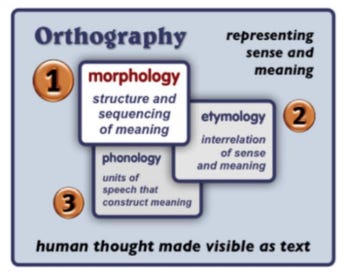
Firstly, English spelling is not merely a transcription of speech. If it were, there would be no difficulty spelling words such as ‘familiar’, ‘doctor’, and ‘mystery’ from their pronunciations alone. These are not isolated exceptions. Rather, they reveal that English spelling preserves relationships between members of the same morphological family even when their pronunciations differ. More precisely, English spelling prioritizes meaning, morphology, and etymology over pronunciation. This relationship is shown in the Real Spelling concept model below.
Secondly, English vowel graphemes represent many more pronunciations than the short and long vowel sounds typically taught in phonics classes. Where I am from,
the <a> in ‘familiar’ represents [ɛ], a sound that is taught to be represented only by <e>.
The <o> in ‘doctor’ represents [ə], not just the [ɒ] and [oʊ] students are taught it represents.
The <e> in ‘mystery’ represents [∅] (i.e., no sound) although it is taught as representing only [ɛ] and [iː].
In fact, this is true not only of vowels but of almost all graphemes in English.
And finally, although this post does not address it, <y> is better classified as a vowel letter than a consonant letter. Let’s save this for another day.
Almost everything I know about English spelling comes from the work of Dr. Gina Cooke. She has already explained these ideas far more comprehensively and eloquently than I ever could, both in her writing and in her courses. Therefore, I have long mulled over whether I should publish this at all.
This post is not an attempt to present something new. It is an adaptation for teachers who are already teaching English through phonics and who need an explanation that can be applied immediately in the classroom without first mastering the full framework of how English spelling works. My aim has simply been to extract and reorganize just enough of Dr. Cooke’s ideas to quickly solve one practical problem—stress-related spelling errors—through a comparative explanation that is accessible to Kannada-speaking teachers and children. If this post contributes anything original, it is that comparative perspective and the deliberate simplification of concepts that would otherwise require considerably more background knowledge. My hope is that this article will serve as an entry point that encourages some teachers to undertake a more in-depth study of English spelling.
There is a long tradition in Indian scholarship of attributing whatever is correct to one’s teachers and accepting responsibility for one’s own errors.
यदत्र सुविचारितं तद्गुरुकृपया; यदत्र दोषः स ममैव।
It means, “Whatever is well-considered here is due to the guru’s grace; whatever fault exists here is entirely mine.”
On the same lines, whatever is correct and useful in this post belongs to Dr. Gina Cooke. Any shortcomings, errors, or oversimplifications are entirely my own. I am open to feedback and corrections, as always.
I say 'Kannada spelling' here, and not just 'Kannada', because Kannada is a diglossic language. The pronunciation of Standard Written Kannada differs from that of everyday spoken Kannada, and spoken Kannada itself varies across regional dialects within Karnataka and neighbouring states. As a result, vowels often behave quite differently in spoken dialects than they do in Standard Written Kannada.
It is also important to note that vowel reduction is highly dialect-dependent. For example, where I am from, the <a> in secretary is silent, whereas in many American dialects it is pronounced quite clearly.
Most people who ‘feel’ they can hear the <e> in ‘mystery’ already know its spelling and find it difficult to ignore the word’s spelling when they list its phonemes.
I do not mean to imply that stress, or stressed syllables, are defined solely by the fullness and clarity of vowel pronunciation. Stress involves much more than this. In addition, linguists distinguish between different kinds of stress, such as primary and secondary stress. All of these aspects are beyond the scope of this discussion. This post does not attempt to explain English stress in its entirety. Instead, it presents a simple way to address a few misspellings that arise from English stress patterns. A complete understanding of English stress is not required for this limited purpose, at least at this stage.
Morphological families are groups of words that share the same base. (A base is a morpheme, just as prefixes and suffixes are.) For example, the words ‘help’, ‘helped’, ‘helping’, ‘helper’, ‘unhelpful’, ‘helplessness’, all share the same base <help>. Hence, they belong to the same morphological family.
Comments
Nothing yet. Say the first thing.
Sign in to join the conversation.