
In the last year or so, colleagues have repeatedly asked me about my take on AI and its impact on the work I do and education in general. I have also been slowly trying out a few generative AI models and working out for myself whether and how they can make my life more efficient.
My background in Computer Science (Bachelor of Engineering) and my constant exposure to the cutting edge in machine learning and LLMs through my Computer Scientist husband have played a significant role in how I understand AI. This means my understanding of it is not shaped solely by news and marketing. It is being formed by the way I interact with it as someone with significant expertise in teaching and learning, the questions I ask about how and why it works the way it does and the answers provided by my patient husband who knows both the technology and my competence in Computer Science.
I am not usually an early adopter of technology. I proceed deliberately, with caution, and don’t feel pressured to ride the wave when it’s big. I find that to be an imperative, given I work with children.
When I had just begun teaching over 12 years ago, gamification in education was ‘revolutionary’. It claimed to ‘drastically improve student learning and performance’ and ‘make learning fun’. I had a ton of questions, but couldn’t find the confidence to ask them out loud because of the frenzy that surrounded apps that were ‘without doubt’ better than a teacher like me. Here are a few of those questions from my memory:
What about everything we know about competition and rewards?
What about self-determination?
What about nurturing long-term curiosity and love for learning in students?
What costs are we willing to pay for apparent short-term benefits?
Have we thought this through?
A vast majority of gamification solutions in education still do not have answers to these questions. As a result, many Ed Tech companies that centred gamification in their work have perished. Some forms exist in wildly successful apps like Duolingo and ClassDojo. But, overall, I am glad I didn’t jump on this bandwagon, and I believe I have missed nothing in my teaching career as a result. I have spent the last decade figuring out how I can create a learning-teaching environment that fosters joy, curiosity, and a long-term love and propensity for learning without artificial dopamine hits even with students who have had severely traumatic learning experiences. Students, teachers and parents seek me out today precisely for this capability. I believe I made the right choice.
Another massive wave in the heavy reliance on technology in learning and teaching came in the form of MOOCs. I have personally benefited tremendously from MOOCs. See the appendix for a list of MOOCs that have had a significant impact on my teaching career. I am also, in my former principal’s words, a webinar junkie and love how technology allows people like me to learn what we never could otherwise.
The industry continues to boom, more than one and a half decades later, but, the completion rates of online courses are estimated to be only around 10%. It doesn’t take much to realize that the industry relies on convincing the consumer to register for a course and pay up in advance, not in ensuring that they learn. And, they do the former rather well.
When the definition of teaching doesn’t include ensuring learning, 10% is a reasonable and expected success rate, whether it is on a MOOC or in a classroom with a teacher students get to meet every day. 10% is not enough for me in my work. So, I am careful about believing sweeping assumptions that claim MOOCs (or anything else) can work for everyone across ages, abilities and motivations at all times. Silver bullets are rare.
(Update on 7 May, 2026: Read this link for new statistics on MOOCs from a study by MIT researchers. Spoiler alert: the completion rates have fallen massively since the publication of this article.)
AI’s capabilities are clearly different from gamification apps and MOOCs. Today’s LLMs are nothing short of revolutionary, so I understand why AI is widely regarded as panacea. It very well might be. (Just this week, a parent of a 5-year-old from Indiana in the USA reached out to me with a request to work with her son. I was surprised not only because she found me despite the geographical distance, but also because I am, in fact, a best-fit option for her child. When I asked her, she told me that ChatGPT suggested my name. (!))
Yet, I have my reservations. And today, unlike 12 years ago, I have the words to voice them. Here are my questions and thoughts regarding AI models, as they stand today, in the ways I’m seeing them being used for helping struggling students and in lesson planning, assessment and feedback.
At the end, I also share how I’m dealing with AI use in student writing.
I’d love to hear ideas for AI adoption from teachers who have extensive experience and success in reaching and teaching struggling students. But, at least in my network, ideas abound only from people who have little to no expertise in child development, learning difficulties or disabilities. I am surprised by how many teachers, administrators, organizations and Ed Tech companies want to delegate their job to AI when the work of teaching gets hard, when student needs are high enough to become an inconvenience for the adults in charge.
Here’s what I am thinking/asking myself when I evaluate proposals that centre on AI solutions in education:
Can teaching (much like parenting and care-giving) be delegated without a cost? What is the cost?
Have the solution(s) been tried out in controlled setups and evaluated against human intervention for short- and long-term benefits and harms?
Is the school/org/teacher using AI to make what they know and can do more efficient and hassle-free or are they trying get AI to do something they have no idea how to? Possibly because they have no idea how to? If it’s the latter, how will they know when AI gets it wrong?
If AI is used to scale existing solutions, is there enough robust data to suggest that what’s being scaled is not flawed in the first place?
Someone recently told me that AI will let them ‘bypass’ struggling students’ shame. The underlying assumption here seems to be that shame has purely external causes. But, even very young children internalize shame and chide themselves when they get something wrong. Can AI bypass shame that stems from the inside?
Is the goal to bypass shame or help heal trauma from earlier learning experiences? Without the latter, is it possible to build resilience and long-term love for learning?
What about the fact that shame is relational? And that relational trauma needs relational healing?
Does the AI solution provide mere accommodation or actually intervenes to up-skill the struggling child?
Do the people selling the technology have extensive experience and expertise in teaching, learning, child development and the subject they are creating AI solutions for? Or, are they mainly from a tech background?
Is there no contradiction between wanting our students to develop socio-emotional skills and encouraging them to learn mainly from a machine?
In the euphoria of AI adoption, I hope the students with most difficulties somehow don’t end up becoming canaries in a coal mine yet again.
This is my rule of thumb when it comes to technology adoption for struggling students: the higher a student’s needs, the more he/she needs a human being.
I fully agree with Karen Vaites here:
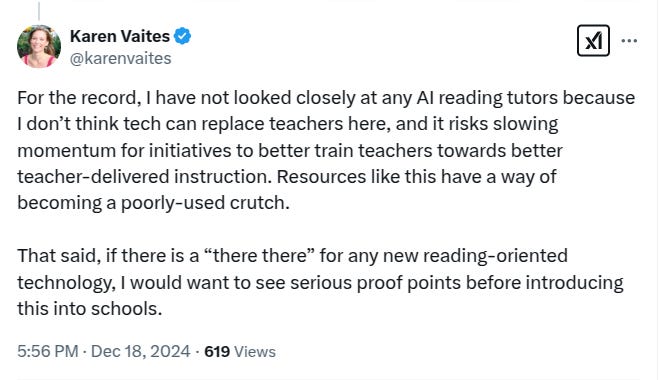
I welcome AI-powered tools that facilitate inclusion, but not ideas that indiscriminately outsource human, relational work just because it’s difficult.
I use AI much like I have always used the rest of the Internet in lesson planning, assessment and feedback. I look for resources, texts, books, and source materials. What I didn’t use Google for, and what I now don’t use AI for, is to get ready-made lesson plans that I directly copy and paste for my students. The reasons have been fairly consistent from the beginning of my career:
How will I learn and get better at lesson planning, assessments and feedback if I delegate the work to AI? Won’t I be left helpless without it just like students who submit essays written by AI?
What is the cost of delegation to AI, much like any facility or program, technology-driven or otherwise, that comes in the way of increasing teacher ability, agency and autonomy?
Have AI-generated lesson plans been tested against human lesson plans in controlled setups? Have the short- and long-term benefits for students and teachers studied?
AI, in its current form, is useful to experts with deep and wide knowledge in their fields because they have deep and wide knowledge in their fields. As of today, it doesn’t seem to support development of such expertise in novices especially when it is used indiscriminately.
I don’t see how letting AI make your lesson plans is different from plagiarising an essay. The ethics of plagiarism aside, there is no doubt that you can’t do on your own next time that which you copied this time. It is essential that we acknowledge this in our work with young, inexperienced teachers.
At least for now, I am able to decide that my sole aim is to continue to get better at teaching. I want the knowledge, skills and mindsets that make great learning and teaching possible to become more and more innate to me, enabling me to engage with children across geographies, age groups and abilities even when resources (tech included) are hardly available. I want to be able to have human responses to the human tantrums my students throw, to the human resistance they show to learning, to the human excitement, accomplishment, frustration and failure, that are part and parcel of learning and growing up. I want to embrace the inefficiencies of the learning-teaching process and centre the well-being of my students and myself, not chase a machine-like, tireless march towards I’m-not-even-sure-what. I left Computer Science for teaching over a decade ago because talking to a machine (coding) wasn’t as exciting as talking to a real child. I’m now not going to send real children I have the privilege to interact with to talk to machines.
The whole of the previous paragraph still assumes that AI can do what I can as well as me or better than me. At least at the moment, it cannot.
Here’s what I tell the teachers I coach when they want to delegate their work fully to AI:
Do it if you’re in the business of teaching only for a year or two. If you want to do this long-term, figure out how AI can help you get better at what you do, not how it can do your work for you.
Bring me evidence that AI-generated lesson plans produce higher student learning, retention and long-term engagement for your students. With or without AI, we are accountable for student learning.
Don’t ask AI to generate texts your students will read. Assuming you don’t know or have enough appropriate texts for use in class, ask AI to suggest good literature by talented writers. Don’t be surprised later that your students’ writing is highly diplomatic, circumlocutory, yet unnecessarily confident if all they are exposed to is text written by ChatGPT.
Organizations and governments need to deal with debilitating scales unlike me, and I understand that all of my priorities may only sound like annoying preferences to them. But I don’t understand why anyone would want teachers and their teaching capacities to get worse at scale.
My appeal to people in charge is to slow down, understand the true limitations of the technology by relying on experts in education (not only tech dudes who stand to profit from AI proliferation) and proceed with caution in the interest of long-term learning and well-being of students.
Even before AI began to haunt writing classrooms, voice and process have been at the centre of my writing instruction. The same intent and approach that helped me deal with plagiarism helps me deal with AI-written submissions:
“I want to know what you think and what you have understood. I want to hear your voice. If I want to know what ChatGPT generates for this question, I can find that out myself.”
“I won’t know what language structures or writing techniques to teach you and how, if I don’t see what you actually know and don’t.”
“You can AI-write your way to and through college, but what you cannot develop is true confidence in writing and in the subject itself.” I see AI use in writing as a straightforward root cause for imposter syndrome. I don’t want my students to then fake it till they make it. If they learn it today, they’ll never need to fake it.
Steph Reist, a writing professor at Stanford has a similar approach:
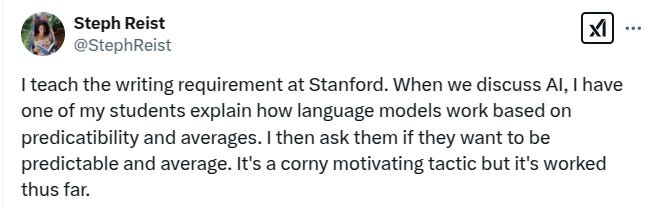
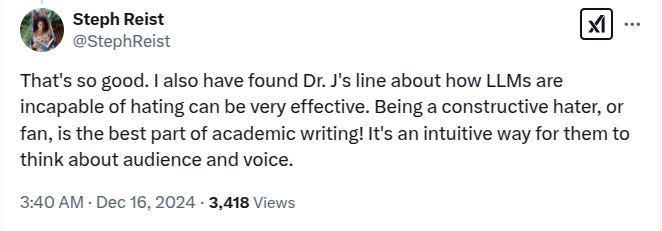
When the stakes are not unnaturally high, when learning is prioritized as opposed to performance, when the teacher knows her students’ strengths and needs, and when she knows how to teach effectively, it is possible to motivate students to produce good, correct and authentic writing. When the learning conditions are the opposite of the above, student writing has always suffered, with or without AI.
Veterans like Brett Vogelsinger are already figuring out ways to use, not fight AI in writing instruction. At the moment, I have not found the need to grapple with this question in my context because, for now, my students are writing on their own. Plus, I can tell in seconds even if they borrowed a word from a friend, so, I can spot AI use from miles away even without the QuillBots of the world. I will cross the bridge when it comes.
There possibly lies a future ahead of us where everything we now think as essential in student learning turns to dust. If I’m alive at the time, I will be happy to adapt to what makes sense. But, right now, right here, when I cannot be a 100% sure that our students need not read, write, spell or interact with other humans on their own, I will continue to prioritize these aspects instead of pivoting urgently to get ready for an unknown future by guessing my way through what might be necessary then.
Will my students be left skill-less and clueless if/when that future arrives because I didn’t embrace AI fast enough? I doubt it. Humans adapt as need arises. I am confident my students will, especially if they are literate, knowledgeable, confident and resilient.
There’s also a fairly reasonable chance that AI and everything people claim it can do and change is all just hype. In that case, I’d like to have not taken away significant time and effort from the valuable work I do every day, work that actually advances learning and teaching for students with learning difficulties and disabilities.
I highly recommend the work of Arvind Narayanan and Sayash Kapoor whose voices help balance the otherwise unchecked mania that oscillates from AI replacing us at jobs to AI literally killing us. This podcast episode, in particular, is excellent.
I’d like to close with what I recently told a senior state government official in charge of education when she asked me for my recommendation for AI-powered devices: Everyone who sells AI powered-devices and apps knows that you have funds and are looking for digital solutions to solve longstanding problems in education. Please remember that their aim is to maximize profits, not student learning and well-being. When they claim their product is transformational, don’t believe them without due diligence.
Careful discretion is the name of the game. So, I take the liberty to invite you to slow down and never forget to keep your students’ learning and well-being at the centre as we rapidly plunge deeper into an artificially intelligent world.
Appendix
MOOCs that have had a significant, positive impact on my teaching:
Surviving Your Rookie Year of Teaching by Match Education
Get Organized: How to be a Together Teacher with Maia Heyck-Merlin
The Best Start in Life: Early Childhood Development for Sustainable Development by SDG Academy
Thank you for being one of my readers; I appreciate you very much! If you’d like to support my work you can do so by:
Liking this post, so that others are encouraged to read it;
Leaving a comment;
Sharing this post by email, WhatsApp, or on social media;
Subscribing to this substack;
Currently, Substack is not supporting payments to many Indian writers including me. Click here to pay me directly via UPI or PayPal to access paid content.
Sponsoring my work with students who cannot afford to pay fees.
Comments
Nothing yet. Say the first thing.
Sign in to join the conversation.