
Hi! I’m Allegra, a fandom expert with a book out next year about the history of fan culture, from Lord Byron to Beatlemania and beyond. If you’ve come via my interview with NY Mag’s Emily Gould, welcome! Here’s some more of the same… But follow me on X, TikTok, and LinkedIn for more commentary on fan trends, cult media, and pop-culture phenomena.
OK, have you read the Vulture/New York Magazine Heated Rivalry cover story by E. Alex Jung yet? No? Go find an unpaywalled link and read the entire thing and then come back to me here.
Now, what did you think of it? I thought it was great. I knew it would be good when I started nodding along with the historical overview section, not egregiously disagreeing with anything, and noticing the Fanlore links sprinkled in there. It seemed like a very even-handed look by a gay journalist at an increasingly popular cultural phenomenon involving gay men, one which approached the subject with earnestness and dignity, not derision.
I particularly liked this paragraph, which compares women developing slash fiction to men developing drag:
I’d like to propose a writ of reconciliation. Gay men and fujoshi have more in common than not as persecuted sexual minorities. We have similar animating interests. Gay critiques of M/M romance and BL are reminiscent of early critiques of drag that said the art form was mocking women. In both instances, the subjective I is key; the BL writer is not writing about gay men but herself, just as the drag queen is creating a female persona for himself. Playing with the semiotics of the “other” gender is a way to explore those aspects within oneself that social norms have prohibited (hence why many M/M writers and drag queens are nonbinary and trans). When the critic believes themself to be the target of derision or fetishization, the reality is that it may not be about them at all.
Other things the piece did right: taking an in-depth look at the convergent evolution of Eastern BL culture and the Western M/M industry; and interviewing people like Casey McQuiston who grew up on slash and are now professional writers of queer fiction.
When I went on X to share my approval, however, I realized that a lot of fans did not feel the same way. Uh oh. I felt it growing within me, inconvenient and unavoidable, like an infected abscess: I have a controversial take. The take is so unavoidable that I am now writing about it while literally still in Antarctica. (Oh yeah I have been in Antarctica for a few weeks. More on that later…)
The arguments against this article from the point of panicking fujos on X seemed to consist of: it’s unforgivable to “put fandom on blast” and “make women seem like freaks” for writing fanfiction (this is arguably not what he did at all); it’s unforgivable for “an outsider” to “invade safe spaces” by writing an article about female and queer subculture, (nevermind that he is a gay man who interviewed and liberally quoted many mentions of said subculture in the article); it’s unforgivable for a journalist to take M/M fandom seriously and explore the consequences of its growing popularity because of the potential threat that doing so in a public forum poses to the subculture as it exists now (nevermind that the subculture is already being rapidly changed by commercial and industrial forces outside its control far more powerful than a New York-based culture magazine).
It was unforgivable, apparently, to refer to Heated Rivalry fandom as “mass psychosis” even though that is a term that people inside or adjacent to the fandom have been using to refer to the phenomenon for some time. It was also a major faux pas, which turned readers against Jung, for him to name and link out to a specific work on AO3 without asking for the author’s consent, as well as to fail to realize the author of the work is not a cis woman.
(This is the only thing I agree was an explicit misstep; however Jung did, unlike most people writing about slash/yaoi culture, take the time to establish that many readers and writers are queer and trans, which I feel like ought to have given him some leeway there.)
The reaction reveals a lot of fallacies in fandom’s perception of not only itself but the larger cultural landscape. First of all, this is NY Mag we’re talking about, not the fucking Wall Street Journal. The fic nonconsensually linked in the article which caused so much of the kerfuffle had over half a million views before being linked, an enormous amount by AO3 standards, by far the most popular fic in the fandom, and most probably more people than will ever read Jung’s article all the way through to the bit where the fic originally got linked.
Fans have built up norms of privacy over the past few decades in order to protect themselves against various top-down predations (Anne Rice, Caitlin Moran, Warner Brothers, et al), but some of those norms are at odds with journalistic norms, which makes both sides seem kind of insane and hate each other when they are violated.
For example: it’s bad journalistic practice to not link out to the stuff you’re talking about; there is no expectation to ask for permission to link to, mention, or credit someone’s publicly posted work. Only actively crossing that line as Jung did (and as Emily Gould did last year with her Pitt fic rec article) would reveal the norm in retrospect, as incensed fans storm an author’s mentions demanding reversal and/or recompense.
Also at base of the fan reaction to the article is the misconception that “real journalism” like this article reaches more people and/or has more of an impact than fanfiction itself. This is simply not true. Lots and lots and lots of people love fanfiction, and more and more people these days are being public about it. Very few people give a fuck about stuff published in NY Mag except a thin band of coastal cultural elites.
However, because it’s glossy and polished, and has had a clickbait headline and eye-catchingly controversial cover art slapped on it, it feels like some kind of genuine threat that comes from a world far more powerful than the world fans live in—on the same level as getting sued in federal court, or being mentioned by like, Joe Rogan.
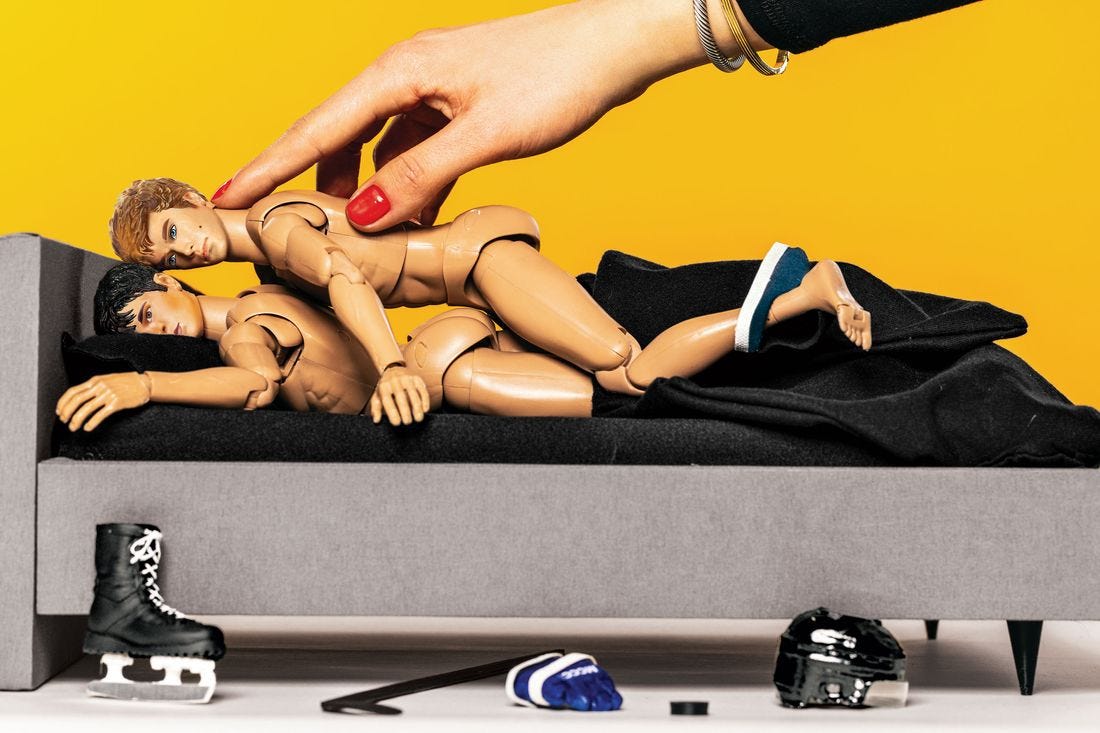
The article was pretty reasonable and while it was not like, fawningly flattering, it in no way insinuated that fic-reading/writing fangirls are universally evil, insane, immature, etc. However one of the main panicky responses was that the article “opens fic writers up to harassment and doxxing” by unsympathetic outsiders.
This is where I began to see a trauma response in action. In fan communities, the vast majority of harassment is coming from inside the house. There indeed have been moments in pop-culture past where mainstream exposure of fan activities have been cause for really heinous public mockery—Caitlin Moran’s Fic Stunt, a 2013 incident in Sherlock fandom, being the ur-example.
But a lot of times the only people who really care about chasing down, doxxing, mocking, bullying fans, specifically writers of fanfic, are other fans. Why would anyone else bother? Within fandom, of course, morally motivated harassment can be seen widely to be at the root of status jockeying, no true Scotsman-ing, and strengthening paradigms of “good/real fans” versus “bad/fake fans.”
A real danger in a journalist posting a non-consensual link to a fanfiction is that the fic might include a trope deemed to be problematic and unleash a wave of fan-on-fan hate…
On the other hand a potential positive outcome, as I see it, would be that the article introduces or inducts new enthusiastic and appreciative people to the world of slash/BL.
Maybe this is just me being loyal to journalism as a profession over fandom as a passion for a moment, but many reactions I saw to the article seemed very “I am feel uncomfortable when we are not about me?”
Reacting like there’s a waiting audience of vicious outsiders ready to harass you, and not actually a big population of new potential appreciative readers and community members, seems like self-sabotage on the part of the fujo population, and a little self-centered.
It’s understandable that people are protective of the community. It very much is a safe space for many people, and the kind of exposure that the article entailed, even taking it to be a roundly positive endorsement (which many did not take it as), can be a klaxon for incoming unwelcome disruption. Many times over the years, fans and non-fans attempting to report on fandom have been met with distrust, dislike, or major wanks, and it doesn’t look like that will change anytime soon.
The fourth wall, as an idea, is very important to fans—nevermind the fact that it has never really existed the way people think it did.
“There used to be a sacred separation of fan culture and mainstream + the creators so that you could be a freak and sleep at night knowing only other freaks saw your work. We used to be a proper country” read a tweet I saw—hmm, not true. The idea that there was a magical, safe past where fandom was completely separated from The Powers That Be (TPTB)/the mainstream and that we need to return to that past is reactionary nonsense—borne out of well-justified fears of the decline of fandom as a sustainable subculture in the face of commercial encroachment, but nonsense nonetheless.
I could speak at length about the historical relationship between transformative fanworks and TPTB, and how that relationship has shifted along with technological changes and the legal questions brought about by the rise of the internet, but you will have to wait for my book for that ;)
Returning to the point: Heated Rivalry or no Heated Rivalry, plenty of fic writers, especially in the Global South or in communities around the world where being known to engage with queer material would put one in danger, do not want their fan practices to be widely known or exposed. Even fans without those pressures who nevertheless have found comfort and community on AO3 dream of an impermeable 700-foot-tall Fourth Wall to defend against the ravaging hordes of cruel invading Others who are not like us and threaten our fragile existence.
But winter is coming or whatever (I’m 25% of the way into the first Game of Thrones book, can you tell) and we are dealing now with the inevitable: counterculture inevitably cycles up to become culture. It’s worked a little slower for stuff like fanfiction because of the erotic element, but romantasy and the women who read it are keeping the American publishing industry on life support, so obviously there is now an arms race to get everyone cool about a bunch of stuff really quickly.
I think it’s a fallacy, borne mainly out of public misconceptions of journalism’s responsibilities and consequences, to pretend like the cover story is more potentially dangerous a public exposure/Toxic Airborne Event than Heated Rivalry, the show, itself has been—right? Vast numbers of newbies flooding the zone is happening because of popular canon, not little-read commentary.
Fanfiction is a literary genre, and critical attention does not inherently disrespect it: I would say that it actually validates it. I’d agree that perhaps nobody is asking for that validation, but as fic communities build public reputations as proving grounds for best-selling authors and critically-acclaimed television, it makes sense from a journalistic perspective that questions of what makes these communities tick would want to be explored, and that commercial interests would require interpretive services in order to justify continued investment in properties connected to these communities.
This is not “manufacturing consent to ban fanfiction” as I saw one person put it on X (lol)—but it may well be making it so that when everyone is a fan, no one is.
“we seriously just need to let women be perverts without pretending it’s some kind of crazy phenomenon,” read one tweet that came across my timeline. OK, yeah, fair enough—but I’d say that is actually what is in the process of happening with stuff like this article. When a genre is seen to be commercially viable, it gets culturally normalized. We are in the midst of a bumpy and uncomfortable round of normalization.
It may come as a shock to some fans for whom this whole thing is a long-inhabited cozy home, but there are still people on this earth who don’t know what a fujoshi is, or what shipping is, or that women and queer people have enjoyed this kind of thing for 60 years. Once the NY Mags of the world have gotten their explainers out of their system, we will hopefully arrive at the promised land of Letting Women Be Perverts Without It Being Crazy, and a lot more new fans of all ages will be sampling the ambrosian delights of AO3.
Unfortunately that will probably require the monkey’s-paw exchange of fandom being “put on blast” regularly, and continually changing with the influx of newbies seeking romantic and erotic thrills.
As a consequence, I think it is going to be increasingly important that we ask questions about how TPTB—in the sense of studios, publishers, and IP owners—can ensure fandom remains self-sustaining and independent.
Modern fandom has always consisted of independent and self-motivated communities evolving and existing in a dialectical relationship with commercial culture. We poach, we remix, we reappropriate for our own delights and communal joy, but there is always a vital living tether back to the original fan object—a tether that has the potential to cause as much pain as pleasure.
Now that those uses are getting re-reappropriated back through the tether as profitable, how might we construct a framework for TPTB to invest in the ongoing independence of fan culture? Is that even possible, or desirable from their end?
If not, what digital and/or physical infrastructure would fans need to build themselves now in order to ensure that independence in the future? If the fourth wall really has fallen (or as I tend to think, has actually never functionally existed) it might now be worthwhile for freaked-out fans to imagine how it could be built back up.
No posts
Comments
Nothing yet. Say the first thing.
Sign in to join the conversation.