
Several months ago, a friend hosted an annual get-together at a local park. Parks have made me increasingly anxious over the past year, and leading up to the event, I wasn’t feeling my best. I reneged. Weeks later, that friend and I made plans to catch up over drinks, and I felt glad. I left work that day, not expecting to be back until the following week, being scheduled to fly out to Boston early that Friday. Between my book club, packing, and catching up, I was busy.
About 5pm. I put my shoes and hat on and walked out the door. Stepping into the stairwell, a cloud of sticky air washed over me. The humidity felt so thick, and looking at the walls and floor, I expected condensation almost like that of a sweating can of Coke. I didn’t see anything so dramatic. Stepping from the landing between the first and second floor, I thought, These stairs are–. Suddenly, I lay sprawled on the first floor, having skipped all the steps.
But that’s not quite right, is it? While it feels like one hard cut now, the truth is I felt my foot lose traction, and my hand reach for something, and my ass hit the stairs, and my left leg bend under me, and I heard that nauseating POP.

For a moment, I lay there feeling the pain in my back, rear, and legs. I felt like something tossed down by a bored kid. I remember making involuntary noises as I slowly pulled myself to a sitting position. Waves of red heat and klaxons announced the pain. Immediately, I knew it was broken. I knew it from the sound when my brain had caught up to it. I took my left shoe off before the ankle could start to swell. A year ago, I’d sprained my other ankle badly, and by the time I’d left the urgent care, it was the size of a coconut and couldn’t take the shoe. The sock off, I moved my hands from my knee to ankle, slowly and with some pressure. Something moved, and it felt like it shouldn’t be moving. Confirming its shape and its pain’s texture, I pushed it around and slid it under my skin. I think what I said was something like, “Ah, fuck.”
Part of me hoped that the noises I’d made would call someone to the stairwell, but that did not happen in the few minutes I sat there thinking about what the next hour now contained. No $6 Miller High Lifes or $8 glasses of wine. No, prices leapt in much the same way they do when the President speaks, and the medical conversations seemed just as appealing. I pulled myself up by the handrail and tested weight on the leg; flames licked up while I made a grotesque noise. With a deep breath, I pulled open the heavy metal door and started loping down the hallway towards the lobby. I put as little weight as possible on the leg as I braced myself against the wall, which seemed to have stretched out several hundred feet. After the elevators, around the corner, stairs. I held the banister and hopped one-legged down them, slowly. Shards of glass shaking in my ankle. Better to imagine those than falling down yet more stairs.
Two women sat in guest chairs in the little lobby. They looked bewildered, and one asked, Do you want my seat? Yes, thank you. The other, Did you fall? I nodded and probed my leg again with my fingers, feeling self-conscious about the lint traces left behind by the sock. Who stood behind the counter but the building’s maintenance man? Wide-eyed, Was it wet? Imagine my annoyance to hear those words, but they also turned on a little machine somewhere in my head, taking note that a few witnesses heard that, just in case. Yes, I said. The women, whom I now took to be a tenant and her home health aid (or maybe a friend just off work?) asked if I needed them to call an ambulance. Great big flashing dollar signs lit up in my eyeballs, and I might even have laughed. Thanking but no thanking them, I called the friend I was supposed to be drinking with at that moment to ask if they’d drive me to Sibley ER.
She pulled in shortly after, and I hopped out to the car and apologized for my bare foot (which I think perplexed her). Driving northwest, I recounted what happened, and then we caught up more generally. Sibley is far from my apartment, but everyone I’ve spoken to—and a few strangers on buses—has warned me away from Howard, and a few away from GW. We passed under the National Cathedral, which I stare at from the metro every morning and which shakes me in a way that has nothing to do with religion.
Pulling up to the ER, my friend said she’d park and be right back to get me a wheelchair. Of course, I hobbled in without waiting. To my dismay, people packed the waiting room. Last time I’d ventured out here, it’d been only me and a self-described suicidal woman with Schizophrenia (who I found, despite us not speaking, rather good company; of the suicidal folks and the schizophrenic folks I’ve spoken to, she seemed pretty even-keeled).
By the time my friend, G—, came through the doors, I’d been seated, and a nurse was taking my vitals. Before G— and I could get into a conversation, they called me back for triage. The nurse asked if I needed a wheelchair, and I, manifesting a sprain, declined. He did not look to like the way I crossed the ten or fifteen feet to the triage bed. The usual questions: How’s your pain? Probably an eight. Any thoughts of harming yourself or others? Not yet (I quickly clarified that bit of sarcasm, remembering having to ask strangers the same question). I asked, Squale 1521? He looked at me, confused, then flicked his wrist up, Wow! Yeah, I’ve never had someone recognize it, and down to the model. Feeling pleased, I shared I’d had that watch bookmarked for years before finally buying it. Always good to make friends in stressful times, no?
Thanks for reading TB in DC! This post is public so feel free to share it.
My new friend did not let me pretend I could easily walk back to the waiting room. He wheeled me out, and I sat there with G—, chatting some more. She asked again if I’d like her to stay while I was waiting, asking if I was sure when I said that’s alright. I’ll probably be here for a few hours, I said. We talked for a bit longer about what we’d been reading, and then she left, making sure I understood I could call her for a ride back if I needed, no problem.
ER waiting rooms are such interesting little petri dishes of the pissed and the pained. Over and over again, a nurse came out, and all looked up to them, like a lost flock towards a shepherd. Inevitably, the name called belonged somehow to only one person, and they all looked downtrodden. (Actually, once, two people did have the same name, and I could see the nurse trying to remember their HIPAA training.) An older couple sat opposite me, both holding books. They spoke in that way that long-married people do, for which I admit feeling a lick of envy. The woman spoke into a phone, and with a pause, it was clear someone had handed the other side of the call over to a child. Her voice and face changed, asking him how his birthday party had gone, if he liked the gift they’d sent. Even through obvious discomfort, she looked genuinely joyed.
A younger couple sat near me and annoyed the room for more than an hour, flicking through videos at full volume and laughing at whatever the guy was mumbling. In my state, this sounded like nails being dragged down a chalkboard by a busted automotive robot that won’t stop until unplugged, or perhaps destroyed.
A middleaged woman came in with her mother, who seemed visibly confused and spoke apparently little to no English. The daughter translated something rather Slavic-sounding, saying it’d started at so and so time and such and such place. All the while, an elderly man billowing the stench of tobacco loafed—literally loafed, I’m not sure I’ve seen it done before—around the room over and over again, babbling to himself. He wore something, I can’t remember now, maybe a hat or his shirt, that advertised him as MAGA or MAGA-adjacent. I spent a little time wondering how an elderly Asian man arrived at that position, but I was not of sound enough mind to be practicing sociology or political science, so I just held my breath every minute or so as he passed.
A woman in black came out and called my name—but wait! I’ve lost time; this happened before G— left, didn’t it? It all runs together in a hazy soup. She wheeled me through twisting corridors, and I tried heartily to resist a raging urge to say, I USED TO WORK IN A PLACE LIKE THIS, to which the only possible response is, Wow, no kidding. I failed to resist at every single point of this tale, each time wondering why I had this compulsion. I think it is something like, I UNDERSTAND, or maybe I AM SHARING THAT I KNOW I AM JUST ONE OF MANY PEOPLE YOU WILL HAVE TO DEAL WITH TONIGHT. Though the reality, of course, is that with few exceptions (the very good and the very bad), all of us blend together and fade to nothing.
She helped me onto an X-Ray table and positioned and re-positioned my foot variously just so. Several times, she said, Okay now, don’t move at all. Each time a click, and finally she came out congratulating me on what a good job I’d done. Wheeling back to the waiting room, I said, Good or bad, I just hope it’s obvious.
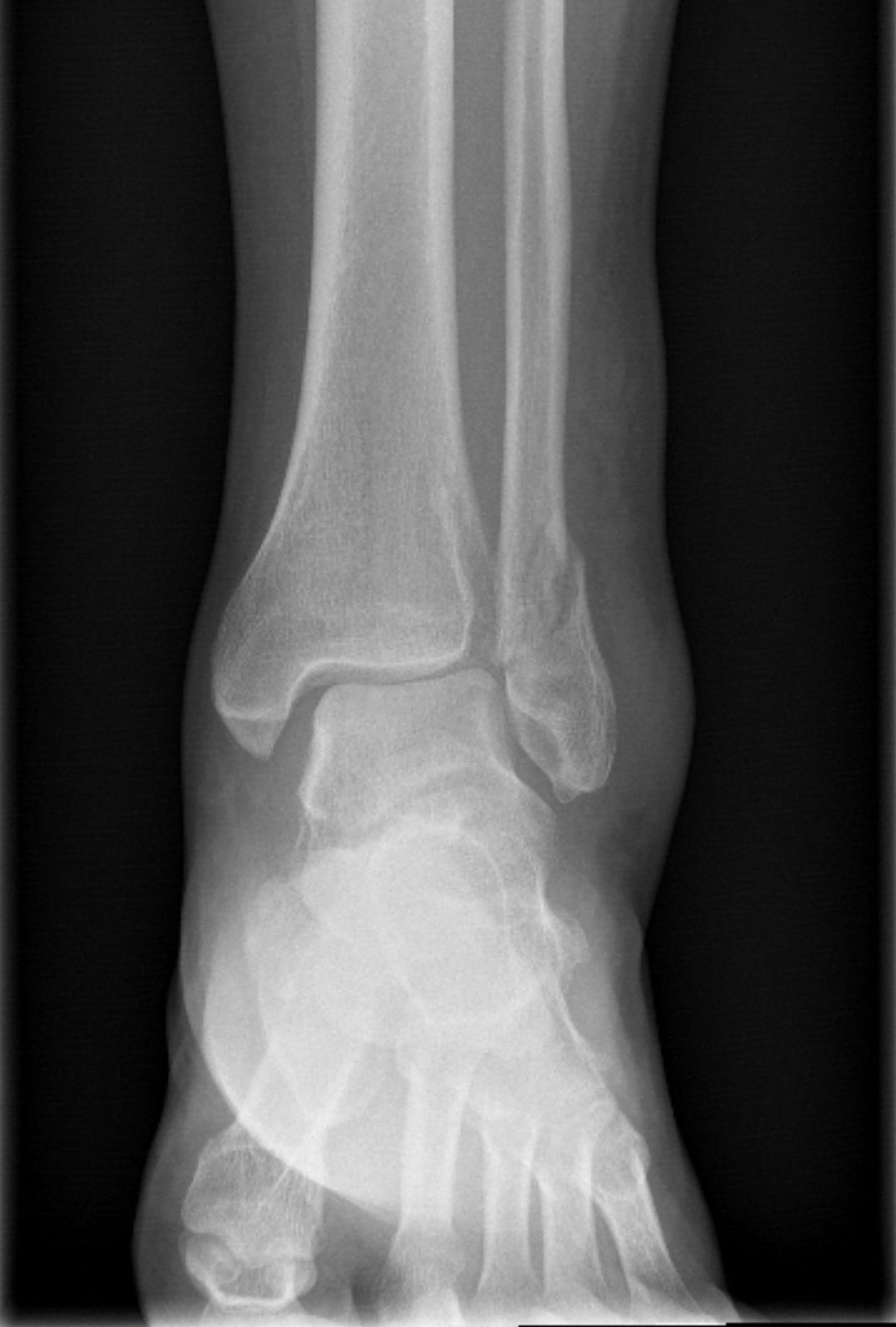
Later, I would find that the X-ray looked like this:
Now, wouldn’t it be a fun writerly experiment to try to express the four hours that passed between then and being seen? Imagine, I could write a two-hundred-word paragraph, unbroken by periods, full of only commas and semicolons and—maybe—dashes; catastrophic and overlong polysyndetic sentences, the duration mirrored by the length, the boredom by the droll onslaught of nouns and adverbs, and the pain by how annoying such an experiment would be in the hands of someone who doesn’t know what they’re doing. No? You think that would be annoying and trite? Probably you’re right.
The sun had set, I’d finished one book (Absence by Issa Quincy) and started another (Wildwood by Colin Meloy), by the time the nurse returned. It was 10pm on the dot, and I’d spent the last several hours wriggling in my seat, becoming increasingly uncomfortable and supremely pissy. In a curtainwalled “room,” a different nurse asked me different questions and said the PA (Physician’s Assistant) would be in soon. It was true; the PA came in right afterward and said, It’s broken. Relief! These past hours hadn’t been a waste after all, and I hadn’t inconvenienced someone for a mere sprain. She asked some questions, I asked some questions, and finally she said, We’ll see if Ortho wants to see you or if they’ll have you come back later. Might need surgery.
Ortho did not want to see me, and so the PA and the first nurse came back with some fiberglass. I’d have to take my pants off, they said, and this splint would go on, then I could go home. The other nurse came in after they’d gone and said she’d find me some shorts or something that’d go over the presumably gigantic splint. Noticing my hat, she stopped dead in her tracks, Oh I love Frog and Toad! We talked a bit about the books and then somehow got to animation films—always good to make friends in stressful times, no? After she’d gone, I gingerly depantsed and covered up with a blanket, poking out the busted leg. The PA and watchwearing nurse came back in, and we did some awkward movements together while they shaped the splint to my leg and wrapped it up with several miles of Ace bandage. It was not pleasant. Bestowed crutches, they asked me to practice walking while placing no weight on the bad leg (writing, I hope that I don’t have cause to think of it as my “bad leg” after all this is over). I was assured I was a natural. They handed me some papers and told me to have a great day. It was 11:30pm. I called a Lyft.
The next day, I went wobbling and lurching down the hallway to get my mail and packages. By the time I returned to my apartment (bag of packages over my shoulder), I was sweatcovered and the crutches had chewed up my armpits and ribs. Which was worse, the pain of the break bouncing around or the ache under my pits? What a joke. I canceled my flight to Boston and let my friends know I wouldn’t be joining them after all. I felt sad to do it.
With the splint, I needed a variety of assistive devices. First, I’d have to have a shower bench and something to cover the splint while bathing. Rather than use a trash bag, I ordered what a friend called a “shower condom,” which slipped over and held closed with an elastic band. It worked well. The shower bench was delivered. A few times to the toilet, I found that trying to get up one-legged, with absolutely nothing to hold on to or with which to lift oneself, was difficult and sometimes a little painful if I had to use my busted leg. I felt embarrassed to order a toilet seat, a raised bench placed over the bowl, after which you hope you’ve got good aim. There was a learning curve to all these things. By day three or so, the crutches and I were sworn enemies. One of them kept slipping on the kitchen floor, and bruises seeped out from my armpits and upper ribs. I asked several people if it would be weird if I bought a knee scooter. I felt extremely self-conscious about all the devices. The people I asked seemed to find the anxiety stranger than the scooter. Reflecting, I think it is important to share that these anxieties weren’t because I felt emasculated by the devices; I was not and am not worried about seeming masculine (as written about elsewhere). I felt broken, but outwardly. Inward brokenness can be hidden, and easily. How to reconcile fear of this perception with the base need for mobility? It’s a broken leg, not cancer! I felt like a baby for being caught up in these anxieties.
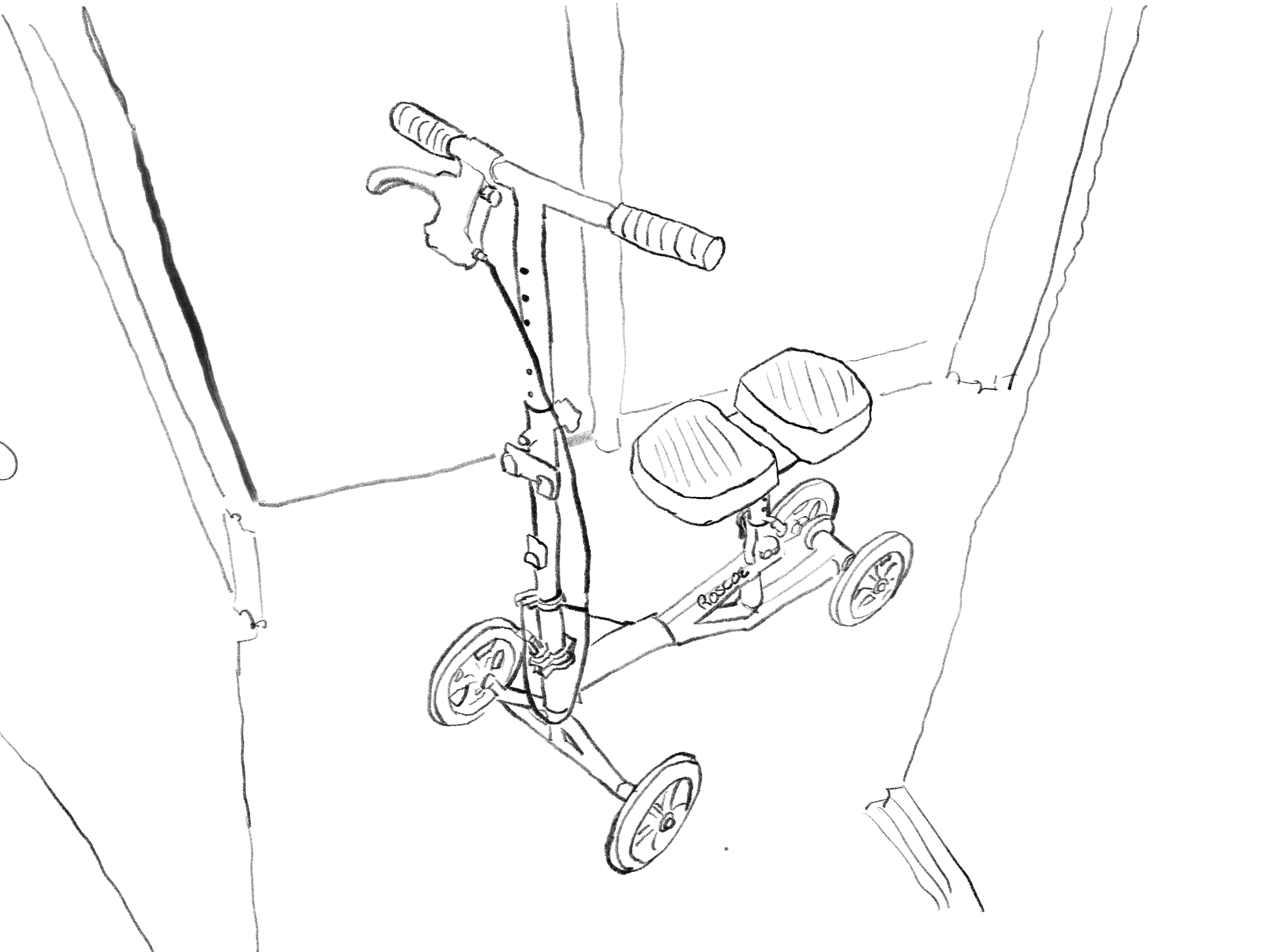
I got over it, at least enough to order a scooter. I bought it from a company called Roscoe, because that was my great-grandfather’s name, and it was even sort of maroon, a color I like and that he sometimes wore. It cannot be exaggerated what a good decision the purchase was. In no time, I was zipping around the place. And I only crashed once!
Expenses started piling up, so I began to think about liability. Well, that’s not quite true. I began thinking about liability there in the lobby when I heard the maintenance guy ask if the floor had been wet, and then while in the ER waiting room. After a few e-mails to my property manager, I had a missed call from their liability insurance.
My first interaction with that company resulted in the only moment of white-hot rage that I’ve felt throughout this experience. The voicemail seemed nice, though I could not hear a name or number on it. I had missed the call by moments, so I called back the number. An answering service picked up, I said my name and that I’d just missed a call. The guy asked for something I didn’t have, with an extraordinary attitude. I said I didn’t have a claim number, but that I’d just missed the call and said the property name. He got snotty, and not in a nice way: That could be anybody! Instantly, Motherfucker, you called ME. (This is what I actually said, because once I’d hung up, I debated the veracity of it, wondering if calling back after a voicemail constitutes me or the company as the caller.) We expressed a mutual anger. I hung up. Eventually, the actual representative called me, and we had a pleasant conversation that took maybe 15 minutes. Promptly after emailing receipts for the equipment, they sent a check in the mail. At this point, I’ve had no problem getting them to cover expenses. I hope that remains true.
I engineered two devices during the interregnum before surgery. One was a ridged stick that I could put into the splint to scratch my leg, which was fine. The other (and the one I’m rather proud of) was a “sole”, with air holes and such, that could be inserted into the splint at the toes to create a surface between my foot and the splint, which, under the foot, felt like having on a sock that is too big and slightly sweaty (it drove me crazy). I also printed out a model of the plate that’d be screwed into the bone, eventually.
At my follow-up with Ortho, which ended up having to be at GW, as apparently my insurance provider and Johns Hopkins (the operators of Sibley) are involved in a blood feud. The doctor told me surgery would be best, then explained the reasons for that, which I did not need to hear. I felt no concerns with the doctor; the idea of surgery did not make me nervous.
A few weeks and many ibuprofen later, I rolled into GW’s surgical center. At the registration desk, I signed various forms, stopping to ask questions about some Artificial Intelligence sections on some of them, the first I’d seen in a hospital. I explained that my insurance would take the claims, but that, ultimately, the liability insurance would be the one paying. They took the claim numbers and gave me the cost estimate, assuming my health insurance, which looked like this:

Outpatient Surgical - (C) CPTS:22792:360 — $91, 455.57
Outpatient Surgical - (C) CPTS:27829:360 — $84, 966.97
Total: $176,422.53
Co-insurance: $5,696.75
They asked that I pay the co-insurance upfront, which I could not do. I paid $500 and said the rest we’d have to figure out later. They took all my information before I wheeled over to a waiting area. Thinking about a $176,000 bill stressed me, despite knowing more than probably the average person does about medical billing. I re-read e-mails with the liability insurance and decided not to worry about it until I had the right number of bones in my body.
Scheduled for 1pm, my surgery did not think of starting until around 4. I’d spent the time in the waiting room reading and wishing I could have some water. Once I went to pre-op, a cadre of nurses and doctors quizzed me. Any allergies? No. Any bad reactions to anesthesia before? No. Have you had anesthesia before? Many times. In your own words, what are we doing today? (This one they asked over and over again; everyone wanted a bite at it.) Variously: screwing my foot back on; bolting me back together; screwing my bones right. Have you ever had a problem with stairs? Not before this. Big laughs, applause, roses thrown to the stage.
While they quizzed me, another pair of doctors had me roll over so they could ultrasound my leg and look at my sciatic nerve. I asked a lot of questions about what I was seeing on the screen, wanting to understand what was happening. They took quite a large needle and prodded it into my leg and poked around, seeking the nerve with the ultrasound as guidance. They injected several areas around my nerve with a numbing agent (something with a -caine ending, like Novocaine or Lidocaine, but not), and left a tube there. After the surgery, they explained, a “ball” of medicine would connect to this catheter and continue the nerve block for several days; I’d need to wear the ball of medicine in a bag over my shoulder.
By the time the anesthesiologist began asking questions, I’d been stripped down and relieved of everything, including and especially my glasses. Still, I thought I recognized something on the anesthesiologist’s wrist and asked, What watch is that? Omega Speedmaster. That’s what I thought, I said, I’ve always wanted one of those.
Always good to make friends with the person putting a tube down your throat (at least in a hospital, perhaps not on Grindr).
He asked if I had any questions. You know that thing where people are anesthetized, but they remain coherent and paralyzed? Yes. I’d like not to do that. He gave a serious answer after his laugh, which I didn’t bother remembering as I wasn’t worried about it.
A nurse: We’re calling E— after the surgery, they’re your ride? Yes. Is there anyone else you’d like us to call? What do you mean? I asked. Like a family member, someone who would want to know that you’re out of surgery and doing okay. No. She seemed surprised and maybe incredulous, No one? Not your mom or anyone? I did not say that no one needs to be getting a call from a hospital about me, and tried to moderate myself. I can text them when I’m out, I said. She looked a little upset, But they might be worried! Well, I said, they will have to learn to live with that.
I’ve long resented having to have other people involved in any way with my medical care. No one needs to know anything until I decide they need to know it, and who would need to know anything? The nurse’s questions annoyed me and made me feel alone, which I resented. And why should someone have to drive me home from the hospital? We have Lyft, Uber, WMATA, any number of things. I amuse a fantasy of leaving AMA (against medical advice) after the surgery. The nurse seemed genuinely bothered by my refusal; I got the sense that she liked making those phone calls. Probably, it made her day a little better if she heard relief or appreciation on the other end of the line.
My surgeon stopped by, all scrubbed up. What’s your favorite color? he asked. I had no idea what this could possibly be about. Maybe Orange or Green, I said. He put on a concerned face, I don’t think we have any in those colors. Any what? The plates, he said, The manufacturers make them in different colors, one of them makes blue plates with gold screws, they’re wild. We discussed and settled on blue, sans gold.
The surgeon seemed in great humor, and we made a pretty good two-person act. He talked me through what they’d be doing (perhaps this was the 37th time I’d heard the spiel), and asked if I had questions. I made my standard request: in the middle of the surgery, take some pictures of the site and the action. No surgeon has ever honored this request, but this guy seemed jazzed. He excitedly told me of a motocross racer that he treats, apparently, once or twice a year, who asks nothing but that he take a lot of photos.
They wheeled me back, and soon I was as far and away in some other land.
Some time later. I woke in the recovery area, midsentence, probably saying something terribly funny or enlightened. This is a big improvement over what happened when I was a child, which is that I would wake up in huge emotional distress, crying, and confused. I like that I can bring myself under control from such an altered state rapidly. I looked at the leg, which was now encased in a thing somehow even more bulbous than the last splint, but which otherwise looked similar.
The surgeon came by to check on me, and all I can recall of this is him airdropping me a few pictures of the surgical site. They were taken at 6:59pm on June 9th. In them, my leg is visible from the exterior, from my ankle up to the lower knee. A long slice exposes perhaps an inch deep of meaty tissue, shades of red, pink, blackish. Only slightly can the ghostly white of bone be seen, bloodcovered. The best view is through the star of the show: a metallic blue titanium plate, maybe four inches long, with six holes along its face. Five of those holes are filled with hex screws (I wonder if I have a bit that will fit them; think they’re proprietary?), with one left open. Just above the open screwport, you can see another screw protruding from the bone, looking like it got lost along the way. It’ll be the first thing you notice on the X-ray. The surgical site looked like this:

A fun bit: it’s a “live” photo, so I can hold my thumb to it, and it’ll play a few seconds of video, with audio. Nothing is discernible, but it is so absurd that it cracks me up.
The recovery nurse gave me post-op instructions and brought me my stuff. I put my clothes back on, able to slide the sweatpants over the splint (perhaps the second time in my life I’ve worn sweatpants in public, the first being at the Ortho consult). I slung the nerve block medicine, which was in a little black bag delightfully advertising the pharmaceutical company that manufactured the medicine inside, over my shoulder. Bringing the scooter over, the nurse asked if I’d prefer a wheelchair. No, certainly not. I got up without any issue, realizing now that my leg felt like a bag of potatoes and had no sensation. When I tried to bend it to the 90 degrees required, I found that I could not. Oh, I said. I stared into space, trying to understand what was happening while the nurse asked me something. I can’t do that, I said. I kept trying, not able to feel what was going on, then I realized that the splint had a much taller (longer?) piece of fiberglass than my first, and it came up into the knee pit. I finally forced it, and the splint’s protrusion scraped against the back of my leg until it was in position, and then it rested there in pressure. It was not comfortable, and would not be comfortable at all throughout my time wearing it. After this, I scootered down and out of the hospital, where E— gave me a ride home.
The first few days post-surgery were more inconvenient than anything else. I spent a lot of time sleeping, my leg propped up on all the pillows I owned. Within a day, the scraping of the protrusion against my knee pit carved away a spot of raw skin and bruised, burned. The nerve block continued to pump medicine into me through its threadlike catheter. Everything southwards that held no feeling at all. Only in rare moments did I perceive what I thought to be the sutures under all of that wrapping, scraping and scratching against the bandages, pressing into the incision site.
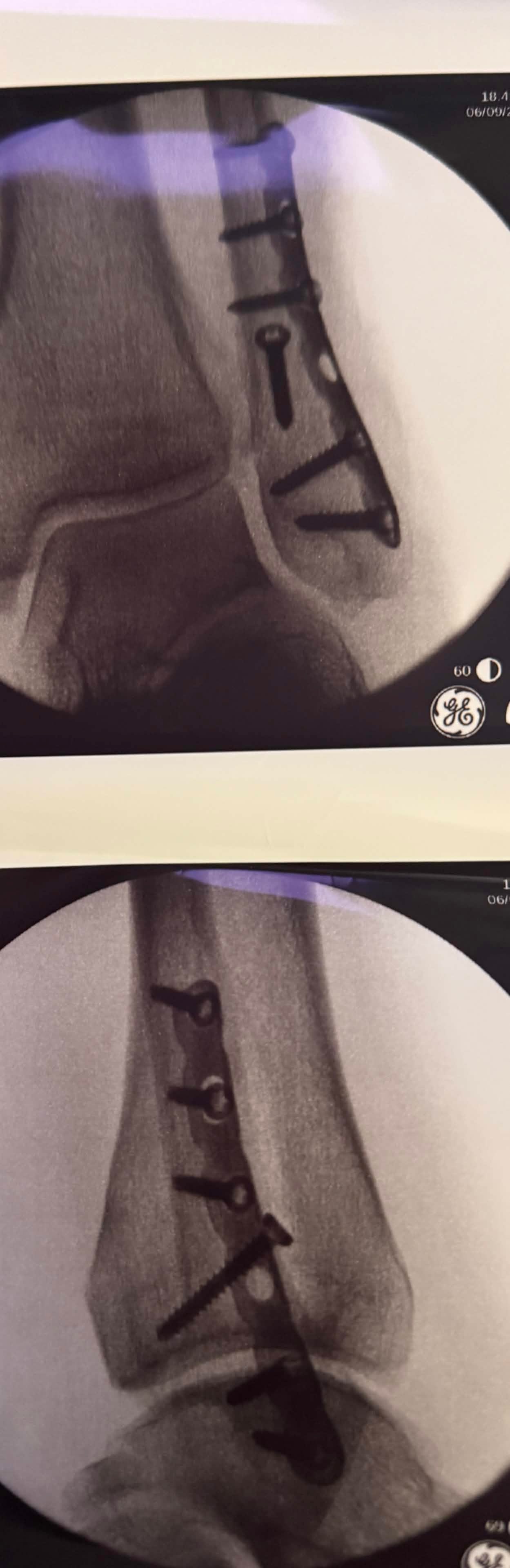
At some point, I flipped through the materials the hospital gave me on discharge; the most interesting were the X-rays, I suppose taken just after they’d stitched me up. Everyone who sees these asks, what happened to that screw!? The one that looks cattywampus. My understanding is that’s the one doing the positional work. It pierces the bonepieces and pulls them together, while the plate and other screws secure everything in place. The X-ray looks like this:
Not until the third or fourth day after surgery did I start to feel real pain. The nerve block began to wean itself off, allowing sensation to haltingly return, first in my toes. I could only move my big toe a little up and then back to neutral (not down, an odd feeling). The site began to ache and burn. I could see the sutures scraping against the bandaging, pressing through the incision, and lighting fire to all the tissue around them. That’s the only day I took something stronger than the prescribed Tylenol; I popped one of the Oxycodone from my ER visit, which I’d mostly refused to take. After a few more days, I removed the nerve block catheter, taking off a thin yellow tape, which in turn peeled away a small bit of skin from the rubbed-raw spot in my knee pit. Taking the threadlike tube in hand, I withdrew it slowly from my leg. It sounds more unsettling than it is; other than a slight pulling sensation, I felt nothing.
After a week or so of recovery, I began working again, from my couch. This, at least, relieved the intense boredom and rumination resulting from lying there for so long. At one point, I did make an effort to properly clothe myself (I forced real pants over the splint, as I refused to go where I was going in sweatpants) and go to the office, for our longtime leader’s going-away party (wake?), which I would not let myself miss. It went far better than expected, even if the scooter made me realize how uneven brick-style sidewalks are. After a few hours, the leg started to ache and ache, and I could not get it into a comfortable spot.
The ER and surgery provided such rich stuff to write through, but account for only a handful of hours over the past six weeks. Between then and now, I’ve done nearly nothing but read, write a little, work from home, and, I guess, heal. The interesting part of having a broken leg is the breaking and the immediate medical aftermath; everything else is just slow time. That my barely month-old new endtables are now marred by a few impacts with the lugnuts of my scooter is not interesting.
As writing, it is Saturday, July 4. This past week, my therapist asked me how I do with this holiday, and the question surprised me. I barely think of it as a holiday, and I said, I have no problems except worrying for my cat, who doesn’t like the fireworks. Around this time, I did have a tickle of schadenfreude, thinking of the MAGA folks roasting on the halfempty National Mall. Then again, I cannot presently get my apartment below 78 F, so I’m not in much a laughing mood.
Now, I am in a medical boot, which looks like a piece of modernday armor cast in ABS plastic and foam. I tighten it up with five big velcro straps and then am free to hobble around. It hurt the first day, and then felt unsteady and nervewracking, but at this point, it is only uncomfortable if I walk around too much. It’s done me a lot of good to be able to clean my apartment, take out the pile of cardboard boxes, the trash, etc. I managed to make it to my book club, socialization I badly needed.
I will be in the boot for a few more weeks, and so the dramatic part of having fallen down stairs and heard a loud pop is over. I’ll be pleased to stop wearing this thing that makes my leg sweat. What will I do with all this stuff? The crutches, forgotten in a closet. The shower seat I will probably pass on freely. But the toilet seat? Seems an odd thing to post on Facebook Marketplace, what’s the meetup for that like? Free: I s(h)at on it, and now you can do the same. The scooter I will probably sell on Craigslist or something. It will all eventually disappear.
Soon, I will only recall this time when the weather changes and an ache reminds me that I once slipped on humidity-soaked stairs. The pain and annoyance will melt away. I will not remember any part of the conversations with nurses, doctors, or insurance agents. I will forget again and again. One day, I will notice a gash on my living room table and ask, What happened?
Thomas
One thing I did do over the last few weeks was finally buy an Olivetti Valentine. I typed the first draft of this on that, and loved it.
The little doodles are my stand-ins for photography, as I haven’t been able to take any photos. I took pictures with my phone, pulled them into Procreate, and sketched over them. I’m not sure I’ll ever do those again.
No posts
Comments
Nothing yet. Say the first thing.
Sign in to join the conversation.