
Christopher Nolan’s The Odyssey did something remarkable this weekend: it officially grossed more than $1 billion.
Not bad for a three-hour, R-rated retelling of an Iron Age poem.
Yet the two groups one might expect to be most excited by the film’s financial and critical success, the hardcore Right whose chief concern is the preservation of Western values and heritage and the author whose “feminist” translation served as a blueprint for the script, are seething.
There’s just no pleasing people who have chosen politics as a lifestyle.
It’s not entirely surprising that The Odyssey is a runaway success, beloved by critics and audiences alike.
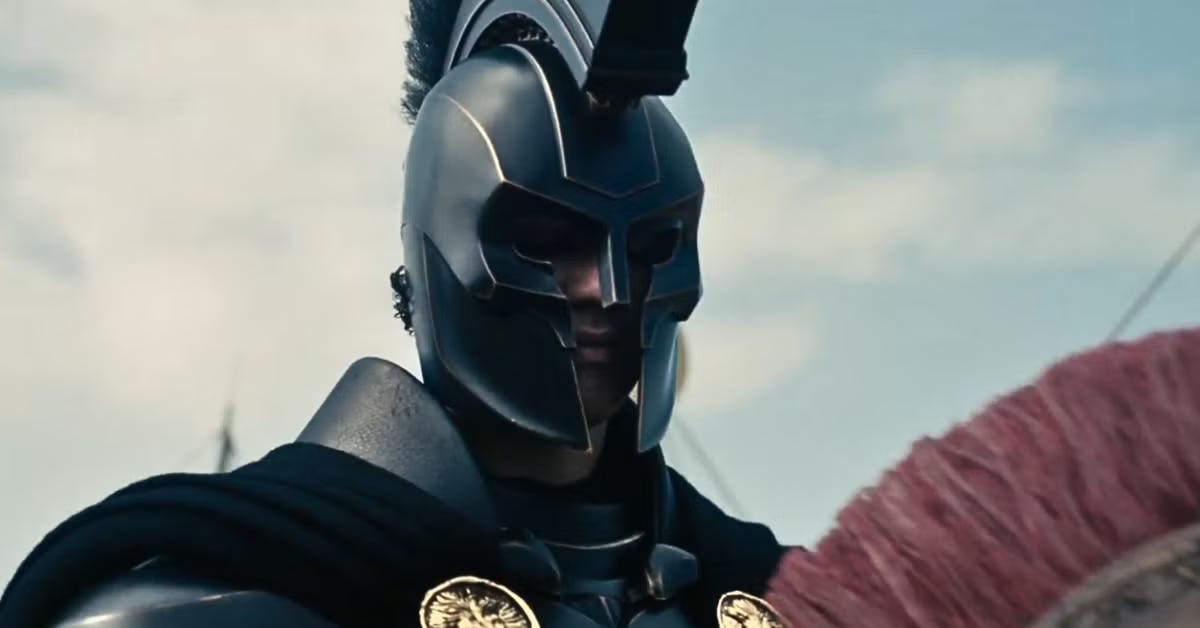
It’s gripping, exciting, and new. From audio to visual, the film does something well worth the price of admission: it marries the ancient with the modern. Just as its score pairs eighth-century B.C. instruments with 20th-century synthesizers, the cinematography pairs the language of the Greek epic with the language of modern cinema. For example: King Agamemnon spends nearly all of his scenes wearing imposing but decidedly non-period-accurate armor. He looks like a Greek Darth Vader. This is by design. Nolan meets the audience where it is and tells a three-thousand-year-old story in a language it understands. Modern viewers know what to feel when they see a Vaderian figure; they know Agamemnon before he speaks.
As for the right-wing holdouts who still insist The Odyssey is “woke” agislop, the film’s themes should have them cheering.
Nolan’s movie argues that civilized society, though imperfect, is worth protecting, as are the laws, traditions, and social contracts that forged it. The alternative is so much worse.
The movie upholds as categorical goods: family, law and order, duty, honor, loyalty, service, chastity, moderation, respect for private property, free trade, tradition, and the examined life. The Odyssey upholds these values while excising the extreme pagan barbarism of the ancient epic, actions as revolting as they are inexcusable to a world that says Anno Domini instead of Before Christ.
Meanwhile, the film identifies as grave, civilization-destroying evils: murder, rape, looting, excess, cruelty, inhospitality, wanton destruction, avarice, cowardice, and treachery. Odysseus specifically bemoans the loss of a high-trust society!
Then there is the Christian imagery that undergirds everything.
“Zeus’s law,” which obviously predates the birth of Christ, is simply the Golden Rule refitted, with characters practically quoting Matthew 25:40 verbatim: “whatever you did for one of the least of these brothers and sisters of mine, you did for me.”
To be saved, Odysseus is told he must first pray and repent—not in roundabout terms, but in those exact words. He is freed from Calypso’s island and sails for home only after abandoning the illusion of control and surrendering his life to the divine. When a storm destroys his raft, he does not fight it. Instead, he allows the ocean to take him and wash over him entirely. He wakes on the shores of Ithaca, home at last.
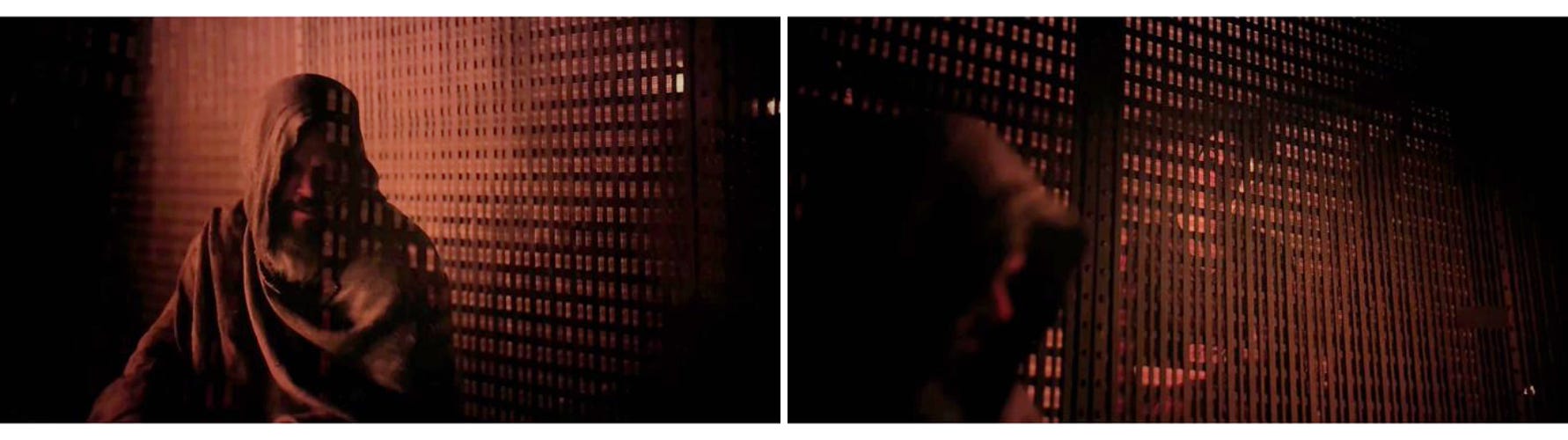
Before Odysseus can end his ten-year estrangement from home and family and free his soul from the weight the audience understands as the guilt of sin, he must go to confession. He does. The film even places a screen between him and his confessor.
Yet even these overtly conservative and Christian elements have not cooled the pure hatred of the weird Right, whose animus predates the film and whose complaints run from costume design to color palette to the script’s use of the modern vernacular.
They say the portrayal of Odysseus as grieved by the Achaeans’ excesses at Troy is all wrong. This might surprise Homer, whose Odysseus weeps in King Alcinous’s court at the retelling of Troy’s fall, his mourning compared to that of a conquered war widow. It’s a scene that has long left scholars asking for whom the tears are intended. The idea of an Odysseus untroubled by the savagery exacted on the Trojans would likewise confuse the ancient Greeks who recount his efforts to have Ajax the Lesser executed for the rape of Cassandra in Athena’s temple.
Their biggest complaint of all is the casting: Lupita Nyong’o, a black woman, as Helen of Troy, and Elliot Page, a biological woman who identifies as male, as the Greek soldier Sinon. Of the two, Page draws the greater ire. Critics cite her presence in The Odyssey as indisputable proof that it’s a Trojan horse (ha!) for a “woke” agenda. This is pure conjecture and ignores what we know: Nolan has a long habit of reusing actors (Page had a lead role in 2010’s Inception); he is among the most conservative directors working today; and the movie has a clearly Christian and conservative message.
We can argue speculation versus fact all day. Better to stick to the film as presented. Disbelief is impossible to suspend for Page’s scenes at Troy; despite the makeup department’s best efforts, it’s impossible not to see the young woman from Juno. Yet Page’s later turn as an embittered shade in Hades is excellent, balancing the earlier, unbelievable scenes. Nyong’o is equally strong in her dual roles as Helen and Clytemnestra.
Praise may be disputed, but that is beside the point.
Disagreement over a performance is one thing. To maintain the movie is “woke” even after audiences can see for themselves that the performances are strong, the casting works, and the story is no left-wing fever dream is simply irrational.
Insisting that the movie is left-wing propaganda is especially silly given Nolan’s evident casting strategy. He did not assemble a generationally and multiculturally diverse cast to preach progressive values to a narrow Western audience. Rather, he built a cast to speak to a generationally and multiculturally broad audience in defense of civilized society. Do you suppose Travis Scott landed the role of Phemius based on his acting talent or because he is one of the biggest music stars in the world? It is obviously the latter. But why do you suppose Nolan wanted a rapper in that role?
As the good Rob George has noted, it seems no accident that The Odyssey stars Batman, Spider-Man, Catwoman, and the Punisher, as well as Spider-Man’s Mary Jane, Doctor Strange’s Clea, Black Panther’s Nakia, and X-Men’s Kitty Pryde, most recently played by Page.
“Rather than asking audiences to forget these actors’ superhero identities, he leans into them. In effect, he’s saying: You already know these faces. Bring those associations with you. Far from limiting these performers, their years inhabiting modern mythological figures become an artistic asset,” George writes. “Audiences instinctively recognize Holland as a plucky youth seeking to live up to the burdens of a missing father figure; Pattinson as a haunted hero, Hathaway as clever and daring, Bernthal as relentless determination made flesh. Nolan isn’t asking viewers to erase those associations. He’s using them as cinematic shorthand to guide audiences into a world of gods, monsters, kings, and epic quests.”
He adds, “That’s more than clever casting. It’s a recognition of how audiences actually discover stories.”
From a black Helen of Troy to a Boston Odysseus, from Academy Award winners to MCU staples to a megastar rapper who can’t act, Nolan cast (ha!) as wide a net as possible with one clear aim: to speak to the old and the young, the black and white, and the Western and non-Western in defense of the laws and virtues that make civilized society as we understand it possible.
A conservative could not hope for better representation in popular culture.
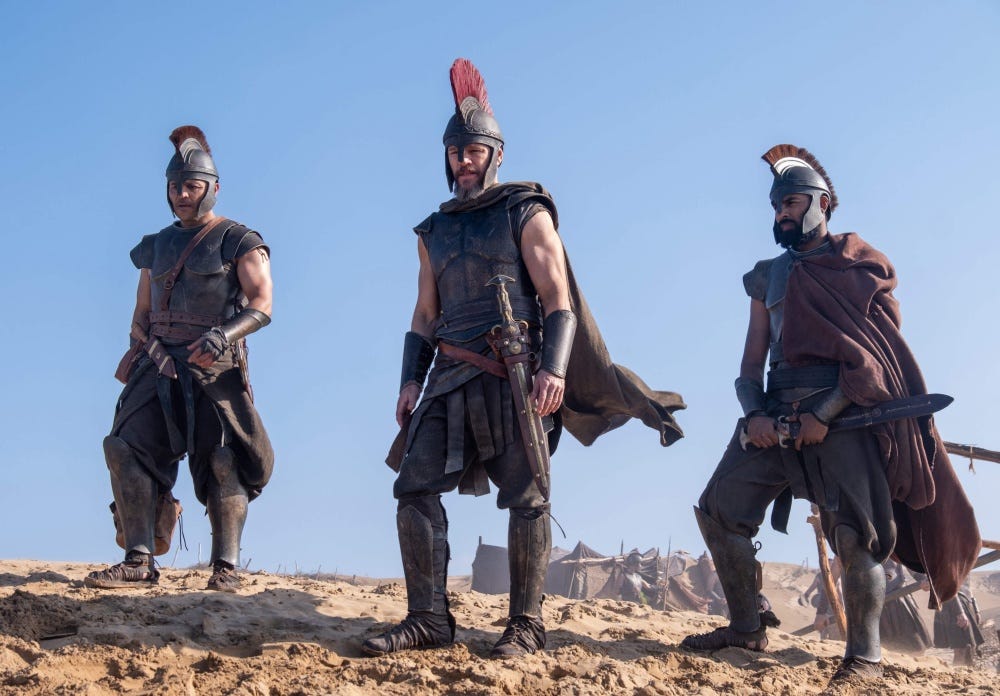
Yet this is where the weird online Right stands: insisting on fiction and inventing new ones.
Some claim Rotten Tomatoes quietly blocks negative reviews. Others claim Page was first cast as Achilles and that an inexplicably “woke” Nolan — who gave the world George W. Bush as Batman — panicked and rewrote the part. Others cheered that The Odyssey, budgeted at roughly $250 million, took only $230 million domestically and $363 million internationally in its first two weeks. (This latter point was stone-cold desperation from the jump. Early projections that excluded China, where The Odyssey opens later this month on roughly 800 IMAX screens, showed it would easily clear $1 billion.)
The right-wing cope runs so deep that when Emily Wilson, whose “feminist” translation helped shape Nolan’s script, condemned the movie for not being progressive enough, parts of the weird online Right claimed victory.
Speaking of Wilson, her review of The Odyssey is so unhinged and incoherent that it nearly outweighs the months of right-wing frenzy.
What a world: A billion-dollar summer blockbuster incorporates her work, removes what she calls the “problematic” and “misogynistic” elements of earlier translations, and stirs excitement for the classics—and she could not be angrier.
That’s the problem with politics as personality: anything short of total victory feels like defeat.
A version of this article was originally published by the Washington Examiner on Aug. 5, 2026.
Comments
Nothing yet. Say the first thing.
Sign in to join the conversation.