
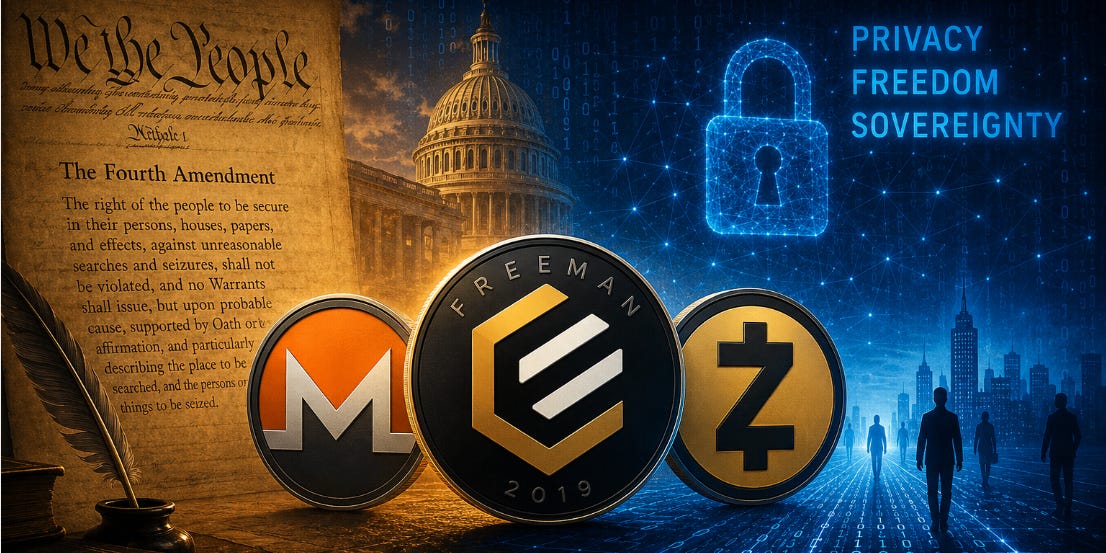
The Constitution of the United States rests on a simple idea: freedom is only durably protected when power stays limited.
Separation of powers, freedom of speech, protection of property, and the right to resist form a system of mutual checks meant to shield the citizen from an overreaching government.
The Fourth Amendment makes this clearest: the state may not simply search homes or seize documents. In the eighteenth century, that meant protection for houses, letters, papers. Today it increasingly concerns financial life — money documents relationships, political convictions, illnesses, habits. Whoever knows all of a person’s payments often knows them better than their closest friends.
When the Constitution was written, money was largely anonymous. A gold coin told no story. What has changed is not human nature, but technology.
With digitized payment systems and transparent blockchains, it becomes technically possible for the first time to trace a person’s payment behavior permanently and almost seamlessly. Information that once required painstaking investigation to assemble now often arises automatically as a byproduct of every payment.
Two patterns show how this power emerges even where it is formally prohibited.
The change of sender. — The debate over CBDCs focuses on who issues the money. What actually matters, however, is the architecture. A centralized stablecoin can also freeze balances, block transactions, or blacklist addresses. Banning a CBDC therefore does not eliminate financial control; it merely transfers it from a public institution to a private issuer that remains subject to regulatory and political pressure. In some respects, this may even be more problematic: the practical powers remain the same, while accountability becomes less direct.
The detour through third parties. — Constitutional rights are generally directed against state action. Private banks or payment providers are not bound by the same restrictions in the same way. If a government exerts informal pressure on such companies to exclude undesirable customers, the practical result can be one the state itself could only achieve under far stricter legal conditions. Similar mechanisms arise whenever governments delegate influence or responsibility to private actors, allowing them to achieve outcomes that would face much narrower constitutional limits if carried out directly by the state.
Both patterns converge on the same point: money whose use depends on someone else’s consent is conditional money. Unconditional money is money whose use does not depend on anyone else’s consent or cooperation.
Physical cash in the form of precious metals was history’s answer to precisely this question: unconditional money. A banknote asks no permission. It cannot be frozen, cannot be reversed, cannot be rejected on the basis of a policy. Its use depends on no one but the two parties to the transaction.
That exact property is disappearing without ever having been outlawed. Card payments and mobile payment displace cash through convenience, not through law. Where cash exists, the possibility of paying without condition exists. Where it disappears, that possibility disappears with it — and with it, the outer limit of every form of power.
Behind the Second Amendment stands the idea that a free society should hold decentralized means of power, in case a government exceeds its own limits. A monetary system that cannot be surveilled, frozen, or centrally shut down fulfills a similar function in the financial domain: not a call to resistance, but a safeguard for the case where power exceeds its own limits.
This is not an abstract concern. A free society depends on citizens not being forced to lay their lives bare. Political donations, journalistic sources, support for opposition groups, everyday consumer choices: whoever knows that every payment remains permanently traceable behaves differently — not because they are criminal, but because observation constrains freedom.
Bitcoin freed money from a central issuer. No one can reverse a Bitcoin transaction or block a payment outright — in this respect, Bitcoin is unconditional. But its unconditionality ends at the transparency of the blockchain: because every transaction remains public forever, exchanges, payment providers, and analytics firms can retroactively derive conditions from the history. “Tainted” coins get rejected, addresses get blocked based on past transactions. The condition does not come from the protocol. It arises wherever a permanently visible past becomes the basis for judgment, exclusion, or coercion.
Privacy coins emerged to close this gap — though by two fundamentally different means.
Monero and Zcash pursue different methods yet share the same basic approach: transaction data is obscured, but the history remains permanently stored. The critical flaw discovered in 2026 in Zcash’s shielded pool, which under certain assumptions would have allowed undetected inflation, illustrated how demanding it is to combine encrypted history with independently verifiable money supply.
Mimblewimble takes a different approach. Its Cut-Through procedure removes large portions of historical transaction data entirely; what remains is only what is required for verification. Not more encryption — but the renunciation of permanently stored history.
Here the fundamental difference between the two architectures becomes visible. Data that does not exist can be neither stolen, nor decrypted, nor used against its owner. What appears unanalyzable today could be analyzable tomorrow. Every bit of history that persists is a potential condition of tomorrow.
One network implements this principle with particular consistency: Epic Cash makes Mimblewimble the foundation of its entire architecture, not an add-on feature. A banknote does not know its own past; a Mimblewimble blockchain retains only what system security requires, coming closer to the ideal of unconditional money than blockchains with permanently stored history.
This produces a second effect: because historical data is continuously removed, the blockchain grows markedly slower. New full nodes can sync faster, hardware requirements fall, and more participants can validate the network in full. Decentralization, too, is ultimately a form of independence.
And Epic Cash goes further: its polyphasic proof-of-work — RandomX, ProgPow, Cuckatoo — deliberately spreads mining power across multiple hardware types, so that no single group of actors or ASIC manufacturer can dominate the network. Not only the use of the network, but its security as well, stays distributed across multiple independent participants.
The American Constitution names no explicit right to financial privacy. What matters, though, are the principles the founders enshrined: power should be distributed rather than concentrated, and freedom must not depend on whether a central authority grants its consent.
Freedom does not just mean being allowed to say what one thinks, or to own what belongs to one. It also means being able to pay and receive without anyone needing to consent — and without a stored past retroactively withdrawing that consent.
Perhaps the contemporary implementation of these principles does not begin with new laws, but with a question: should digital money be as unconditional as cash once was?
If so, financial privacy is not a luxury. It is the precondition for money being able to remain unconditional at all.
No posts
Comments
Nothing yet. Say the first thing.
Sign in to join the conversation.