
A case for optimism for recent grads — and a call to action for standing out in the AI era.
I’ve had the pleasure of attending some amazing dinners with some incredible people leaders here in New York this year. The topic of our conversations: almost exclusively AI. While we’re all eager, interested, and sometimes concerned about the implications, there’s a hefty amount of urgency to understand and implement quickly.
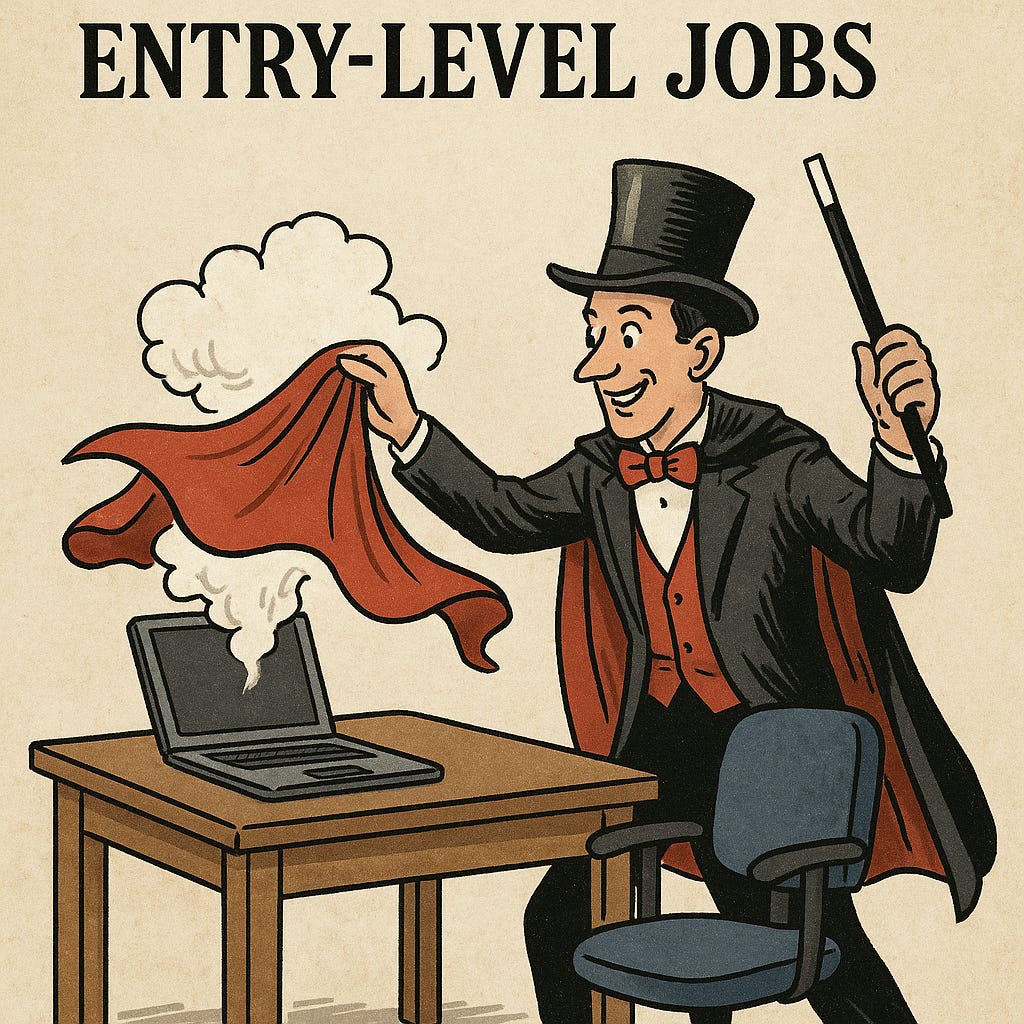
There's been a recurring offshoot of the AI conversation that’s become so apparent: nobody’s hiring for entry-level talent right now. We all agree this sharp drop in junior level hiring hurts everyone in the long run. (What will we do in ten years when there’s no senior talent available because they weren’t hired in 2025?) But none of us can justify prioritizing this headcount today.
I’ve thought a lot about this subject in recent months. While I can imagine how it must feel to have only an internship on your resume right now, I truly believe this entry-level pain is temporary and there’s a bright road ahead for tech and knowledge work. Here’s my take, and some advice for anyone early in their career right now.
You’re not imagining it. Entry-level jobs have plummeted this year, down 50 percent by some accounts¹. And it’s no longer attributable to post-COVID weirdness or a “tech recession.” This isn’t the tail end of a disruption. It’s the beginning of something much bigger.
The truth? AI is replacing entry-level knowledge work. But not because AI can do it all by itself. AI plus a smart, motivated human with subject matter expertise is a productivity monster. One person armed with GPT-4 can now do the work of many². This is true across nearly every job function in a modern software company.
On top of that, this major step forward in productivity potential comes just at the tail end of a tech downturn. And if we’re honest, that downturn was preceded by insane hubris and irresponsible hiring from big tech to small. Layoffs and bankruptcies are painful. A new pill for efficiency just dropped. So for now, companies don’t feel any urgency to invest in junior talent. They’re hiring less, stretching leaner teams, and delaying the next generation of employees in favor of equipping senior-level talent with AI to do more than they could before, and with less³.
Now, a case for optimism: this is temporary. If history has taught us anything, it’s that capitalism doesn’t use technology to do the same amount with less time. When technology leaps forward, economies produce more with the same amount of time. We don’t downshift. We level up. In a world where writing was done by hand, the first writer with a typewriter might have replaced the five writers next to them. But how long do you think it took before the chief editor realized they could achieve exponentially more with six writers, all equipped with their own machine?
Before we know it, companies will be doing more with more. The companies skipping junior hires today will be fighting over AI-native talent tomorrow. That shift is already underway, and if you miss it, you could be playing catch-up for years. By as early as 2026, it might be a full-on talent war for people who can wield AI fluently, creatively, and fast. Those who can’t could be left out.
This also means even if you're a senior person who’s not using AI, you’re putting your career in jeopardy. I don’t say that lightly. If you're at a company that prohibits AI, that’s not an annoying quirk. It’s a red flag. One of the best reasons to leave a job today is a culture of AI avoidance⁴. Run toward the teams diving in headfirst. Your ability to demonstrate AI fluency could be one of the most valuable lines on your resume next year and beyond.
Regardless of your spicy take on Shopify’s internal AI memo, I guarantee their AI-embracing culture makes them a prime company to poach from next year. (Why haven’t you applied yet?) Shopify isn’t alone. I’ve been so excited and amazed by how quickly and completely our teams at January have adopted and leveraged AI tools across the board. This is already an exceptional team, and everyone here has a head start for the next era of work over slow-to-adopt workplaces. (We’re hiring.)
I’ve always encouraged job seekers at every level to choose your next job for the accomplishments you’ll be able to brag about when it’s time to land the next one. Today, that advice is more urgent and more obvious. It’s AI.
So if you’re entry level and slogging through a historically difficult job search right now, here’s the deal. Your job is to find a job. Now is a great time to use AI to help you in that venture.
Do whatever you can to be marketable in the next age of work. Study. Build. Get dangerous with AI. In your spare time, spend four hours a day learning how to use AI to do incredible work faster than anyone else you know. Take courses. Start a portfolio. Remix ideas. Launch a side project. Write something. Solve something. Anything.
It’s okay to feel down about the market. But don’t sit on the sidelines. Prepare. Because the sooner you can sell yourself as an AI practitioner, the sooner you’ll rise above a flooded market and get hired. Not as a backup plan, but as a no-brainer.
Thanks for reading my very first Substack post. I started this newsletter because I believe the rules of work are being rewritten. And those of us navigating our careers in real time need honest, strategic, and sometimes uncomfortable conversations to stay ahead.
If you're a recent grad, early-career professional, or someone trying to future-proof your path, this newsletter is for you. I’ll be sharing practical advice, career frameworks, bold predictions, and maybe even the occasional rant, all grounded in experience and tested in the real world.
Subscribe if you’re interested in my take on the new era of work as a head of people and talent. Like a tree falling in the woods, I’ll be shouting whether you hear me or not.
SignalFire 2025 Talent Report and TechCrunch confirm entry-level job postings are down by 50% or more:
signalfire.com
techcrunch.comHarvard Business Review shows GenAI is saving teams hours each week and boosting output:
hbr.orgBusiness Insider highlights senior roles rising while junior roles decline:
businessinsider.comCFO Dive reports that 1 in 4 companies have banned or restricted AI tools:
cfodive.com
No posts
Comments
Nothing yet. Say the first thing.
Sign in to join the conversation.