
1 Kings 19.9-13
At that place he came to a cave and spent the night there. Then the word of the Lord came to him, saying, “What are you doing here, Elijah?” He answered, “I have been very zealous for the Lord, the God of hosts, for the Israelites have forsaken your covenant, thrown down your altars, and killed your prophets with the sword. I alone am left, and they are seeking my life, to take it away.” He said, “Go out and stand on the mountain before the Lord, for the Lord is about to pass by.” Now there was a great wind, so strong that it was splitting mountains and breaking rocks in pieces before the Lord, but the Lord was not in the wind, and after the wind an earthquake, but the Lord was not in the earthquake, and after the earthquake a fire, but the Lord was not in the fire, and after the fire a sound of sheer silence. When Elijah heard it, he wrapped his face in his mantle and went out and stood at the entrance of the cave. Then there came a voice to him that said, “What are you doing here, Elijah?”
I wonder what you’re doing here.
…
And I wonder what you made of that surreptitious silence.
Most of us, if not all of us, are deeply uncomfortable with quiet. Which is perhaps why there are fewer and fewer cases of silence in our daily lives. We are plagued by noise. But noise is better than silence. Silence means disconnection. Silence means we have to sit with our thoughts. Silence means stillness.
No thank you.
Perhaps it will come as no surprise to anyone here that I am absolutely numbered among those who don’t do well with silence. It helps to talk for a living.
Years ago, when I was in CPE (Clinical Pastoral Education), we had these mandatory meetings on Mondays during which we had to go through these intensive and reflective conversations about death and dying, suffering and pain management, and spirituality in the darkest moments. It was a group of six seminarians with one facilitator and I was the sole extrovert. So, each Monday, we would gather in this small conference room and our director would ask an open ended question of the whole group. I would sit there as everyone shifted nervously in their seats and when I could no longer stand it, I answered the question. And the next question. And the next question.
This went on for months. At least it did until one fateful Monday morning, the question was posed as usual, and I waited. I made eye contact with everyone around the table, willing them to speak, and when it felt like I was going to spontaneously combust, I opened my mouth to speak and the director said, “Taylor, if you say one word today I’m kicking you out. You have got to learn the value of silence.”
The prophet Elijah learned the value of silence the hard way.
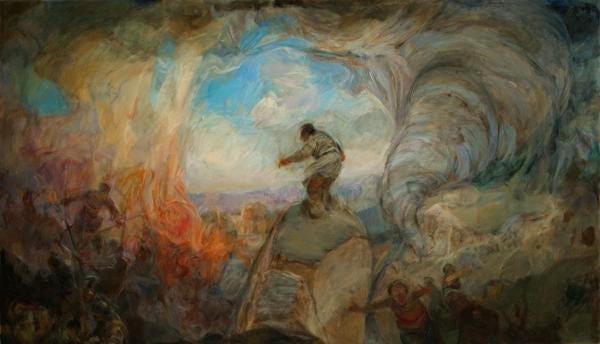
Here’s the story… Elijah shows up seemingly out of nowhere in scripture but he is filled with God’s Spirit to speak truth to power. He confronts the King, Ahab and says, “We’re going to experience a drought.” Why? Because Ahab’s wickedness and his idolatry set God’s people on a dangerous course. His wife, Jezebel has the King wrapped around her finger and she worships Ba’al.
Three years pass with no rain, and Elijah marches right back into the palace with news that its about to rain. And the King groans and says, “Here’s the trouble maker.” Elijah, in turn, says, “I’m no trouble marker, but you are. You have forgotten who you are and whose you are. You belong to God! We all do. But lets do this: Gather everyone at Mount Carmel, and make sure your wife is there with all her pet prophets, all four hundred and fifty of them.”
Inexplicably, Ahab does as the Tishbite commands and they all gather on the mountain. What takes place is one of the more radical moments in the strange new world of the Bible, with a decisive dose of God’s perfect power. The prophets of Ba’al are embarrassed in front of everyone and Elijah celebrates by girding his loins and praising the Lord.
This is what prophets dream of - The vindication of all their words through God’s presence and transcendence. Surely the people will now cast down their idols, even Jezebel will have to confess her foolishness, and they will finally become the people God always wanted them to be.
But it doesn’t happen. In fact, strangely, nothing happens. No one confesses their sin. No one is moved by what happened on the mountain. There’s no transformation.
What should be the highlight of Elijah’s prophetic power, his biggest moment on the biggest stage, turns out to be his biggest disappointment.
And not only that, but Jezebel, who was mocked by Elijah on the mountain, sends word to the prophet that his days are numbered and she paints a target on his back.
Elijah should be celebrating, but instead he has a crisis of faith. For the first time in his life he can’t hear God clearly, and he no longer knows if God hears him at all. So he runs. He runs to the only place where he knows where God spoke before, Mount Horeb (otherwise known as Sinai). The place where God appeared as fire, wind, smoke, cloud, and earthquake. He goes to where Israel was given direction, and Moses received guidance.
Elijah wants and needs what we call a theophany, a public presentation of God’s immediacy. It takes him 40 days and 40 nights to get there and when he arrives he hides in a cave.
And God says, “What are you doing here Elijah?”

That’s not a very kind question. “What are you doing here?” usually implies someone shouldn’t be there. It’s what the popular kids say to the not-so-popular kids at the party. And Elijah does what we all do when we hear the question, he justifies himself.
“Lord, I promise I’ve been very zealous. But the people haven’t listened to me.”
“Go,” The Lord bellows, “Stand on the mountain Elijah, I am coming by.”
A hurricane whips through the mountain shattering rocks in every direction, but God isn’t in the wind. Then there’s an earthquake and a fire, but God isn’t in them either. And then there’s nothing but the sound of sheer silence.
And that’s when Elijah hears the Lord. And God asks him one more time, “What are you doing here Elijah?”
Elijah had to learn the gift of silence. Of all the prophets Elijah delivers more fireworks than all of the others put together, but God speaks to Elijah in the silence because he needs to know, needs to learn, that God is always speaking and always with him, even when God seems silent.
I know a man who, after his wife died, fell into a great deep pit of despair. Everyone tried to pull him out of it with their words. Oh, God just needed another angel in heaven. She’s not suffering any more. He told me that the only one who said anything right was his best friend. I, of course, asked what the best friend said and the man told me, “He didn’t say anything. He just stayed by my side.”

Similarly, and this is perhaps not the best movie to reference in a sermon, but this same point is made in Quentin Tarantino’s Pulp Fiction. Uma Thurman’s character tells John Travolta’s character at a diner named Jack Rabbit Slim’s that you know you found somebody really special when you can just comfortably share a silence.
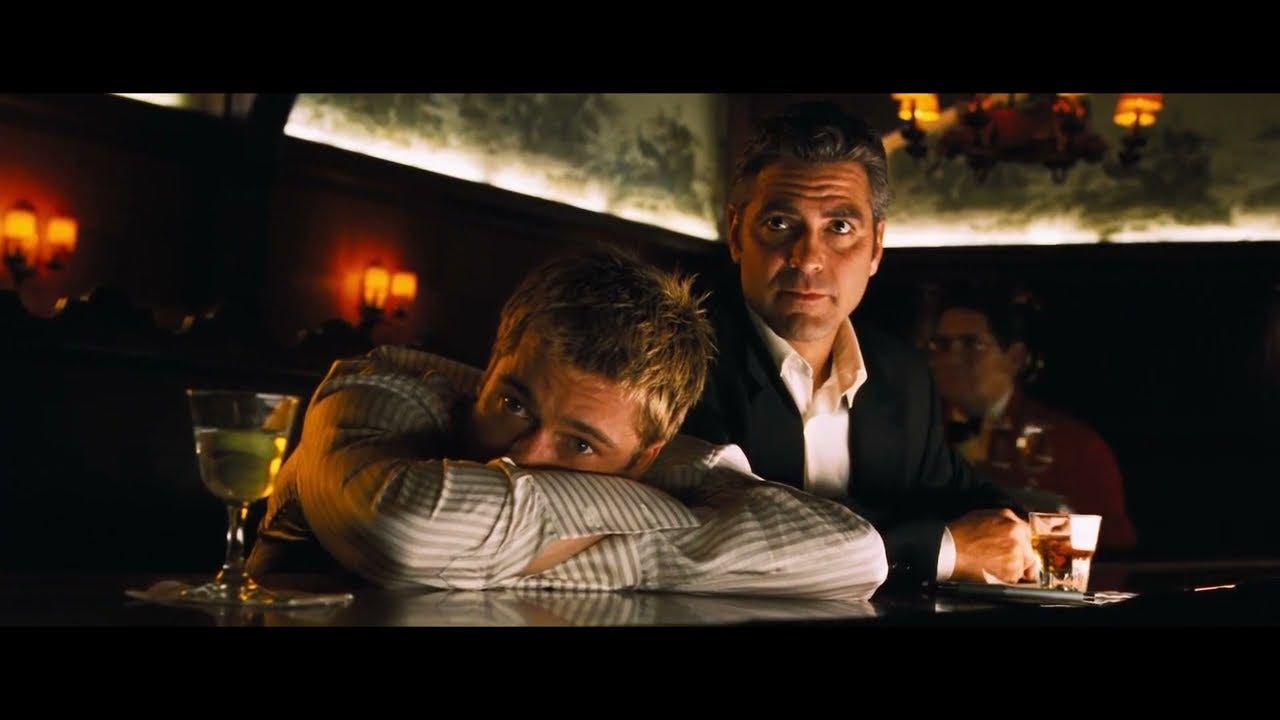
Or, a less salacious movie reference would be Ocean’s 11 when George Clooney and Brad Pitt are putting together the crew and Clooney character asks unanswered question after another while Pitt stays silent, and his silence is its own answer.
Part of the power of this strange story in scripture is its silence, but it’s also about how weird God can be.
Earlier in scripture, in fact near the beginning, when all is falling apart, God decides to start the whole creation business over again with a flood. God acts upon creation decisively. But then, God says, “I’m never going to do anything like that ever again.” Instead, God makes a covenant of subversion. God sets a bow in the cloud, a symbol of God’s hanging up the weapon used against wickedness or even stranger God points the weapon not at us, but at the Lord.
And the rest of the bible becomes a rhapsody of misdirection.
God tells Abraham that God will build a new city of promise but proposes an exceeding strange way of going about it, namely circumcision. God delivers people out of bondage an Egypt through blood smeared on doorposts. God witnesses wickedness among all sorts of leaders and sends backwater prophets to remind them of the truth. And then, strangest of all, God decides to enter triumphantly into the world to bring about salvation through the birth of a totally vulnerable baby born to a pregnant virgin and an older and overly taxed husband, and that child grows in wisdom and stature, embodying the kingdom in his own words and deeds, only to die for it, and then rise again so that we can do the same.
God is nothing if not full of surprises. God is fundamentally mysterious.
The truth, of course, is that we all wish God was a little more obvious. We, like Elijah, are looking for big signs and clear signals. But God’s love is not like the over-bearing parent who wants to do every little thing for their child to the degree that the child never does anything on their own. No, instead God shows up and speaks up and gets super quiet in ways that we can scarcely imagine but makes all the difference. God’s silence and God speech both speak volumes into our lives because, as Elijah learned, God is always with us.
Elijah’s talking got in the way of his listening. Trust me, if you talk long enough and loud enough you can convince yourself that your words are more important than the Word made flesh. He had to get quiet and hear the silence before he could truly respond to God’s question, a question that set him firmly on the foundation of God’s grace.
And God’s grace is fundamentally strange. It is everything for nothing. It is life to the lifeless, hope to the hopeless, and joy to the joyless. It is quiet in a world that has grown too loud. It is stillness when the world moves too quickly. It is amazing precisely because it comes to us as a gift.
I wonder what you’re doing here…
And I know that there are more than a few of us here this morning like Elijah, desperate for God to show up in a big way with some big words. We want to see God at work in a broken relationship, an unfulfilling job, a friend whose choices keep us awake late at night, in an unexpected diagnosis, in the fear about what tomorrow will bring.
And it’s not as immediate, or sudden, or big, or bold, or exciting, or visual, or powerful as a windstorm, a fire, and an earthquake. But sometimes God speaks the loudest in the silence and all we have to do is listen. Amen.
No posts
Comments
Nothing yet. Say the first thing.
Sign in to join the conversation.