

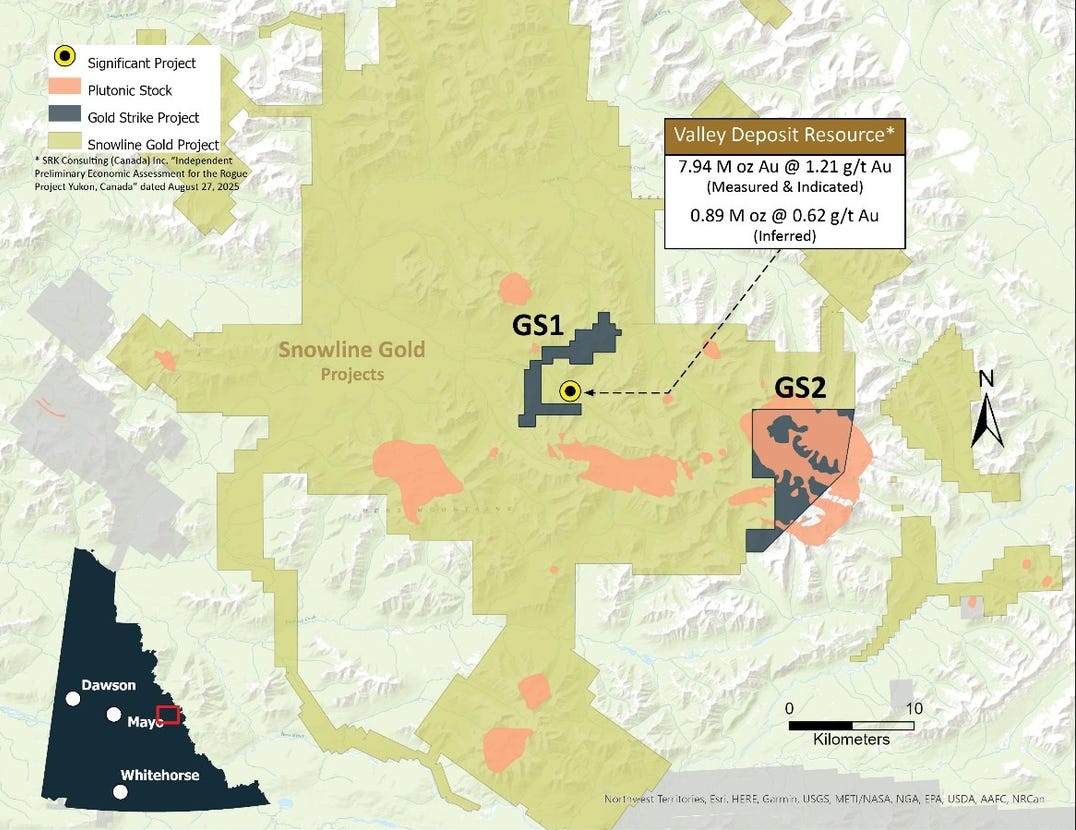
Gold Strike Resources Corp. announced the completion of the 2026 soil and rock sampling program on the GS1 property which is proximal to Snowline Gold’s Valley gold deposit.
HIGHLIGHTS
134 rock and 374 soil samples were collected on Gold Strike One (”GS1”) from July to early August 2026 providing property-wide coverage.
A previously unmapped 100m x100m intrusive outcrop was discovered in the southeast corner of the claims amongst coincident historic gold anomalous soils (see Figure 2 and Figure 3). The outcrop was sampled where the crews could gain access as well as its talus apron for float. Results are pending.
A 289.34 line-kilometre, 100m line spaced, airborne geophysics, magnetics and radiometric survey, designed to augment the geochemical/ geological understanding of GS1 has been completed. Results are pending.
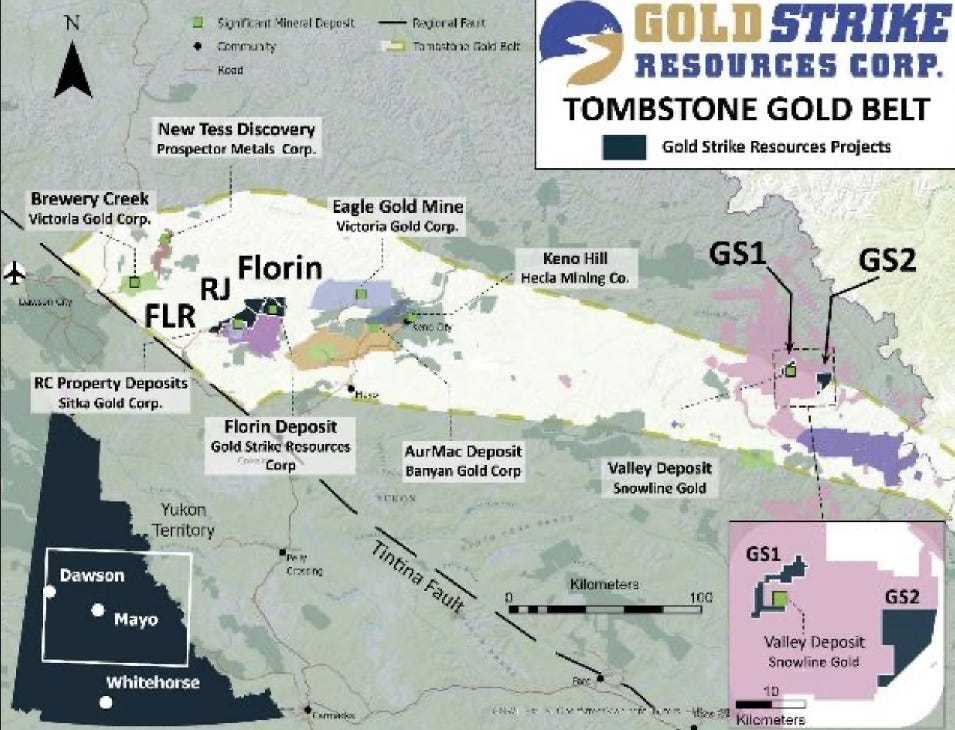
CEO Peter Miles said: “Gold Strike has been busy over the past two months with some 40 people working on advancing our five properties in Yukon: GS1, GS2, Florin, RJ and FLR (see Figure 1). We are now receiving data from our programs and expect to increase our news flow significantly over the next few months. GS1 is an important property for Gold Strike given its proximity to Snowline’s Valley gold deposit and we are pleased that our field crews have completed our 2026 program on GS1 which includes the discovery of an intrusive outcrop that we have sampled. Results are pending.”
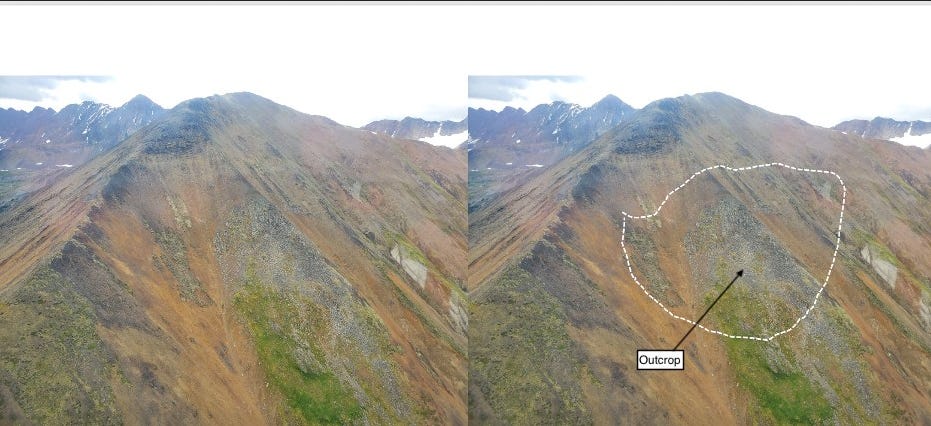
The intrusive outcrop (Circled above right) is about 100x100m, although exact boundaries are covered in scree or talus.
The 374 soil samples and the 134 rock samples were collected along ridge lines and valley contours at a nominal 100m spacing and have been delivered to the laboratory where they await assay. Results will be reported when received.
Previous soil and rock sampling program highlighted zones where the soils are anomalous in gold and or its pathfinder elements (As, Bi, Sb). This year’s program filled in and obtained closer spacing in the gold anomalous zones and sampled new areas giving the property a blanket coverage.
Gold Strike commissioned a 289.34 line-kilometre heliborne geophysical survey over the property which has now been completed. This low level magnetic and radiometric survey flown at 100m line spacing will provide key data that will complement the geochemical results. The Company will provide an update when the final data have been received and interpreted.
EDITOR’S COMMENT:
While this company is grossly undervalued on the basis of its 2.5-million-ounce gold deposit that will likely be enlarged with step out an infill drilling, the potential for a dramatic upside is related more to early stage exploration around the Sitka and Snowline deposits.
If you are interested in a greater geo-technical understanding of of the intrusion discussed above, you can read the entire news release HERE.
Goliath Resources reported that 2026 drilling thus far of the Surebet Discovery has resulted in expansion of the Golden Gate and Bonanza Zones on its 100% owned Golddigger Property. The Golden Gate Zone mineralized footprint is now 1.17 km2, representing a 38% increase compared to 0.85 km2 defined prior to the 2026 drilling program. The Bonanza Zone mineralized footprint is now 1.51 km2, representing a 19% increase compared to 1.27 km2 defined prior to the 2026 drilling program (see news July 15, 2026, August 10, 2026, August 11, 2026); both zones remain open for expansion laterally and at depth. All drill holes completed during the 2026 drill campaign have intersected quartz-sulphide mineralization which generally corresponds to high-grade gold mineralization. 59 out of 98 planned drill holes have been completed to date with a total of 34,990 meters drilled in 2026.
Mr. Kevin Smith, Founder & CEO of Crescat Capital and strategic investor states: “Goliath keeps demonstrating that its large, complex Golddigger gold system is expanding. The cool thing about this advanced exploration project is that three different styles of high-grade gold mineralization all come together in one big package. The work that Goliath is doing could lead to an economical and large gold deposit, so what’s not to like! I look forward to the barrage of assays still to come.”
For more details of a technical nature and numerous visual aids, read the entire news release HERE.
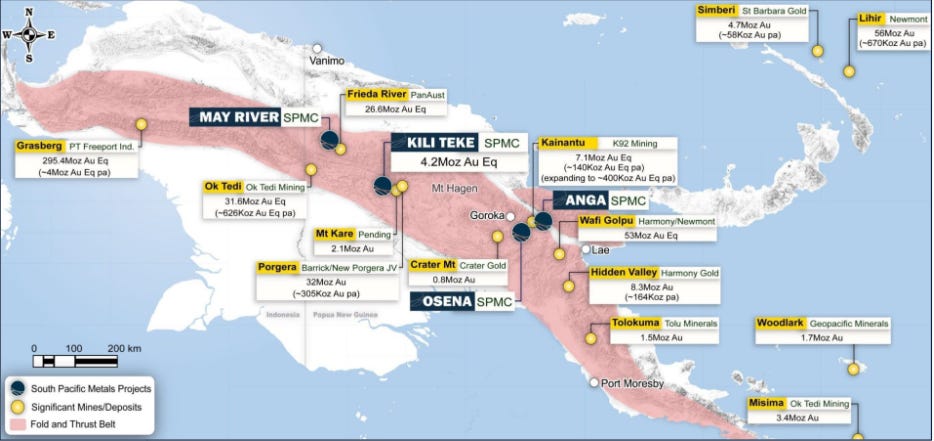
South Pacific Metals announced assay results from five drill holes, ONED26-010 to ONED26-014, at its 100%-owned Osena Project, located immediately southwest of K92 Mining’s Kainantu gold-copper mine in Papua New Guinea. The program involved step-out drilling along the Megabe structures, and a first test of an adjacent structure to the southwest. All five holes intersected mineralised structures. The four holes on Megabe mapping strike extension to more than 300 metres, and the structures remain open along strike in both directions and at depth; ONED26-010 confirmed that mineralisation extends beyond the Megabe corridor.
Highlights
More than 300 metres of confirmed mineralised strike at Megabe. Step-out drilling has traced continuous mineralised structures from ONED26-014 in the northwest to ONED26-012 in the southeast.
ONED26-011 intersects a potential fourth mineralized zone at Megabe. The hole returned 5.1 m at 1.79 g/t AuEq from 313.3 m, including 3 m at 2.66 g/t AuEq beyond the window predicted by the Company’s interpretation.
Information to date indicates the Company is above a significant intermediate-sulphidation epithermal vein system. Every reported hole targeting Megabe has intersected mineralised structures, from the first intercept in ONED26-007 (12 m at 3.1 g/t Au, including 1 m at 18.1 g/t Au) (see news release dated June 16, 2026); through the ONED26-009 discovery; four of the five step-out holes reported today cut Megabe in the upper part of the system, above the high-grade target zone.
Megabe is one of eight identified mineralised structures at Ontenu — most remain undrilled. Only small portions of three of the eight NW-trending structures — Jorkol, Onki and Megabe — have been drill-tested across the five-kilometre Ontenu trend (see Figure 3).
Geometry defined — drilling now turns to the high-grade target. The step-out program has delivered the structural framework to drill the high-grade target at depth and down-plunge to the southeast of discovery hole ONED26-009 — 5 m at 12.84 g/t AuEq (including 2 m at 28.06 g/t AuEq) and 12.2 m at 6.24 g/t AuEq (including 2 m at 16.65 g/t AuEq) (see news release dated July 6, 2026).
CEO Timo Jauristo commented, “These four holes confirm the Megabe structures hold together along strike, are mineralised, and indicate the upper margins of an epithermal system. We think the high-grade zones in hole ONED26-009 have only clipped the upper edges of the main system, and we will drill a few deeper holes below ONED26-009 to test for continuity of high grade in that direction.
“It is important to note that we are currently drilling only one small section of Megabe and it is just one of eight currently known NW-trending mineralised zones that have been mapped at Ontenu, most of which have yet to be drilled. We have commenced planning for the next phase of exploration to test these other known structures. Much of the Ontenu area remains to be mapped. Our immediate focus is the deeper high-grade at Megabe, targeting veins showing the same character as Kora and Judd next door at K92 — and will start drilling the first of these holes shortly.”
Vectoring High-Grade
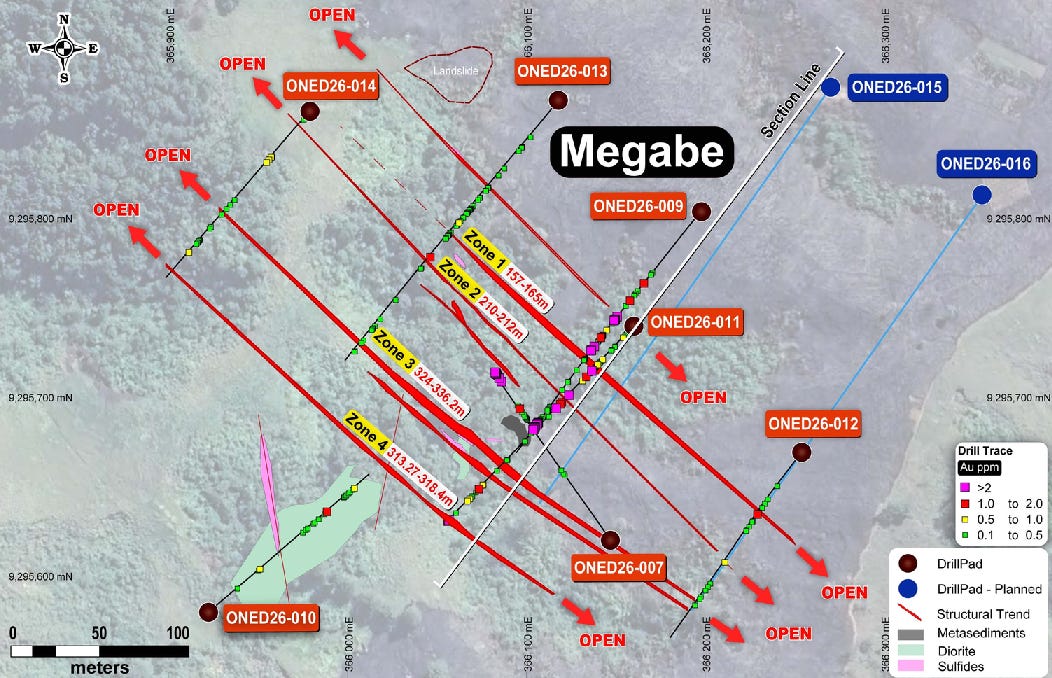
Four of the five holes in this program were designed to define the geometry and strike continuity of the Megabe NW trending structures. Every hole intersected the targeted structures, confirming that the Megabe trend is continuous over more than 300 metres of strik. The structures remain open along strike in both directions and at depth: ONED26-012 and ONED26-014 support the interpreted geometry of the structures, marked by the current limits of drilling, not the limits of the structures.
The step out drill program intercepted the top of the system, cutting the Megabe structures above the interpreted productive high-grade zone and within the leached horizon, an area that we now understand extends to at least 100 metres below surface.
Follow-up hole ONED26-011, drilled up-dip of previously released discovery hole ONED26-009, cut the Megabe structures within the window expected in the Company’s interpretation, returning 5.1 m at 1.79 g/t AuEq in a potential fourth mineralised zone (see Figure 2). The result of this drilling effectively supports vectoring towards stronger grades.
ONED26-010, tested a separate set of structures southwest of Megabe, intersected 18 m at 0.25 g/t AuEq — confirming that mineralised structures extend beyond the Megabe corridor.
Exploration manager, Octavio Garcia commented, “Following confirmation of the initial mineralised zone in drill holes ONED-007 and ONED-009, the objective of this step-out drilling program was to define the key geological parameters of the system, including its geometry, continuity, size, mineralisation controls and others required to validate the geological model.
“The results have confirmed several key parameters. Mineralised structures remain open in both directions, while geochemistry indicates strong potential for continuity over more than 300 metres of strike. We have also identified subparallel minor mineralised structures and a local leaching effect, similar to that observed in the Kora vein. The data provide clear evidence of an intermediate-sulfidation epithermal (ISE) system, comparable to neighbouring deposits. Recent drilling intersected the upper zone of this hydrothermal system, while also expanding the mineralised envelope. Further drilling is required to validate the geological model and determine the full extent of the system.
"The next phase will test vertical variability by drilling below the current mineralisation, helping establish the system's position within the hydrothermal system and guide targeting of higher-grade mineralisation."
Best wishes,
Jay Taylor
No posts
Comments
Nothing yet. Say the first thing.
Sign in to join the conversation.