
Most career advice for creative people with multiple interests leads you to one of two dead ends.
The first tells you to pick one thing, go all in, and stuff the rest of yourself away like a young Harry Potter in a cramped room under the stairs. The second tells you to “be yourself,” and it’ll eventually figure itself out. I tried both. The first built me a business but starved the rest of who I am. The second left me broke and directionless for years.
What actually worked for me sits in between: I found my problem cluster and learned how to turn it into stable income. And that’s why, at the time of writing this article, I’m the closest I’ve ever been to having my “dream job.”
I work for myself, from home. I write almost every day. I read manga. I work late into the night (any other night owls?) and wake up when I want to. I hop on calls with genuinely interesting people and help them synthesize their scattered interests and passions into writing that actually gets noticed.
I spent five years brute-forcing this into existence, and it’s the reason I now run a multi six-figure writing biz and a multi-dimensional brand out of interests I used to think couldn’t share the same spotlight.
Below, I’m going to break down the 5-step framework I used to turn my scattered obsessions into a high-earning career and multi-dimensional brand. But if you try to skip straight to the steps without understanding why your previous attempts failed, you’ll fall right back into the same two traps that keep most creatives broke or struggling. Starting with the most common trap in modern careers...

I grew up in Northern Canada, where it was pretty much the norm to become a welder, pipe fitter or rich but miserable rig worker, right out of high school. Pick one thing, work 60 hours per week in -40 weather, buy a house. Call it a life.
This is the typical career advice that our entire system runs on. Go to school, become a lawyer, or a doctor, or an accountant. Done. That’s it. Life decided. Most people value this certain but narrow path over the uncertainty of a creative, possibly more fulfilling one. This path gives them that. Fair enough.
And I have to admit, picking one thing did work for me in the beginning of my writing journey. When I first started writing on Twitter five years ago I wrote about random stuff I was interested in, and... few gave a shit. I struggled to gain a readership because no one had a real reason to follow me. It wasn’t obvious how I was serving them.
So I started writing about ghostwriting (otherwise known as niching down), landed my first ghostwriting client, wrote about that, landed more clients, and became known as “Taylin the ghostwriter guy.” I grew to 20,000 followers before writing about much else.
The money was great. Just a few $3,000 per month ghostwriting clients gave me the freedom to quit my college teaching job to become a full time writer. Some of you reading this will think, “that sounds like you already made it as a writer.” But you need to understand that for multi-passionate people, no amount of money can fix the guilt that bubbles up when you’ve neglected entire parts of yourself for years. I know plenty of people who left $200k+ salaries because their multi-faceted nature was drowning in zoom meetings, board rooms and corporate jargon. Maybe you know some of those people too.

The bad news is, that creative neglect builds up over years until you can't ignore it anymore. And when you finally decide to do something about it, the most natural move is to swing to the other extreme. To stop forcing yourself into a single box and just write about whatever you care about that day. It feels freeing at first. But without realizing it, you walk straight into the second trap that can leave you stuck and struggling to pay your bills for years...
Quick side note - In September I’ll be launching The Weekly Writers Challenge. If you struggle to write consistently, want to hone your craft, or crave being part of a community of budding writers, this is where we’re going to gather. Click below to join the waitlist if you don’t want to miss the details & launch window:
Up until the last year or so, every time I tried to build a brand around my random ADHD interests I’d hit a wall. I told myself things like:
I am the brand
My voice is my brand
I am the intersection of all my interests and then some
Armed with this advice, I wrote about whatever the hell I wanted. As long as I do that, my multi-interest brand and career will slowly birth itself into existence. Right? (Please let it be right.)
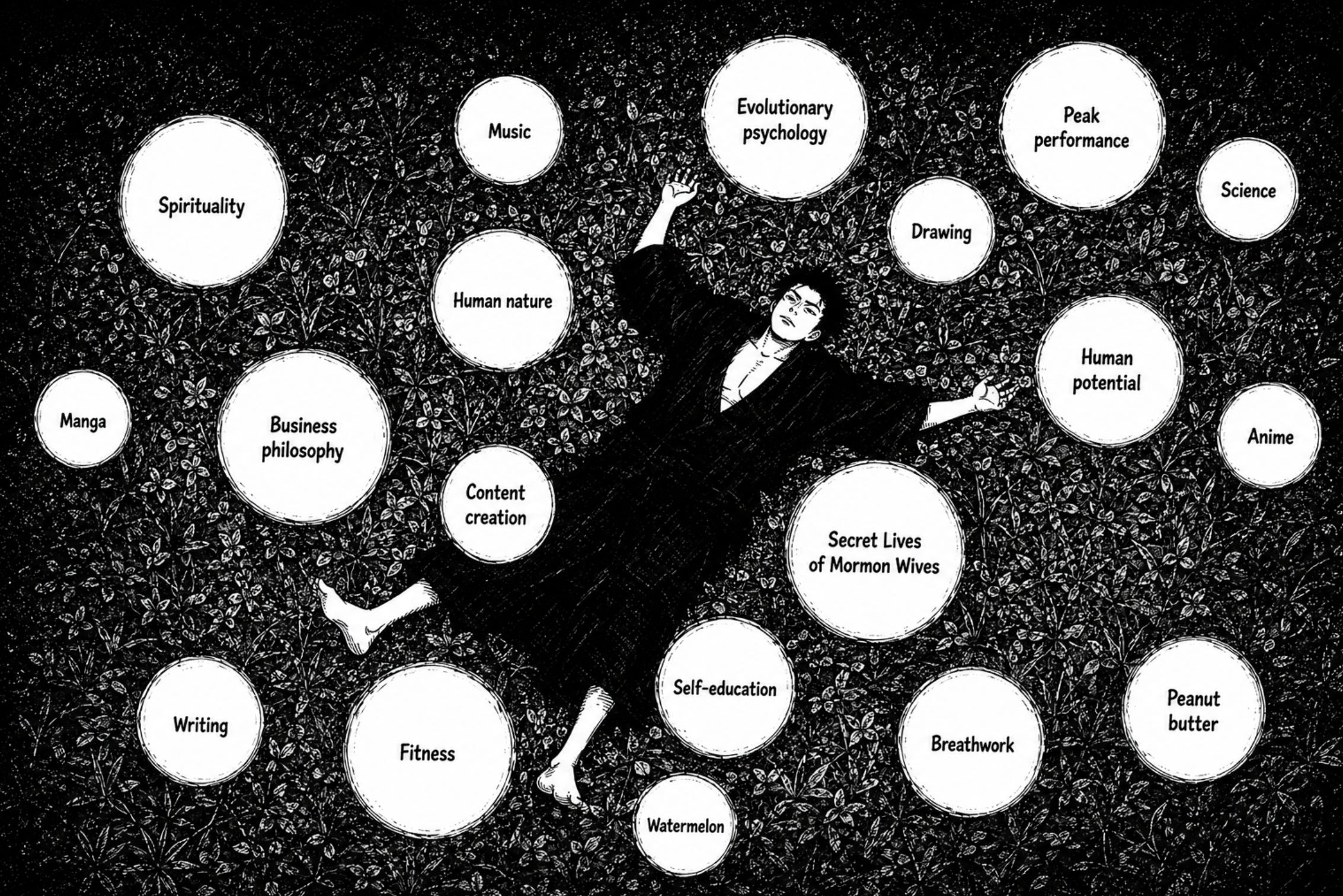
But when it came time to make money, few people bought what I was offering. There were stretches I could barely pay my bills, and I got close to going back to just being the ghostwriter guy again. Cause hey, at least it’s somewhat creative. And allows me to work on my own schedule (which is something that’s hard to give up once you live it).
In hindsight this happened because most multi-interest advice falls into one of two buckets and each comes with its own failure mode:
a) Advice like “you are the brand, just post about all your interests and it will work out.”
This tells you what’s possible but not the steps to get there. And that hope is quickly taken from you as you struggle to earn stable money with multiple interests.
b) Tactics like “time-block better” or “prioritize your main interest and squeeze the others in on evenings and weekends”. Fine. You’ve given me a decent path to learn multiple skills. But how do I turn this into stable, predictable income? And what’s that trajectory? Where’s the thing that tells me how to shape my work and life around what matters most to me?
It’s frustrating because standard career advice doesn’t offer much middle ground. You’re given a choice between a narrow niche that pays well but feels robotic, or an open field that feels creative but barely pays. I see creative people like Naval and Taleb living in the middle, but there isn’t a clear blueprint to bridge that gap. This is the mechanism that connects all those scattered pieces to steady income.
Path 1, pick a lane, has a clear path. But succeeding with multiple interests is a pathless path. That’s what’s so damn frustrating about it. I saw people who pulled it off:
Naval Ravikant:
- Wealth building, Spirituality, Writing, Philosophy
Donald Glover (AKA Childish Gambino):
- Comedy, Writing, Acting, Music, Performance, Directing
Dr. Alok Kanojia (Dr. K):
- Psychology, Gaming, Spirituality, Neuroscience, Ayurveda
...and these are just a few well-known examples.
Deep in my being, I knew it was possible. I just didn’t have the clarity needed to do it myself. Yet.

After five uncertain years of exploration, I finally figured it out. It’s not another aspirational mindset shift. It’s a real step by step process that synthesized all my crazy obsessions into a stable career. And it’s the reason I’ve been able to earn just shy of $18,000 last month as a writer on the internet.
I had the pleasure of testing this idea live at the Future Proof Summit just a few months back. It was one of the most talked about ideas that weekend. And if you ignore it, no amount of passion will make your creative work financially viable. For the first time, in writing, here it is...
Before any of this lands, we have to reframe what a job even is.
A job isn’t something you do in exchange for money. It’s a problem you solve in exchange for money. A plumber is known for fixing your pipes. A doctor is known for making you healthy. A lawyer is known for making sure you don’t end up in jail when you pass Go. Every one of them gets paid because they solve a specific, recognizable problem that someone else can’t.
So when the niche-down crowd tells you to “get known for one thing,” what they actually mean, whether they know it or not, is: get known for solving one problem people will pay you to solve.
And they got that part dead right.
The mistake, however, is assuming that “one thing” has to be narrow. It doesn’t. It can be big. Big enough that solving it actually requires multiple interests...
I call this your problem cluster: the specific bundle of interconnected problems that solves one big problem... and requires everything you care about to solve.
Here’s my problem cluster as an example. As you can see, I’ve grouped them into three sub-problems, which combine to solve my big problem: Helping people with multiple interests build multi-dimensional brands.
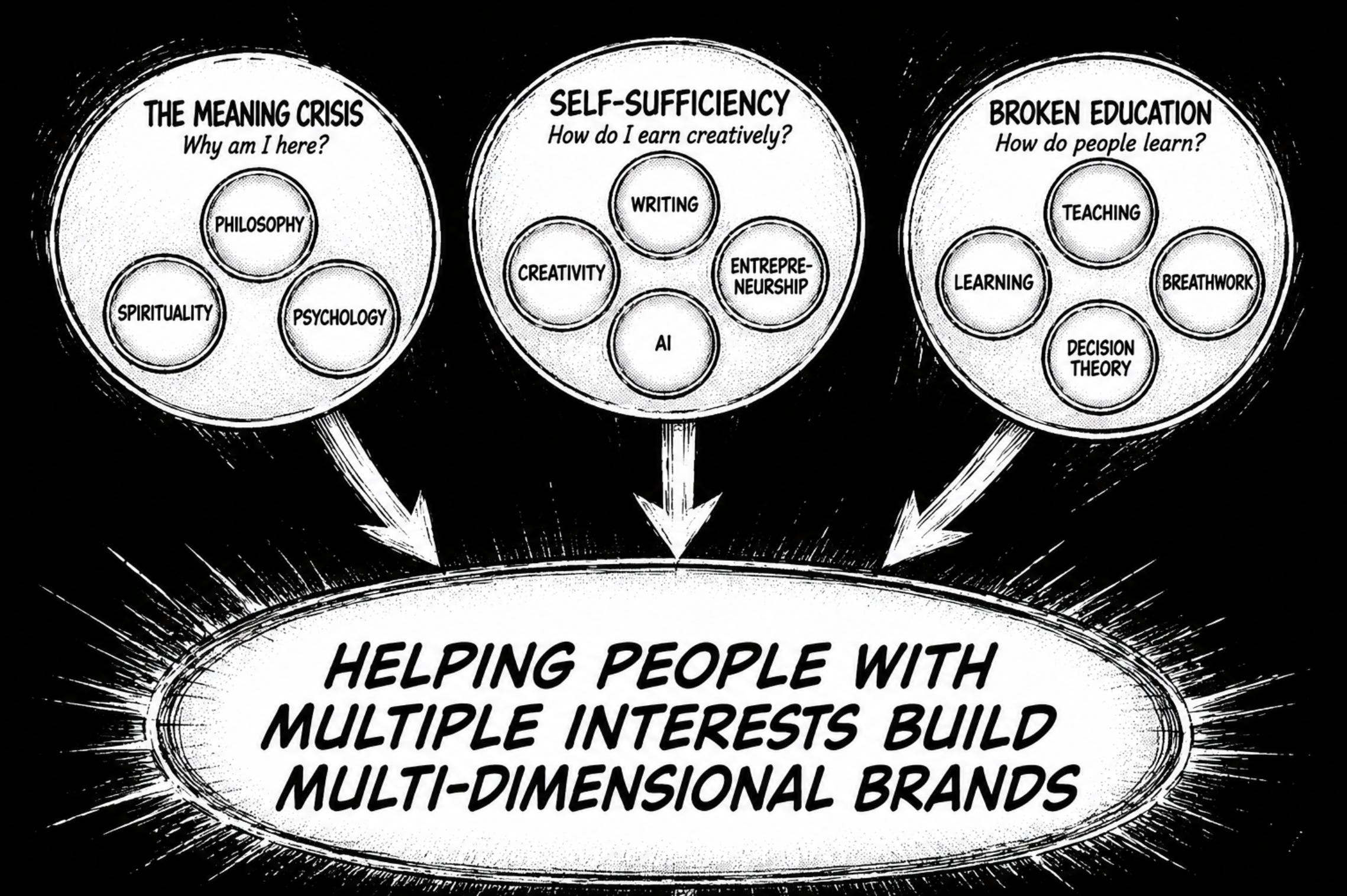
I’m still known for one thing. That thing is just big enough to have room in it for my “scattered” interests.
Da Vinci gets dragged out every time someone wants to prove you can thrive with multiple interests. Honestly he’s been beaten half to death as an example. But I think most people misread him.
Imo, Da Vinci wasn’t interested in everything. He was obsessed with one thing that happened to have many different manifestations: representing the world accurately. That single obsession is what forced him into engineering, physics, anatomy, cartography, perspective. He didn’t study those as separate hobbies stacked on a shelf. He learned them on the job, because you cannot accurately draw and paint and invent the things he wanted to create without solving every one of those problems first.
That’s a problem cluster. Not just an intersection point where your interests happen to overlap. I’m talking about a problem that uses every one of them. Each interest becomes a tool, each tool solves a sub-problem. Solve enough of the little ones and the big one becomes solvable.
In a second we’ll get you started on an exercise to help you find your problem cluster. But first, there’s a limitation here I need to be honest about. Because it’s a trap I see many creative people fall into on Substack. And it’s why they struggle for years to earn real income creatively. They build a cluster so broad that it sounds profound to them, but gives a potential reader little reason to pay for it.
If this article is hitting a nerve for you, and you think it could help someone else, feel free to share it with your multi-passionate friends.
“I want to help people live a meaningful life”
“I want to help people live intentionally”
These sound like problem clusters. But they’re so universal they don’t actually point at anything. You haven’t found a cluster, you’ve just described being human.
There’s a sweet spot here. Too broad, and you end up sounding like a life coach. But too narrow, and you’re back to neglecting the parts of yourself that matter most.
But when you do land in the sweet spot, something rare happens. There’s almost no one walking around with enough tools in their kit to solve a problem this big. So when you become the one who can, you stop competing with the narrow specialists altogether. You can actually earn more than them, because almost no one else is equipped to solve what you solve. That’s one the true benefits of becoming multi-disciplinary (also known as a multi-specialist).
Once you hit that sweet spot, you stop fighting for attention in crowded niches because you're solving a problem that few people have the tools to fix. Here is how to map yours out in five steps.
Write down everything you’re genuinely interested in
Brain dump it totally raw, don’t overthink it, and do not filter for whether the interests “fit together” yet. Two things, ten things, fifty things, it doesn’t matter. Just get them down and let yourself feel through the list.
Sort them
There’s a difference between an interest and a passion. An interest means you’re still exploring it. Like browsing tools at Home Depot. A passion means you’ve explored it, realized you love it, and you want to keep practicing it. Your passions are the tools you actually commit to picking up.
And if you’re earlier in the journey, say you’re 18 and you don’t know your interests yet, that’s fine. It just means your real first step is exploration. Go try things, and write down whatever you’re even curious about exploring. That list alone is enough to start pointing you toward a direction.
Use AI to find your problem cluster
This is the part that used to take me years of confusion, and now takes an afternoon.
Put your whole list of interests into AI and have it do two things. First, map every interest to the sub-problems it could help solve. Second, look for the bigger problems and clusters that would require several of those interests working together, and surface the career directions that sit on top of them.
What you’ll walk out with is a shortlist of problem clusters you’re uniquely positioned to solve, because they happen to need the exact combination of tools you’ve been collecting your whole life.
If you’re a paid subscriber, I’ve got a prompt for you that streamlines this.
Also, I’ve recently added a 20-minute 1-1 Substack audit to the list of benefits you get as a paid subscriber.
Quick note before we continue.
Steps 1 to 3 work for everyone. They hand you your cluster. What comes next depends on what that cluster turns out to be.
If your cluster lines up with a job title that already exists, and that job needs a gatekeeper’s credential to practice (a psychologist, a lawyer, a doctor), your path might be the traditional one. Go get the credential. But then bring all of your interests into that role so you solve bigger, weirder, more human problems than the people who only trained for the narrow version.
Think back to Dr. K. He went the traditional route and became a psychiatrist. But he also trained as a monk, got deep into meditation and spirituality, and clawed his way out of his own video game addiction. Now he can solve a whole class of mental health problems that a standard-issue psychiatrist can’t touch, because he’s lived the spiritual, meditative, and addiction side of it too.
But if your problem cluster doesn’t map to a traditional title, or it does and you just don’t want to walk the traditional path, that’s your signal. You’re going to have to build your own multi-interest career. Become known for the thing, and build a readership or a following around it. Steps 4 and 5 are your roadmap.
Learn by picking a project that demands all of you
Now you have to actually get good. Good enough to be known for your problem cluster, and to get paid for it.
The way you learn to solve a big problem is not by studying its parts separately. It’s by picking one project that requires all of you at once. Right now, for example, I’m vibe coding a piece of software that’s well beyond my current ability. I’m not studying code during the day and then studying design in the evening and then studying marketing on the weekend as separate subjects. I’m learning each thing the moment the project demands it. Some days I’m stuck on a coding problem, so I learn code. Some days I hit a design wall, so I research design right then, at the bottleneck.
That’s how you learn many things at once. Most people study everything separately, hoard skills, and tell themselves they’ll need them someday... for a project they never actually start.
Don’t do that. Pick the project that needs everything, and learn everything as it comes up.
Build your digital resume in public
While you’re building the project, start building the thing that attracts clients: your digital resume.
For me that means writing on Substack. Two notes a day, one article a week, all of it about what I’m learning and the progress I’m making. This does three things at once:
You learn in public.
You build genuine expertise around the work.
You attract like-minded people, some of whom become the customers who pay you.
Sometimes the project is the publication. If that’s the case you’re killing two birds with one stone. I wrote a pretty extensive breakdown on how to grow your Substack by 500 subscribers per month. You can read it HERE if you like.
... and then you stay consistent.
You run this loop over and over, iterating as you go, until you’re getting paid for it.
Will this take off in the next three to six months? Probably not. Will you have a full-time, stable career from it within a year? Maybe, maybe not. For most people, honestly, the answer is no.
But if you run this exact process for somewhere between one and five years, do you have a real shot at becoming a creative person with the agency to build your own career and earn a stable, honest, soul-led income without amputating a single interest? Yes. You do.

I know, because it’s what I did over the past five years. And as much as I wish it hadn’t taken five years to figure out, it was the most meaningful, fulfilling journey of my life to date. The doors it’s opened, the fiction I can now write toward, the people I’ve met, the memories, made all of it worth it. Not one piece of that was on the table back when I was a college teacher.
So that’s my challenge to you. Not just “be yourself,” and not the dreaded “niche down.”
Find your problem cluster and work towards solving it in public.
- Taylin & Dale
No posts
Comments
Nothing yet. Say the first thing.
Sign in to join the conversation.