
Over the past six months I’ve grown to 27,000 Instagram followers, built a newsletter 18,000 people read each week, taken on my first $2,500 client, and landed a job that came straight out of building this in public. All on the side of a full-time job, on about 16 hours a week.
People assume it’s because I’m good with AI. Or because I’ve been using it for longer than everyone else.
It’s not.
The truth is, it was never about AI. Everyone has the same AI tools now. The only edge left is you. Your judgment, your taste, your vision, your action. And how well you can get AI working around all of it.
I figured this out 7 months ago when Claude Cowork was released and I finally stopped collecting AI tricks and did something almost nobody talks about.
I built an AI operating system. And I’ve been pulling ahead of 90% of people using AI since. I’m saying that fully aware of how up myself it sounds. But it’s true, and it’s the whole point.
The hard part was never the tools. AI isn’t hard to talk to. You know how to prompt, you’ve made a few projects and tried out Cowork, you’ve built skills and saved prompts and brainstormed use cases in a folder somewhere. You have all the pieces.
The hard part is building the system that truly connects AI to you.
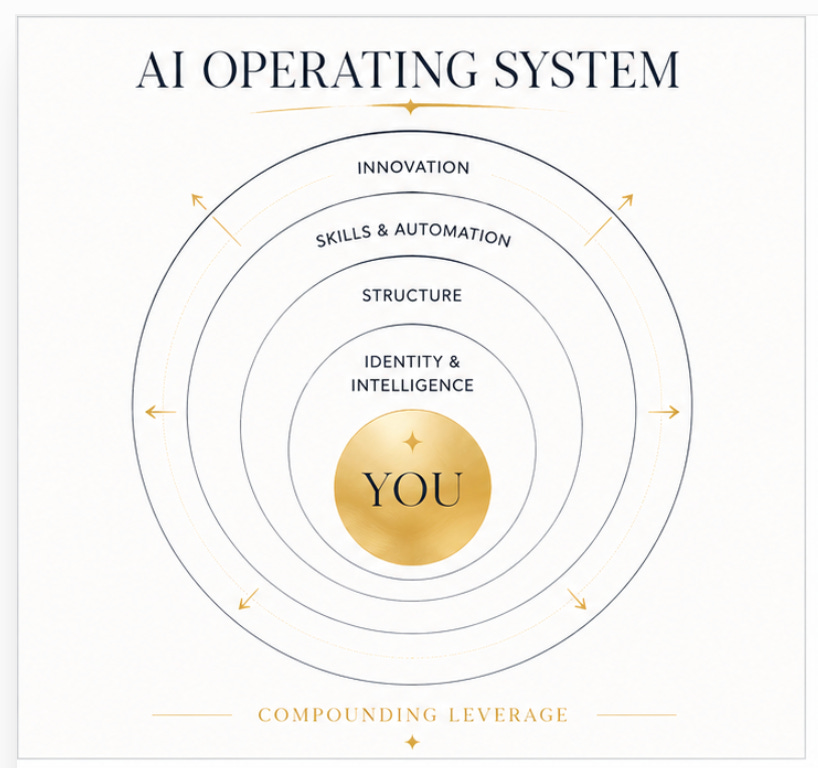
Today I want to hand you the exact system I’ve been building over the last six months to do this. Five layers that take your judgment, taste, knowledge and expertise and put the right AI tools in place to compound them.
I call it your AI operating system. You build it once and it gets better every time you use it.
This will be a long newsletter. But I’ve spent 10+ hours writing it to make sure it’s one you won’t forget about.
It’s something you’ll want to save, take notes on, and set aside time to action. I’ve saved the most important layer for last, because without it the other four won’t work. All I ask is that you dedicate your full attention to this. It will be worth it.
AI is a stranger until you tell it who it’s working for.
The ancient philosopher Aristotle had a line for this. Agere sequitur esse. Action follows being. A thing has to have a defined identity before it can act with any meaning.
When it comes to AI, if you don’t give it a ‘being’ through context files, its actions will always be generic. A precise average of everything on the internet.
Every time you’ve written custom instructions for a Claude or ChatGPT project, or set up a context file, that was you building this layer. You were giving AI a being.
There are two parts to doing this well:
Context is who you are
How you work
What you’re building
Who you’re talking to
What you would never do
How AI should work with you.
My Dangerously Educated setup knows my audience, my boundaries, my voice, and the fact that I will tear it apart if it generates anything with em-dash.
Content is what it can draw on to make well-informed decisions and produce higher quality results.
My swipe files
A survey of my audience
Brain dumps from my walks
10 examples of my top performing posts
Transcripts of meetings with clients and sponsors
The best thing you can do to build this first layer is to start a habit. Treat AI like the facebook ad algorithm that’s listening to your every conversation and tell it absolutely everything.
I no longer have conversations at work without a transcriber running, even if it’s an in-person meeting. I revisited my content strategy last week by going for a two-hour walk voice-noting Claude through my entire thought process. And I know some of you won’t want to do this because the lack of privacy feels uncomfortable. That’s okay.
But I can say with no shadow of a doubt that my AI system is getting better every single day because of the sheer amount of context it has access to.
(I’m not condoning this at all and I do think there was a lot of AI-washing involved, but a big part of the reason Square and ClickUp have been able to lay off so many workers is because they’re remote-first companies. Everything is recorded or written. The sheer amount of context means their AI capability skyrocketed).
Another fast way to build this layer is to let Claude or ChatGPT interview you. If you’re working on a new project with AI, paste this in to generate a new context file:
You're helping me build a context file so you understand my work without me having to re-explain it every time.
Interview me one question at a time. Don't move on until I've answered.
Ask me about:
- who I am and what I'm building
- who I'm talking to or serving, and what they need from me
- how I work, and what I care about
- my standards: what "good" looks like to me, and what I'd never put my
  name to
When the interview is done, write it all up as a clean context file I can save and reuse. Keep my actual words where they matter. Flag anything you think I should add later.
If you’re working on an existing project and want to improve the context AI has access to, use this prompt:
I've been using AI but I want to improve the performance by giving you more context. Review the information you currently have access to, then assess whether it is working, incomplete, or missing entirely. Identify if there's any information that would help with the tasks we work on together, and interview me to gather that additional context. When the interview is done, write it all up as a clean context file I can save and reuse. Keep my actual words where they matter. At the end, give me a full summary of your findings and changes made.These work across all platforms and all modes (i.e. Claude Chat, Cowork, Code, ChatGPT, Codex, Gemini, etc.).
Installing a speech-to-text tool like WhisprFlow or Resonant is extremely helpful for this. When I was forming this habit, I also set three daily alarms at 8am, 12pm and 6pm, as a reminder to brain dump anything that would be helpful context.
As you start doing this there are two main problems you’ll run into. Problems you might already be facing as you’re using AI.
First, where this context lives. The last thing we want is for your entire brain to be stored in a Claude project you can’t export.
The second: we don’t want to overload AI with information. It doesn’t need to read your content calendar to build a client deliverable. The key is to give AI everything it needs for the task you’re working on and nothing more.
Our second layer solves both these challenges.
A brain full of knowledge is useless if it can’t find anything.
We all remember the mass migration from ChatGPT to Claude at the start of this year. What’s been less talked about is the transition many are now making from Claude Code back to Codex.
What I’ve come to realise is that I need a system structured clearly enough that it doesn’t matter if I’m in Claude or ChatGPT or whatever ships next year. A system that doesn’t force me to choose between Cowork or Code.
A system where all my context lives in one place, set up so any AI tool can read it like a well-organised filing system. It knows where to look, pulls what’s needed for the job, and doesn’t have to read through the whole library to do it.
At work, I also need a system that allows me to share context and skills with my entire team.
That’s where the idea of the AI Operating System was born.
In practice, it’s just a folder. But it’s a folder that contains your entire brain, everything you want AI to access and everything AI has ever created for you.
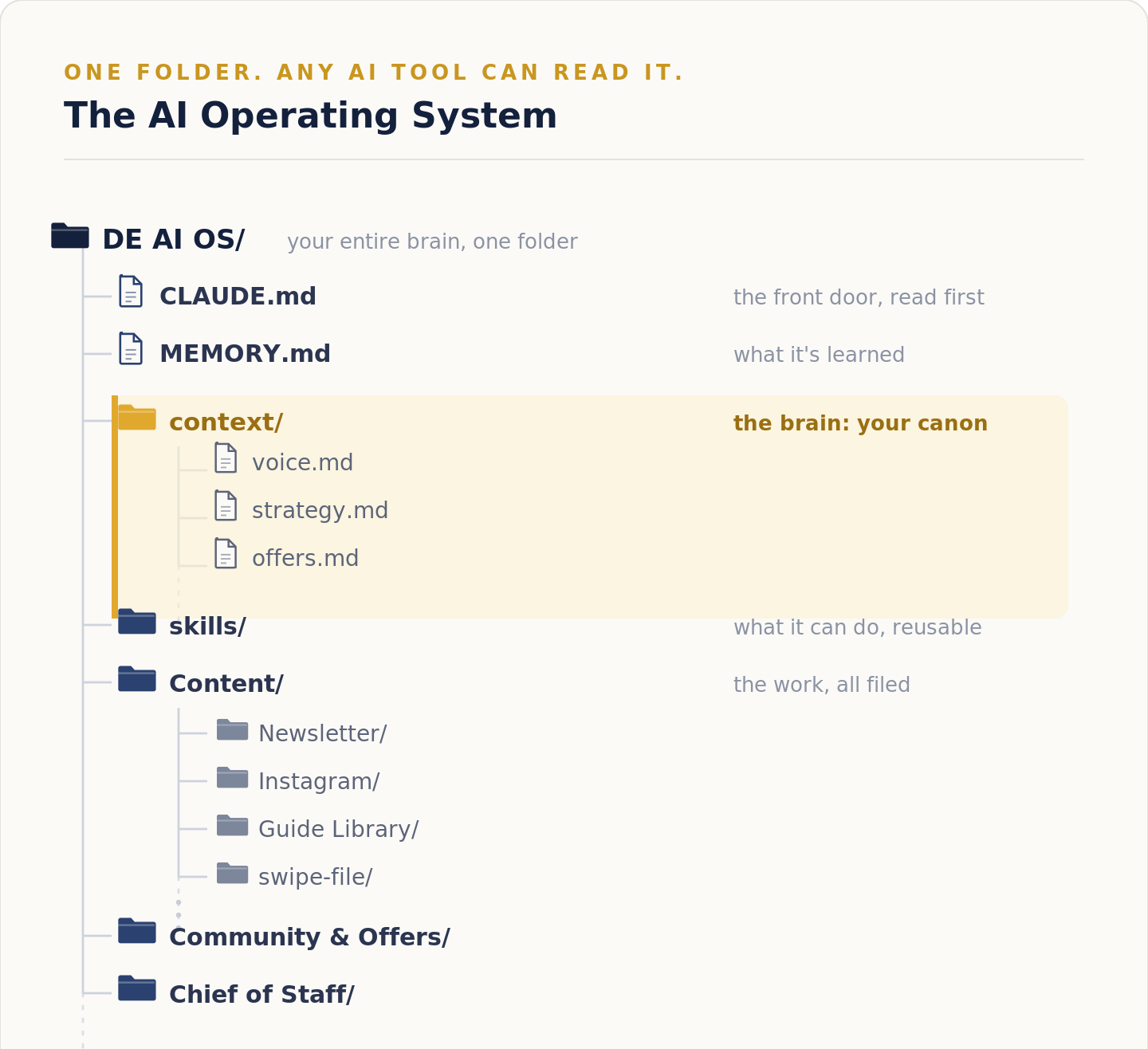
This folder is why I basically live in Claude Cowork now instead of Chat. I don’t really have to worry about updating project instructions or documents anymore, because it’s all live in my folders.
Get this right and layer one stops being a pile of documents or context sitting in random chats and becomes something Claude can actually navigate.
If setting up this structure is the thing standing between you and actually having this done, I’m putting together something that might help. A small group, building the whole system together over a few weeks, with someone walking them through each layer. More on this at the end.
Challenge is inevitable in life, and thank god for that. Because progress only comes through overcoming challenges. And life, like a video game, becomes truly addictive when the progress never stops.
This is a direct reflection of how I think about the role of AI. You don’t want to play the same level in a video game over and over. You want to keep facing bigger challenges because that’s how you level up.
But unlike video games, there’s a certain level of maintenance and monotony that comes with life. The boring and repetitive is non-negotiable. You can’t stop marketing or responding to emails or delivering for clients once things are working, or they stop working quickly.
But imagine if you could capture the work you do once, hand the brief to someone who costs $20/month, never sleeps, is always available, and gets that work done while you move on to the next task.
Better yet, imagine that this worker, once trained, repeats the process perfectly. You can give a one-sentence brief and come back to find your task 80% complete, ready for you to put the final touches on.
That’s what skills and automations do. AI handles the repetitive work, while you get to tackle the real challenges.
2 weeks ago I wrote a whole newsletter on skills and shared some of the ones I use every day. In short, I think of skills as a team of employees I’ve trained.
A researcher
A lesson designer
A newsletter editor
A content repurposer
A brand-deal manager
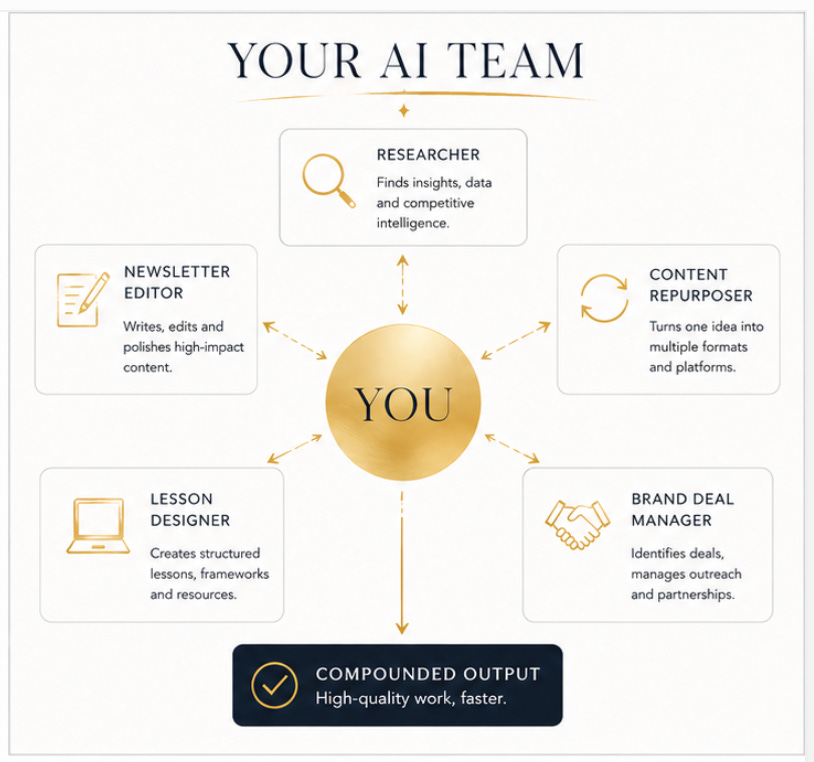
Each one knows its job, my standards, and the way I like it done.
Turning a newsletter into a carousel post used to take me three hours. My repurposer skill now does the first draft in 5 minutes and gets me 80% of the way there.
Speed is only part of it. The bigger thing is that every workflow you build is one less thing you have to dedicate your precious focus and mental energy to.
You might be starting to see how the layers connect. You tell Claude to use a skill to complete a task. AI takes that skill, searches your structure for the right context and content, and executes, delivering the result straight back into that folder structure. Because of that folder, the same skill works across Codex, or for another person on your team. It’s a library of information and instructions you can take anywhere.
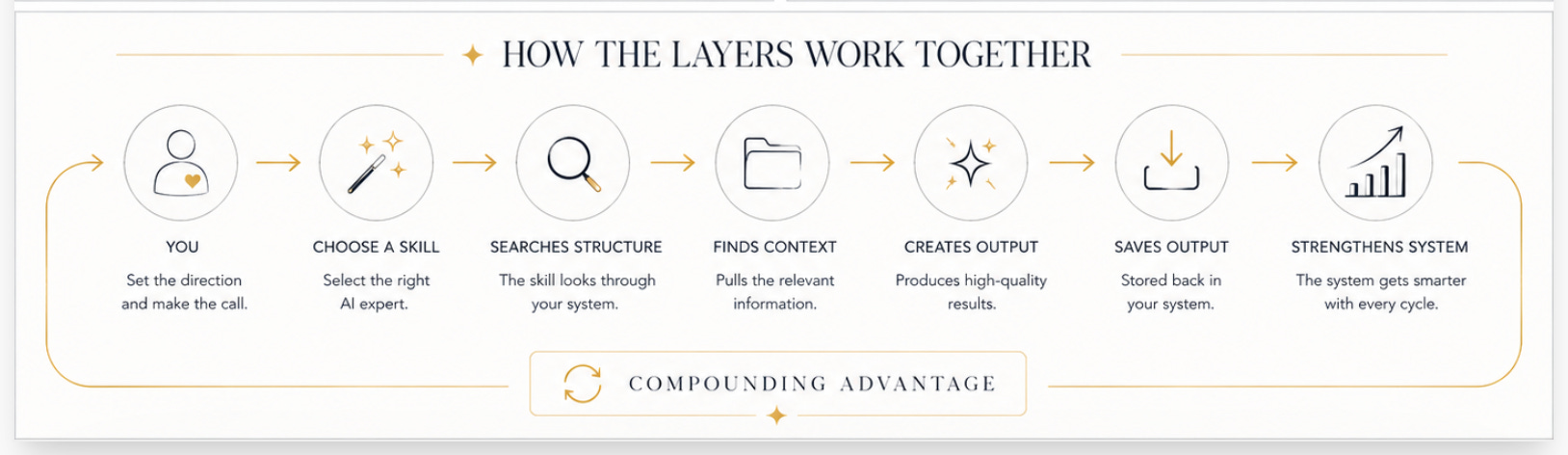
And when you get this right, you get to do something most people haven’t even considered yet.
“If something is permitted by the laws of nature, then the only thing that can prevent it from being technologically possible is not knowing how.”
- David Deutsch
There are two ways people use AI.
The first is efficiency: what am I already doing that I wish took less time? Sorting emails. Checking industry news. Pulling reporting dashboards. This is where most people start, and where most people stay.
The second is innovation: things that weren’t realistic or even possible before. Linking current events to your content strategy or to guide your financial decisions. Building brand new apps. Sharing proposals, resumes or strategies as websites instead of static documents.
I think the next generation of serious wealth comes from here, from people who go beyond automating old tasks and start solving problems that were previously unsolvable.
Most people never get to innovation because they’ve only ever been taught to think inside the lines. School and society train us to fit in a square box.
But innovation is the very thing that drives human progress. The lightbulb, the car, the internet, the computer - they were all created through a process of innovation. Combining multiple ideas in a new way, or taking a pre-existing concept and approaching it in a new light made possible by technological developments.
Last week I built an app that maps every coffee shop on the Gold Coast, filterable by indoor versus outdoor seating, coffee type and atmosphere. I shared it with my friends and we’ve been using it ever since. Two years ago that required a developer, a database, and weeks of back-and-forth. I literally wrote three prompts.
I now present strategies at work using html websites AI builds for me. Instead of a written plan that loses people halfway through, I can take our founder visually into the future I see us creating.
Innovation is the primary reason that humans have evolved beyond 99% of other living creatures on this planet. It’s the reason the modern standard of living far exceeds that of King George III back in 1815.
Once the first three layers are in, you can stop asking AI to help with existing work and start asking what’s possible now that wasn’t last year.
That question is where the fourth layer lives.
And the answer depends almost entirely on what comes next.
This is the layer you’ve had all along. It’s also the only one that really matters.
My follower count hides the truth. The only reason that I’m good at ‘AI for your business and brand’ is because I’m good at the things underneath it.
I’ve been learning business, systems, psychology, copywriting, content creation and sales for the past five years.
I made my first social media account in 2020 documenting my journey of losing 20kg during covid. I’ve been posting every week since.

I spent hundreds of hours reading books and listening to podcasts. I’ve invested over $10,000 in my own skill development, joining courses and masterminds for personal branding, mindset, business and more. Not to mention a five-year university education.
I’ve worked in small businesses since I was 19 seeing exactly how things run behind the scenes. I’ve already sold my own digital products and done coaching and consulting in the past (if anyone was here during the Notion Digital Home Base days, you’re a real one).
AI didn’t make me good. It turned up and multiplied five years of work I’d nearly given up on hoping would pay off.
I think that’s what gets lost when people reach for AI to do their thinking for them.
We’re drowning in sameness. Everyone wants to stand out, nobody wants to be different, and AI is pouring petrol on a fire that was already burning. It’s trained on data. Zeros and ones. And the most common patterns in that data win. So the more people use it without thinking, the more everything converges toward the average.
Just last week I was speaking to a creator who tried to use AI to generate an example for her content. Two days later she saw someone else in her niche using the exact same one.
The way out of the sameness is you.
Your knowledge, your experience, your failures, your creativity, the books you read and the way you see the world. (Which is exactly why I wrote this article last month).
When I built the system for that first $2,500 client, we got to a point where I could tell Claude to make a post perform better by building in an open loop and setting up a contrast to evoke curiosity. I could ask for that because I’ve studied this for years. I know what the levers are.
If you don’t know them, you can’t ask for them. You’re left taking whatever the average hands you.
Your judgment is the thing that pulls your results up off the average. AI can’t give you that. It can only multiply what you already bring.
In 2004, the US sent an absolutely stacked roster to the Athens Olympics. LeBron James. Carmelo Anthony. Dwyane Wade. Tim Duncan. Allen Iverson. Literally the best players on the planet.
They came home with bronze.

They lost to Puerto Rico by 19 points in the opening game. Then Lithuania. Then, in the semis, Argentina knocked them out.
The US were five brilliant individuals standing next to each other. But Argentina was a team who had been playing together since they were teenagers.

That’s all an AI operating system is. Bringing the pieces together so they all serve the big goal.
Identity, so it knows who it’s working for. Structure, so the knowledge is findable. Skills and automation, so the repeatable work runs itself. Innovation, so you reach things you couldn’t before. And you, at the core of it all, deciding what’s worth doing in the first place.
Five layers, and one system that compounds every time you use it, because every context file you write and every workflow you build makes the next one faster.
If you’ve been following along with the Claude MBA, this is everything you’ve learnt, assembled.
We started with how AI actually works, and we’ve ended here, with a system that runs your business and your brand alongside you. If you’ve built even half of it, you’re already working far beyond most people touching these tools.
The how for every layer is in the Claude MBA Action Plan. It’s free, it’s in Notion, and it walks you through the build step by step. If you haven’t grabbed it yet, you can do so by subscribing to this newsletter. You’ll receive it in your welcome email.
If you’ve been following along with the Claude MBA and this AI Operating System interests you, I want to give you an invitation.
I built my operating system over months, figuring it out alone in the gaps of a full-time job. It worked, but it was far more time consuming than it needed to be. So I’m thinking about running a short guided sprint where a small group builds the whole thing together over a few weeks. You’ll leave with not only my exact AI Operating System, tailored and installed for your own brand/business, but also specific skills to help you run your business operations and content, and a post-program community for ongoing support. If having people to build it with is the difference between you actually doing this and not, reply to this email with ‘HELL YEAH’. This would be a paid program and there’s no obligation. I just want to know if it’s something you’d genuinely want.
Thank you for reading this series. It’s been the most fun I’ve had building anything.
See you next week,
Tayla
No posts
Comments
Nothing yet. Say the first thing.
Sign in to join the conversation.