
Hey tasty nation, its Dan here, filling in for the rest of the team as they take a much needed vacation.
This week is a primer on one of the recent outperformers in crypto Venice ($VVV) up over 370% in the past year. We dig into what it is, how it works and how to think about the valuation.
Ryan and I break it down along with the recent Hyperliquid push to ATHs in this weeks edition of Crypto Curriculum on tastylive.
Every message you send to ChatGPT, Gemini, or Claude lives on someone else’s server. It can be logged, classified, fine-tuned on, subpoenaed, or breached. For most people most of the time, that tradeoff is invisible. Venice AI is built for the people who decided the tradeoff is unacceptable, and it has wrapped that thesis inside one of the more unusual token designs in crypto.
This is a primer on what Venice is, how it actually works, where its growth stands, and how the $VVV and $DIEM tokens turn AI compute into something you can own rather than rent. We will also walk through how to think about valuing it, and where the risks lie.
Venice is a privacy-focused, censorship-resistant generative AI platform. Founded in 2024 by Erik Voorhees, the founder and former CEO of ShapeShift, It does the things you would expect from a modern AI app: text chat, image generation, code, real-time web search, and more recently video generation. From the user’s seat it looks a lot like ChatGPT or Claude. The difference is entirely in how it handles your data, what it refuses to do, and how you pay for it.
Venice runs on open-source models served through managed GPU infrastructure. Two design choices define it. First, privacy: conversations are kept in your browser rather than stored on company servers, and prompts are not tied to your identity. The GPU sees the text of a given prompt while it processes it, but Venice itself does not retain your conversation history the way the large labs do. Second, a lighter content-filtering posture than the mainstream consumer products, which Venice frames as user control rather than corporate restriction.
Voorhees describes the philosophy as the “separation of mind and state,” the idea that humans should be able to query machine intelligence without that intelligence being routed through, and recorded by, large platforms working closely with governments. Whether you find that framing essential or overstated, it is the entire product strategy, and it is the reason Venice positions itself as the decentralized alternative to the centralized hyperscalers rather than just another chatbot.
Venice has grown quickly from a standing start. At the VVV token launch in January 2025, Venice reported more than 450,000 registered users, with over 50,000 active daily and roughly 15,000 inference requests per hour. By early 2026, third-party trackers and aggregators were citing figures in the low millions of registered users, though it is worth being clear that the largest user numbers circulating online come from secondary sources rather than audited disclosures.
A few growth markers are easier to stand behind. The developer API, launched in beta in November 2024, arrived right as AI agents became a serious category, and agents are heavy, automated consumers of inference. That timing matters more than any single user-count headline, because Venice’s token model is built specifically for machine-to-machine demand rather than humans typing prompts one at a time. Web traffic estimates from analytics providers put Venice in the range of millions of monthly visits in early 2026, with the United States as the largest single source of traffic. Treat any specific traffic figure as an estimate, since these tools model rather than measure.
The product itself has also widened. Venice added real-time web search in 2024, text-to-image in 2025, DIEM (more on that below) in August 2025, and video generation as part of its V2 push later in 2025. The direction of travel is from a single chat app toward a full inference platform that other applications and agents build on top of.
Here is where Venice diverges from a typical crypto project, and where you should keep your skeptic’s hat on for the specific numbers.
Venice makes real money in a boring, understandable way: subscriptions. The Pro tier runs $18 per month or $149 per year, payable by card, Bitcoin, or Coinbase, and there are higher Pro+ and Max tiers above it. That subscription revenue is the engine, and it is denominated in dollars from actual customers, not in token emissions.
On top of subscriptions, Venice earns from paid API usage and compute-credit sales. Venice’s CTO publicly noted that mid-May 2026 marked the platform’s strongest revenue day to that point, which at minimum tells you the revenue line was still climbing into the spring.
The numbers you will see thrown around, annual recurring revenue in the tens of millions and forward projections well north of that, come largely from independent analysts and crypto research desks rather than from Venice’s own audited filings. They may well be directionally right. They are not something I would present as confirmed fact in a brokerage statement. The honest summary: Venice has a genuine, growing, dollar-denominated revenue base from subscriptions and API usage, and the precise magnitude depends on whose model you trust.
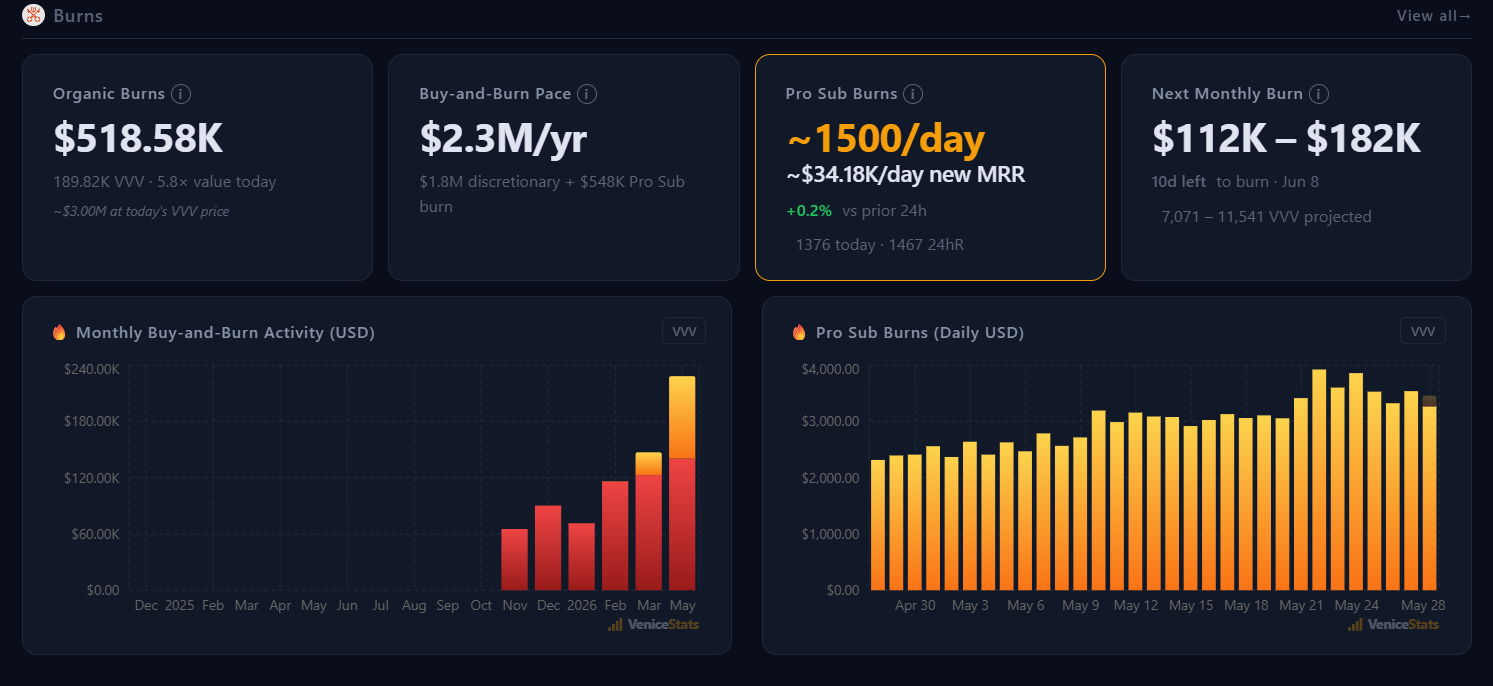
What is verifiable on-chain is the burn. Since November 2025, Venice has run discretionary buybacks, using a portion of revenue to buy VVV on the open market and send it to a burn address. In March 2025 it also burned roughly a third of total supply, the unclaimed airdrop tokens, which remains the single largest burn in the token’s history. Across all events, Venice reports over 33.7 million VVV burned, about 42.9% of the original 100 million supply, with every transaction posted to a public burn tracker. In April 2026 Venice formalized this into a programmatic engine: every new subscription automatically triggers a buy-and-burn, scaled by tier at roughly $2 for Pro, $5 for Pro+, and $10 for Max. The point of all of it is to push VVV toward net deflation, where tokens burned outpace new emissions.
This is the part worth slowing down for, because it is the actual product.
$VVV is the capital asset. Think of it as owning a share of Venice’s inference capacity rather than a balance you spend down. When you stake VVV, you are entitled to a pro-rata slice of the platform’s total daily API capacity, on an ongoing basis, without paying per request. Stake 1% of the staked VVV and you can draw roughly 1% of Venice’s daily capacity, every day, indefinitely. You do not burn through it; you hold the claim and pull inference when you need it. While staked, VVV also earns emissions-based yield.
The clever twist is what happens as compute gets cheaper and Venice’s infrastructure grows. Capacity is measured in an internal unit Venice calls DIEM, where 1 DIEM equals roughly $1 of model credit per day. As total capacity rises, each VVV represents a larger absolute amount of inference over time. In other words, the asset is designed to benefit from the same falling cost of compute that erodes a pay-per-token API business.
$DIEM is the usage layer made ownable. Introduced in August 2025, DIEM turns that daily inference allocation into a standalone, tradeable ERC-20 token on Base. The mechanics: you mint DIEM only by locking staked VVV, and each DIEM gives the holder $1 per day of Venice credit, perpetually, usable across Venice’s full model catalogue, which now includes leading proprietary models alongside open-source ones. While your VVV is locked to back DIEM, it keeps earning the bulk of normal staking yield (roughly 80%, with the remainder flowing to Venice). To get your VVV back, you burn the DIEM.
That last detail is the supply mechanic that matters. Minting DIEM locks VVV out of circulation for as long as the DIEM exists. So rising demand for guaranteed AI compute translates directly into VVV being pulled off the market and held as collateral. Agents can own their inference budget, DeFi protocols can collateralize compute, and applications can build AI costs into their own tokenomics rather than facing variable monthly API bills. The dual-token design effectively separates the investment asset (VVV) from the consumption unit (DIEM) while hard-wiring them together at the supply level.
This creates an interesting flywheel that powers the incentives for inference within the Venice ecosystem.
Everything above describes Venice as a destination. The more interesting story for builders is Venice as an open resource that other software can tap directly, without a human in the loop. Three things make that possible: an OpenAI-compatible API, the x402 payment standard, and an MCP server. Around those, a small constellation of adjacent projects has formed.
The first and oldest path is staking. Stake VVV, or lock it to mint DIEM, and you hold a standing claim on a pro-rata slice of daily inference. An application or agent draws on that allocation through the API without paying per request. This suits anyone with predictable, ongoing demand who wants to own their compute rather than rent it.
The second path, and the one that genuinely changes what is buildable, is x402. Originally created by Coinbase and now stewarded by the Linux Foundation, x402 is an open standard for paying for services over HTTP using crypto. Venice went live with x402 on Base in April 2026, and it removes the single biggest piece of friction in agent development: the human setup step. With every other major provider, a person has to create an account, add a card, and provision an API key before an agent can make its first call. x402 deletes that. You give an agent a funded wallet on Base, point it at Venice, and it pays for its own inference inline, request by request, with no API key at all. The wallet is the identity layer and the on-chain balance is the spend layer. Venice supports x402 across the full surface: text and reasoning, image and video generation, audio and music, transcription, embeddings, and search. So a single agent can think, retrieve, generate an image, and produce audio in one workflow, all settled from one wallet. Payment can come from USDC on Base or from staked daily DIEM allocation, and x402 support has since extended to Solana as well.
Concretely, the flow with Venice’s official x402 client looks like this. An agent signs each request with a fresh sign-in header derived from its wallet, the protocol checks the wallet’s spendable balance, tops up with USDC if needed, and the inference response comes back, typically settling in a couple of seconds for a fraction of a cent in gas. No dashboard, no billing account, no stored credential.
The third path is the Model Context Protocol. Venice ships an MCP server, available as an npm package, exposing dozens of tools across chat, embeddings, image, video, audio, and web capabilities. MCP is what lets an AI assistant or agent framework treat Venice’s models as callable tools rather than a raw HTTP endpoint, which is the same plumbing that makes Venice easy to wire into agent stacks like OpenClaw.
Because Venice is open infrastructure on Base, a set of independent projects has grown up around it. It is worth being precise here, since the market often blurs the line: these are not Venice products, and Venice has not endorsed them as part of its own token system. They are separate teams building in the same orbit, and several of their tokens have traded as high-beta proxies for Venice’s momentum.
The most substantive is POD, the token of Dolphin (dlphnAI), the team behind Venice Uncensored, which is Venice’s default uncensored model. POD is not just a Venice speculation vehicle; it has its own inference business. Dolphin runs a distributed inference network on idle consumer GPUs, accepts POD as a payment option for that inference, routes network revenue into buying back POD on the open market, and gives stakers (xPOD) daily inference allocations across the models the network serves. If that structure sounds familiar, it should: it echoes Venice’s own staking-for-compute and revenue-to-buyback design, applied to a crowd-sourced GPU layer. The connection is real, through the Uncensored model, which is why POD repriced sharply when that link drew attention, but the standalone thesis rests on whether Dolphin’s distributed network attracts genuine inference demand.
The signal worth watching is which of these projects actually process inference or build tooling that developers use, versus which simply share a thematic tailwind. The Venice Incentive Fund, a pool set aside to fund developer tools, applications, integrations, and on-chain apps built on the Venice API, is a better place to look for projects with a real connection to the platform than a trending-tickers list.
Venice is unusual because, unlike most tokens, it has a revenue line you can anchor to. That invites a comparison to how equity investors value the centralized AI companies on a price-to-revenue or price-to-forward-revenue basis.
The bull framing, which you will see from crypto research desks, runs like this. The large private AI labs trade (in their funding rounds and secondary markets) at very high multiples of revenue, often many tens of times forward revenue. Venice, by contrast, has been valued at a far lower multiple of its estimated forward revenue. If you believe Venice’s revenue is real and growing, and you believe the market will eventually re-rate it toward even a fraction of where centralized peers trade, you get a much higher implied token price. That is the entire bull case in one sentence: a real revenue business wearing a token, trading at a discount to its closest comparables.
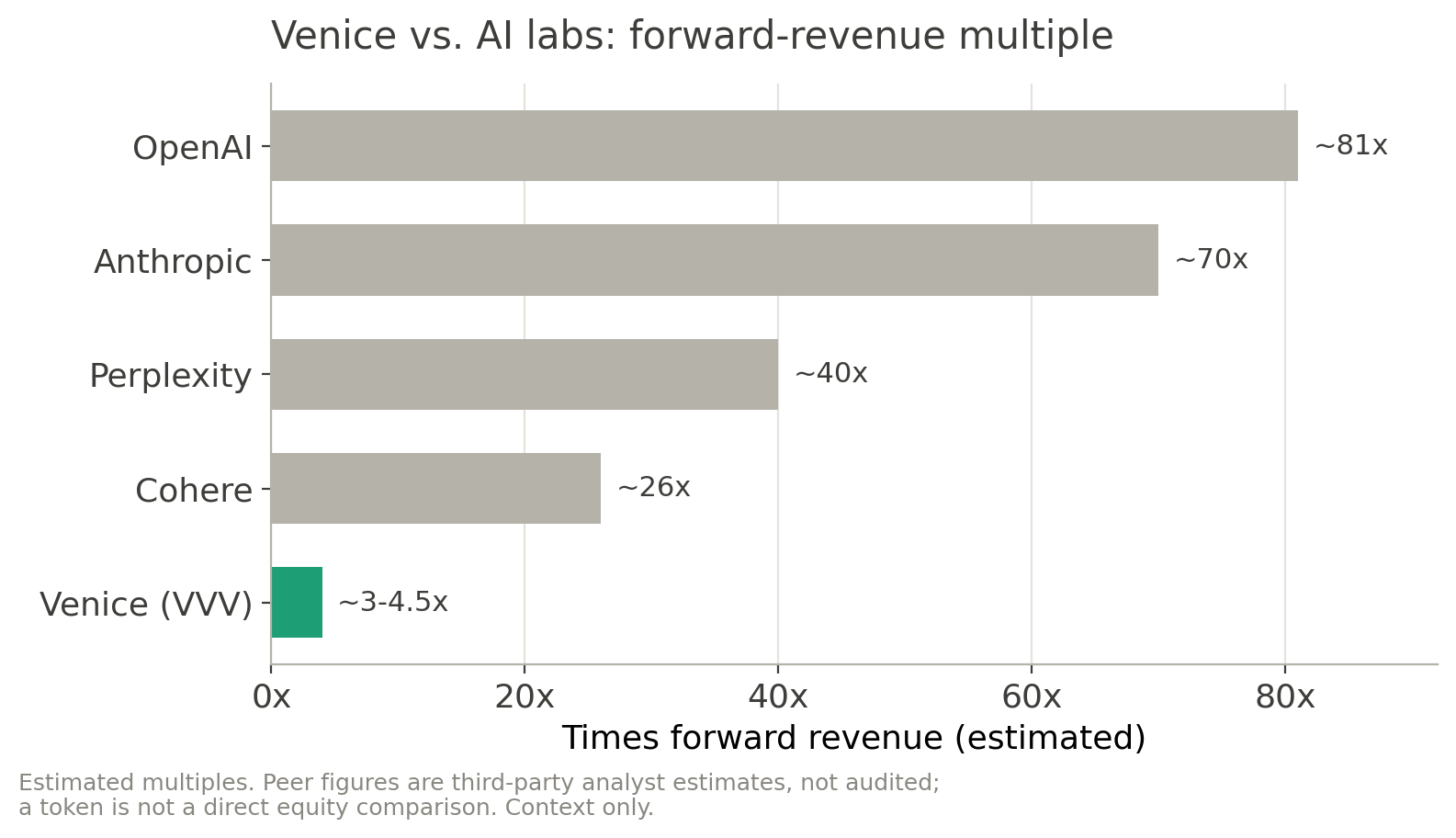
Now the caution. That argument depends on three things being true at once: that the revenue figures are accurate, that a crypto token deserves the same multiple as an equity stake in a high-growth private company, and that the comparison set (private AI labs) is the right one rather than, say, other infrastructure tokens. Each of those is debatable. Forward-revenue projections in particular are estimates layered on estimates. The deflationary token mechanics genuinely do add a second lever that a normal equity does not have, since shrinking supply against flat demand supports price independent of the revenue multiple. But “trading at a discount to OpenAI’s multiple” is a thesis, not a fact, and the discount may exist precisely because the market is pricing in the risks below.
Comparing Venice to OpenAI is the flashy framing, but the fairer comparison is to the other tokens it actually lives among: the agentic and AI projects on Base, the same universe tracked by dashboards like AX1 Research’s Base agentic ecosystem monitor. Here the picture inverts. Against the private labs Venice looks cheap; against its on-chain peers it looks expensive on market cap, and that is arguably the point.
The cleanest way to see it is price-to-revenue, market cap divided by annualized protocol revenue or fees. The problem, and it is worth stating plainly, is that most Base agentic tokens have very little verifiable recurring revenue to divide by. Venice is the unusual one: it has real, dollar-denominated subscription revenue, so even on conservative estimates its market cap maps to a price-to-revenue multiple in the rough range of low double digits. Virtuals Protocol, the largest agent-launchpad on Base, earns real but highly variable fees from agent launches and trading taxes; reported figures swing from a few million dollars a quarter to much larger cumulative numbers depending on the window, so any single multiple is more of a smear than a point. And aixbt, the best-known agent token by name recognition, is effectively a signal and attention product with no comparable protocol revenue stream at all, which makes a price-to-revenue multiple undefined rather than merely high.
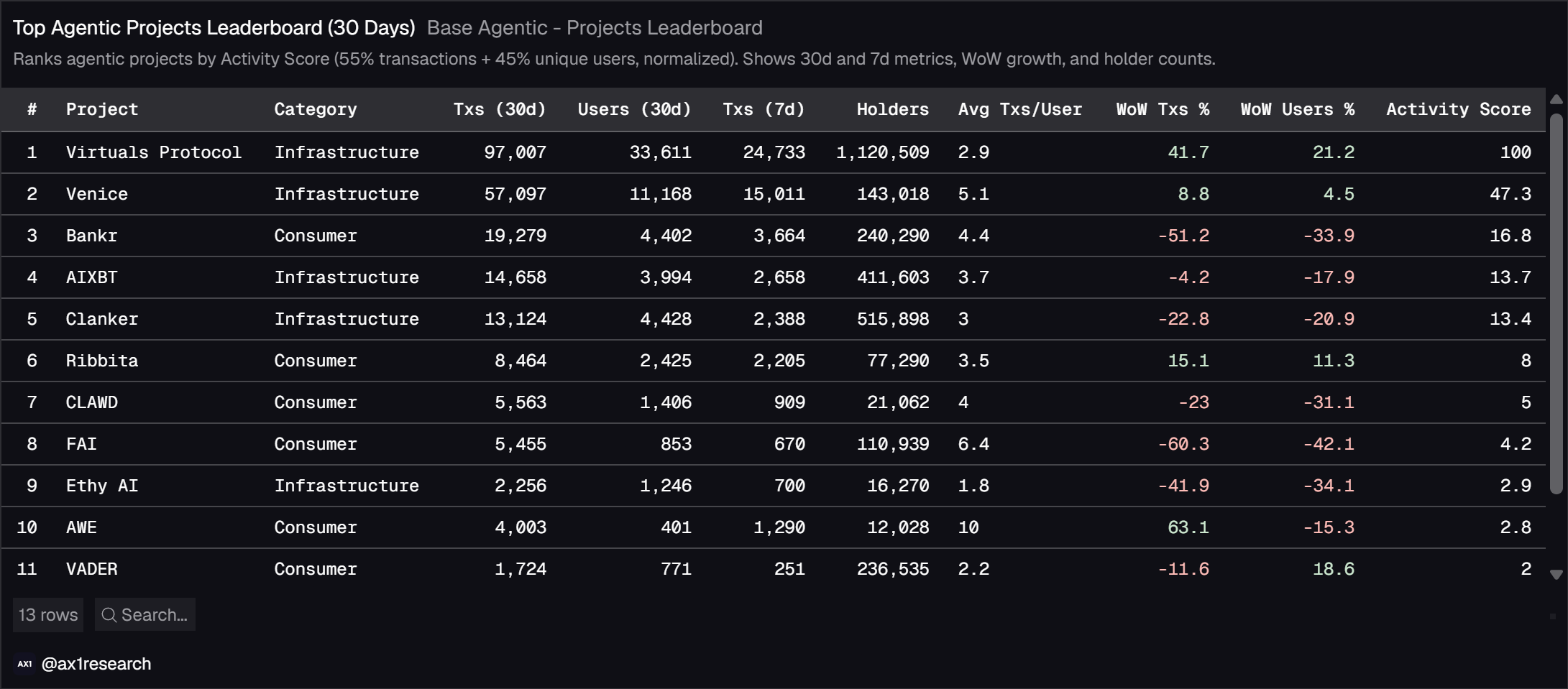
The takeaway is not “Venice is cheaper than aixbt” or “more expensive than Virtuals.” It is that Venice is one of the only tokens in this category whose valuation can be anchored to a real revenue line at all. Most of its on-chain peers are valued on narrative, attention, or launchpad volume that evaporates when the cycle turns. So the relative-pricing case is less about a precise multiple and more about quality of earnings: among Base agentic tokens, Venice is closer to a business, and the bull argument is that the market has not fully repriced it as one. The bear argument is the mirror image, that a token trading at a business-like multiple in a category that mostly does not deserve one is the one with the most room to fall if sentiment shifts.
No primer is honest without this section, so here it is plainly.
The numbers are largely self-reported or modeled. Revenue, ARR, and user counts mostly come from Venice or from third-party trackers, not from audited financials. The burns are verifiable on-chain. Most of the rest requires taking someone’s word.
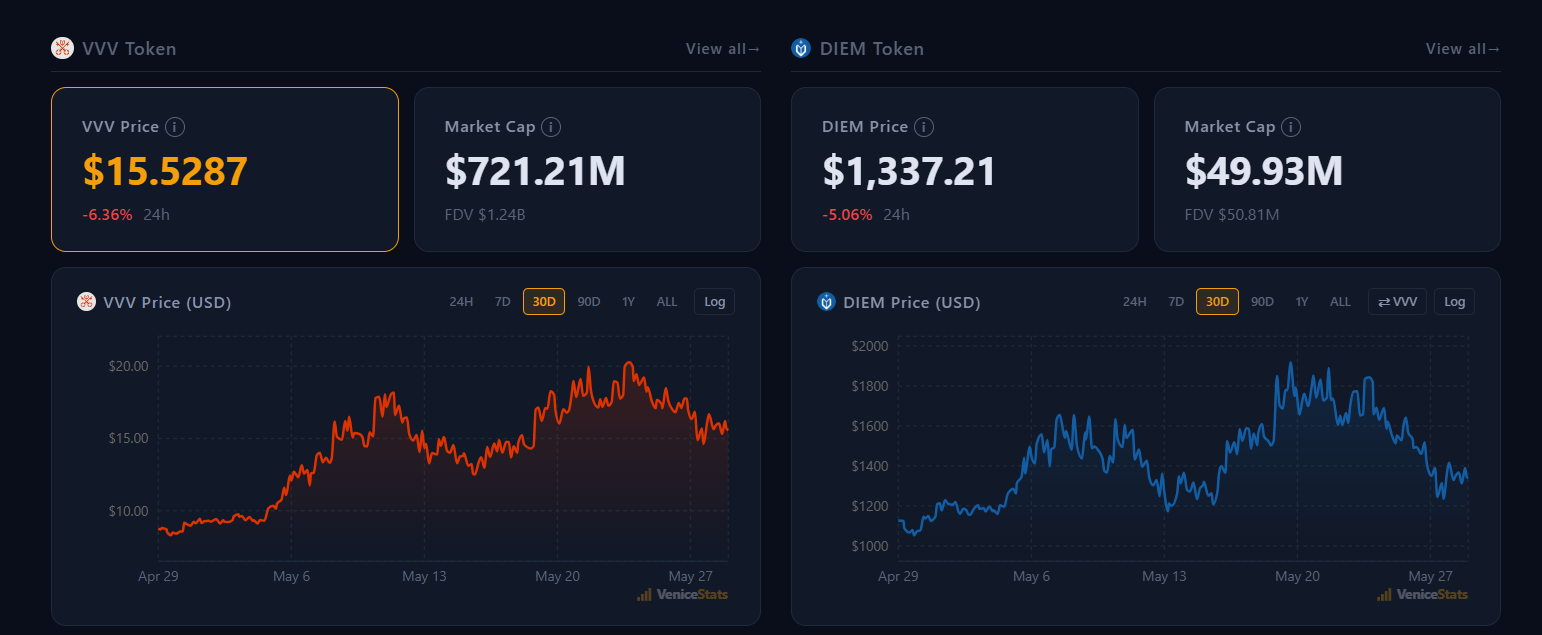
Token price is highly volatile. VVV has swung dramatically, including large single-week and single-day moves. The deflationary design supports a long-term thesis but does nothing to dampen short-term volatility.
Competition is brutal and well-funded. Venice competes for users against OpenAI, Google, and Anthropic, and for the open-source privacy niche against anyone who can stand up GPUs and serve open models. Its moat is positioning and token design, not a technology the incumbents cannot replicate.
The token model is novel and unproven at scale. Pro-rata inference, DIEM minting, and a deflationary flywheel all sound elegant. They have not been tested through a full market cycle, a sustained demand shock, or a period where compute costs stop falling. If utilization or capacity assumptions break, the staker value proposition changes.
Regulatory and content risk cuts both ways. “Uncensored” is a feature to its users and a liability to regulators and payment processors. A privacy-first, lightly-filtered AI platform is exactly the kind of product that draws scrutiny, and that scrutiny could constrain growth or access.
Concentration. Venice the company is the largest VVV holder, and Voorhees is closely identified with the project. That alignment is a feature for bulls and a key-person and concentration risk for everyone.
Venice is a rare crypto project where the token is a claim on a business that sells something people actually pay for. The product is a private, uncensored AI platform aimed squarely at users who do not trust the centralized labs with their data. The token design is the genuinely novel part: $VVV is an ownable share of inference capacity that grows as compute gets cheaper, $DIEM turns that capacity into a tradeable, perpetual credit, and minting DIEM locks VVV out of circulation. Layer on a fixed, declining emission schedule and an automated buy-and-burn funded by subscriptions, and you have a token engineered to trend deflationary as usage rises.
The bullish case is straightforward: real and growing revenue, a deflationary supply structure, deep relevance to the rising machine-to-machine agent economy, and a valuation that looks cheap against centralized AI peers if you accept the revenue figures and the comparison. The bearish case is equally clean: the key numbers are hard to independently verify, the competition is enormous, the token mechanics are untested through a cycle, and “uncensored” invites regulatory friction.
If the agent economy plays out the way Venice is betting, a private, censorship-resistant inference layer with an ownable compute asset is positioned well for it. That is the bet. As always, it is one to size with your own risk tolerance, not on the strength of a single primer.
Trading platform and brokerage: tastytrade
Crypto trade ideas and more content: YouTube
Follow: X
Disclaimer: None of this is to be deemed legal or financial advice of any kind and are solely the opinions of the authors. tastycrypto is provided by tasty Software Solutions, LLC. tasty Software Solutions, LLC is a separate but affiliate company of tastylive, Inc. and tastytrade, Inc. Neither tastylive, Inc. nor tastytrade, Inc. are responsible for the products or services provided by tasty Software Solutions, LLC. Cryptocurrency trading is not suitable for all investors.
No posts
Comments
Nothing yet. Say the first thing.
Sign in to join the conversation.