
Hello my tasty friends, I hope you’re all having a wonderful start to your weekend.
Crypto price action remains mostly range bound, with the exception of DOGE, +13% on the week.
If you follow our performance dashboard, a couple signals to call out. ETH and SOL daily price momentum both flipped from bullish to neutral (ETH) and bearish (SOL). This transition is also within the bearish weekly and monthly trends.
On the other hand, BTC daily price momentum remains bullish.
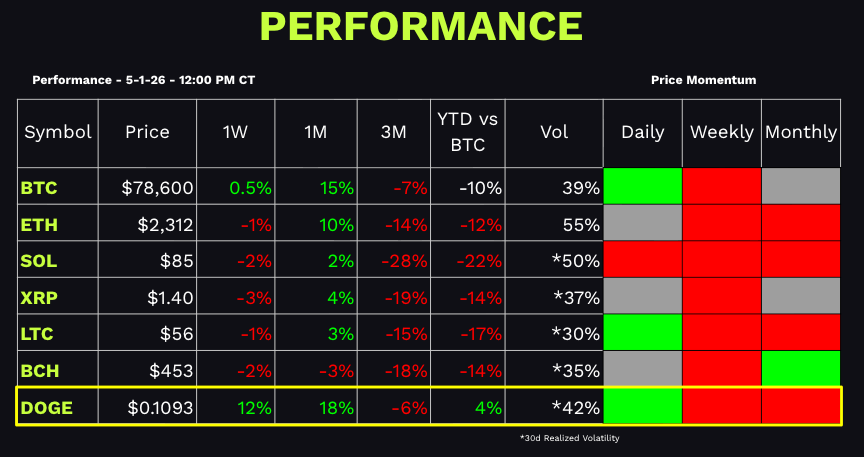
Price momentum signals derived from EMA cross-overs.
The market continues to signal BTC vs ALTS, as bitcoin market dominance has increased from 58% to 61% over the past month, and ETH/BTC -1% W, -4.5% M, -8% 3M.
DOGE is alive (again), moving higher +13% W, +19% M, with DOGE/BTC increasing +12% W.
DOGE is one of the few coins outperforming BTC year-to-date, ripping higher on news of a DOGE mining firm going public on the Nasdaq.
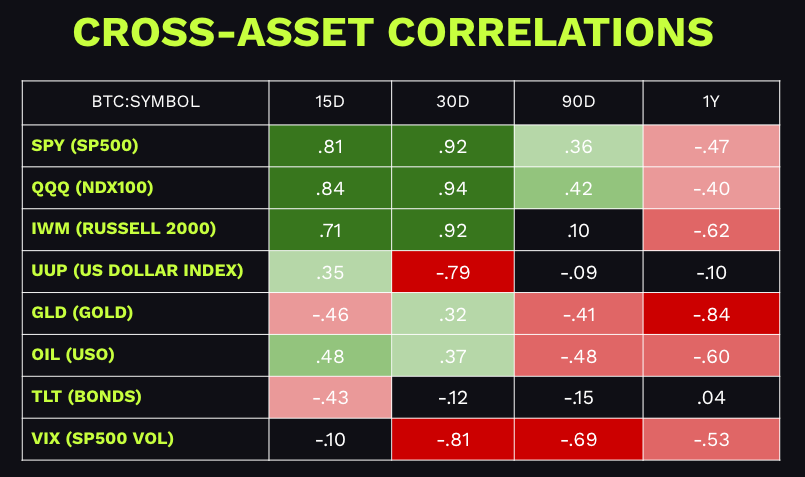
Big picture, we’re seeing signs of accelerating economic growth and inflation - a macro environment historically supportive of BTC prices and growth stocks. BTC remains positively correlated to risk assets short-term.
As we chop around here, we’re shifting attention to the regulatory front this week (get excited). We could be close to finally getting regulatory clarity.
Also, make sure to check out Shelley’s new Beginner Block section below.
But first… Weekly volatility derived trading ranges:
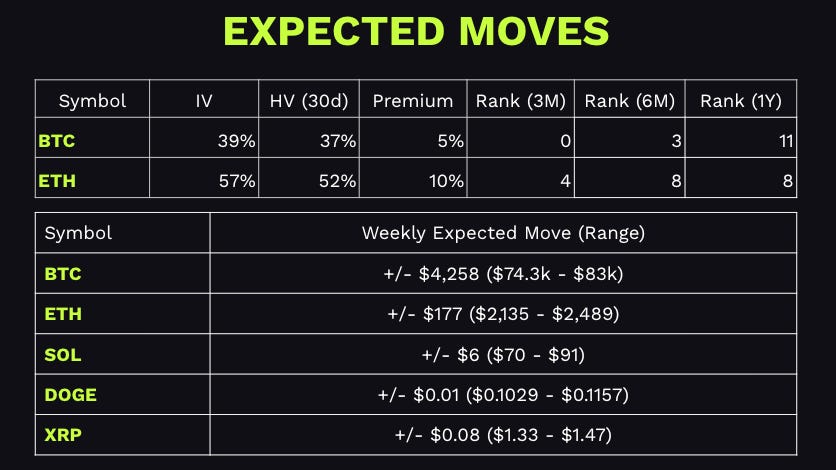
BTC’s range is pricing in a higher-high and a higher-low.
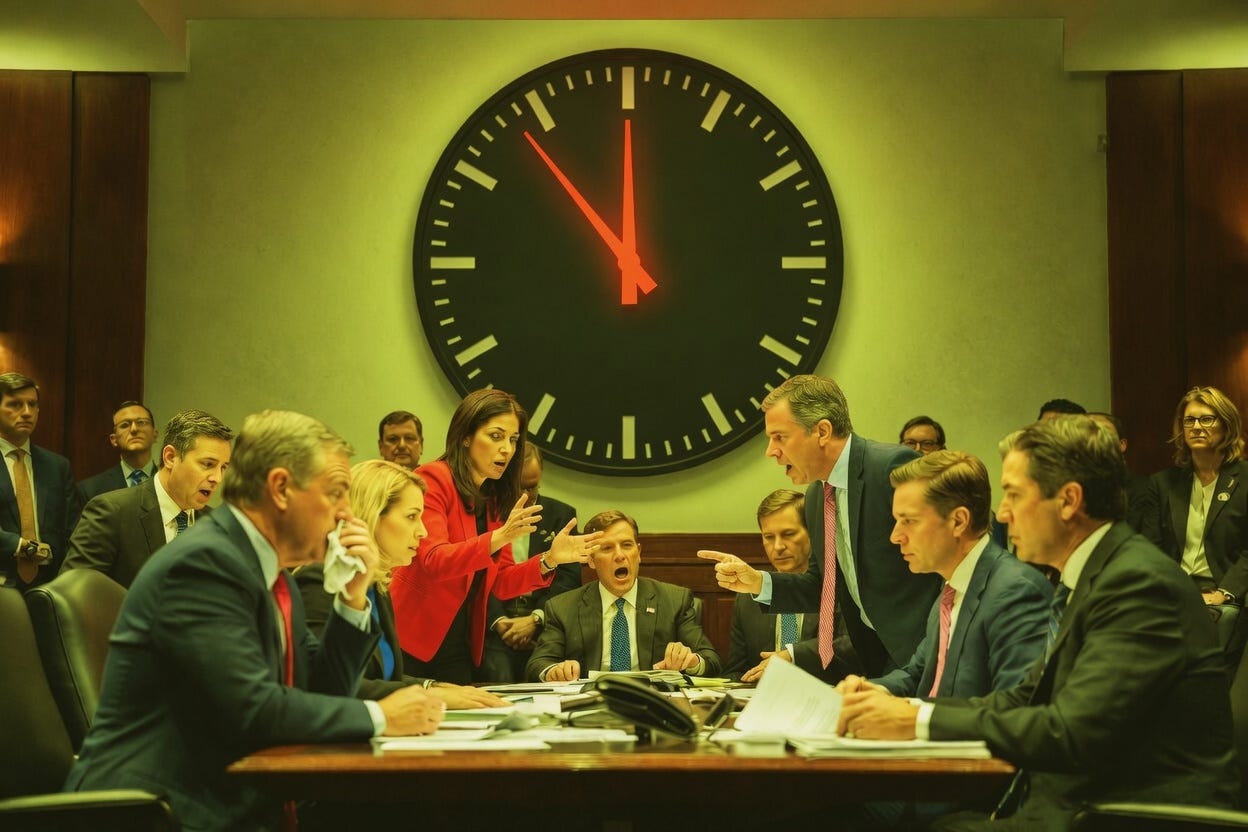
While we trudge through the crypto bear market, The CLARITY Act is the closest thing to any singular known catalyst crypto has in 2026, and while it looks to be moving forwards, it’s running up against the clock.
According to Senator Thom Tillis, the bill is ready for Senate Banking Committee markup, targeted for the week of 5/11.
But, before we jump to conclusions and get all bullish, let’s revisit the details.
High-level, the bill splits the regulatory turf war that’s paralyzed crypto for a decade. The CFTC gets clear authority over crypto assets that function like commodities such as bitcoin, where there’s no company behind it, and no central party to hold accountable.
The SEC keeps authority over crypto assets that function like an investment in a company or project.
That’s the big picture takeaway, but the provisions within the bill arguably matter more, and could lead to future opportunities.
What to know:
Token classifications can evolve over time. Tokens can move from securities to commodities as their networks decentralize. The same asset can have different regulatory status at different points in its lifecycle. E.g., a token can launch as a security and be reclassified as commodity later if it becomes fully decentralized.
Banks can custody crypto through Title IV qualified custodian framework. While SAB-122 rescinded SAB 121, it lives as SEC staff guidance, and is reversible by any future administration. Title IV codifies custody in statute, adds licensing and customer-asset-protection rules, and resolves the regulatory capital question SAB 122 didn't touch. This means banks can custody crypto without the capital treatment that has frozen them out of the market. In my opinion this is one of the most important unlocks for institutional flows, beyond the ETFs of course.
Stablecoin yield compromise. This was the primary sticking point for the past four months and it’s now broadly resolved. Passive yield on stablecoins is banned. Activity-based rewards are permitted. Jamie Dimon has signaled the banking industry can live with transaction-based rewards.
Anti-CBDC provisions are bundled in. The bill explicitly prohibits the Federal Reserve from issuing a central bank digital currency directly to individuals. This was a non-negotiable for the bill's Republican coalition, who view a Fed-issued digital dollar as a financial-surveillance tool. Including it locked in the votes needed for passage.
The bill builds on the GENIUS Act (enacted July 2025) rather than replacing it. GENIUS is already the law for stablecoins. It created the federal licensing regime, reserve requirements (1:1 backing in cash and short-dated Treasuries), and consumer protections for payment stablecoins like USDC. CLARITY layers on top and handles everything non-stablecoin (token classification, custody, market structure) and also resolves the one piece GENIUS punted on - the stablecoin yield question. Together, the two bills will form a complete U.S. crypto regulatory architecture for the first time. Neither alone is sufficient, but together they cover everything.
The industry needs a regulatory framework before it’s too late.
If you follow the timeline:
The House passed CLARITY 294-134 in July 2025, marking the largest bipartisan crypto vote in U.S. history. The Senate Banking Committee released its 278-page draft on January 12, 2026. Then we had four months of stalemate, mostly over stablecoin yield. Now, with markup ready, the clock is ticking.
Up next, The Senate returns from recess May 5, with markup targeting the week of May 11. Memorial Day (5/21) is basically the soft deadline. If markup slips past this date, it could potentially get buried by appropriations season, then recess. The August recess effectively closes the 2026 window, assuming congress shifts into midterm campaign mode when it returns from recess. Then, we get a new Congress in January 2027.
Sounds a bit dramatic…
But, consider the current Congress is the most crypto-friendly in years, built on a bipartisan coalition that took years to assemble. Midterms reshuffle that. Major financial legislation runs on a 2-3 year clock from introduction. And the election calendar (2027 freshman year, 2028 presidential, 2029 inaugural year) swallows this up. 2030 is the first non-election year with an experienced Congress that could realistically take another comprehensive swing.
The window is open, but after August… Well, let’s hope for the best.
Let’s assume it gets done, how could it impact the industry?
Passage triggers four concrete mechanical changes:
1. Custody fix. As mentioned above, banks can custody at scale and this could lead to new institutions participating and introducing more products.
2. Pension and insurance company allocations. Formal commodity classification opens the door for fiduciary allocation. Even a 50bps investment from the ~$40T U.S. retirement complex is orders of magnitude larger than current ETF AUM.
3. Spot ETF expansion. Formal digital commodity classification could open the door to more spot ETFs. E.g., ADA, AVAX, LINK, etc.
4. FCM clearing and crypto-as-margin. Crypto becoming permitted collateral at futures commission merchants connects the spot, derivatives, and traditional finance plumbing for the first time.
In my view, formal crypto regulation is bullish for the industry long-term; leading to more participation and capital formation over time. But, I also think the market has been front-running this catalyst over the past year.
BTC ran from $60K post-election 2024 to and $126k in part on the regulatory clarity narrative. The GENIUS Act passed in July 2025 and absorbed a chunk of the “regulatory unlock” premium.
Polymarket is currently pricing CLARITY act passage at 46%, so if it does pass, it’s bullish, but I don’t see this as a binary event which takes us to new highs.
What if it doesn’t pass? How much downside is there?
The clock is ticking.

Shelley here. If you just read Ryan’s breakdown of the Clarity Act and thought, “okay, that sounds important, but explain it like I’m five,” you’re in the right place.
Here’s the thing: for years, nobody in Washington could agree on what crypto actually is. Is it a stock? A commodity? Some weird new third thing? And that question matters way more than it sounds, because the answer determines who regulates it, what rules companies have to follow, and whether crypto projects can legally operate in the U.S. at all.
Think of it like zoning laws. Whether a building gets classified as residential or commercial determines who inspects it, what it’s taxed like, and what you’re allowed to do inside. Crypto has been stuck in this legal gray zone where nobody agreed on the zoning. So nobody knew the rules. And when nobody knows the rules, big institutions stay on the sidelines.
We actually broke this down on X a while back — still the clearest one-liner we've got:

tastycrypto@tastycrypto
W3Word of the Week 🍒 ⚖️ CLARITY Act = CFTC vs SEC gets a referee more 👉 https://t.co/hEDlzkF1Bx


tastycrypto @tastycrypto
🇺🇸 It’s #CryptoWeek on Capitol Hill. We’re tracking it all and dropping some tasty nuggets to help you understand the BIG crypto policy moves happening this week. 🍒👇
5:00 PM · Jul 16, 2025 · 237 Views
The Clarity Act is Congress trying to finally draw those lines. Ryan breaks down what's actually in it above. But if you take one thing away from this: clearer rules mean more players can participate, more projects can build here, and the whole industry gets a little more legit.
That's not a bad thing for anyone holding crypto right now.
Want beginner explainers like this in your feed every week? Follow @tastycrypto on Instagram. And if you want to go even deeper, our HODL UP series on YouTube was made exactly for you: Watch the playlist here.
That’s it for this week. Thanks for reading and supporting us at tastycrypto. If you enjoyed the content, please like and share it, and help us grow our audience.
Keep your head on a swivel.
And, as always…
Stay tasty,
Ryan
Trading platform and brokerage: tastytrade
Crypto trade ideas and more content: YouTube
Follow: X
Disclaimer: None of this is to be deemed legal or financial advice of any kind and are solely the opinions of the authors. tastycrypto is provided by tasty Software Solutions, LLC. tasty Software Solutions, LLC is a separate but affiliate company of tastylive, Inc. and tastytrade, Inc. Neither tastylive, Inc. nor tastytrade, Inc. are responsible for the products or services provided by tasty Software Solutions, LLC. Cryptocurrency trading is not suitable for all investors.
No posts
Comments
Nothing yet. Say the first thing.
Sign in to join the conversation.