
Hello my tasty friends, I hope you’re all having a wonderful start to your weekend.
This week we’ve got a special edition of the newsletter from Dan on the tastycrypto team.
Enjoy.

Every exchange starts the same way: someone builds a place where buyers meet sellers, and the house takes a cut. The formula hasn’t changed much, from the New York Stock Exchange to the Chicago Mercantile Exchange to Coinbase. What has changed is who gets to run the house.
Hyperliquid is a perpetual futures exchange built on its own custom blockchain. It offers permissionless access, with no middlemen and no closing bell. It operates 24 hours a day, 7 days a week, with performance that rivals the largest centralized exchanges in the world. By early 2026, major media outlets like Bloomberg reported that Hyperliquid had grown into one of the biggest venues for perpetual Bitcoin swaps, breaking into a market historically dominated by centralized giants like Binance and Coinbase.
Many have labeled Hyperliquid as “The Blockchain to House All Finance”, in fact this claim is on the main Hyperliquid website. With a market cap of $8.6 billion and explosive growth in its commodity trading markets, it is well on its way to achieving that label.
So what is a perpetual exchange?
A perpetual contract (or “perp”) is a derivative that lets you go long or short on an asset with leverage (up to 50x on Hyperliquid) without an expiration date. Unlike traditional futures contracts that settle on a fixed date, perps use a funding rate mechanism to keep the contract price tethered to the underlying spot price. If the perp is trading above spot, longs pay shorts. If below, shorts pay longs. This hourly payment keeps prices in line without the need for physical settlement.
The contracts never expire, the market never closes, and you don’t need a broker. The result is a 24/7 derivatives market where anyone with a crypto wallet and USDC can take a directional view on Bitcoin, Ethereum, oil, gold, or increasingly, traditional equities.
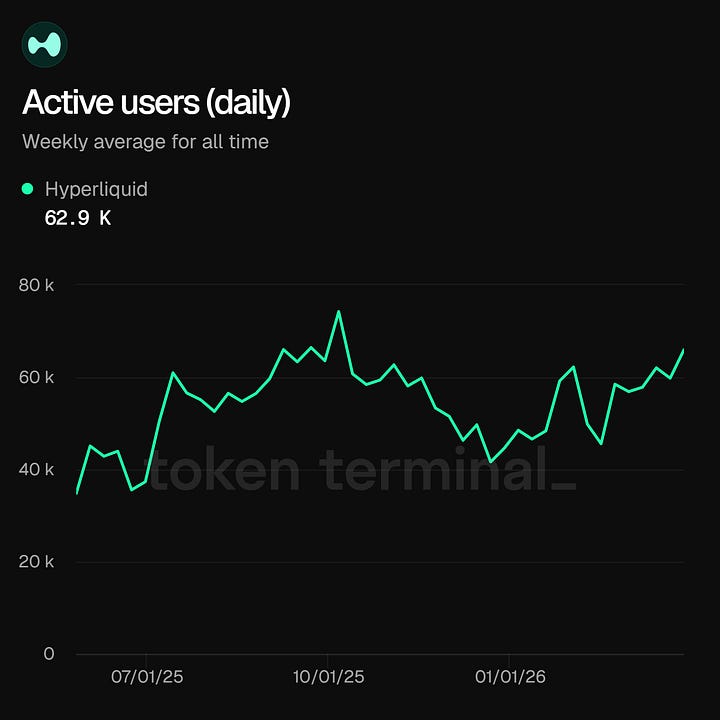
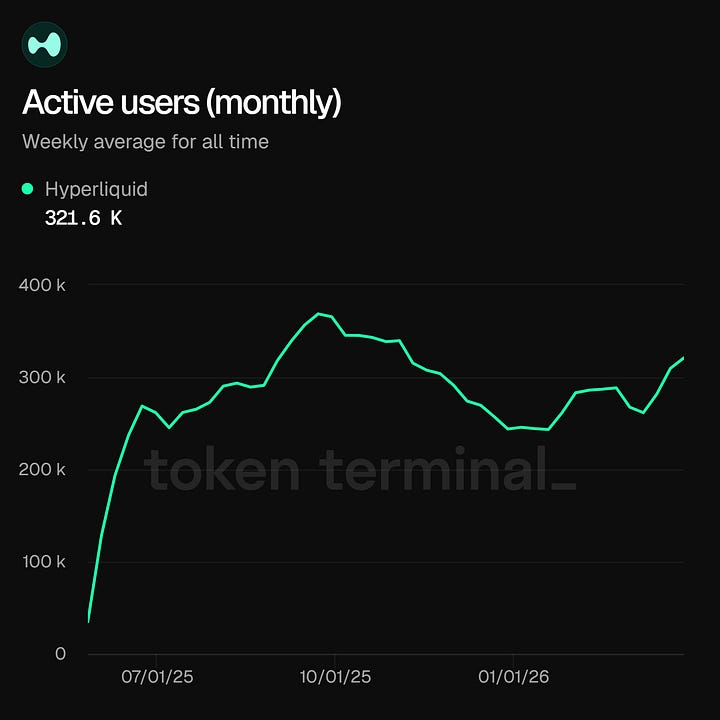
Hyperliquid launched its mainnet in 2023 and grew at an extraordinary pace. By the end of 2025, the platform added approximately 609,700 new users, bringing its total user base to a level that rivaled centralized exchanges. Daily active users were reported above 60K, with monthly active users exceeding 300K.
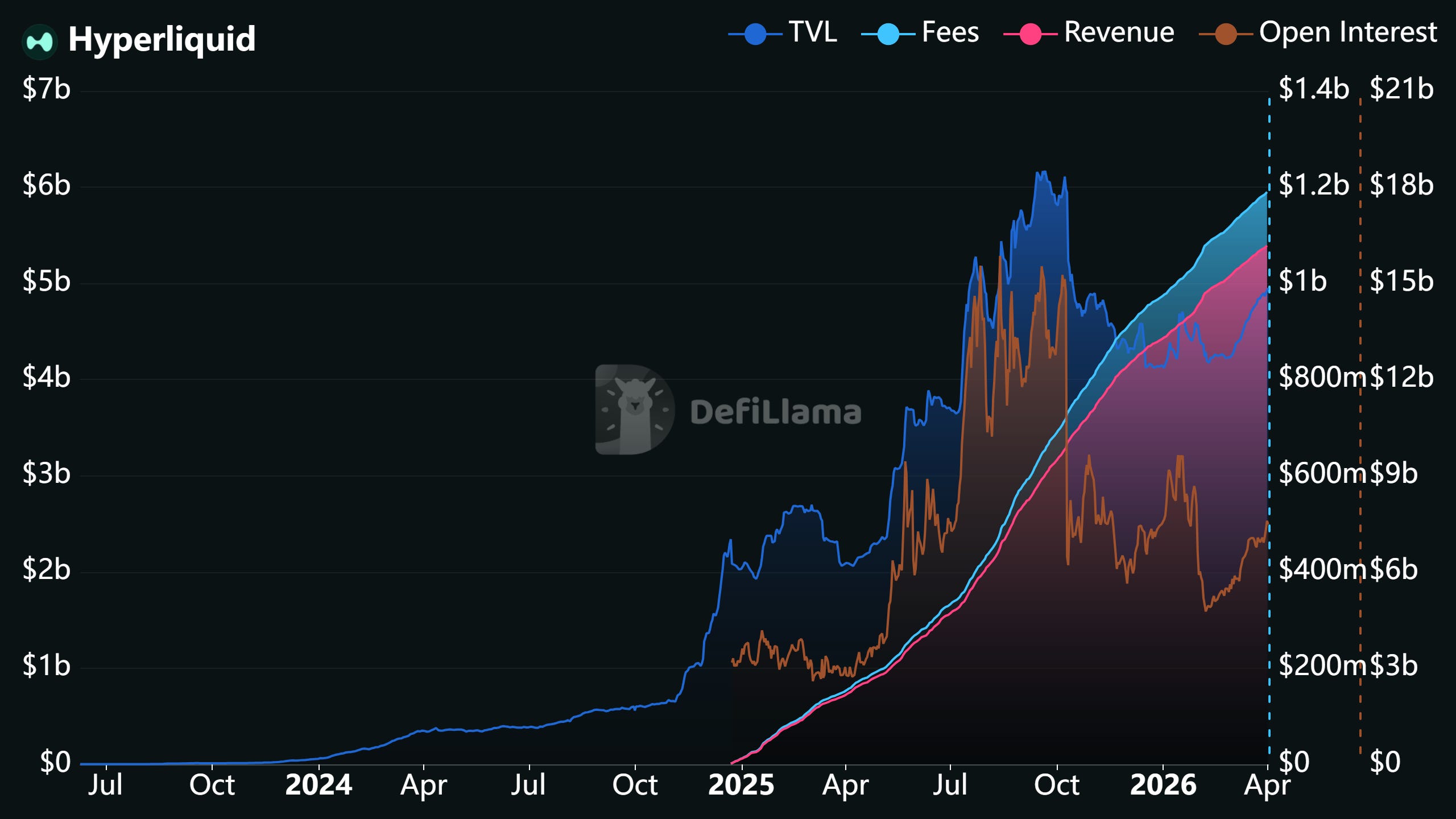
The revenue and liquidity story is impressive. In 2025, net inflows totaled $3.87 billion, and total value locked (TVL) quadrupled over the course of the year, climbing from roughly $1 billion to approximately $6 billion at its peak. Open interest surged from $4 billion to $16 billion over the same period. As of early 2026, DefiLlama data shows stablecoin market cap on the Hyperliquid L1 at over $5.1 billion, with USDC serving as the dominant margin and settlement asset.
The context makes these numbers remarkable. Hyperliquid Labs is entirely self-funded, with no venture capital, no private investors, and no seed rounds. The team, led by Jeff Yan and Iliensinc, both Harvard classmates, started as crypto market makers in 2020 before building Hyperliquid. The rest of the team hails from Caltech, MIT, and Waterloo, with deep backgrounds in quantitative trading and distributed systems. Without external funding pressure, the team has been able to prioritize product development over short-term token economics or investor timelines.
The project’s growth trajectory has tracked closely with the broader maturation of decentralized derivatives. According to DL News, perpetual DEX revenue doubled from roughly $100 million per month to over $200 million per month during 2025, and Hyperliquid was the primary engine of that growth. At its peak in Q3 2025, Hyperliquid captured over 70% of the entire decentralized perpetual futures market.
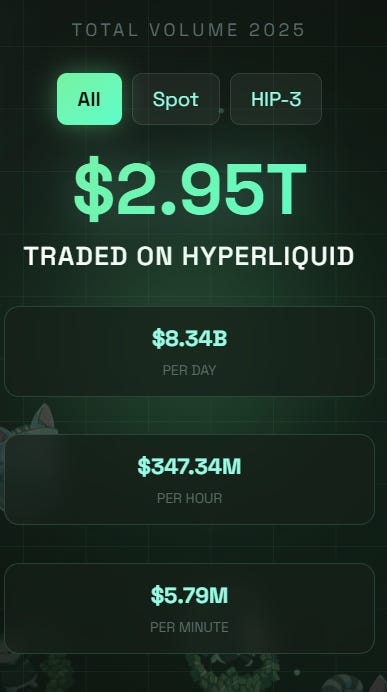
The numbers speak for themselves. In 2025, Hyperliquid processed $2.95 trillion in total trading volume across 198.9 billion transactions, averaging approximately $8.34 billion in daily volume. The 24-hour trading volume high-water mark hit $32 billion, a figure that places it among the top centralized exchanges on any given day.
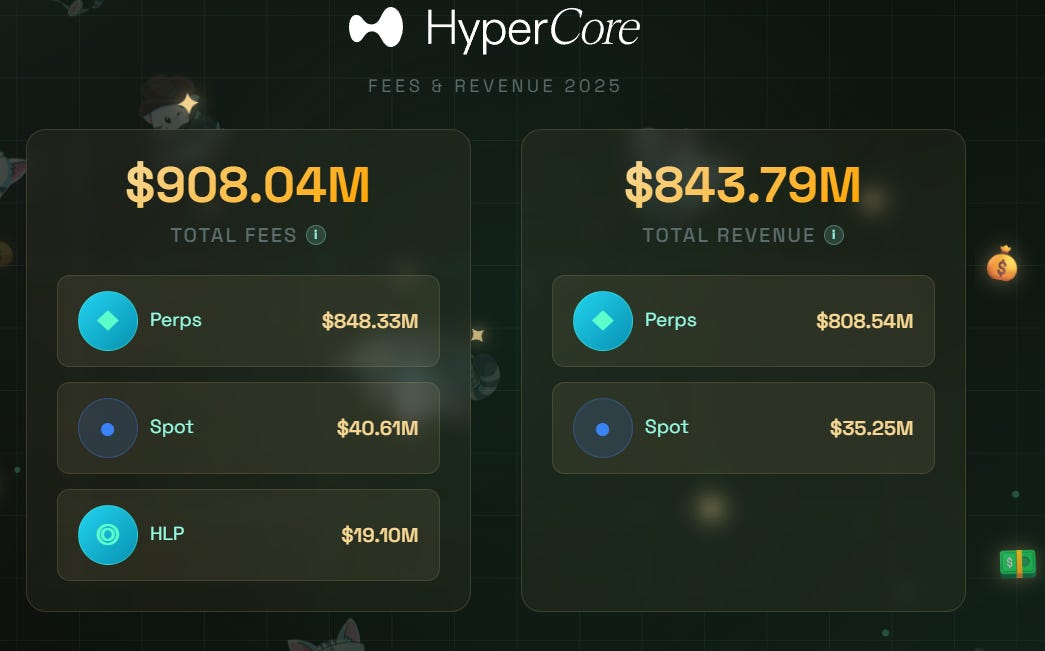
For the full year, revenue came in at approximately $843 million, with total fees reaching $908 million. The breakdown tells you where the real business is: perpetual contracts generated $808 million in revenue and $848 million in fees. Spot trading contributed $35 million in revenue, while HLP (the Hyperliquidity Provider vault) added about $19 million in fees.
In terms of individual asset performance, Bitcoin dominated with $1.16 trillion in volume. It was followed by Ethereum at $824 billion and Solana at $269 billion. Spot trading volume reached $116.8 billion, while HIP-3 markets contributed an additional $11 billion.
By July 2025, Hyperliquid recorded approximately $320 billion in monthly perpetual trading volume and $86.6 million in monthly protocol revenue, both all-time highs at the time. This activity rivaled centralized players such as Binance, OKX and Coinbase who have historically made up a majority of crypto futures volume.
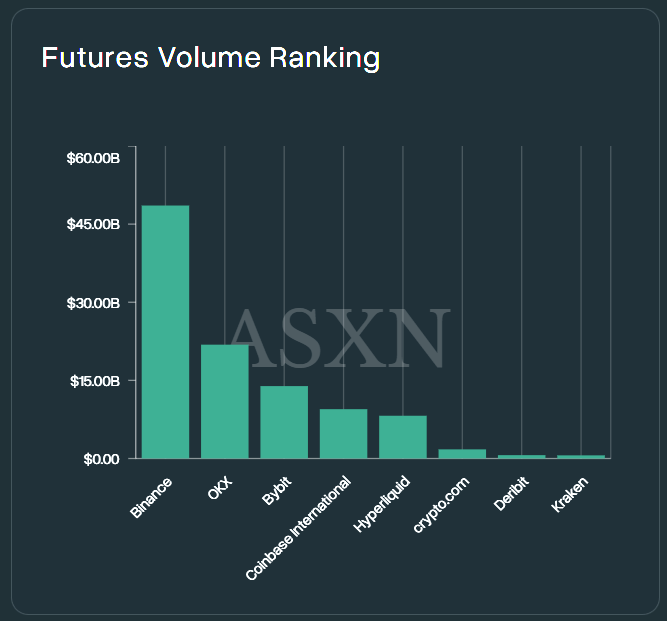
This level of revenue generation is historically significant for a protocol with no outside investors and no marketing budget.
Hyperliquid’s round-the-clock availability has made it the de facto venue for trading commodities like crude oil and gold over the weekend. This capability proved especially valuable on February 28th, 2026 when the Iran Conflict broke out and oil supply fears sent a shockwave through markets.
With every traditional commodity market closed for the weekend, traders flocked to Hyperliquid where commodity linked perpetual futures contracts surged in open interest and volume. Oil linked contracts rose more than 5% within minutes of the US-Israeli strikes providing a real time price signal for traders unable to react on traditional venues.
As the conflict escalated through March, commodity trading volume on Hyperliquid surged from roughly $30 million to over $1 Billion as commodity traders took advantage of the 24/7 markets.
Major media outlets and traditional asset managers took note with JPMorgan releasing an analyst note stating that “non-crypto” traders were using the platform as an alternative to traditional commodity trading venues and that this trend was likely to continue, a signal that Hyperliquid had gained traction amongst traditional finance.
What is even more impressive to note is that these commodity markets were independently launched through Hyperliquids upgrade framework known as “HIPs”. Validating that decentralized permissionless protocols can rival centralized financial markets.
Most blockchains upgrade through drawn-out governance votes, off-chain proposals, or full protocol forks. Hyperliquid takes a different approach. Its Hyperliquid Improvement Proposals (HIPs) embed upgrade logic directly into HyperCore, making protocol changes modular and immediate. Each HIP builds on the last, and together they tell the story of how Hyperliquid evolved from a perpetual futures exchange into a comprehensive financial platform. Think of them as four building blocks: define the assets, seed the liquidity, let anyone build a derivatives exchange, then add entirely new categories of financial contracts.
HIP-1: Native Token Standard
HIP-1 established the foundation by creating a formal token standard native to HyperCore. When a deployer launches a HIP-1 token, it automatically gets a built-in on-chain spot order book paired with USDC. This means a new token and its trading venue launch simultaneously, with no additional infrastructure required. The deployer defines the token’s name, supply cap, decimal precision, and initial distribution, and can even airdrop a proportional allocation to holders of an existing HIP-1 token (the “anchor token”) to reward an established community.
A 31-hour Dutch auction that determines the gas cost in HYPE gates deployment. The price starts high and decreases linearly until someone bids, which limits the system to roughly 280 new token launches per year. This was a deliberate design choice to prioritize quality over quantity and prevent the platform from being flooded with low-quality projects. Hyperliquid’s flagship community memecoin, PURR, was the first HIP-1 token, launching in April 2024 with a fully functional spot market from day one.
HIP-2: Hyperliquidity
Launching a token is one thing; making it tradeable is another. HIP-2 solved the cold-start liquidity problem by introducing Hyperliquidity, an automated, on-chain market-making strategy built directly into HyperCore’s block transition logic. Unlike traditional AMMs (like Uniswap pools) or third-party market makers, Hyperliquidity has no operators. It runs autonomously as part of the blockchain’s consensus layer.
The mechanism works by automatically placing buy and sell orders on a token’s spot order book. It refreshes every three seconds to maintain a guaranteed spread of 0.3% or tighter. The sell-side liquidity is permanently locked (tokens allocated during deployment cannot be withdrawn), while the buy side is funded by the USDC seeded at launch. Active liquidity providers can layer in their own orders alongside Hyperliquidity at any time, allowing markets to deepen organically as demand grows.
HIP-3: Builder-Deployed Perpetuals
If HIP-1 and HIP-2 created the infrastructure for spot markets, HIP-3 opened the door for anyone to launch derivatives on top of it.
HIP-3 introduced permissionless builder-deployed perpetual markets. This framework allows third-party developers to deploy their own perp markets directly on Hyperliquid’s infrastructure. Any builder who stakes 500,000 HYPE tokens can deploy their own perpetual DEX with independent margining, order books, and configurable settings. The deployer is responsible for market definition (including oracle setup and contract specifications), setting leverage limits, and managing the lifecycle of each market. This includes the ability to settle contracts and recycle asset slots for new listings without going through an additional auction.
HIP-3 inherits the full HyperCore stack, meaning builder-deployed perps get the same high-performance margining, order books, and API infrastructure as native Hyperliquid markets. From a user’s perspective, the trading experience is unified. Same API, same interface, regardless of whether you’re trading a native market or a builder-deployed one. The fee structure is designed for alignment: the deployer receives a 50% fee share, while users pay approximately 2x the standard trading fees, ensuring the protocol collects the same total fee regardless of venue.
The real-world impact has been transformative. trade.xyz became the first team to deploy under HIP-3, launching 24/7 perpetual markets for US equities including Tesla, Apple, Nvidia, and Amazon, as well as a synthetic Nasdaq index. CoinDesk reported that Hyperliquid’s S&P 500 perpetual market hit $100 million in volume within its first day. Since its launch on October 13, 2025, HIP-3 trading volume has grown to represent over 35% of all trading volume on the platform, with open interest reaching $1.43 billion by March 2026. Major wallet providers like Phantom, Rabby, and MetaMask have integrated through Hyperliquid’s builder code system, collectively generating roughly $50 million in builder fees during Q3 2025 alone.
HIP-4: Outcome Trading (Prediction Markets)
On February 2, 2026, HIP-4 was announced. It represents Hyperliquid’s expansion into an entirely new category of financial contracts: outcome trading.
Outcome contracts are fully collateralized binary instruments that settle at either 0 or 1 depending on whether a specific real-world event occurs. If you buy a YES contract on “Will BTC close above $100,000 by March 31?” at a price of 0.60, you’re paying 0.60 USDH per contract. If the event resolves YES, the contract settles at 1 and you collect 0.40 USDH in profit. If NO, you lose your 0.60 USDH. This is the same basic structure used by prediction markets like Polymarket and Kalshi, and by CFTC-regulated event contracts in traditional finance.
The key distinction from Hyperliquid’s existing perpetual products is that outcome contracts involve no leverage and no liquidations. This makes them accessible to a broader range of traders and opens the door to use cases beyond pure speculation, including hedging, insurance-style products, and structured derivatives.
Outcome contracts run natively on HyperCore, so they live in the same trading account as a user’s perpetual futures and spot positions. A trader can hold a long ETH perp and simultaneously buy a downside outcome contract as a hedge — all within a single account, composing with portfolio margin, without moving funds between platforms. This composability is something no other prediction market platform currently offers.
HIP-4 will launch on mainnet in two phases. The first phase will include a curated set of canonical markets using objective settlement sources denominated in USDH. The second phase will open to permissionless builder deployment, following the same playbook that successfully scaled HIP-3. Builders deploying outcome markets will need to stake 1,000,000 HYPE and receive up to 50% of trading fees above the base rate. Notably, Kalshi’s head of crypto co-authored the HIP-4 proposal, and in March 2026, Hyperliquid and Kalshi announced a partnership to launch on-chain prediction markets together. As of April 2026, no specific mainnet date has been confirmed, though it is expected within the year.
The Flywheel
The four HIPs create a self-reinforcing economic loop. HIP-1 defines assets. HIP-2 seeds their liquidity. HIP-3 lets anyone build a derivatives exchange on top. HIP-4 adds prediction markets and bounded options. Each new market that launches generates trading volume, which generates fees, which fund HYPE buybacks, which raises the effective staking cost for deployers, which strengthens network security. More markets, more volume, more fee revenue, more buybacks and the flywheel compounds. If HIP-4 reaches mainnet and gains traction, Hyperliquid would become the only platform in crypto offering spot trading, perpetual futures, and prediction markets natively on a single execution layer.
The HYPE token sits at the center of Hyperliquid’s economic design, and its tokenomics are unlike anything else in the L1 landscape.
Supply and Distribution
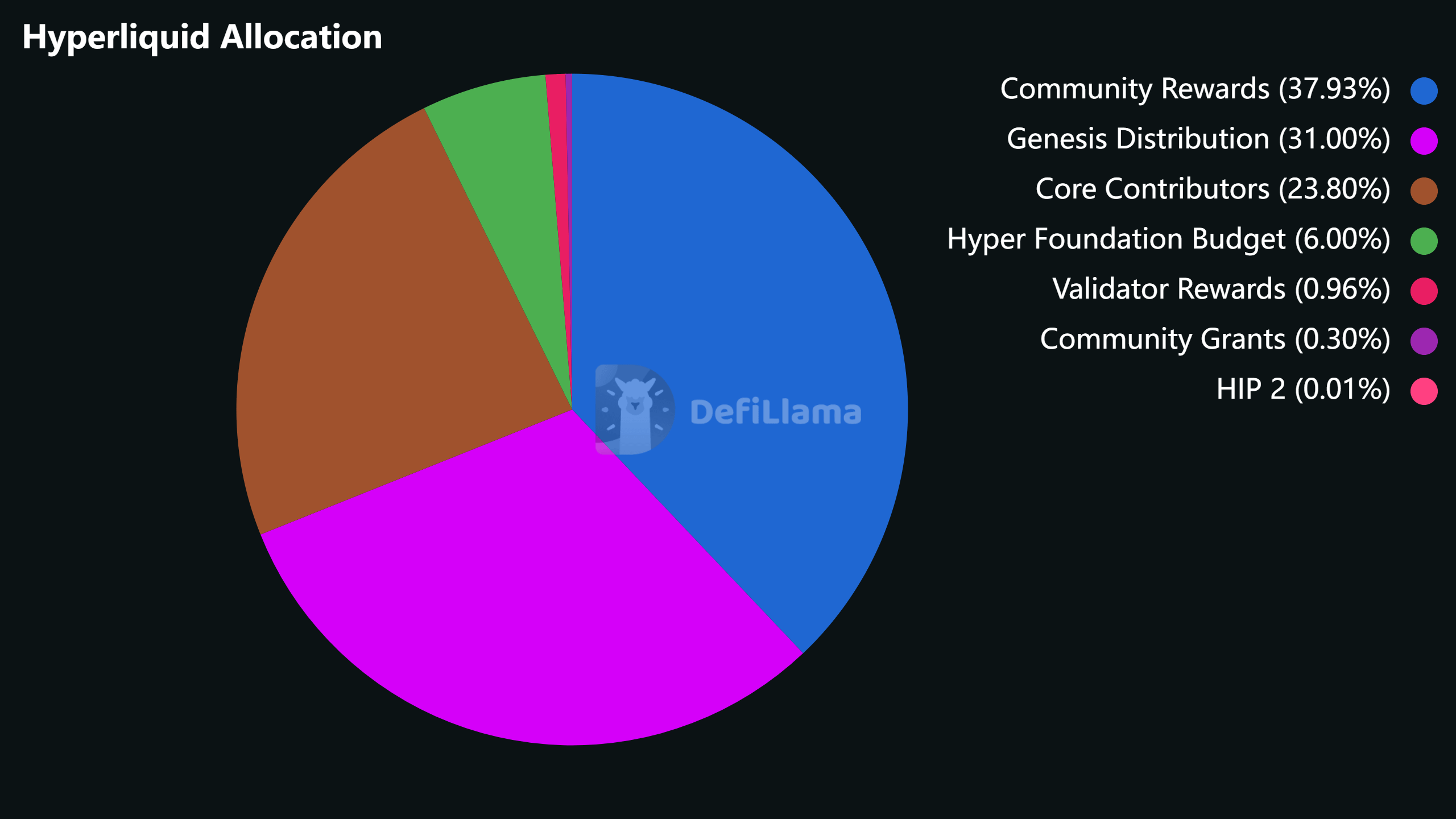
HYPE has a fixed maximum supply of 1 billion tokens, with approximately 337 million currently in circulation. Critically, there was no venture capital allocation. The initial distribution came via a genesis airdrop to 94,000 early users (31% of total supply), one of the largest airdrops in crypto history, when it took place on November 29, 2024. Over 70% of total supply is allocated to the community. Core contributor tokens (23.8% of supply) vest linearly until 2027-2028, with monthly distributions of approximately 1.2 million HYPE.
The Buyback and Burn Mechanic
This is where it gets interesting for anyone who thinks about value accrual. Hyperliquid directs 97-99% of all trading fees into an automated mechanism called the Assistance Fund, which continuously purchases HYPE tokens from the open market. This creates a direct, transparent link between trading volume and token demand.
In 2025, Hyperliquid spent approximately $716 million on buybacks, representing roughly 3.4% of total supply. This was the largest buyback program in all of crypto. The Assistance Fund accumulated over 28.5 million HYPE tokens with a market value exceeding $1.3 billion. The Hyper Foundation has maintained a pace of approximately $1.5 million per day in buyback activity.
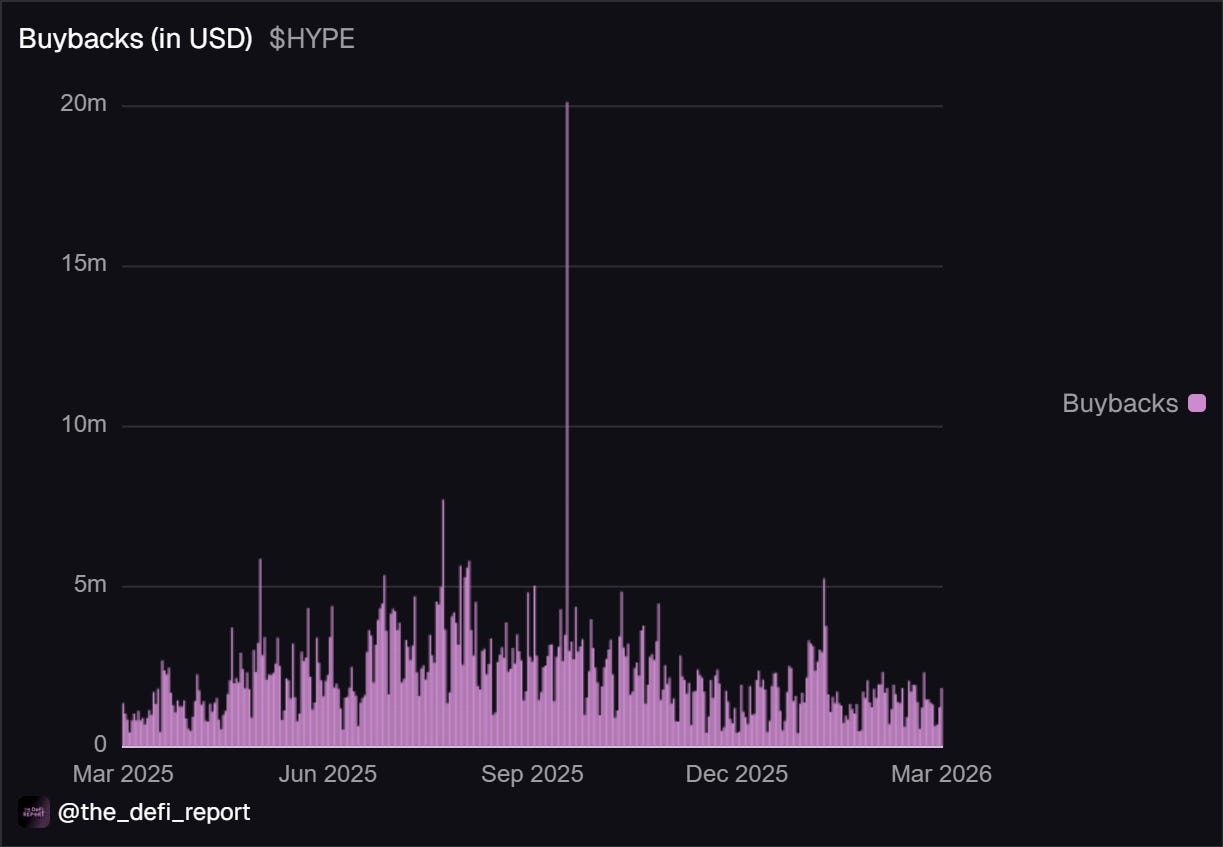
In early 2026, the community approved a governance vote to permanently burn approximately 37.5 million tokens held in the Assistance Fund, roughly 13% of circulating supply. This removed them from circulation entirely rather than holding them in treasury. Recently, weekly burns have run at approximately $9.2 million worth of HYPE.
Staking
HYPE also serves as the gas token for the Hyperliquid L1 and the staking token for network validators. Staking provides additional yield on top of the buyback-driven price appreciation, and stakers receive trading fee discounts. As ecosystem activity grows with new applications launching on HyperEVM and more transactions flowing through the network, gas demand creates organic buying pressure independent of the Assistance Fund.
Public Market Access
Three major asset managers have launched spot HYPE DATs & ETFs in a signal of growing institutional interest. The filings are from Grayscale (ticker: GHYP) on Nasdaq, Bitwise (ticker: BHYP) on NYSE Arca, and a third via a publicly-registered SPAC entity (Hyperliquid Strategies, ticker: PURR) which filed an S-1 to raise $1 billion and holds 12.6 million HYPE tokens.
Valuing Hyperliquid requires thinking about it more like a cash flow generating business than a typical blockchain project. Hyperliquid can be evaluated on the same metrics you’d apply to a traditional exchange, with $843 million in 2025 revenue and annualized run rates that have at times exceeded $1 billion.
As of early April 2026, HYPE has a market cap of approximately $8.8 billion and a fully diluted valuation (FDV) of roughly $35 billion. Tokenterminal data shows a price-to-fees (P/F) ratio of approximately 13x on an annualized basis, a metric that compares favorably to traditional exchange valuations. For context, CME Group trades at roughly 20-25x earnings, and Coinbase has historically traded at significantly higher multiples during bull markets.
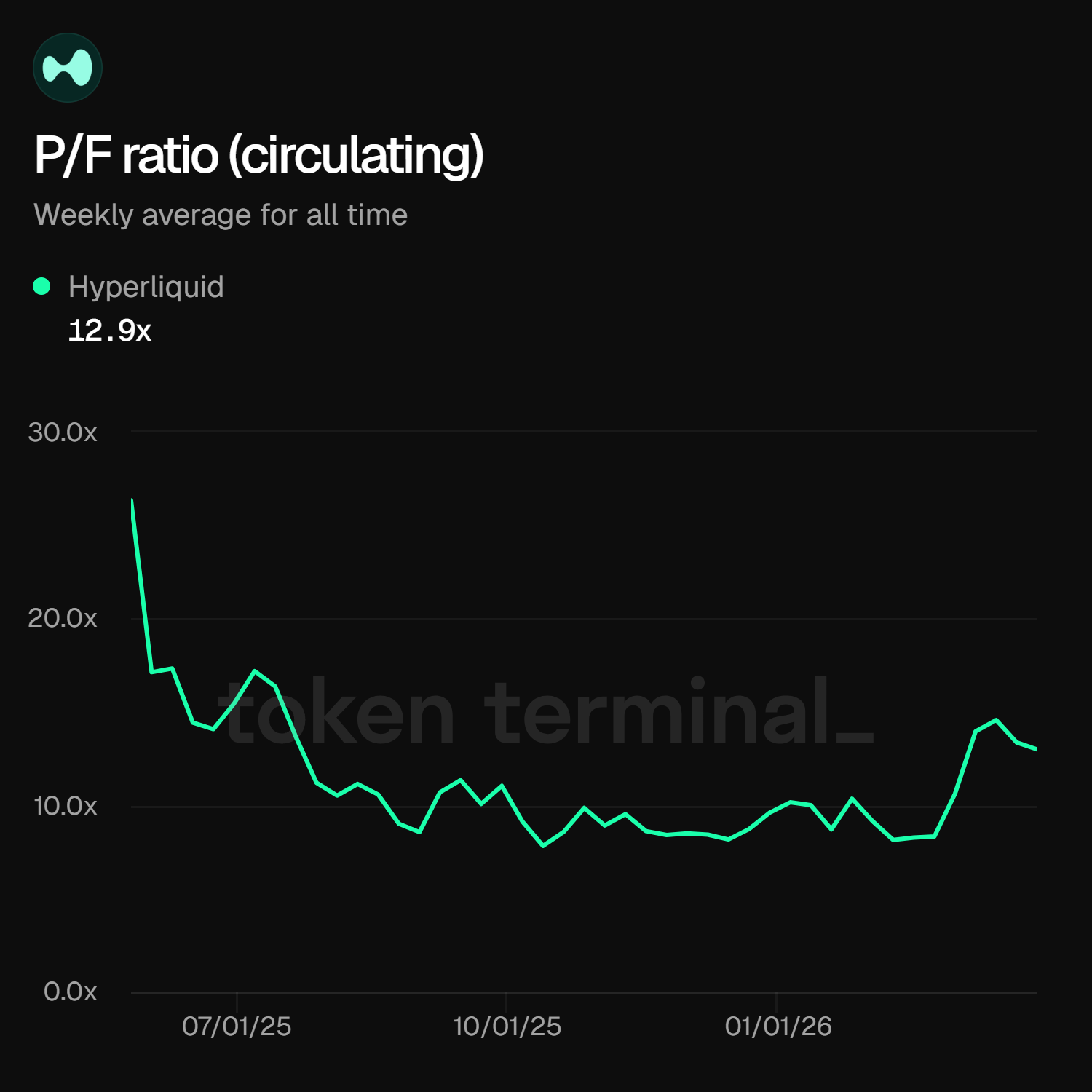
The key question for valuation is sustainability. Hyperliquid’s revenue is directly tied to trading volume. If volumes contract in a bear market, buyback revenue drops proportionally. However, several structural tailwinds support the bull case: the expansion into non-crypto assets via HIP-3 (oil, gold, equities, prediction markets via the forthcoming HIP-4), the launch of the USDH stablecoin backed by U.S. Treasuries with 95% of reserve interest supporting HYPE buybacks, the introduction of portfolio margin for sophisticated traders, and the potential approval of HYPE linked ETFs opening the door to institutional capital flows.
Hyperliquid has emerged as the dominant force in decentralized derivatives. It has processed trillions in volume, generated nearly $1 billion in revenue, and done so without a dollar of outside funding. Its custom L1 blockchain delivers performance that rivals centralized exchanges. Its buyback-and-burn tokenomics create one of the most direct links between platform usage and token value in all of crypto. With HIP-3 turning the platform into a permissionless marketplace for any derivative imaginable, Hyperliquid is positioning itself not just as an exchange, but as the infrastructure layer for a 24/7 global derivatives market.
Hyperliquid represents an upgrade for traders already comfortable with leverage, one where the market never closes, the order book is accessible to anyone, and the house actually gives most of its take back to the people using it.
That’s it for this week. Keep your head on a swivel.
And, as always…
Stay tasty,
Ryan
Trading platform and brokerage: tastytrade
Crypto trade ideas and more content: YouTube
Follow: X
Disclaimer: None of this is to be deemed legal or financial advice of any kind and are solely the opinions of the authors. tastycrypto is provided by tasty Software Solutions, LLC. tasty Software Solutions, LLC is a separate but affiliate company of tastylive, Inc. and tastytrade, Inc. Neither tastylive, Inc. nor tastytrade, Inc. are responsible for the products or services provided by tasty Software Solutions, LLC. Cryptocurrency trading is not suitable for all investors.
No posts
Comments
Nothing yet. Say the first thing.
Sign in to join the conversation.