
Check out our library of subscriber resources to help you draw closer to Jesus!
This last year I have been swamped with AI in both my personal life and as a teacher.
This fall I will begin to completely redesign one of my Technical Writing courses from the ground up to include AI literacy, so my students are better prepared for the actual technical writing tasks they will be asked to do, and not the ones they were doing just a few years ago.
What does this have to do with our Christian life? With our kids? Everything.
In a recent study, it was found:
Roughly a third of young adults (32 percent) reported turning to AI for help with their personal life, including “advice about relationships or life decisions.” One in four young adults (23 percent) reported using chatbots “as a friend,” and one in ten young adults (10 percent) said they used an AI chatbot “as a girlfriend or boyfriend.” (Lira et al.)
Yes, these statistics are young adults, but as this new school year begins, AI is becoming a normal part of so many apps and programs that our children will be exposed to this year, whether we like it or not.
Should we hide them from it completely? Can we?
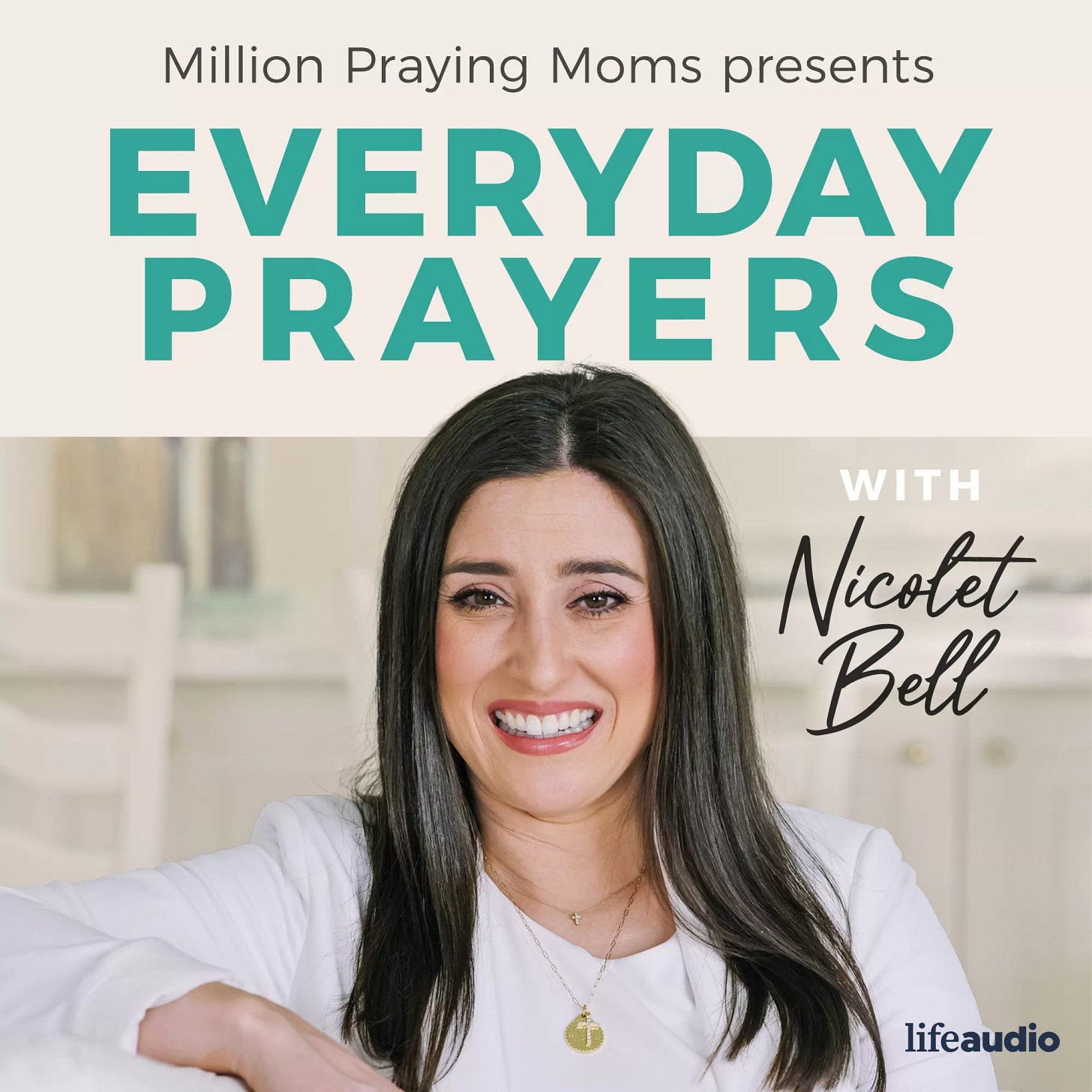
I discuss the answers to those questions and more on the Everyday Prayers podcast this month with Nicolet Bell. We’re joining with Million Praying Moms for our annual book club over Everyday Prayers for the School Year, and on the podcast we will have devotionals from the book, interviews, and more! On several Fridays this month, Nicolet and I discuss AI and friendship.

Unless your children are very young and not on devices, or you don’t have an Alexa or other smart device, then it is almost impossible to keep them completely away from AI. It is also going to be part of their job and likely a normal part of their school in the very near future. So ignoring or avoiding it isn’t a helpful answer.
Instead, I would work to educate them and yourself on the challenges and benefits of AI.
False information–called hallucinations. AI doesn’t intentionally lie, but it often gets information wrong due to it simply “guessing” the next right answer instead of searching as Google might. Double-check all information, even URL citations that it gives you.
Bias–Depending on the company, AI is fed on the whole internet. Good, bad, and ugly. It doesn’t have discretion between what is biased and a caricature and what is real.
Data Privacy–unless you’re paying for the AI service, and even then, read the fine print, your information is not private. It will be used to “feed the machine.” As Dr. Amber Quaranta-Leech says, “If you’re not paying for the product, you are the product.”
False Emotional Intelligence–as mentioned in the quote above, many young adults, and others, are turning to AI for relationships. It is programmed to sound like it cares. To sound chatty and helpful. It is no more aware of what it is doing than your microwave.
Critical thinking–this is the biggest concern of every educator I talk to. So many people are not thinking for themselves and turning to AI for all the answers. Yes, it is useful, but overuse will begin to atrophy our thinking.
However, it isn’t all bad. There are many helpful tasks AI can do and workflows it can speed up once you know what quality results look like.
Ideas to overcome writer’s block–many kids and adults get stuck on projects due to a lack of ideas. AI is helpful because you can ask it for 25 ideas for XYZ and then choose the best ones for your situation, purpose, and audience. The key is you need to know what good ideas look like so you can tell what is trash and what is treasure.
Editing–for years I have used free Grammarly to follow me around my computer. It is even giving suggestions right now as I type. There is a big difference between paid, which dramatically changes your writing, and free, which helps with grammar, spelling, and slight wording. There is little excuse to have poor grammar and punctuation nowadays.
Research capabilities–Google is great for research with discretion, and so are databases and libraries. I still use them. However, when I have a vague question or don’t know quite how to word what I’m looking for, AI is extremely helpful. Because it guesses the “right” response based on massive amounts of data, it can fill in the blanks. Looking for a random Bible story about friendship and feel the story of David and Jonathan is overused? Ask AI for other ideas. It looks in the crevices that you may have forgotten about since your flannel board days. Yes, double-check it and read the verses in context due to hallucinations, but it is helpful.
Citations–as a teacher and author, this is one of my favorite uses. I’m sharing it with my students this week. AI is brilliant with citations. Any style of citation. I drop a URL, like the one for the article I cited earlier, and ask it to cite it in MLA. It comes up with a citation in seconds! Something that when I was a student would have taken me at least 5 minutes. I verify citations with the OWL Purdue website to make sure it includes everything. But it is often correct or very close.
There are many, many more, but these are just a few I use regularly.
I address these topics and many others in my other monthly newsletter, the AI Awareness Hub. Sign up at the link below:

AI can be a helpful tool, but it can also begin to sound like truth and edit your information intake as it learns more about you. Just this week, I drove by a property and looked at it on Zillow. In less than 24 hrs Facebook showed me a reel of that exact property with pricing and details. That behind-the-scenes use of AI is what concerns me the most. Helpful. Yes, maybe. Creepy. Definitely. Filtering my feeds? Absolutely. These problems existed before AI and will continue to get worse.
It is hard to think outside the box and see the world from another’s point of view when the box moves from cardboard to cement, and all you see online is an echo chamber for your ideas and viewpoint.
It is challenging to “love God…and love others as we love ourselves” if it’s hard to hear God above the noise, we never notice others, and we’re constantly told we need “one more thing” to be happy.
Am I saying be fearful? No. Be aware? Yes.
Keep your family in God’s word and consistent Bible reading. Though I love to read in apps and the access they give me to quick Bible studies, I regularly turn to my physical Bible to make sure I’m reading truth.
Keep praying and seeking God’s wisdom. It can be tempting to ask AI what you should do or have it suggest options. Remember to seek God and his Spirit’s guidance first. Maybe he will work through AI’s response, maybe not. I’ve seen prayers answered as I’ve scrolled Instagram, but most of the time it’s just noise.
If you’d like to pray in community this month, join me and Million Praying Moms as we read Everyday Prayers for the School Year this fall. We begin today, Monday, August 3rd, but it’s not too late to join! Just grab a copy of Everyday Prayers for the School Year. The Million Praying Moms website and Amazon have them for sale now.
Get the book, listen to the podcast, and ask a friend to join you as we pray together for our children’s school year!
There are two books I’m reading right now that complement each other well. They are in different styles, but one keeps me focused on my actual calling as a Mom, and the other helps me maintain a realistic perspective on AI and its capabilities. Both give practical advice, which you know I love!
When Mothering is Hard and No One Sees by Shalene Roberts
The Trojan Horse of the Digital Age: Why Christians Must Discern AI by Misty Phillip
Father, with all the changes coming at us, especially with AI, give us and our children discernment. Help us to keep our focus on you and to see the people around us. In Jesus’ name, Amen.
Grace and Peace,
Tara L. Cole
P.S. Yes, some of the links above are affiliate links. This just means that when you purchase through them, you’re helping support my ministry at no extra cost to you. Win win! Thank you!
Lira, Benjamin, et al. “How Gen Z Is Using AI And What It Means for Educators.” Harvard Business Impact, Harvard Business Publishing, 26 February 2026, hbsp.harvard.edu/inspiring-minds/how-gen-z-is-using-ai.
No posts
Comments
Nothing yet. Say the first thing.
Sign in to join the conversation.