
We’ve all been told the power of a polished personal brand.
You know, colors, wardrobe, fonts, a great headshot with you in front of your laptop, maybe an inspired Instagram 9-grid.
And don’t get me wrong: I love a good aesthetic. I created Stilettos in the Sandbox. I won’t pretend I don’t enjoy a curated shoot or a signature shade of lipstick.
But let’s be clear: a personal brand isn’t about being pretty. It’s about being profitable.
And if your brand is only built to attract eyeballs, not build trust, you’re leaving credibility (and cash) on the table.
Somewhere around 2020, we all migrated online and started building personal brands.
We were posting. Growing audiences. Trying to showcase ourselves as someone who should book the part (because at least we looked the part).
And somewhere in that shift, we stopped acting like business owners and started acting like influencers.
We used MrBeast as the benchmark, thinking our content had to hit millions to matter.
(hat tip to Adriana Tica for the inspo)
We looked the part. Personal branding meant publishing polished websites with high-end templates (Tonic Site Shop has me in a forever chokehold).
That was enough to impress at first sight. Insert testimonial here, and a laptop photo there, and a client yelling shut up and take my money was soon to follow (I legitimately had a client find the only page I hadn’t unpublished during a rebrand and not take no for an answer when I said I’d sunset that service).
More was more. More eyeballs literally meant more money. It also meant we were in the era of “content is kingqueen.
We were told the top of our funnel should be generic, that the goal was ‘reach first, relevance second’.
And so we watered our messages down to ‘fill the top of the funnel’. We tried to appeal to more people in hopes that we’d eventually convert a few to our signature course (and we’d ride off into the sunset with pockets full of “passive income”).
But passive income was just that, “a dream.” And in the end, course creation was a dream for some course creators, but course takers not so much.
According to Harvard Business Review, online course completion rates hover around 10–15%.
That’s completion, not success. Implementation? Probably even lower.
We were promised passive income and scalable transformation. What we got was burnout, buyer regret, and Google Drives full of outdated PDFs.
And yet, we keep following formulas built for 2020 as if the market hasn’t moved on.
If you enjoyed the time when audience size correlated with income, you know it’s certainly not the case today. We’ve left the attention economy. In fact, organic social reach is firmly in the single-digit percentages across platforms. We’re firmly in the trust economy.
Before 2024, I felt like I could write “hello” on LinkedIn and get 800 impressions (even before I started building an audience). These days, I’m reaching for 500 impressions with an audience of 5k and a strong network that engages.
When organic reach plummets, you have two choices: pay-to-play or find your people and build trust.
Fortunately, trust is more than a mood. It’s measurable.
According to Weber Shandwick, a CEO’s reputation contributes to nearly half of both their company’s reputation (45%) and market value (44%). That’s not just optics, that’s impact.
Your personal brand doesn’t exist to make you look good. It exists to make you known, trusted, and credible to the people who are most likely to buy.
That means choosing specificity over scale.
That means staying consistent, even when you’d rather be quieter.
That means showing signs of life that say: I’m here. I’m in it. I’m not going anywhere.
Because the brands we trust most?
They’re not the loudest.
They’re the ones still standing and still speaking specifically to their target audience.
Here’s how I know this works.
I love skincare. I’ll spend hours down the YouTube rabbit hole, soaking up product reviews, tutorials, and ingredient breakdowns.
And while I enjoy creators like James Welsh (his voice is a dream), when it comes to actual skin advice, I go straight to Dr. Vanita Rattan and Dr. Alexis Stephens.
They don’t have the biggest followings.
They’re not on every “Top Influencer” list.
But they speak directly to me: a woman in her 30s with skin of color who’s worried about hyperpigmentation, premature aging, and seeking sunscreens that won’t leave me looking ashy.
Their content doesn’t try to please everyone.
It pinpoints me, and because of that, I trust them implicitly. This is the magic of niche authority.
It’s not just about who sees you, it’s about who still believes you.
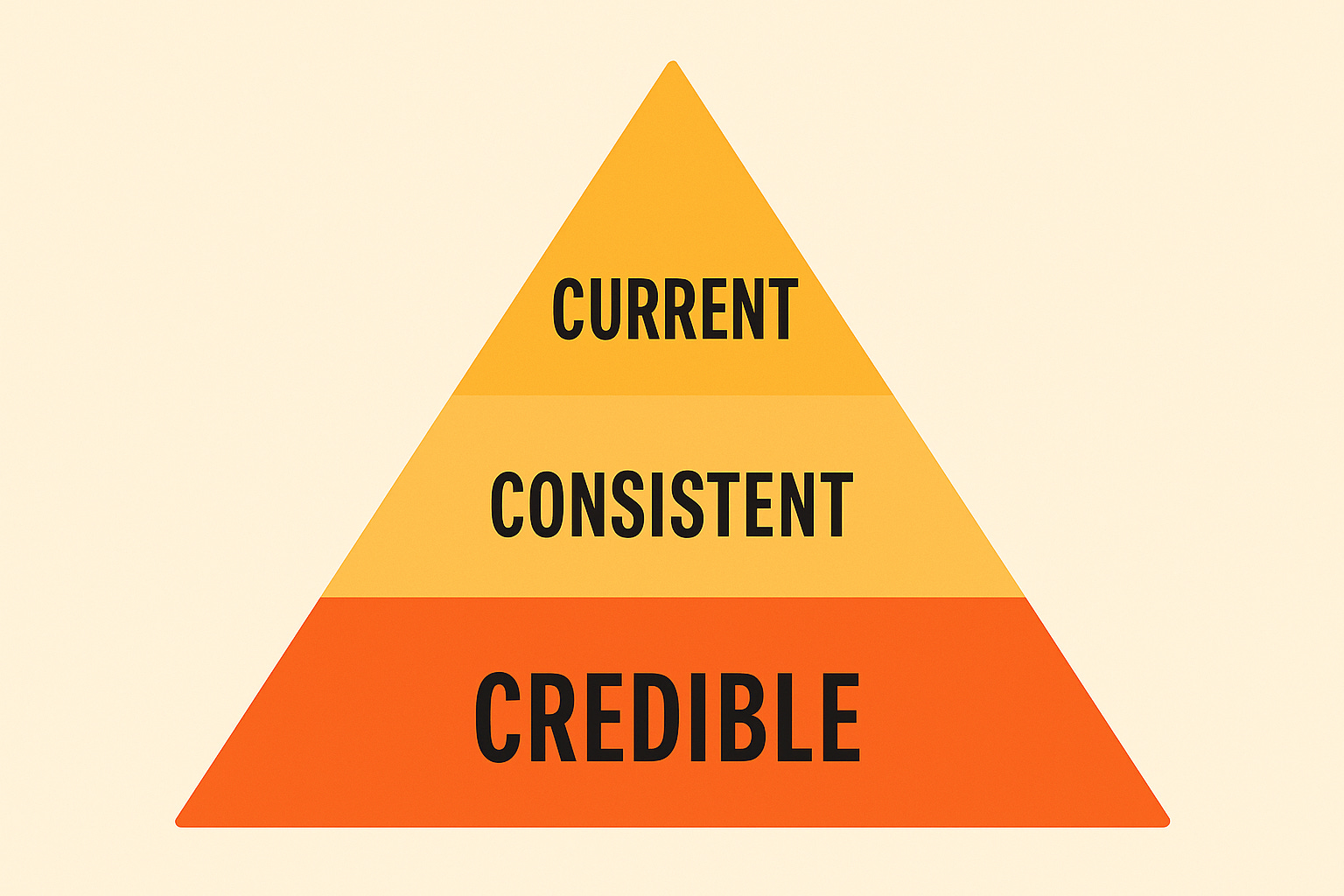
If you want a personal brand that drives pipeline, not just popularity, you need to be three things:
Nothing signals “out of business” like a dead LinkedIn activity feed or a podcast from 2019. People buy from the brands that are active, not just online, but in the work.
Think: last post, last collab, last stage, last review.
These are all signs of life that say, “This isn’t a ghost town.”
You don’t need to post daily, but you do need to show up regularly over time. You can’t cheat this one, but you can set a goal to show up with the same message for the next 6 months, then consistency will be on your side.
Consistency breeds familiarity, and brands that feel familiar earn more trust than brands that pop up sporadically.
Familiarity that takes you from “I’ve seen her before” to “I know her work.”
You can’t fake this one.
Credibility comes from specificity, repetition, and results within a clear niche. Don’t worry about just sounding smart. It’s about being known as the right choice for something to someone.
In Harvard Business Review, they say personal branding only works if your narrative is:
Accurate: Is it true?
Coherent: Does it make sense?
Compelling: Does it draw people in?
Differentiated: Does it demonstrate what makes you unique?
If you don’t intentionally build your brand, someone else’s perception will. And chances are, it won’t be all four of those things.
So many founders were taught to treat content like a funnel.
Reach the masses, then hope a few trickle down into buyers.
But in the trust economy, content is a filter (and funnels look more like months-long mazes). Your best-performing content isn’t designed to attract everyone. It’s designed to attract the right ones and repel the rest.
Your top-performing (not to your ego or the algorithm, but according to your bottom line) content isn’t designed to attract everyone. It’s designed to attract the right ones and repel the rest because content can’t be queen when AI can churn out months’ worth of content in a matter of minutes.
This is why nano and micro-influencers are outperforming mega-influencers in brand deals.
Buyers want someone who’s deeply trusted within a community—not someone who’s hawking supplements to 3 million strangers.
And the data backs this up: 99% of buyers say thought leadership is important, or critical, in their decision-making.
Visibility matters. But who you’re visible to matters more when trust is scarce.
For 2026, broad = broke, but specificity leads to sales.
So what do you want your content to achieve?
Are you catering to buyers & believers? Or bots?
If we zoom out, here’s the real shift:
We used to chase impressions. Now we’re chasing impact.
We used to try to look the part. Now we’re trying to live the work.
Your personal brand isn’t a vibe.
It’s not a signature font, colors, or logo.
It’s not a funnel. It’s not a post that went viral one time.
It’s how you build credibility in public. It’s how you stay relevant to the people who count. It’s how you translate your expertise into equity.
So yes, polish your presence. Take the photos. Curate the colors.
But don’t stop there.
Because your brand isn’t optional.
It’s operational.
If today’s post hit home, let’s keep the conversation going. You can:
Get ROLO, your free Digital Social Selling Advisor (a GPT to help you GTD)
Complete my 7-question subscriber survey so I can shape future posts around you (I’ll donate $100 to Kiva for every 100 responses)
Join the waitlist for my 1:1 advisory if you’re ready for a personalized system that sticks, or book a Catalyst Call if you need help untangling your brain right away
ADdictive, The Decline of Organic Reach on Social Media in 2025: Link
Weber Shandwick, The CEO Reputation Premium: Link
Harvard Business Review, 11 Ways to Build Your Personal Brand: Link
Harvard Business Review, Where Online Learning Goes Next: Link
Momentum ITSMA, Thought Leadership Research, 2021:Link
Comments
Nothing yet. Say the first thing.
Sign in to join the conversation.