
A decade ago, we had a problem in political discourse: there was an increasingly influential and concerning political ideology that we didn’t have a name for. While the ideology in question was adjacent to variants of liberalism, progressivism and socialism, you couldn’t label it as either liberal, progressive or socialist and level the accusation at that label, without someone correctly pointing out that you are making unfounded accusations. After all, it isn’t as if liberals in general going back to Locke and Mill are responsible for anti-universalist identity politics, or that old-school socialists like Bernie Sanders were for clamping down on free speech. What we soon learned was that, when you have an ideology that you couldn’t name, in a way that everyone understood what you meant, you couldn’t discuss it properly, which meant you couldn’t accurately point out its flaws. To be able to validly pin the accusations on the problem itself, we needed to have a word to identify where the problem was exactly, and that didn’t also include adjacent but clearly different parts of the political landscape. After some clumsy and unsuccessful attempts (e.g. ‘postmodern neo-Marxism’, ‘identity socialism’, ‘successor ideology’), everyone finally ended up on the same page, by using the word ‘woke’. Only after that did we have a universally understood word, to describe where the problem was coming from, in a specific way. This, in turn, allowed us to have a proper discussion about the problem, and begin to fix things.
Right now, I think we actually have the problem of there being another increasingly influential and concerning political ideology that we don’t yet have a name for, but on the right. An ideology that has either taken over pre-existing conservative parties, like the Republicans under Donald Trump, or led to the rise of new parties that are threatening to supplant or at least split the existing conservative party, like Reform UK, National Rally in France, AfD in Germany, and One Nation in Australia. The ideology is concerning because it seeks to use state power to limit free speech, coerce academia, private business and other previously independent institutions into following certain cultural stances, and otherwise forcibly change society in an inorganic way. Many commentators have called this force the ‘populist right’, however, I think that ‘populist’ should refer to the way they conduct politics, rather than the ideology itself. Moreover, there are indeed governments that I would identify as sharing the ‘populist right’ way of doing politics but not the highly authoritarian ideology of the aforementioned movements, like Argentina’s Milei administration. This is why it is important to have a separate term to discuss the actual ideology that underlies MAGA, Reform, and similar forces, in order to critique its adverse impacts on individual freedom.
If you asked what ideology those supporting MAGA, Reform and other similar movements identify with, I guess most of them would say ‘conservative’. However, the reason why I have long been reluctant to use ‘conservative’ to describe these movements is because, at least in some of their behavior, they are anything but conservative. In fact, in these ways, they are actually far less conservative than their center-left opponents! For example, Trump’s extensive use of constitutionally questionable executive orders, and his tendency to want to enlarge executive power beyond what has long been understood to be its limits, is clearly not a conservative trait. If we are looking at things like these, then objectively speaking, Biden is much more of a conservative than Trump! You know that Trump is not actually behaving like a conservative in any sense, when this very conservative Supreme Court is nevertheless regularly declaring his actions unconstitutional, from a conservative and originalist point of view. I think this observation has clear parallels with an observation about the woke left a decade ago: many woke activists identified themselves as liberals, but given that liberalism should be all for free speech, and woke left activism was against free speech in many instances, it was actually, by definition, illiberal, i.e. the opposite of liberal. This 180-degree conflict between the claimed label of ‘liberal’, versus the actual illiberal behavior of these activists, demonstrated the lack of fit of the self-chosen label, and the need for a more accurate label instead. Similarly, the claim of MAGA to be a conservative movement, versus its clearly unconservative ways, demonstrate the need for another label instead.
Let’s take a deeper look at how MAGA and similar movements actually differ from conservatism. It is clear that the biggest way MAGA and similar movements deviate from what we have long understood to be ‘conservatism’ is in its glad embrace of state power to bring about their preferred cultural and economic outcomes. This violates genuine conservative philosophy, on multiple levels. On the most literal level, the wayward breaking of long-standing norms, traditions and guardrails is, by any definition of conservative, not conservative. On a deeper philosophical level, conservatism is inherently skeptical of top-down radical change, preferring instead a society governed by norms that have organically evolved over time. This is basically the whole point of Burke’s philosophy, and the core reason why he opposed the French Revolution. Moreover, one major reason why conservatism is skeptical towards top-down ideologically-driven change is because of the adverse consequences for long-standing freedoms, including possible unforeseen circumstances. Conservatives have long made a point about how Burke was able to foresee the inevitable authoritarian results of the French Revolution, long before the liberals of his time even had any idea of this pitfall. Thus the conservative reluctance towards radical change driven by state power is often actually a manifestation of the fear of loss of long-standing freedoms. Unlike genuine conservatives, Trump and his supporters clearly have no such worries. Given all these differences, it is clear that MAGA-ism cannot be classified as a form of conservatism, just like wokeism cannot be classified as a form of liberalism. This is because the practices of MAGA-ism are repugnant to actual conservative values, just like how the practices of wokeism are repugnant to actual liberal values.
If MAGA-ism is repugnant to conservatism, or at least philosophical conservatism of the Burkean variety, then where do we find its parallels or cousins, in either the present or the past? Many would undoubtedly answer, ‘fascism’. Objectively speaking, even I, who have long opposed calling MAGA-ism ‘fascism’ on the basis that it does not share many of fascism’s characteristic features (from its economic ideology to its antisemitism), have to acknowledge that, it appears MAGA-ism is indeed relatively closer to fascism in its nature, than to any other ideology that has occupied national government in the history of any Western country. Given its willingness to use state power to coerce previously independent institutions and private business, MAGA-ism clearly shares much more of its DNA with fascism than with any version of conservatism. As for why MAGA-ism is closer to fascism than it is to liberalism, centrism, or socialism, I don’t think that needs much explaining. Thus, even if MAGA-ism is only, say, 50% similar to fascism, it is still much more similar to fascism, than to any of the other ideologies we are familiar with. (Still, I maintain that it wouldn’t be correct to call MAGA-ism fascism, because they are still clearly different in too many aspects.)
The next question to ask is, besides fascism, where else can we find something similar to MAGA-ism? I think there are actually two other places where we can find something similar to MAGA-ism. The first is in the former Soviet Union, at least regarding social (non-economic) issues, from Stalin onwards. Stalinism clearly had no limits when using state power to shape society in an authoritarian way, and Stalinist Russia undertook a lot of reactionary policy-making that reversed the previous liberalization under Lenin, such as restoring anti-homosexuality laws. Stalin clearly wanted his country to be culturally reactionary, and he clearly had no problem with using state power to that end. Stalin’s model of state-enforced reactionism even outlasted the USSR itself, and is arguably the reason for the illiberal political and legal landscape seen in many Eastern European countries even today. (This also ironically means that the reason why many MAGA supporters like Eastern European cultural politics is because of their history of Stalinism, despite MAGA being supposedly very opposed to ‘communism’, according to Trump himself. But that’s for another article perhaps.)
The second place where one could find some parallels to MAGA-ism, or at least a precursor to it, was within the ‘fusionist’ conservative politics of the 20th century West. Of course, the authoritarian strand was never dominant in that coalition, but it was always there, often attached to the religious right ‘leg’ of the so-called three-legged stool. The authoritarians in the fusionist coalition were responsible for proposals from banning gay teachers in the 1980s to forcing schools to teach ‘intelligent design’ in the 2000s, but fortunately, most of these proposals never became law, thanks to the strong counter-influence of the libertarians in the fusionism coalition. The most successful campaign of the authoritarians within the fusionist coalition was perhaps the passage of constitutional bans on gay marriage in many states across America in the 2000s, but even these were later invalidated by the US Supreme Court in its Obergefell ruling in 2015. The overall picture seems to be that the authoritarians were there, but for the most part, they were not very successful, because they were only a relatively minor player in a coalition that also had libertarian elements.
The overall conclusion here is that, the kind of authoritarian reactionary politics that MAGA represents actually has some precedents, but they were either part of some bigger program, or else a relatively minor player in a larger coalition, where they didn’t get their way all that much. In other words, it was always playing second fiddle. This, I think, is why this kind of politics lacks an independent identity, and a label we can use to talk about it, to distinguish it from other things. However, these days, the cultural-authoritarian right (for lack of a better term) is actually in the driver’s seat, and is primarily, or even solely, responsible for Don’t Say Gay, book bans, drag bans, the Trump administration’s coercion of academia and private business, the right’s War on Disney and ‘woke corporations’, the authoritarian actions of ICE, and more. This means they are now one of the biggest threats to individual freedom.
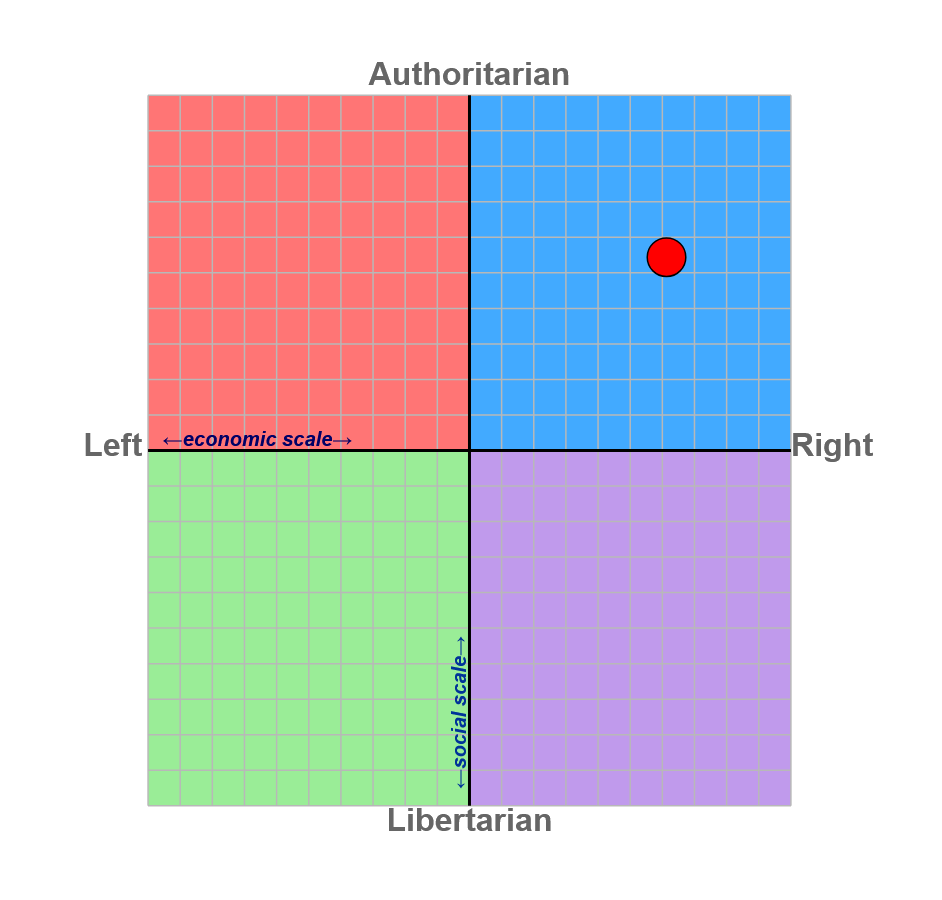
As in the case of woke, I think we do need a label to talk about this ideology, given its primacy as a force threatening individual freedom these days. I suggest using the word ‘Auth-Right’, short for ‘Authoritarian Right’, to describe them. Firstly, it is something that most people would roughly understand, in terms of what kind of politics it refers to. Secondly, the popularity of the Political Compass, and the common use online of the word ‘Auth-Right’ for the top-right (blue) quadrant, adds to the pre-existing understanding. (As someone firmly in the bottom-right purple quadrant, I find this visual contrast very helpful in explaining and clarifying my own fundamental differences with the Auth-Right.) Finally, using the label ‘Auth-Right’ can also make clear what alternative labels attempt to hide: for example, National Conservatism (NatCon) is clearly a form of Auth-Right, because it clearly requires a state-enforced, standardized version of Christianity to function. However, you would not know it from the name itself. Hence Auth-Right is a much better, and much clearer, label for that kind of politics than NatCon, especially in terms of highlighting its impacts on freedom.
TaraElla is a singer-songwriter and author, who is the author of the book TaraElla’s Political Theory of Everything and the Moral Libertarian book series. She is also the author of her autobiography The TaraElla Story.
No posts
Comments
Nothing yet. Say the first thing.
Sign in to join the conversation.