
Have I ever told you how we found the courage to jump into investing with both feet?
It's because someone else decided to be completely transparent and show us what was possible.
Many finance gurus, YouTubers and bloggers talk about investing, stocks and strategies, but they keep it surface-level.
You never actually see their portfolio, see what’s working, what isn’t, or the mechanics behind how it all comes together.
Because of that, investing can feel murky, confusing, and even terrifying when you're new.
So in an effort to open my wallet and show you exactly how it works for us, I’d love to welcome you to my Dividend Report.
A quick note before we dive in: I’m not a financial advisor, and this isn’t financial advice. This is just our real, lived experience building this portfolio since 2021 — the wins, the choices, and the reasoning behind them. Our fund selection was built carefully around our goals, our risk tolerance, and our timeline. Please don’t copy our portfolio — do your own research, understand your own numbers, and build a strategy that actually fits your life. Our portfolio is also always evolving. What you see here today may look different six months from now.
Let’s get right into it, because that’s the whole point of this series.
In June, our covered call ETF portfolio paid us $9,182.00.
Here’s exactly where it came from:
$4,149.00 landed in our TFSA (tax free savings account). Every dollar of that is completely, 100% tax free, forever.
$5,033.00 landed in our non-registered account. This income is fully taxable on paper and is the account we pull from first when we need cash.
I say “on paper” because right now, we actually don’t pay any tax on this income (legally!). That’s a whole story in itself, and I’ll be writing about exactly how and why in a future diary entry, so stay tuned for that one.
That’s the split. Two account types, two very different tax treatments, one very real deposit hitting our portfolio like clockwork.
We started this strategy back in early 2021, and this is the first time I’m laying it out publicly, holding by holding, month by month, so you can see exactly what building, and eventually living off of, a dividend portfolio actually looks like.
I’m going to keep using the word dividend throughout this series because it’s the word most people search and relate to. But technically, what these covered call ETFs pay out each month isn’t a pure dividend — it’s called a distribution.
A distribution is a blend of different types of income all rolled into one payment: things like foreign income, actual dividends, capital gains, premium received from writing covered calls, and return of capital (ROC). Each of those pieces gets taxed differently — some more favourably than others — which is part of why this strategy can end up being quite tax-efficient.
I’m not going deep on the tax mechanics in this post, but if there’s interest, that’s an easy future entry.
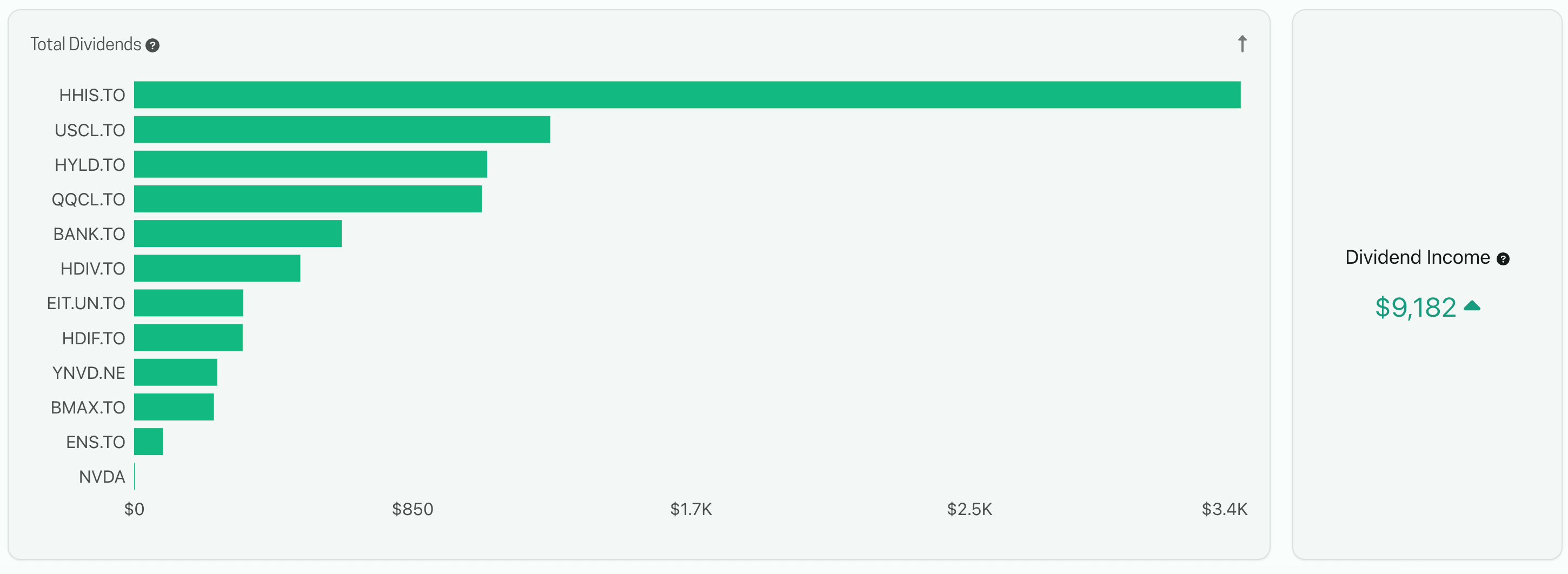
This is the fund-by-fund breakdown for June. HHIS.TO (Harvest High Income Shares) is our biggest single contributor by a wide margin this month, but before you assume that means it’s our biggest position, it’s not.
HHIS.TO currently yields somewhere around 25%, while most of our other holdings yield closer to 10-14%.
It’s not that we have more money sitting in that fund. It’s that that particular allocation simply pays more per dollar invested.
Behind it, USCL.TO , HYLD.TO, and QQCL.TO make up the next tier, followed by BANK.TO, HDIV.TO, EIT.UN.TO, and HDIF.TO rounding out a solid middle, with YNVD.NE, BMAX.TO, and ENS.TO as smaller, still-growing positions.
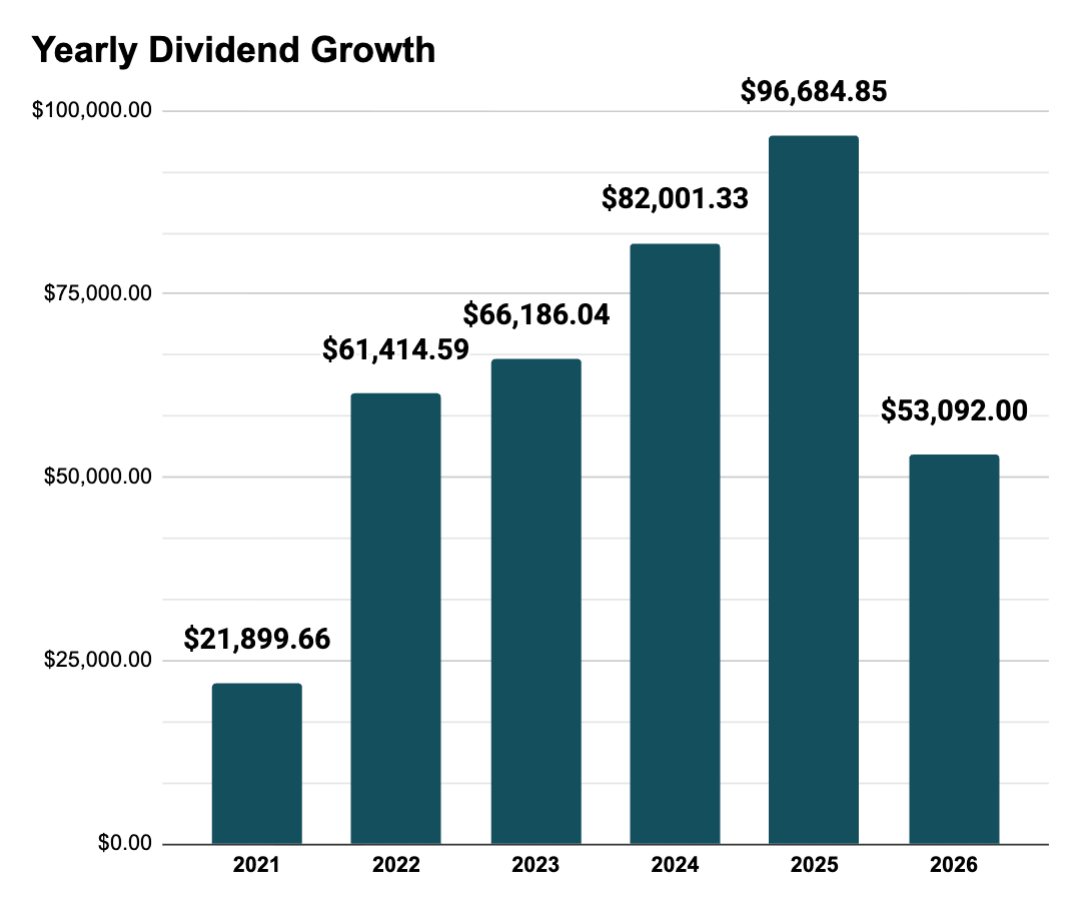
This is the chart that still stops me every time I look at it.
2021: $21,899.66
2022: $61,414.59
2023: $66,186.04
2024: $82,001.33
2025: $96,684.85
2026 (through June): $53,092.00
That last bar looks smaller, but don’t let it fool you — that’s only six months of data next to five full years. Run the math and we’re actually pacing ahead of last year, not behind it. If the second half of 2026 holds anywhere close to the first, we’re looking at a new record year.
And here’s the number that really puts it in perspective: since we started this strategy in January 2021, we’ve earned approximately $381,278.47 in total dividend income. Five years ago, this was a game to see if we could cover our phone bill. Today it’s a six-figure-a-year, self-sustaining paycheque that shows up whether we work or not.
For context on how we actually use this money each month (what gets reinvested, what gets spent, and why), I broke that down in How We Live Off Monthly Dividend Income.
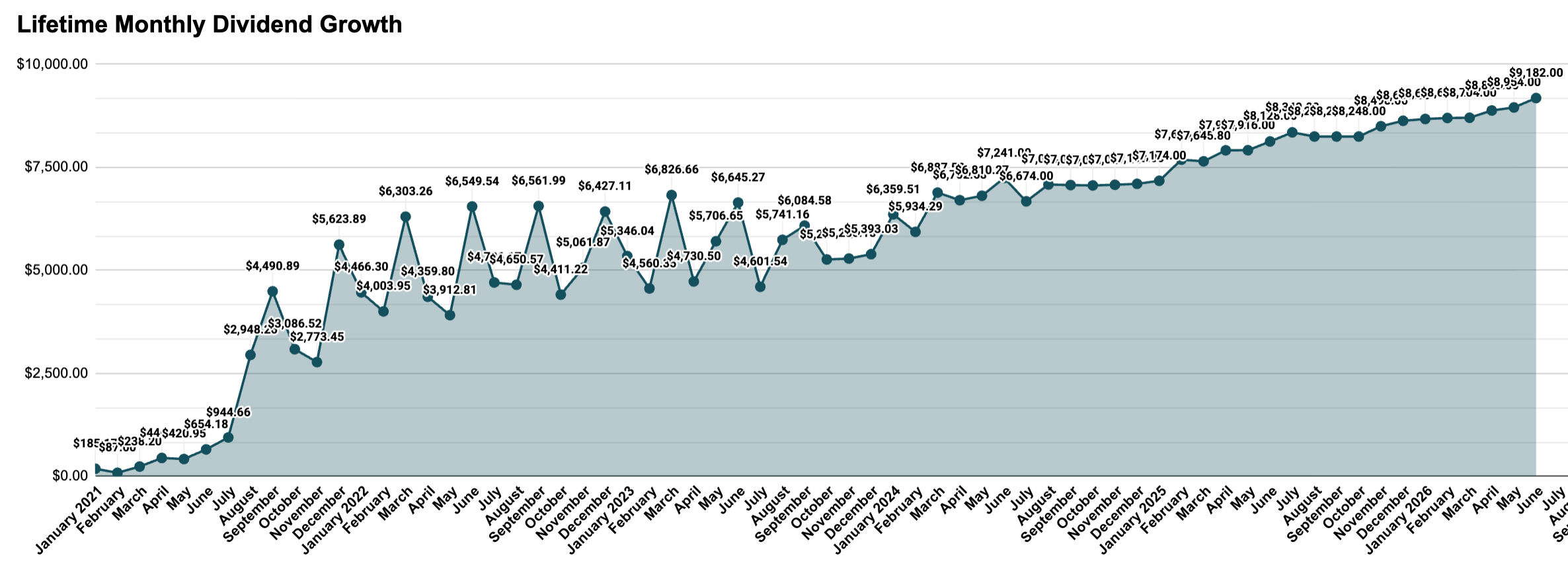
This is the unedited, zoomed-out version. Every single month since January 2021, when this all started at $185.00.
You can see the jump in mid-2021 when we sold our house and invested it.
The choppiness through 2022 and 2023 was due to being heavily invested in funds that paid distributions quarterly, as opposed to our current monthly strategy.
And you can see the climb from 2024 onward starting to smooth out and compound on itself.
June 2026: $9,182.00 — the highest single month, ever, in five and a half years of doing this.
If you want the full story of how we landed on this particular strategy (and the three other strategies we tried before it), I wrote about that here: We’ve Changed Our Investing Strategy 4 Times (Here’s Why).
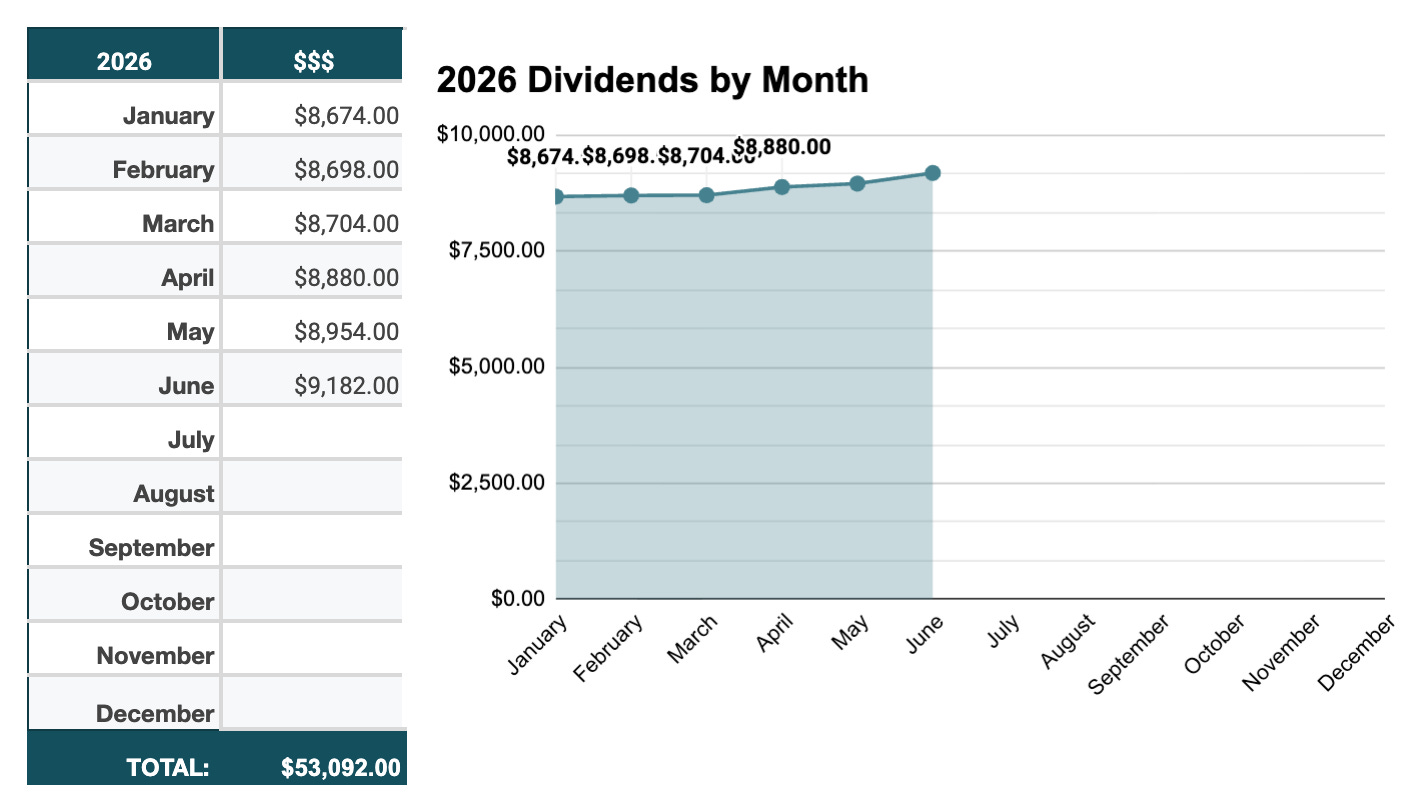
Six months in, six months of growth. Nothing dramatic, no single month that made or broke us.
Just a slow, steady climb, roughly $100–$250 more with each passing month.
That growth is coming from two places:
We reinvest 100% of our TFSA dividends every single month, so that portion of the portfolio keeps buying more shares, which pays more dividends, which buys more shares. Compounding, doing what compounding does.
Some of our funds have actually been raising their monthly distributions. Funds like HYLD, HDIV, and BANK have all bumped up their payouts this year.
This second point is honestly one of my favourite parts of this strategy. It’s like getting raises we didn’t have to work for. And to be clear, this has nothing to do with the underlying ETFs going up in value. This is purely the income going up. The capital appreciation, if there is any, is a completely separate bonus on top of this.
That’s the whole strategy in one sentence: boring, repeatable, and compounding.
If you’re curious how our non-registered withdrawals fit into our actual monthly budget and cash routine, I laid that out step by step here: My Workflow for Tracking My Cash Every Month.
And if you’re wondering why we lean so heavily on TFSAs and non-registered accounts instead of traditional retirement accounts, that’s covered here: Why We Don’t Invest In Retirement Accounts.
Since renting an apartment and establishing a home base in December, I feel like I’m re-learning our budget all over again.
It was easy to travel as nomads for 16 months because we had no ongoing expenses back at home to think about, aside from our storage locker.
Now we have to figure out how much travel we can realistically afford each year without compromising the compounding effect of our portfolio.
Heading into the back half of 2026, we’ve set a target to reach $10,000 months with our portfolio by the end of December. It’ll be close!
That would bring our TFSA income alone up to over $4,500/month, completely tax free. Wild.
I hope this has been insightful, or at the very least, interesting for you.
I don’t pretend our way of investing will make the most money or be the best way to do it.
It’s just what works for us.
Have you started building a dividend portfolio? Got questions on how ours works?
Leave a comment, I’d love to hear from you.
Comments
Nothing yet. Say the first thing.
Sign in to join the conversation.