
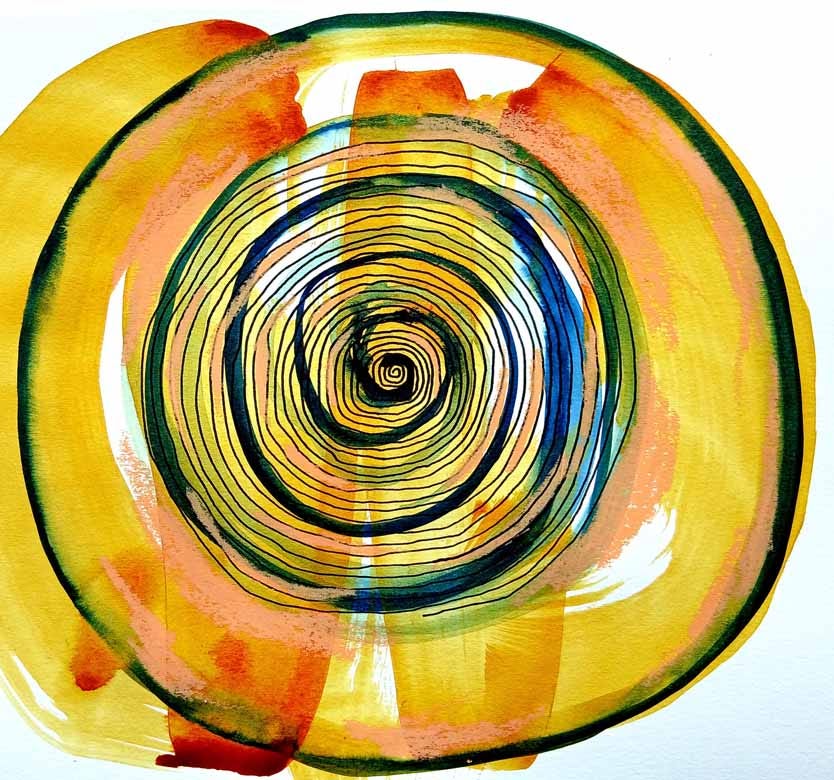
For the last few weeks I’ve been thinking about the ebb and flow of creative processes; the way that things appear and disappear, are born, change and die, over and over again. Last week I looked at this from the perspective of complexity and emergence, but, despite its dynamic, multi-interaction and multi-system framing, complexity is clearly still a forward-moving through time way of thinking.
I wrote a number of articles last year which explored the cultural assumptions that seemed to be dominant in my thinking about time. I looked at the problems of linear chronology and the problems of decontextualised themes, and tried to articulate a more multi-dimensional way of thinking from the point of view of complexity theories. But then I realised that I was still thinking of time in a forward-moving way. Towards the end of the fifth article, I asked:
How might it be in art, in personal processes and cultural expectations, if the focus was on seasons, cycles, or simultaneity, rather than the desire for the continual combustion of new, forward-moving explosions? What might reveal itself from a circling back, over and over, or attention to parts of the weave that didn’t get much attention the first time round; or perhaps from setting out to investigate the way that things regularly fall into grooves, but each time in a slightly different way?
Maybe being new and different doesn’t matter any more. Maybe what matters is to stop craning our necks forward and instead spread our fingers deep into the soil beneath our feet. What haven’t we seen of what’s already here? What’s been composting all of this time, hiding in the darkness as we relentlessly surged forward in the search for newness and thrill?
Writing here, this last year and a half, I’ve been delightfully caught up in an always-new, always-emerging process, which has effortlessly and continually come up with more and more new things to write and about explore.
Now I’m in a different place, and, actually, I want to be here. I want to compost. I want to circle back, review and revisit; to look at where I’ve been, turn things over and view them with eyes that have lived twelve months since then.
So this week I’m returning to what I wrote about stepping off the linear timeline, and thinking again about the (oddly recurring!) sense that everything is always supposed to be moving forwards.
This is regular rhythmic time. The rhythms are never standalone or controlled. But it is the resultant rhythm of the dynamics of an entangled universe. And yet it is also a kind of expected rhythm. A certain stability of its arrival and presence. A stability that is soft and yet never wholly so.
Like seasons or diurnal rhythms. There but imprecise. Sunrises and sunsets or moonrises and moonsets are never at the same clock time or coordinates each day. They shift as per the other interplanetary dynamics and the rotation of Earth. Seasons change based on conditions of oceans, global temperatures, ocean-surface temperatures, iceberg conditions, winds, and so on.
Having moved from the limitations of single-thread chronologies, to the two-dimensional weaves involved in a theme, then on to the idea of dynamic three-dimensional multi-stranded contexts moving through time, I realised that I still have a tendency to imagine even multi-stranded histories as unfolding in a forward-moving, past-to-present way, presumably because I don’t know how to imagine anything else.
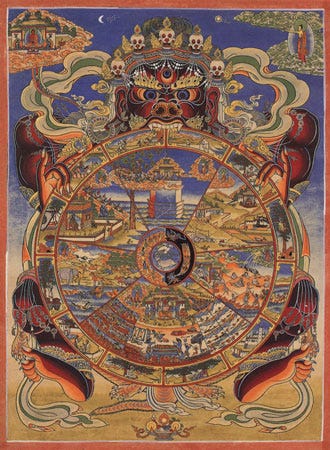
Once again, I’m going to turn to the Indian tradition for help. In India, time tends to be thought of as cyclical rather than as an arrow moving towards a destination. As well as the idea of karma and rebirth, cycles of repetition appear repeatedly in its history, mythology, cosmology, metaphysics, literature and art.
Humans live through cycles of Ages; the cosmos is often a layered wheel.
Philosophy, poetry, painting, theatre, dance and medicine frequently arrange their narratives around the repetitions of the seasons; patterns of feeling and behaviour associated with the greening of spring, the parched heat of the summer, the coming of the rains, the cool of winter, as the cycle of the seasons repeats, year after year1.
I like the idea of the season. Seasons are regular rhythms; they’re recognisable in their coming and going, but as Bhavana Nissima says, they’re also ‘imprecise’. The rains will come, but not necessarily in the same month as last year. The moon rises, but it rises differently, following its own cycle in relation to the planets and the earth. Seasons and rhythms also include the idea of periods when nothing happens; when the ground rests, or when incubating things can only proceed after a period of inactivity underground.
I recently came across a description of a circular reading of time in a discussion about narrative art. In Europe we tend to read narratives from left to right, as we read text, and consistent with the idea of a linear chronology. A synoptic narrative, by contrast, places events from a story beside, above and below each other, rather than sequentially along the horizontal.
A synoptic narrative depicts a single scene in which a character or characters are portrayed multiple times within a frame to convey that multiple actions are taking place.
When I read this, I realised that this is what’s happening in the murals at both Mattancherry and Ajanta. I had noticed the way that space in these murals is neither linear nor three dimensional, but instead overlapping and co-existing.
I hadn’t thought about the fact that the murals at both of these sites are usually telling well-known stories, and that the elements of the stories are not placed on a line, but arranged together almost three-dimensionally over the visual plane. Bodies hover, limbs straddle across other figures in unanatomical ways, events happen simultaneously.
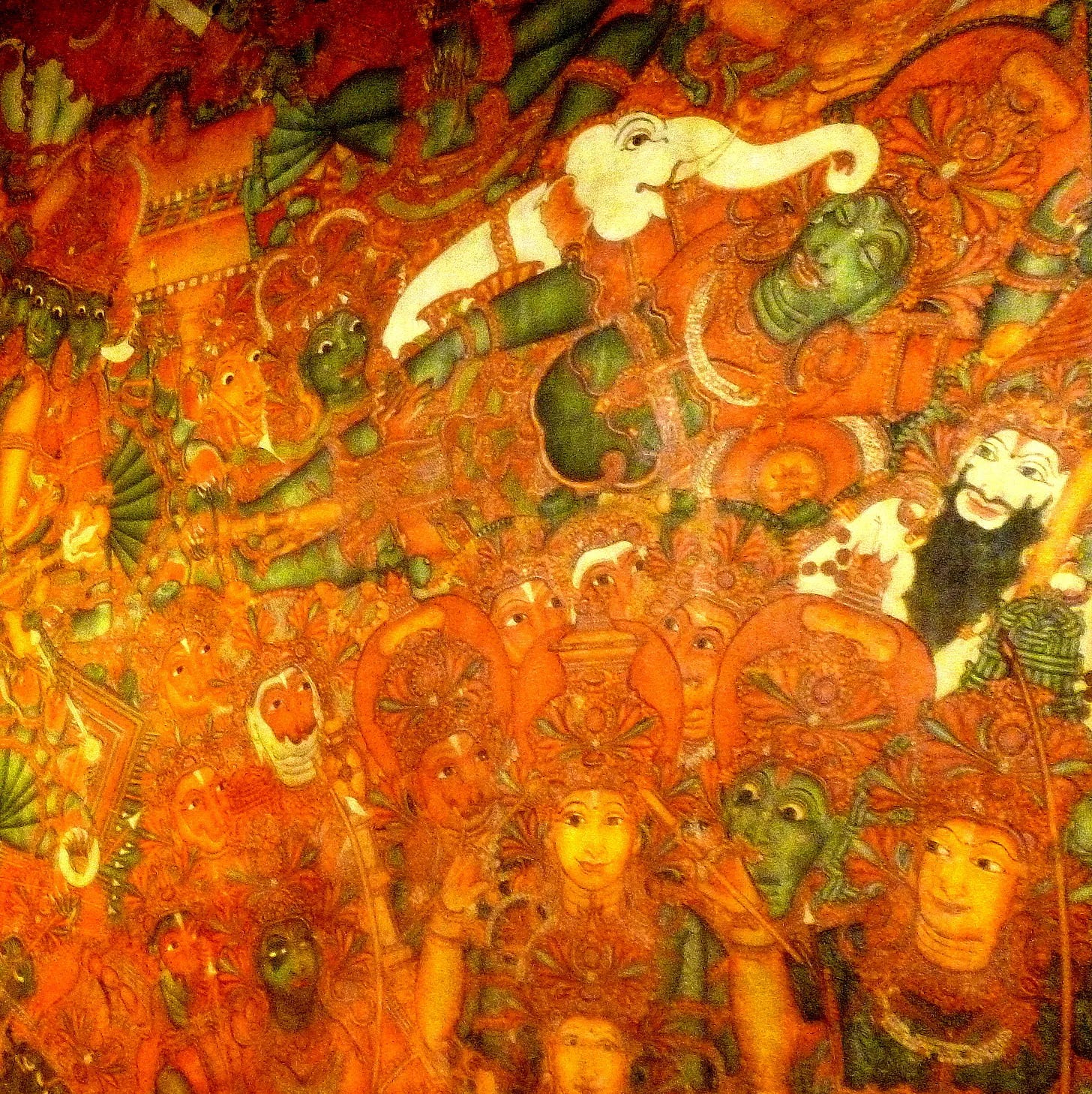
The carved medallion below is from the much-studied stupa at Amaravati, Andhra Pradesh, in South India. On the medallion, events from a well-known story of the life of the Buddha are arranged within a circle, with no indication of how events were ordered in time.
An instance of a synoptic narrative is one represented in a medallion from the stupa at Amaravati. It, like many synoptic narratives, can be difficult to interpret. The medallion is meant to present the reader with the story of Buddha's previous birth as the elephant Chaddanta. The center of the medallion has only decorative carving, which is a visual cue on how the medallion is meant to be interpreted; which is in a circular pattern. Other than that subtle visual cue the artist leaves very little indication of the order.
Perhaps we can assume that people reading this image knew the story well, and that the arrangement of its elements in this way wouldn’t have presented any kind of problem. But that interpretation assumes that people needed to understand a story as a sequential line, when perhaps they didn’t. This reminds me of accounts of conversations with Indians, and Balinese, about exactly when an important mytho-historical event took place in chronological time. On both occasions, the Indian and the Balinese were nonplussed by the question. They had no interest in when, or in fact, whether, a particular character had actually existed, because they were thinking in mythological time, which had no need for either chronology, or proof of material existence. What mattered was the truth of the idea.
Creativity, by its very nature, is the making of something new; whether it’s the unexpected change of direction in a murmuration, a nervous system’s capacity to find a ways to help a person survive an intolerable situation, or a human making a mark on a surface with a brush. But does creating something new always mean moving forward into unknown territory? New things can also arise when two already-existing things are unexpectedly brought together, or when we cycle back to something that we thought was over and done and find out that we missed something the first time around.
How might it be in art, in personal processes and cultural expectations, if the focus was on seasons, cycles, or simultaneity, rather than the desire for the continual combustion of new, forward-moving explosions? What might reveal itself from a circling back, over and over, or attention to parts of the weave that didn’t get much attention the first time round; or perhaps from setting out to investigate the way that things regularly fall into grooves, but each time in a slightly different way?
Maybe being new and different doesn’t matter any more. Maybe what matters is to stop craning our necks forward and instead spread our fingers deep into the soil beneath our feet. What haven’t we seen of what’s already here? What’s been composting all of this time, hiding in the darkness as we relentlessly surged forward in the search for newness and thrill?
I had this sense of cycling back to make something new in the work of two artists I’ve seen recently. To those of you steeped in European art history, who will probably have seen at least one of the images below before, they may not offer anything of particular interest. But both of them stopped me in my tracks, which is a rare experience for me in the presence of contemporary European art.
The first is by Michael Armitage, in the Scottish National Gallery of Modern Art. When I saw Armitage’s painting, I immediately felt a sense of something familiar, which I couldn’t put my finger on. Then the ghost of a recognition began to emerge from the back of my mind, and Gauguin’s ‘Vision After the Sermon’ came into view. I couldn’t remember the Gauguin clearly, but it was a strange experience. What I was looking at felt known, but also entirely new. The colours were different, the paint was thin, hardly staining the canvas, and the figures were definitely not in France, or Tahiti.
When I checked the Gaugin it was not nearly as similar as I had imagined, but somehow Armitage had managed to conjure it in my mind.
Later I read about Michael Armitage’s intentions in making this work. What remained for me though was a strange feeling of being thrown backwards in time, at the same time as being transported to a different continent, and a unknown climate. There was a new story here, being held in an old container, transforming both.
The second image I saw recently that had a similar effect was the drawing below by Jenny Saville. This image has turned up on Substack a few times recently2 in the context of discussions of her recent exhibition3 at the National Portrait Gallery in London.
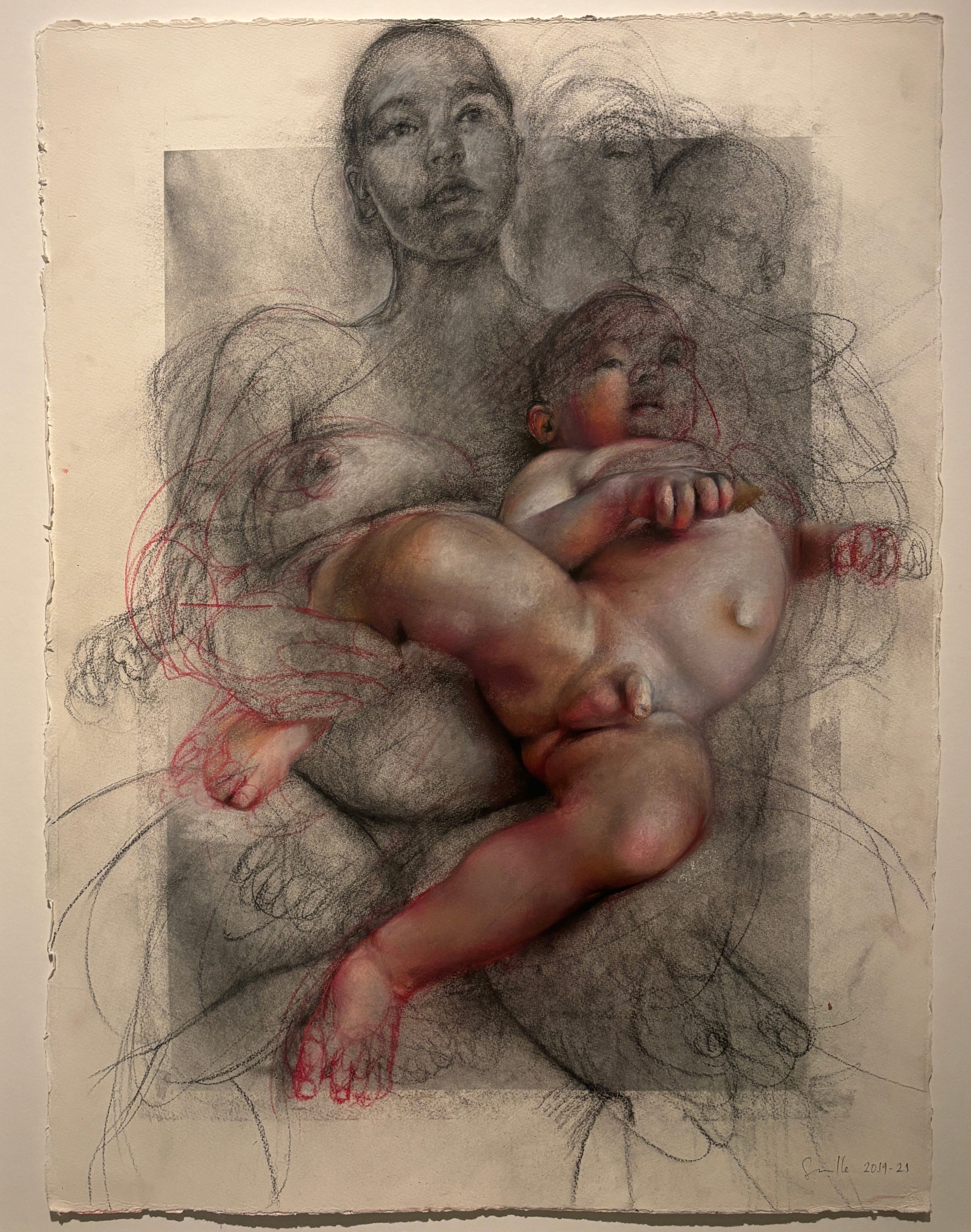
The drawing really affected me. I felt like I was looking at a Michelangelo, with all its detailed accuracy and texture; and at the same time I was shocked by the size and energy of the wriggling human baby that was being thrust towards me. I didn’t know at that moment that Saville had studied European painting from a young age, and that she had made many drawings and images that were direct responses to Michelangelo’s drawings and sculptures; that she was consciously and deliberately mining the past in order to make something entirely new. But I felt it, no explanations needed.
I’m quite fascinated by the effects these two images created for me. They jarred me uncomfortably across time and space, in an unfamiliar way. There’s strangeness and power here, which has been created precisely by cycling back, digging down, burrowing into history and time.
This is the final article of a five part series. It started with me going to the Scottish National Gallery of Modern Art and being surprised to find paintings there organised by theme, rather than chronologically.
You can find the preceding articles here:
Time (1): A theme has no context. Obviously.
Time (2): How did it feel, to have no history?
Time (3): Without context, we lose history
Time (4): The scarred particular
If you can find it, this is a beautiful book of poetry translated from Tamil, Prakrit and Sanskrit: Selby, Martha Anne, (2003), The Circle of Six Seasons, Penguin, India
No posts
Comments
Nothing yet. Say the first thing.
Sign in to join the conversation.