
Engage Louisa is a nonpartisan newsletter that keeps folks informed about Louisa County government. We believe our community is stronger and our government serves us better when we increase transparency, accessibility, and engagement.
For the latest information on county meetings, including public meetings of boards, commissions, authorities, work groups, and internal county committees, click here.
Tuesday, June 30
Human Services Advisory Board, 114 Industrial Drive, Louisa, 10:30 am.
Finance Committee, Administration Conference Room, Louisa County Office Building, 1 Woolfolk Ave., Louisa, 1 pm.
“I think it’s important for the state to maintain its word to businesses that [it has provided] incentive programs to invest in the commonwealth. I applaud the governor, and I applaud the House budget negotiators for working very hard to keep that commitment to the data center industry. I think that commitment has been very helpful in attracting billions of dollars in investment to Louisa County.”
-Board of Supervisors Chair Duane Adams on a state budget deal that retains a controversial tax exemption for data centers. Read more in the article below.
The Democratic-controlled General Assembly last week passed a $205 billion state budget for the next two years that includes funding to improve water quality and boater safety at Lake Anna and keeps a controversial sales tax exemption for data centers that could help ensure the continued buildout of the giant warehouse-like facilities locally.
Budget negotiations had stalled for months over the data center tax break, which waives the sales and use tax for most data centers through 2035 and is expected to cost the state’s general fund nearly $2 billion in direct revenue annually over the biennium.
Led by Sen. Louise Lucas, D-Portsmouth, the powerful chair of the body’s Finance and Appropriations Committee, Senate Democrats had sought to axe the exemption in the face of growing discontent over data center development, especially in Northern Virginia, home to largest concentration of the power-hungry and water-guzzling facilities in the world.
In social media posts and public appearances, Lucas repeatedly said that wealthy technology companies should pay their fair share and insisted that the state is forgoing billions in revenue that could pay for schools, healthcare and other services.
“Anyone that knows me understands that I stand with the people and work toward representing their interests. This issue is bigger than the governor. It’s bigger than the speaker [of the House of Delegates]. It’s bigger than me. This is about data centers and their inability to understand that they need to pay their fair share of the taxes,” Lucas said during a committee meeting earlier this month.
But Lucas’ counterparts in the House and Governor Abigail Spanberger, also a Democrat, defended the exemption, pointing out that it sparked landmark investment in the state that, in turn, generates significant revenue, and pulling it now would mean breaking a commitment to the industry.
State and local officials, including in Louisa, expressed concern that abruptly ending the exemption could cost localities billions in planned investment if data center operators pulled up stakes and looked for greener pasture elsewhere.
While the spending plan retains the sales tax exemption, it takes modest steps to address concerns about the industry.
Most notably, the deal slaps data centers with an energy consumption tax of 1.1 cents for every kilowatt hour of electricity each center uses in a month. The tax will generate a maximum of $600 million per year—or $1.2 billion over the biennium—for the state’s general fund. Any taxes data centers pay that exceed $600 million in a year will be refunded.
Beyond the consumption tax, the budget deal directs the Joint Subcommittee on Tax Policy to study the sales and use tax exemption and other data center impacts, with particular emphasis on examining the impact of existing and potential exemptions or incentives. It instructs the State Corporation Commission (SCC) to collect data on the centers’ water, energy and back-up generator use.
The deal also requires the Department of Environmental Quality (DEQ) to establish criteria for determining “Cooling Water Scarcity Zones” with new and existing data centers in those areas required to implement cooling systems that require less water. In addition, the proposal requires DEQ to adopt minimum noise standards for data centers, effective by the end of 2029. Any data center that violates the regulations would be subject to a civil penalty of up to $32,500 per day.
The budget deal still requires final action by the General Assembly and the governor, who sent down more than a dozen mostly technical amendments on Friday. Lawmakers will return to Richmond on Monday to consider the amendments. The budget takes effect July 1, the start of the new fiscal year.
Members of the Louisa County Board of Supervisors welcomed the news that the budget would preserve the sales tax break even as resistance to data centers grows in the community. At public meetings and on social media, residents have expressed concern that the facilities, which house servers and chips that power cloud computer and artificial intelligence, are raising their power bills, threatening the public water supply and bringing an onslaught of heavy truck traffic to roads that can’t handle it.
Amazon Web Services (AWS) is in the process of building two data center campuses in the county’s Technology Overlay District, a special zoning designation adopted by supervisors three years ago and designed to attract lucrative tech sector development, while EdgeCore Digital Infrastructure is planning to build a campus at the Shannon Hill Regional Business Park.
Supervisors say the facilities are smart economic development, which will deliver millions of dollars in tax revenue annually to pay for schools, fire stations and other services while requiring a relatively small footprint.
In a telephone interview last Thursday, Board Chair Duane Adams, R-Mineral, said he’s glad to see Virginia keep its word to the industry and credited the exemption with helping lure historic capital investment to the county.
“I think it’s important for the state to maintain its word to businesses that [it has provided] incentive programs to invest in the commonwealth. I applaud the governor, and I applaud the House budget negotiators for working very hard to keep that commitment to the data center industry. I think that commitment has been very helpful in attracting billions of dollars in investment to Louisa County,” Adams said.
Adams said he hasn’t had specific conversations with AWS or EdgeCore about how the exemption factors into their development strategy, but he believes that keeping it in place helps solidify the companies’ long-term plans with respect to Louisa.
“Any time you have uncertainty in the business climate it can lead to changes in people’s plans for investment, and we have billions of dollars that are being invested in Louisa County, and we’re already starting to see the fruits of that investment,” Adams said, noting that the board lowered the personal property tax rate by 15 percent during the last budget cycle and plans to get rid of the tax completely over the next few years. “I think we’ll see other opportunities for the county to reduce the tax burden on the citizens and that is being driven by that investment.”
Data center operators that invest at least $150 million and create 50 jobs in a locality have been promised the exemption through 2035 while a state law passed in 2023, primarily to benefit AWS, extends the exemption for another five to 15 years, depending on the extent of the company’s capital investment and job creation.
Critics of the industry’s unconstrained growth, especially environmental groups, dubbed the budget deal a missed opportunity.
“Sadly, here in Virginia, our leaders still have no plan to assess the aggregate impacts of data centers on our communities, our land, and our environment. To allow further impacts before we have better information and a plan for action is irresponsible. On top of that, Virginia continues to give away billions of uncollected tax revenue to the richest companies in the world, while ignoring growing outrage from citizens effectively subsidizing uncontrolled data center growth,” Piedmont Environmental Council President Chris Miller said in a statement on the organization’s website.
Funding for Lake Anna
The budget deal includes other items of local interest. Most notably, it allots funding to address water quality issues and boater safety at Lake Anna.
The proposal allocates $500,000 in Fiscal Year 2028 to the Department of Conservation and Recreation for cyanobactera mitigation and remediation, raising support for the efforts to $1.3 million over the biennium, according to the state budget website.
The Lake Anna Advisory Committee (LAAC), a multi-jurisdictional panel that includes representatives from Louisa, Spotsylvania and Orange counties, will use the money to support its Cyanobacteria Mitigation and Remediation Project, a multi-year effort to reduce excess nutrients, particularly phosphorus, in the lake’s upper reaches.
For much of the last decade, cyanobacteria clusters, also called Harmful Algal Blooms, have plagued the lake’s shallower upper end. The blooms can cause skin rash and gastrointestinal illness in humans and harm wildlife and pets. Excess phosphorus feeds the blooms’ growth.
LAAC launched its program three years ago with the goal of incrementally lowering phosphorus levels in several of the lake’s upper branches. Over the last three fiscal years, the program has received $1.75 million from the state.
The budget deal also allocates $30,000 in the next two fiscal years to support hydrilla management and buoy maintenance on the 13,000-acre waterway.
Hydrilla is an invasive aquatic weed that forms mats under the water and can impede navigation. LAAC manages its growth by deploying herbicides that kill it and sterile carp that eat it. Due to funding constraints, the committee has struggled to keep pace with the weed’s proliferation over the last few years. LAAC also deploys and maintains a network of no-wake buoys, which flag navigational hazards and play a key role in boater safety.
In a press release last Wednesday, Louisa County thanked lawmakers for including funding to improve water quality and safety at the lake. The board of supervisors has requested money for the programs in its legislative platform for the last several years and the Lake Anna Civic Association, an 800-plus member environmental advocacy group, has also lobbied for the funding.
The county said the funding would enable the implementation of targeted measures that ensure the lake “remains a safe, vibrant, and healthy ecological and economic asset for residents and visitors alike.”
“Securing this funding is a win for the County and our partners in the greater Lake Anna community. Protecting our water quality and ensuring boater safety requires proactive management which these dollars will support,” Cuckoo District Supervisor Chris McCotter said in the release.
Valley Link Transmission Company’s proposed Joshua Falls to Yeat transmission line has emerged as an issue in the 5th District congressional race.
The ultra-high voltage power line, under development by Dominion Energy and several other utility companies, operating as Valley Link, would cut across Central Virginia—and the heart of the 5th District—as it travels some 115 miles, from Campbell County to Culpeper, channeling bulk power generated in the Ohio River Valley, mostly to feed data centers in Northern Virginia.
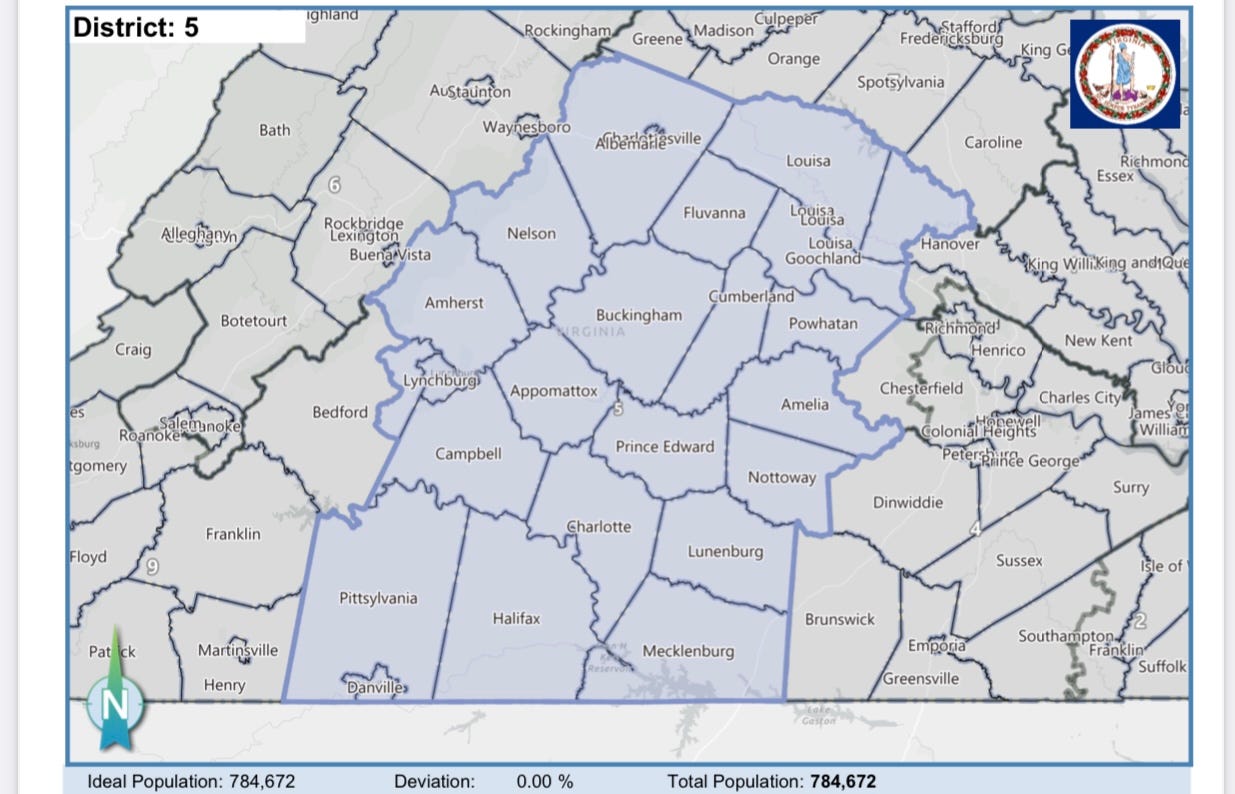
The project has roiled residents and county officials in the nine potentially impacted counties—Louisa, Fluvanna, Buckingham, Appomattox, Campbell, Goochland, Orange, Culpeper and Spotsylvania—six of which are in the 5th, with some residents arguing that rural land is being sacrificed for industrial development to the north.
While the power to approve the 765-kilovolt line, the biggest ever proposed for construction in Dominion’s territory, lies with state regulators—Virginia’s State Corporation Commission (SCC), specifically—the project is gaining significant attention in a pair of congressional primaries in the 5th, a mostly rural district that stretches from Louisa and Albemarle at its northern edge to the North Carolina border.
The district’s current representative, Republican John McGuire, a Goochland resident and former Navy SEAL, has faced criticism from both sides of the aisle for what some see as his lackluster response to constituent concerns about the project.
In the August 4 primary, the one-term incumbent, who narrowly defeated former Congressman Bob Good in a bitter primary two years ago, faces a challenge from political newcomer Melanie Lucero, a Marine turned realtor who resides on Lake Anna.
Three Democrats are vying for the right to run against either McGuire or Lucero in November’s election: Lynchburg physician Suzanne “Dr. K” Krzyzanowski; Louisa County resident and ex-Tea Partier turned Democrat Rob “T-ski” Tracinski; and former Congressman Tom Perriello, an Albemarle resident who represented a slightly different 5th from 2008 to 2010. Thanks to his name recognition and significant fundraising advantage, Perriello is regarded as a heavy favorite to win the nomination.
Both Lucero and Perriello have said they oppose the Joshua Falls to Yeat project, highlighting its lack of community support and raising concerns about property rights and corporate power. They’ve sharply criticized McGuire for, as they see it, playing political games instead of fighting for his constituents.
In a Facebook post earlier this month, McGuire addressed the line, saying that he’s listened to community concerns and voiced them to both Dominion and PJM, the regional transmission organization that oversees the power grid in 13 states, including Virginia, and last year determined the line is necessary to ensure the reliability of the grid.
“Even though I’ve been told this is not a federal issue, I’ve shared Vally Link concerns with Dominion and PJM in the district and in my DC office over the last few months. I asked them, can you bury the lines, they said no. I asked them, can you reroute the lines, they said very little room for change due to restrictions. I asked why does it go through Appomattox County, Buckingham County, Louisa County, and others instead of in a straight line from Campbell County to Culpepper County? On this question, I get a mixed bag of answers,” McGuire said.
McGuire stopped short of offering full-throated opposition. Instead, he said he’s been told that Democratic Governor Abigail Spanberger could stop the project “if she wanted to” and “your local board of supervisors has influence on projects like this as well.” The SCC, not the governor or local officials, has the power to approve the line.
McGuire concluded that the project is still in the planning stage, “so maybe something can be done.”
Perriello seized on the post. In a video response on Facebook, he said that McGuire had put on a “free masterclass on how corruption works in Washington.”
“[John] shows first that he’s taking more meetings with these huge corporations then he is with his own constituents. Second, he fails to disclose that he’s taken thousands of dollars in campaign cash from these same corporations. Third, he then literally repeats their talking points about how this transmission line has to happen even though everybody on the right, left and center is furious about this attack on our environment and our property rights. And, fourth, he somehow tries to distract you by blaming the other party,” Perriello said.
In campaign videos, Perriello highlights his opposition to the line and what the project could mean for rural communities. In a statement in mid-June, his campaign said that Perriello’s committed to standing with those who are impacted and references his past opposition to the Atlantic Coast and Mountain Valley pipelines, proposed gas transmission infrastructure that sparked widespread community opposition.
“I oppose this project, and I will fight to defeat it. I support investing in our infrastructure, but not when it’s forced on local communities with no input and the benefits going to private corporations far away. Our communities would bear the burden of this project every day, while the biggest benefits flow elsewhere,” Perriello said.
Lucero, McGuire’s opponent in the Republican primary, has focused much of her campaign on what she sees as McGuire’s lack of interest in serving his constituents, arguing that he’s delivered little for the district during his two years in Washington and has few legislative achievements.
In a June 18 Facebook post, Lucero said that McGuire was “acting concerned” about the project, but only after she expressed opposition.
“I’m genuinely grateful that I’m finally getting politicians to do their job because we need support on these issues. But here’s the problem...The outcome of all this sudden concern is usually the same from useless politicians like my opponent: Nothing,” Lucero said.
Lucero showed up last week at a Valley Link open house in Louisa, which the company held to gather feedback about the latest proposed routes. She chatted with community members, some of whom donned yellow “No Valley Link” t-shirts and listened to their fears and worries about what the project could mean for their land and their neighbors.
In a brief interview, Lucero suggested that McGuire’s tepid response to the project is another example of his disinterest in fighting for everyday people in the 5th.
“He’s a congressman who’s bought and paid for. He will do what he’s told to do. I am not impressed with him. I think he’s a placeholder, and he’s just focused on his reelection, not helping the people,” she said.
Lucero made clear that she opposes the project because, as she put it, “[the people] don’t want it and that’s what it comes down to.” As a realtor, she said that she understands the negative impact the line, with its 175-foot towers, would have on property values. She also expressed concerns about other potential impacts that she believes haven’t been adequately addressed.
“This is not running through property I own, however, it’s running through a lot of people’s property, and it is going to affect them. As a real estate professional, I know this is going to be devastating for their property values, and I have a lot of questions about the damage that this is going to cause those homeowners. There’s so many unanswered questions, and I feel like it’s negligent to move forward without answering those questions for the people,” Lucero said.
While Congress doesn’t play a role in approving the project, Lucero said there’s plenty McGuire could do to support his constituent, but he isn’t.
“This is something that people could reach out to his office for and seek support, guidance, and resources, and he is failing to do that. His constituent services have failed on every single level, and it’s a disservice to all of us,” she said.
How to vote in the primary: Early voting is underway for the Democratic and Republican primaries in the 5th. Voters can cast ballots in-person at the Louisa County Office of Elections, 103 McDonald St., Louisa, Monday through Friday, from 8:30 am to 4:30 pm through Friday, July 31. The office is also open for early voting on Saturday, July 25 and August 1, from 9 am to 5 pm, and Sunday, July 19 and July 26, from 11 am to 4 pm. In addition, voters can request an absentee ballot by mail.
Election Day is Tuesday, August 4. Polling places across Louisa County are open from 6 am to 7 pm. Click here for more information about voting or call the Louisa County Office of Elections at 540-967-3427.
The Towns of Louisa and Mineral will hold elections this fall to choose a mayor and members of their respective town councils. And the races have attracted a fair share of candidates—especially in the Town of Mineral.
In Mineral, where all six council seats are up for grabs, nine candidates filed to run ahead of the June 16 deadline, according to Louisa County Registrar Cris Watkins.
The candidates include a mix of fresh and familiar faces. Current council members David Hempstead, Afton Von Tye, Rebecca “Becky” McGehee and Michelle Covert are all running to retain their seats while former Council Member Blair Nipper is hoping to return to the body.
First-time candidates Christopher Dillard, Maggie Larson, Cara Lundgren-Stowe and Nicole Washington are also running. Washington formerly served as Mineral’s town manager while Larson serves on the town’s planning commission. Dillard and Lundgren-Stowe are newcomers to town politics though Lundgren-Stowe’s husband, Ryan, is a recent appointee to the planning commission.
In the mayor’s race, Council Member Robert “Bob” Spedden, an Air Force veteran, is the lone candidate. Current Mayor Pam Harlowe, who won a one-year term in a special election last November, opted not to seek re-election. Council Member Bernice Kube also chose not to run for another term.
The upcoming council race looks to be an intriguing one as many of the players involved in the town’s political drama over the last few years are hoping to stay on or return to the stage.
Hempstead frequently spars with McGehee and Covert. Both women have accused him of bullying and mistreating town staff, including Washington, who was fired as town manager earlier this year on a motion by Hempstead.
Covert and McGehee were part of an ill-fated effort to remove Hempstead from office nearly two years ago, alleging he misused his position and violated town code and council’s civility pledge, among other transgressions. But Louisa County Commonwealth’s Attorney Rusty McGuire eventually stepped in, asserting that the process council employed to boot their colleague ran afoul of state law.
Amid the council drama, the town has seen significant staff turnover. Aside from Washington’s departure, council lost its attorney late last year and, earlier this month, treasurer Kelly Singletary left her post.
In her letter of resignation, Singletary alleged that she was subjected to a “hostile and toxic work environment” and “observed numerous practices that [she believes] are inconsistent with professional, ethical, and operational standards.”
“As the official entrusted with the custody and management of public funds, I cannot continue to serve under conditions that, in my judgment, compromise accountability, transparency, internal controls, and sound financial governance,” Singletary wrote.
The election is expected to center on which candidates are able to convince voters they can bring stability to town government as council meetings frequently dissolve into heated arguments, punctuated by personal attacks and occasional calls to the Louisa County Sheriff’s Office. Several recent meetings have adjourned early with council unable to conduct town business
In the Town of Louisa, Council Members Graven Craig and David Purcell are vying for two of the three seats on the ballot. A third Louisa resident had filed to run, but withdrew, according to Watkins.
Council Member Vicky Harte, whose seat is up for grabs this year, said at a council meeting last month that she doesn’t plan to seek re-election, citing frustration with her committee assignments.
Council appointed Craig and Purcell to temporarily fill vacancies earlier this year. They’re now vying for four-year terms.
While both men are newcomers to elected office, they’re familiar faces to many residents. Craig is a partner in the Main Street law firm, Craig Williams, and previously served as chair of the Louisa County Republican Committee. Purcell grew up in the town and runs JS Purcell Lumber, one of the community’s oldest continuously operating businesses.
No one has filed to run for the other council seat, which is on November’s ballot as a standalone special election. The winner will serve for two years, filling the unexpired term of former Council Member Danny Crawford, who resigned in April. The filing deadline for that seat is August 14.
Ashley Michael, who won a one-year stint a mayor in a special election last November, is the only candidate vying for the job this time around. Michael is a human resources executive, who’s lived in the town for over a decade.
Election Day is Tuesday, November 3. Early voting starts September 18.
Click here for contact information for the Louisa County Board of Supervisors.
Find agendas and minutes from previous Board of Supervisors and Planning Commission meetings as well as archived recordings here.
Click here for contact information for the Louisa County School Board.
Click here for minutes and agendas for School Board meetings. Click here for archived video.
Click here to access past editions of Engage Louisa.
No posts
Comments
Nothing yet. Say the first thing.
Sign in to join the conversation.