
As a collaborating book editor, I see a lot of early drafts. I usually find that the most useful thing I can do at this stage is to reflect back the story I think the writer is trying to tell and give the strongest options for telling it in the next revision.
I’m convinced a first draft is a blueprint without an architect’s stamp. Editing is where writers gain clarity—not only on how to tell the story, but on what isn’t working as they’d hoped.
For six years now I’ve had a writing partner. She is the person I show my work to when I think it “might be finished.” When Buckskin Rides Again arrived as a printed proof, the first thing I did was go to Anne’s house and ask her to “Go to town. No comment is insignificant or unwelcome.”
Thankfully for my readers, she did just that.
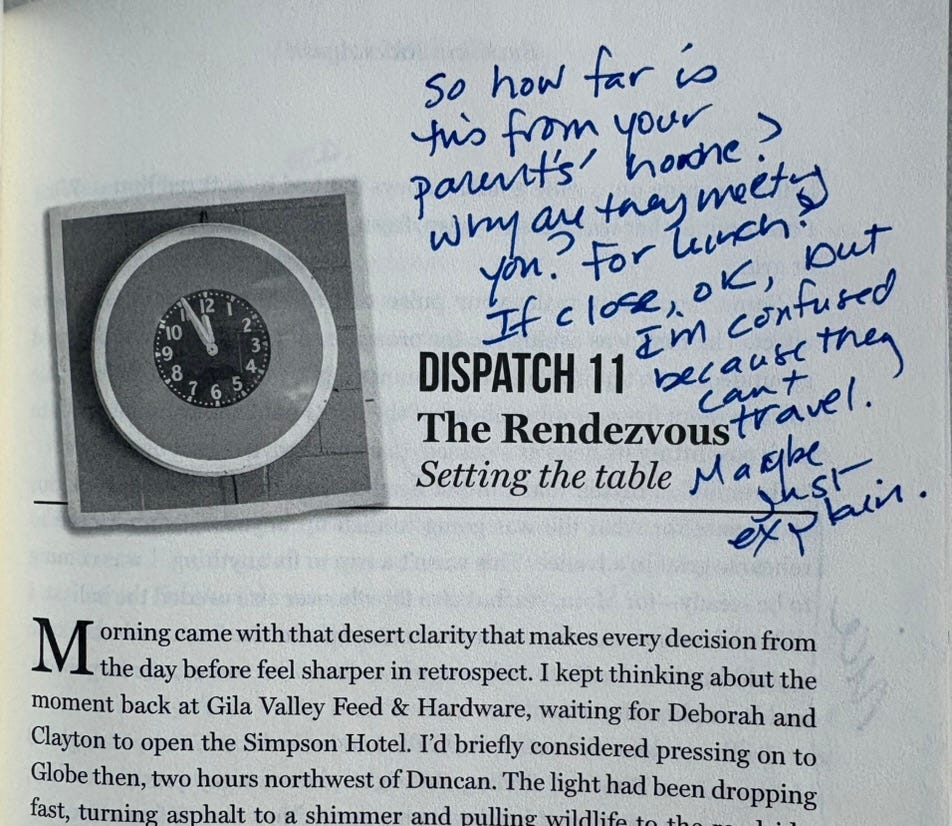
Before Buckskin got to Anne, I’d already made dozens of passes through the book. No word was left unquestioned. I moved scenes from the present to flashback. I cut and added dispatches. I gave some minor characters a little more oxygen and removed scenes that didn’t carry their weight. I planted signals 100 pages before the reader could understand what they meant.
With Anne’s thoughtful questions and observations, I’ve just finished the fourth major revision on Buckskin.
Do I feel incompetent for taking so long to get it right? Not at all. A book in need of edits is not a failed book. It’s just like a cake that needs more time in the oven. My readers are worth that time and commitment.
Buckskin is told through a road trip, but it’s not a story about one. Only after the third major redraft did I begin noticing some things I did intuitively. One of those things was using the wind as an antagonist.
Without the presence of the wind, Buckskin would have been an entirely different book.
Wind is the book’s most persistent motif. It appears in nearly every dispatch, doing work that no other element can do. I didn’t invent the wind or how it worked on my body, my memory, and my interior life. The wind was kismet; bestowed on my trip, not constructed in my mind. I didn’t assign it meaning ahead of time.
What makes the wind so powerful isn’t always in what it does to me, the bike, or the landscape. Even its absence registers with the reader, whether consciously or not.
I don’t consider myself an expert on emotions; I’m more thinker than feeler. What Buckskin taught me is that emotions first hit the body. Only with time can the mind do its job. In Buckskin, the way into my body was through the road, the temperature, the wind.
For example, in the dispatch where I leave Phoenix and my family to go home, notice what the wind does before I can make sense of it:
I couldn’t hold back the tears so I took the only available option besides pulling over to sob. I lifted the face shield and let the sorrow run in rivulets while the wind swept the tears away. The ache lingered and I didn’t try to outrun it.
In that passage didn’t sit with my grief and then describe it. I described what the wind was doing to my face, and the grief arrived on its own.
Later, the reader feels the shift when the wind loosens its grip:
The winds still blew, but the walls gave me shelter, so my bones could throw off the cold. For the first time all day, I felt held. Grounded.
Notice how I never had to say, “I was relieved,” because I described being held and grounded.
Those two excerpts were not in the first draft. They arrived through the editing process. My muse shows up early as an essayist who hits it straight on—“I was sad. I was freezing. I was tired.”
The memoirist arrives later, in the editing, insisting on experience over explanation — showing instead of telling. Recognizing what the experience gave me—and shaping it so someone else can feel it too.
The wind knew what the book was before I did. What a miracle.
I did not study English literature or creative writing in college. When my boys were in preschool I met my first creative writing teacher, Rebecca McClanahan, on her sister’s front porch. At the time, she was Writer-In-Residence for Charlotte-Mecklenburg Schools and teaching workshops on the side. I signed on for a series, which opened a new world for me.
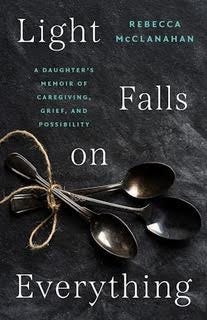
Rebecca has since written twelve books, and thanks once again to kismet, the subject of her most recent is giving me solace and inspiration. Light Falls On Everything: A daughter’s memoir of caregiving, grief, and possibility, is told in a series of essays, where the author reflects on the ten years that she and her husband were “first responders” for an extended family that cared for their parents, both of whom had dementia.
From the book’s Prelude:
I have no wisdom to impart, and certainly no advice. As my grandma Goldie used to say, “Take my advice! It’s perfectly good and never been used.”
Last week, I was invited to a private reading by Rebecca with friends from the old preschool days. I hadn’t seen some of my fellow moms for 30 years and I felt like I was in a movie scene where all the young actors had gone through a few hours in the hair and makeup department to make themselves look older.
“Katie? Is that you?”
“Tamela! It’s been years…”
Yes, it’s been years. They are fewer today than yesterday. I’ll leave you with a relevant passage from Light Falls on Everything:
During the darkest years of caregiving, when the days and nights seemed interminable, I wished for an end to the story. Then, when the end finally came, I found myself (for yes, we find ourselves in such moments), wishing back those years. Some days, I ached for their return. I still do…”
Comments
Nothing yet. Say the first thing.
Sign in to join the conversation.