
I’ve been to Cairo before. This time was different.
Cairo sits at the southern tip of what Illinoisans call Little Egypt — a name with roots in Napoleon, the Nile, and a 19th-century Baptist missionary on a bluff, if you want the full story.
I parked near a food pantry — recently renovated, tidy, clearly still in use — sitting behind a welcome sign for the Cairo African American Heritage Trail. From there I walked down streets built for a city that isn't here anymore. But the town isn't empty in the way I had remembered.
In the hour or so that I lingered and admired architecture and civic responsibility I saw maybe a dozen people. The main drag is four lanes wide, but the traffic that passed through was mostly eighteen-wheelers headed elsewhere. There’s not much to deliver in Cairo.
The houses that people still live in are easy to spot — freshly painted and often sharing a property line with one in ruin and covered in kudzu. The cars parked outside look newer than the houses themselves, which tells me the owners live in ancestral homes and probably work outside of the city to pay for the upkeep.
The public library was decorated for the Fourth of July and looked, from the outside, like a library with a pulse — it still offered programs, still had someone unlocking the door in the morning and greeting visitors. There’s a small administrative office nearby, but I didn’t pass a single gas station or package store in the city limits.
Hello, friends — this seems like the right place to pause and say why I’m in Cairo. Since Buckskin Rides Again took over this newsletter last year, I haven’t said much about what I’m actually working on next: a book called Along the Ohio: Stories the River Still Carries, under contract with the 3 Fields imprint of University of Illinois Press. This book traces the racial legacy of the Ohio River, which was the nation’s longest and only visible border between slavery and freedom. Or so it was claimed.
I spent much of July drafting chapters, then a week at the Appalachian Writers Workshop studying with Charles Dodd White. Cairo was one of the last stops on the research swing that followed through Indiana and Illinois — the final two border states along the river’s 981 miles.
Back on the ground in Cairo, you should know that it’s pronounced like Karo syrup: Kay-Row the city sits at the confluence of the Ohio and Mississippi Rivers. Somewhere in the 1870s–1890s the Cairo post office was third-busiest in the nation. It got that way because of the city’s role as a river-and-rail transfer point moving mail toward the emerging West. Up to 4,000 dockings a year made Cairo a Port of Delivery in the first place.
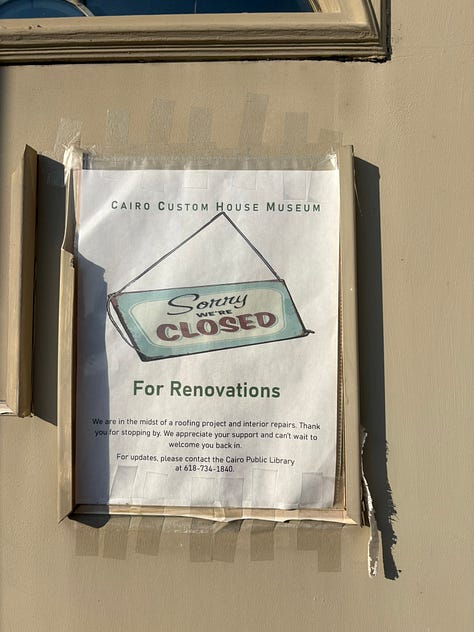
The post office is no longer housed on the first floor of the U.S. Custom House, but oh, it’s still gorgeous. Built 1869–1872, it was designed by Alfred B. Mullett, the same architect as the San Francisco Mint and the old State Department building.
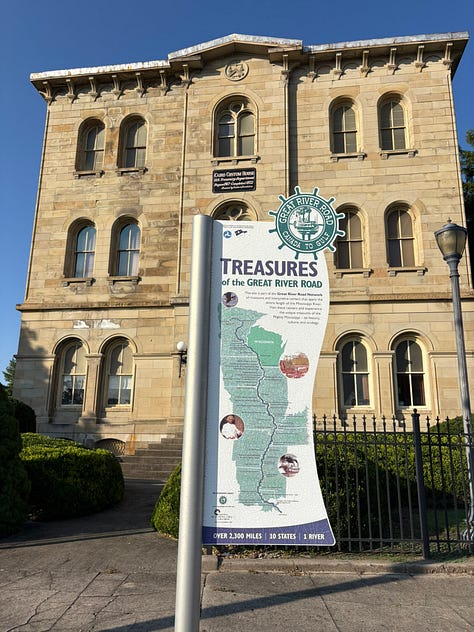
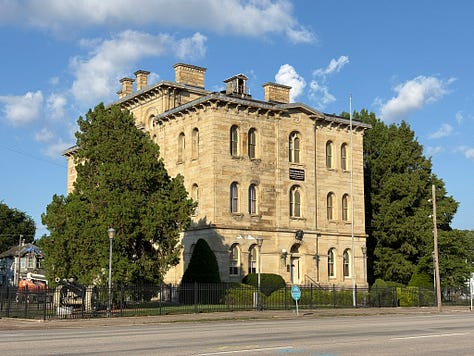
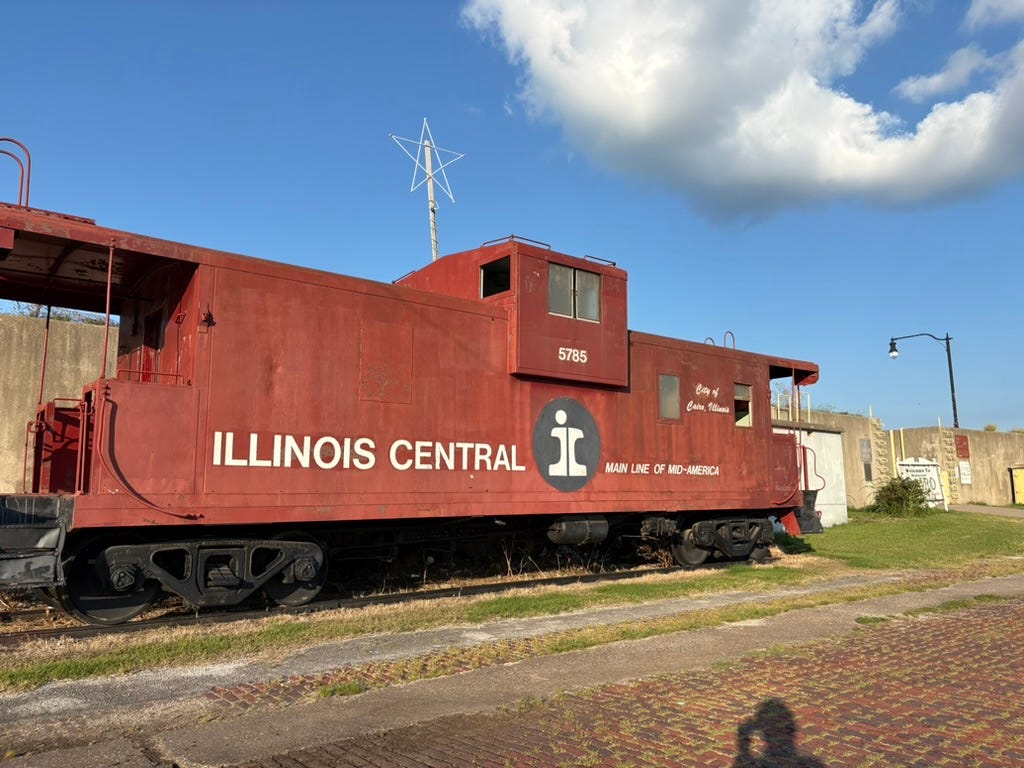
Cairo’s a place where the landmarks do the talking. A 1930 plaque at the levee honors the Union Army’s Western Gunboat Flotilla; a levee mural reads “We ❤ Cairo” in fresh paint. An old Illinois Central caboose sits marked with the city’s name like a nameplate on a grave that someone still visits.
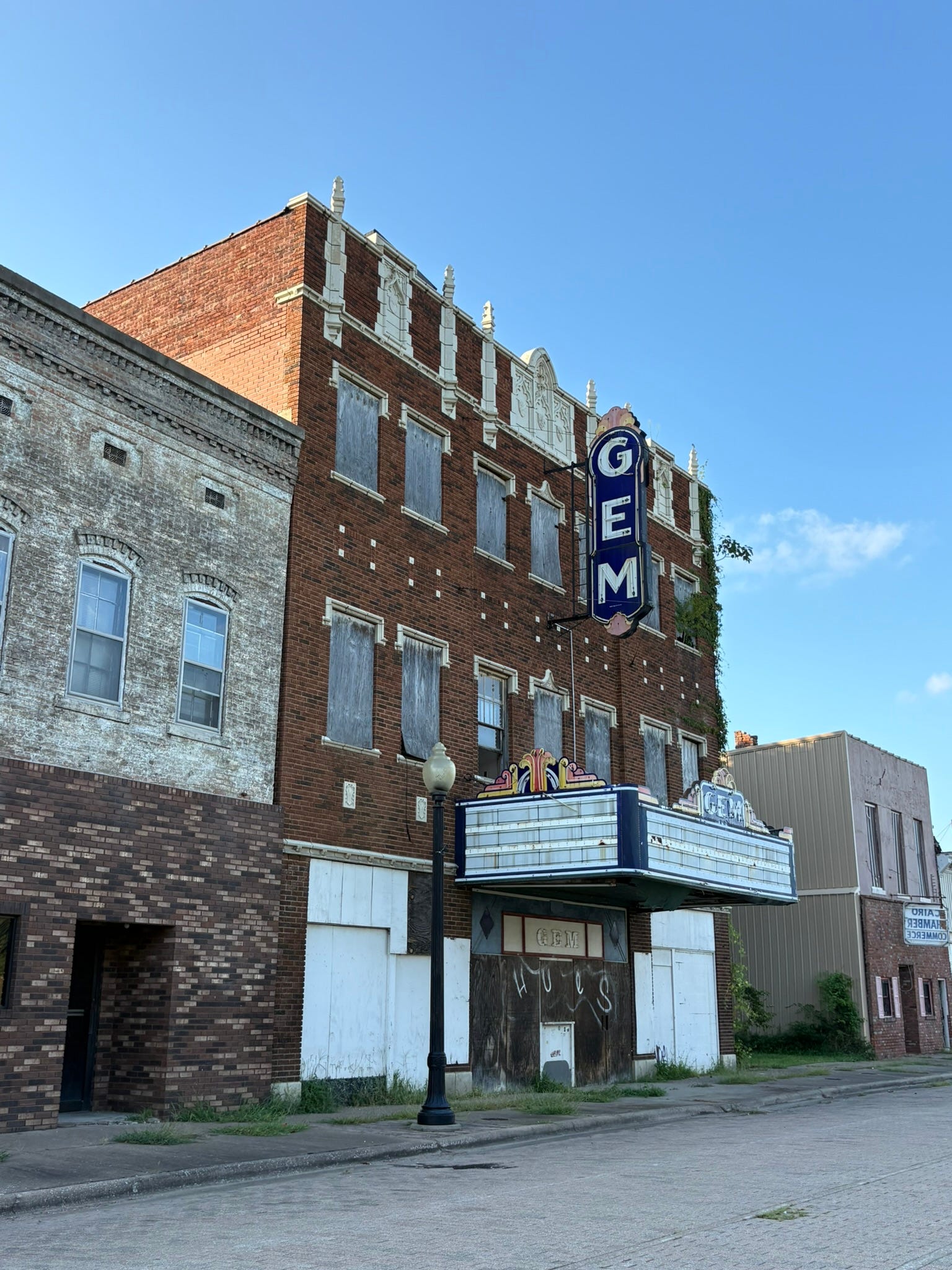
Two blocks inland, a two-story brick building still has its old marquee lettering — GEM — spelling out a theater that hasn’t shown a film since 1978.
Look at the top floor. Research says it’s decorative appliqué (likely pre-cast) stuck on an otherwise plain brick block — theater architects in the 1910s–20s loved using this treatment to borrow the exotic, festive silhouette of a movie palace without the cost of a full stone facade. The GEM sign and marquee were added much later (mid-century) with neon.
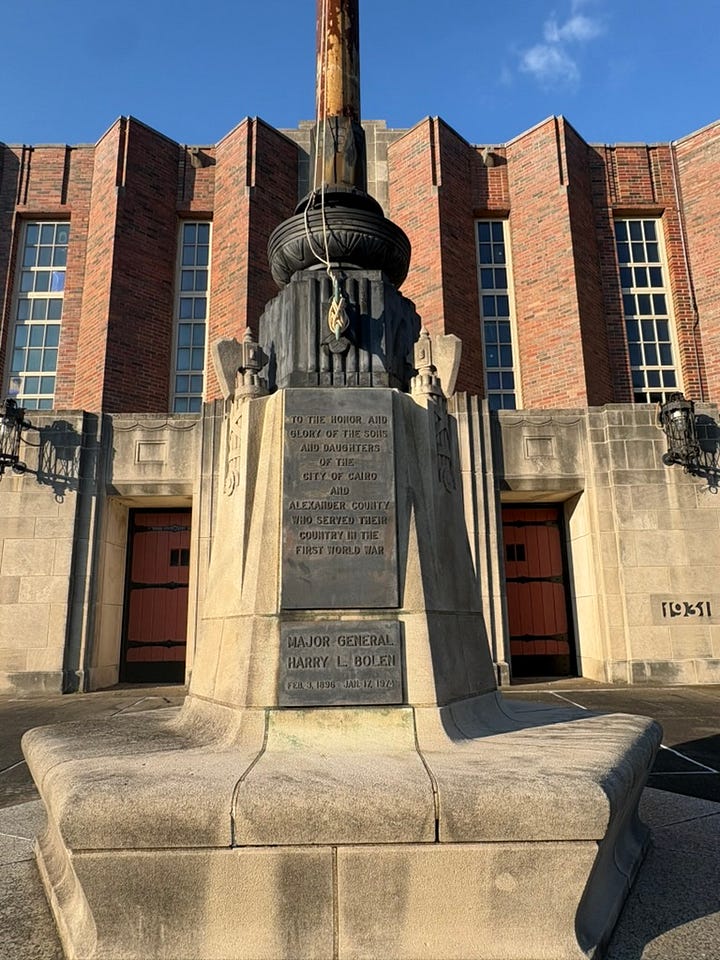
My favorite building is The National Guard Armory, cornerstone 1931, with an Art Deco eagle over the door and a WWI memorial out front naming the sons and daughters of Cairo and Alexander County who didn’t come home.
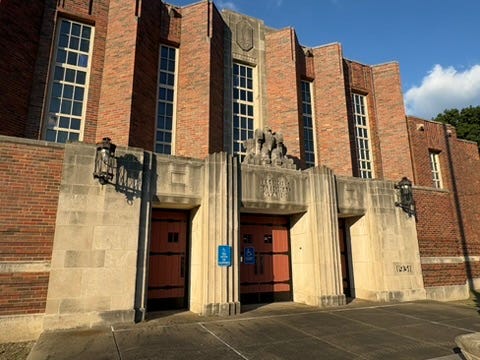
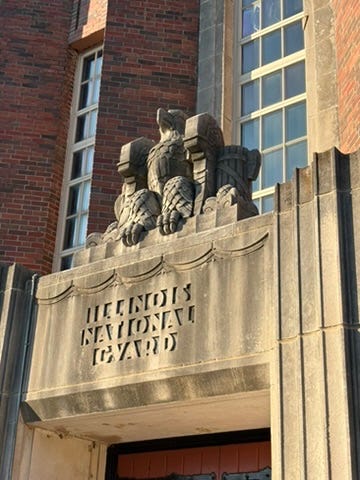
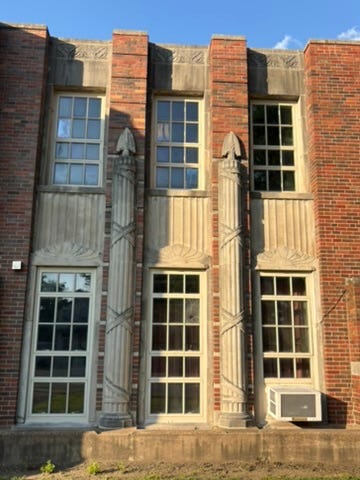
Nothing in Cairo was shoddy or provisional; everything was built to last. “The Hewer” is a serious piece of American art, standing watch over blocks that didn’t last. It honors a Gilded Age businessman who predicted the Civil War would matter to Cairo, moved there, and became responsible for expanding the town after the war. You don’t build a National Guard armory with an Art Deco eagle or commission a bronze sculpture for the downtown if you think the city is a flash in the pan.

Cairo was built by people who assumed continuity — who believed, reasonably, that the town they were standing in would still be standing in a hundred years, with their children or grandchildren still in it. Continuity is exactly what got taken away from this place. Not through neglect alone, and not by accident.
One of the photos I brought back isn’t of a building at all. It’s an ordinary intersection — 8th Street and Commercial Avenue, sun on the pavement, but nothing marking what happened there.
In 1909, a mob dragged a Black man named William James through Cairo’s streets to that corner and lynched him on suspicion of raping and killing a white woman from neighboring Union County. I was surprised not to see a marker, but not surprised to learn that James was one of five people arrested for the crimes and that his “confession” was forced.
Word spread like wildfire and a white mob drove out roughly 40 Black families from Union County over the following days — including about 10 stone-quarry laborers, some of whom fled into the woods. The local paper, the Jonesboro Gazette, praised the quarry managers afterward for committing to hire only white workers going forward. A handful of exceptions remained but the towns have been essentially all-white ever since.
Another unfortunate outcome of the violence is the “Anna” acronym — “Ain’t No Niggers Allowed” — which dates from this event and was apparently still common knowledge into the 2000s. Signs reading “Don’t Let the Sun Go Down on You in Anna” reportedly stood on the highway into the 1970s.
Cairo’s decline has many stories and sources, but anyone who doesn’t understand that 1909 lynching and its aftermath into the present day hasn’t grasped the full picture. The city’s decline wasn’t immediate, but it was rooted in racial fear at every turn.
For a fuller account of this lynching, read John A. Beadles, Stained with Blood and Tears: Lynchings, Murder, and Mob Violence in Cairo, Illinois, 1909–1910 (Southern Illinois University Press).
If Cairo’s the kind of place that stays with you or think other places like it might, read my other newsletter called The 981 Project, named for the length of the Ohio River in miles. It’s where the raw material for Along the Ohio is being built.
This post is public so feel free to share it.
Comments
Nothing yet. Say the first thing.
Sign in to join the conversation.