
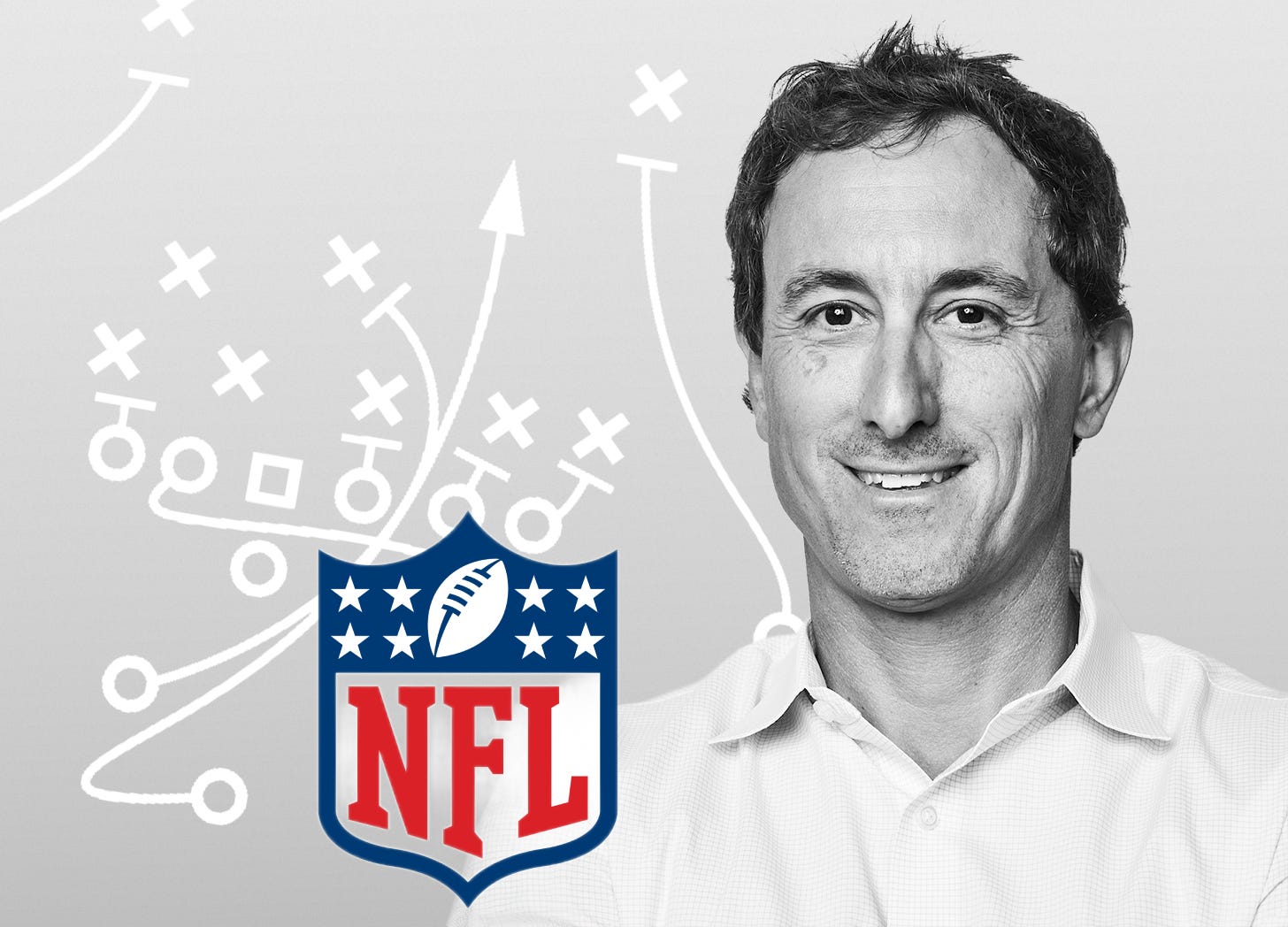
In the high-stakes world of the NFL, “protecting the Shield” has evolved from managing game-day broadcasts to navigating massive global expansion and viral cultural crossovers. Leading the League’s business, media, and international communications strategy is Vice President of Communications Alex Riethmiller, whose time at the NFL has been marked by enormous growth in all areas as the Shield has evolved from the most popular sport in the United States into a cross-platform global brand.
We caught up with Alex to discuss how he’s navigated his 13-year career at the League, the unique hurdles of marketing an American sport abroad, winning over the next generation of fans, and a behind-the-scenes look at the comms engine that powered Super Bowl LX.
This interview has been slightly edited for length and clarity.
JSA: Let’s start by talking about the evolution of your role. You joined the NFL in 2012 and now serve as the VP of Comms responsible for media, business, and international. Tell us more about your remit.
Alex Riethmiller: When I think about my 13+ years here, I picture it in thirds. I initially came to the NFL from CBS Interactive for an opportunity to run communications for League’s media group, “NFL Media,”which is comprised of NFL Network, NFL Red Zone, NFL Films, the NFL app and all our owned and operated media assets. At that time (2012), cable was still a growing business and NFL Media was a great brand to represent and help take to the next level. I worked for one of the most accomplished sports media executives in the business, Steve Bornstein, who after an over 20-year run building ESPN into a juggernaut had helped the League launch NFL Network in 2003. Steve was a demanding boss which really helped me learn and grow and he had an appreciation for the role that comms can play in building a business. It was an incredible opportunity to help grow tentpole events such as Thursday Night Football, the Scouting Combine, and the NFL Draft.
When Steve retired, NFL Media’s then COO Brian Rolapp, who was based at League headquarters in New York, took over. At the time, NFL Communications was led by Joe Lockhart who, among other roles, had served as the White House press secretary during the Clinton administration. Joe recognized that Brian and I had developed a good working relationship and so my role expanded to include the other areas Brian was leading for the League on the business side, including our partnership and consumer products businesses. This was the beginning of the second “third” of my time at the NFL and one where, while I still spent most days working in LA, at least half my day was spent on work coming out of our New York office.
The final third and my current one has brought even more change. I now cover emerging businesses, such as legalized sports betting, which have grown substantially and become a huge focus from a communications standpoint. Not only are we talking about it from a business perspective, but also speaking to the regulation and responsible betting sides to ensure our fans who choose to gamble are doing so safely. At the same time, my work in LA has changed as the League decided to actively pursue a sale for a portion of the media group. Just recently that deal closed as ESPN purchased NFL Network and other media assets. The most recent piece which has been added to my portfolio is overseeing international communications, which is where I now spend the majority of my time. As the League pursues the goal of becoming a global brand, we are holding more and more games around the world; we played seven in 2025 and have nine planned for 2026.
JSA: Over 13 years is a long time to be at one place. What keeps you engaged?
AR: Being at one company for 13-and-a-half years is no small amount of time, especially in a day and age where people tend to job hop relatively quickly. Given the “thirds” I just laid out, it feels like I’ve “job-hopped” inside of the NFL because my scope has evolved from media, to the business side, and most recently adding international. That’s really what has kept me energized, excited, and growing here.
JSA: As the NFL explores international expansion, what have been some of the challenges of selling a traditionally American sport to a global market? How are you currently approaching communicating to international audiences?
AR: It’s been a really interesting experience for me. There’s obviously language differences, cultural differences, and differences in the ways that people interact with the media and reporters’ expectations from communicators. We absolutely rely on agency support on the ground to help us navigate the unique nuances that each new market brings.
In 2026, we’ll be heading to London, Munich, Mexico City, Madrid, and three new markets in Melbourne, Paris, and Rio. Each of these places has vastly different levels of maturation and existing fandom, so the biggest thing that we need to remember—whether it’s for comms or the business generally—is to approach this with a different mentality than we’re used to. While the NFL is considered the king of the sports industry here in the United States, globally it’s a much different story. We need to recognize that in international markets some people don’t even know about the NFL, some people don’t care about it, and there is a portion who likely never will. We try to constantly remember to have a challenger mindset when it comes to our work around the world.
Tapping into broader culture can really help start conversations in new markets as well. When Taylor Swift was trying to make it to Las Vegas for the Super Bowl to watch her now fiancé Travis Kelce play, she was coming from her concert in Tokyo. People were very invested in her journey and even tracking her flight, and the Super Bowl viewership we garnered in Japan that year was the highest it had ever been. Cultural conversation starters, whether it’s something non-football-related like Taylor Swift or the rise of flag football, can be pivotal in drawing people into our world.
And despite popular belief, Taylor Swift’s involvement was not orchestrated by us, but we’re not complaining! I will say, we were already doing pretty well increasing female fandom prior to Taylor Swift becoming a fan, but it’s certainly helped turbocharge the female demographic and in particular, with younger females.
JSA: To that point, the NFL is more culturally relevant than ever. What do you attribute this to? How do you stay ahead of the curve? How has your comms strategy evolved to keep up?
AR: When our generation became sports fans, there was really only one screen and on Sundays during the fall, football was always on the television. In today’s world, people have their phone, tablet, and endless choices, so we have to figure out how to capture that attention. Our marketing group has done a great job of recognizing ways to build the next generation of fans by looking at where young people are spending their time. To that point, we’ll strategically insert ourselves into areas such as music, fashion, and video games to try to capture attention and start a conversation. It can be as simple as partnering with Fortnite to integrate iconic NFL player touchdown dances into their game. That’s where we start conversations that can, eventually, lead to long-term fandom.
JSA: How are you and your team navigating “new” media formats?
AR: They 100% have to be on your radar. We see things like what happened with the Washington Post’s sports department and more journalists going to newer platforms like Semafor, so they certainly need to be in your mix. We are absolutely aware of the changes and constantly thinking about what the podcasts people are listening to, or what newsletters we should be actively sending news to. It’s not as simple as it used to be; the days are gone of worrying about the nightly news or morning newspaper the next day.
You also never know where influence will come from, as newer outlets and independent personalities are impacting a lot of what traditional media covers as well. We’re always looking at which third party experts press are talking to, and aim to build as many relationships as we can with the people that are quoted often. I think of Wall Street analysts as a different form of media. While they’re not always publishing themselves, they’re writing reports that are then getting quoted on CNBC.
We sometimes get looked at as being old school at the NFL in terms of our comms approach and in some ways we are—we still put out plenty of press releases! At the same time, we’re also staying on the cutting edge of media trends and outreach and constantly thinking about new and different ways to get our messaging out.
JSA: Take us behind-the-scenes of the communications strategy of Super Bowl LX.
AR: The week starts off with the commissioner’s press conference on Monday, which is something we spend a lot of time on, which is followed by “Opening Night” with the teams–an event that has really grown over the years. The following days really build on a lot of the messaging we share on Monday. As you can imagine, there’s a tremendous amount of media inbounds and interest, so we want to be strategic in how we channel that and ensure we’re promoting key initiatives while we have the world’s attention.
Of course, there is another side to that week—thinking through potential threats or crisis situations we need to prepare for. To the extent we can, we certainly want to make sure we’re ready for these controversies well in advance of the media fixating on them. That’s a challenge, as it’s impossible to see around every corner and prepare for the myriad of unforeseen circumstances that inevitably pop up during Super Bowl week. As always, the main goal is to promote many wonderful storylines, protect the shield, and keep the focus where it should be–on the best game in the world.

For Puck News’ AI Correspondent Ian Krietzberg, the path to becoming one of the most discerning voices on the AI beat was built off a background in business reporting, music theory, and an “insatiable hunger” to write.
When the AI boom ignited in early 2023, Ian was already in the room, covering the “Magnificent Seven” tech giants at TheStreet. But it was a specific moment in May, watching Sam Altman testify before Congress, that pulled him into what he calls a 70-year-old rabbit hole.
“I remember watching the testimony live... and Sam said his famous quote: ‘If something goes wrong here, it can go quite wrong,’” Ian recounted. “At that point, I kind of describe it as falling backwards into this rabbit hole because there’s just so much history and context to the field of artificial intelligence.”
Now at Puck, Ian brings a refreshing layer of skepticism to an industry often smothered in hype. He treats his reporting like a classroom, frequently turning to academics and researchers who have been studying these questions for decades. To Ian, the fundamental questions–like whether a machine can truly think–haven’t actually changed since the 1950s.
When we asked him how he cuts through the AI buzzword clutter to determine what’s really an innovation worth watching vs. just a marketing ploy, he says his method is simple.
“I have to sit where the science is, and I approach that in a very rigorous way,” Ian told us. “I ask myself: Do we have evidence to support these claims? The conversation can start and stop there.”
This fact-based mindset also extends to how he personally uses the technology he covers. While many reporters are experimenting with AI-assisted drafts, Ian remains a staunch holdout. He believes that the struggle of early stages of drafting is essential to actually understand a topic. He avoids using AI to summarize documents or filter his inbox because, as a journalist, he has what he calls “paranoid trust issues” with any tool that takes him away from a primary source.
“The golden thing for a journalist is first source information,” he explained. “Anything that takes me away from the primary source can be dangerous and potentially irresponsible for the work that I’m doing. I need to physically see the information myself.”
At Puck, Ian is part of a “journalist-as-a-brand” model that he believes is the only way forward for a media industry struggling with a lack of audience trust. The relationship is the definition of direct; if you hit reply to his newsletter, The Hidden Layer, it goes straight to his personal inbox. It’s a level of accessibility that builds a genuine relationship with his readers–even if his inbox gets inundated with out-of-office replies every time he hits send.
For the comms professionals looking to reach him, Ian’s advice is to skip the product fluff. Now that he publishes twice a week rather than daily, his bar for what makes a story is significantly higher. He’s looking for impact-focused stories, backed by material evidence or truly new approaches to architecture that move beyond the standard LLM narrative.
And if you’re able to land the interview, our clients have said that it feels like more of a high-level exchange between peers than a typical press Q&A. His deep AI knowledge has made many of them say it was one of their best interviews to date–and we can’t agree more.

Communicators are entering a four-year stretch defined by AI disruption, misinformation risk, and rising expectations to prove business impact, advisory firm Gartner shared in a new report this month. The firm explains how search, internal comms, reputation management, personalization, and analytics will fundamentally reshape comms in the coming years. Here’s the key takeaways:
AI search will double PR budgets: Mass adoption of LLMs will drive a 2x increase in PR and earned media spend by 2027 as AI answer engines continue to favor earned over paid content.
Chatbots will replace legacy internal channels: By 2028, 75% of employees will rely on conversational AI for internal communications—Gartner says “employee chatbots offer an effective solution to the information overload and information burden challenge.”
Narrative intelligence tools are poised for growth: By 2029, Gartner predicts 45% of CCOs will adopt advanced narrative monitoring tools to counter disinformation.
Employee data will power personalization: Three-fourths of comms teams will lean on analysis of their team’s digital footprint to tailor internal messaging by 2029.
Data and analytics investment will double: Spending on data and analytics will rise to 6% of comms budgets, aiming to accelerate decision-making and prove greater value (up from 2.9%).
On the topic of GEO, the report states that over 95% of cited links in AI answers are non-paid, while 27% originate directly from earned media. Throughout the study, Gartner’s position is that third-party validation, and not paid media or press releases, will most reliably determine what surfaces in AI-generated responses.
At the same time, AI has democratized software development and enabled teams to quickly synthesize large datasets—either through third-party metrics or internally developed tools. And as nearly half of CCOs report struggling to demonstrate impact of the function, it seems clear why data and analytics investment would trend up by double over the next several years.
[Pocket Gamer] Subway Surfers City brings the iconic endless runner to the next generation as it hits mobile today
[CNET] Meta and AMD’s Multibillion-Dollar Deal Is All About the AI Chips
[NBC 5] Young man from McKinney crowned world’s best Madden NFL player, winning $250,000
[KCAL] Eaton Fire survivors get help rebuilding from high-tech tools
[AZ Big Media] Building the Atari Hotel: Big challenges, bigger heart
[Esports.gg] EA’s Jasmine Chiang keeps ALGS real: “Gamers can smell the BS”
[GamesBeat] Madden Bowl headlines pre-Super Bowl esports action
[The Tech Trek by elevano] Stablecoins, AI Fraud, and the Future of Sports Payouts
Story ideas, feedback, or just want to get in touch? Email us at contact@jsapartners.co or drop us a line on LinkedIn.
No posts
Comments
Nothing yet. Say the first thing.
Sign in to join the conversation.