
Just 18 months ago, the communities of Altadena and Pacific Palisades were virtually wiped off the map by devastating fires in Los Angeles. More than 16,000 structures—including many homes and businesses—were destroyed, and thousands of others badly damaged.
Like most people, before it happens to you, you sympathize, maybe donate or volunteer, and then you move on. What I learned firsthand was that for those who are in the communities where disaster strikes, it’s up to you to take action. It is easy to assume that if you aren’t a first responder, you don’t have the right skills to help. But communicators are uniquely suited to make an impact—the question is just how to use that expertise.
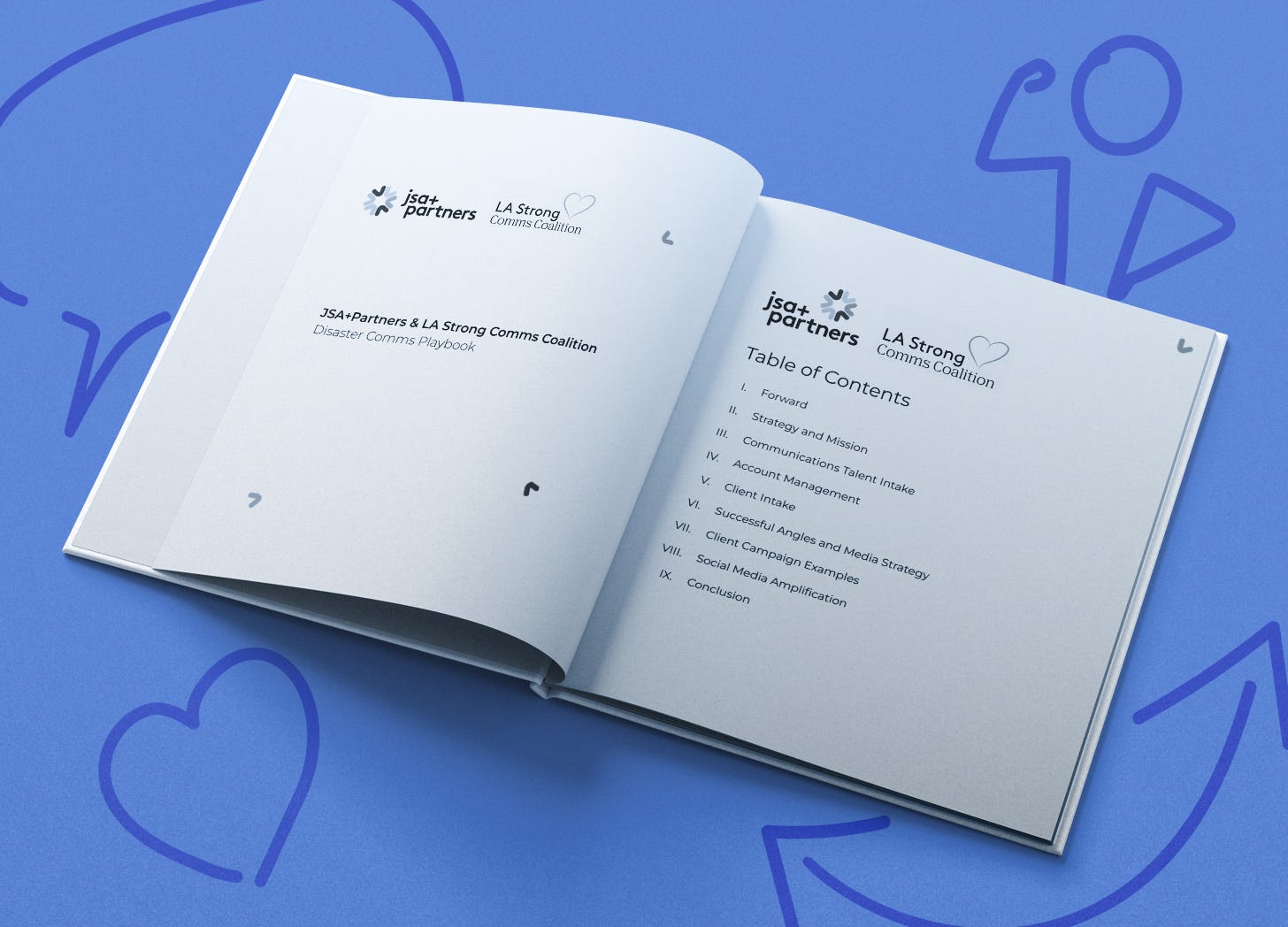
That’s where our Disaster Comms Playbook starts, a free resource designed to help any communicator facing a disaster with the blueprint to make an impact during a natural crisis. It’s the exact playbook we’ve used for dozens of affected businesses. The biggest lesson we took away wasn’t about the tactics, but about who needed help most.
Following a disaster, everyone thinks of storefronts, but individual professionals—the hairdresser who lost their in-home studio, or the bartender who lost their equipment and client base—were often the ones hit hardest. Lose your home, and you lose your entire base of business. The worst part is that insurance rarely covers it. They’re the easiest group to overlook and among the most in need.
From there, the guiding principles keep you focused: don’t start from scratch (most businesses already have a story worth telling), simplicity wins over scale, and go where the customers already are. Sometimes a local broadcast segment or neighborhood influencer can move the needle more than a tier-one placement.
That work became the LA Strong Comms Coalition—a group that includes JSA+Partners, Zeno Group, Weber Shandwick, Hustle & Co, and Karsha Chang PR, plus independents including Kate Walters, David Eckstein, Cara Mia DiMassa, Brittany Sykes, Kate Flannery, Stephanie Sedlak, and Emily Bernstein. We even brought in Call to Action Stories to help provide high-quality video for social media. Together we’ve supported dozens of businesses with more than $200,000 in free services.
Disasters will keep coming—whether fires, floods, or hurricanes. Washington and Oregon are living this right now. And businesses and lives that are destroyed will continue to need help beyond the first month or even the first year. So we’re sharing the full framework we’ve run in our new playbook with the hope that it can guide others to use their talents to support their own communities through recovery.
Please help us spread the word.
Conversations around AI visibility have a chokehold on the comms landscape. How are you approaching it? How does it make you feel? And does it even matter?
Respond to the brief, three-question survey below and we’ll share what fellow communicators are considering when it comes to AI visibility.
No posts
Comments
Nothing yet. Say the first thing.
Sign in to join the conversation.