
Hi, I’m back again to talk more about everyone’s favorite topic: online lit (or “alt lit” if you’re nasty).
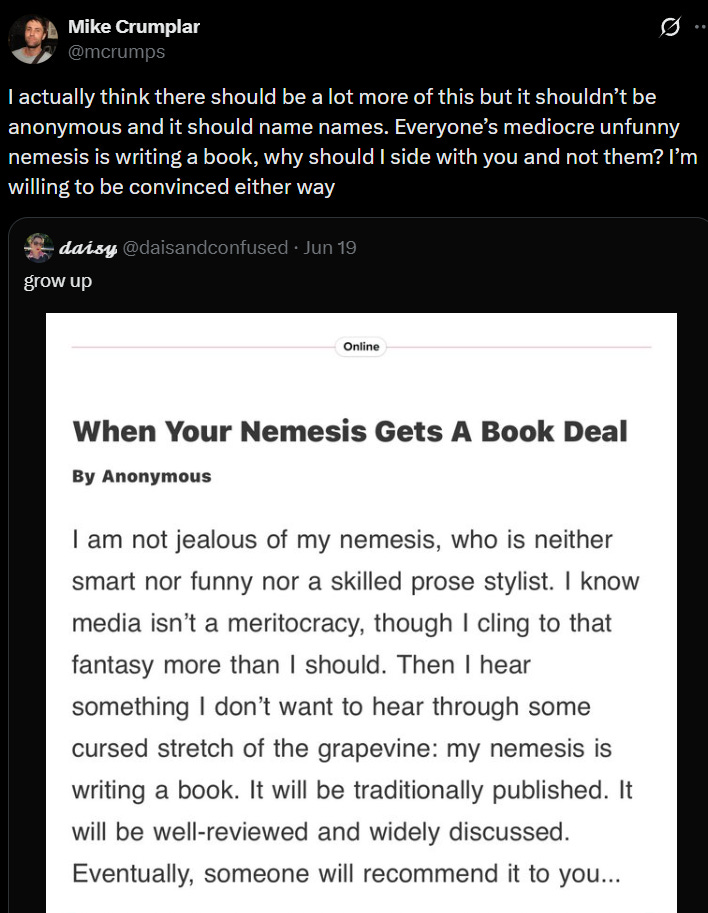
There’s been a lot of hubub and chatter happening on twitter about criticism recently. Melon is getting dragged for trashing Halsey’s album (I have never listened to this artist and therefore do not care, though I do believe that music critics should be allowed to say why they think an album sucks!), my anonymous mutual wants to know who wrote the worst piece in Loser I, and Mike Crumplar thinks we should be naming names instead of subtweeting our nemeses.
Question for the culture: Is literature about taking sides?
I feel like there might have been more criticism, more naming of names, more discourse when I first became aware of online lit (née alt lit). I’m talking about the early 2010s. Writers talked a lot of shit about other writers, and not always in a defamatory way. It felt more Wild West. The Facebook group Alt Lit Gossip was a hot bed of hot takes. Someone would post an image they found on tumblr and an hour later there would be 100 comments and at least five people going back and forth about what it meant and what OP intended by sharing it in the space. It was live. It was a great way to kill time while sitting at a computer at an office job. Poets shared their poems they wrote while on the toilet and sometimes they were heaped with praise and also ridiculed. You had to be there.
Andrea Coates was a shining example of a writer who wasn’t afraid to write scathing critiques of her alt lit peers. She got a lot of flack, but I loved her for it. When ARCs of Marie Calloway’s book were sent to alt lit writers for their review, I was warned by my boyfriend at the time to not send it to Andrea, who I had become friendly with, in the fear that she might write a takedown piece or possibly post the novel in whole on her own blog. I did not send it to her, but I was amused by the notoriety she had cultivated for herself.
Maybe there was more back then, or maybe I’m just better at tuning it out for the most part now. Alt Lit Gossip is gone, and social media has fine tuned its algorithms so we’re only really seeing what some programmers’ formulas decided what we want to see.
This was the piece that Crumplar was responding to, from the Embedded substack. It’s paywalled, and you can already get the gist from the first paragraph, but here it is in toto:
When Your Nemesis Gets A Book Deal
By Anonymous
I am not jealous of my nemesis, who is neither smart nor funny nor a skilled prose stylist. I know media isn’t a meritocracy, though I cling to that fantasy more than I should. Then I hear something I don’t want to hear through some cursed stretch of the grapevine: my nemesis is writing a book. It will be traditionally published. It will be well-reviewed and widely discussed. Eventually, someone will recommend it to you.
I am told that worse things have happened, historically speaking. That very bad people will always benefit from very good deals. That having a nemesis is a good thing, actually. That I should let it fuel me.
For now, let me be the town crier. The town complainer? I am out here with a megaphone and a pitchfork, mourning the talented artists who will never make it big; the books that will never find an audience because publishers are understaffed and concentrate their resources on people who, like my nemesis, already have a platform; the many writers who are laid off every day and pushed into debt and financial precarity. My nemesis will never be laid off. He says his work depends on your support, but he almost certainly has a trust fund. He will fail upward, if he fails at all.
How do people keep falling for it? My nemesis is a hack. A clout-chasing grifter. The worst guy in your MFA. He thinks he’s Joan Fucking Didion. (Actually, he thinks he’s smarter than Didion.) My nemesis will do anything to get ahead. He’ll befriend every sex pest in the city. He’ll show up to every party, reading, and magazine launch, working the room so editors will publish his overwrought prose, which reeks of male bravado. And they do. They call him brilliant and brave, one of the good ones, because he hides his bullshit behind his activism.
Call me ungenerous and petty, but I stand by it. I can only hope that, someday, everyone else will see it too.
They said it themselves. In a word, this is petty.
Does anyone really care about this anonymous person’s nemesis and their book deal? What is the point of posting something like this? At least blind items have clues. Gossip we can guess about. All we have to work with here is that this nemesis thinks he’s smarter than Joan Didion and he has a platform. That literally could be any dipshit writer who has a following. Anon is calling themselves a “town crier,” but for what effect? Someone I don’t like is getting recognition that I don’t think they deserve. Okay? And? Either give us the details, or save it for the group chat.
But do we even need the details? What purpose does literary shit talk serve, and who benefits from it? I’m asking genuinely because I do not know the answer. Sure, it can be juicy and no one is really above it despite how much they protest, but what’s the point? Is it a form of gatekeeping? Like a warning to other gatekeepers? This writer sucks actually and if you decide to work with them then you suck actually and also you’re gonna get blacklisted. Talking shit, chatting s, can be a harmless way to vent in private conversations, but does it help anyone to make these declarations in a public forum? I mean, I guess places like kiwifarms exist for this reason, and while I don’t think it’s particualrly kind I am certainly not moralizing anything or making a case why it shouldn’t happen. I’m merely asking if people really want to engage in more shit talk, and, if so, why?
To be clear, I think there is a distinct difference between literary shit talk and the kind of measured analysis that engages with the work itself, what it represents, and what it’s responding to in our culture. Can shit talk be elevated? Does it need to be?
I’ve seen people online asking for more criticism and for fewer critical reviews that basically act as free advertisement for whatever is being discussed. I think that’s a fair ask, though I can understand why we don’t see much of it. It is not easy to be charitable while also pointing out flaws within a work. There’s the sandwich method, that I had to learn at my job as a manager when giving feedback to my team members, where you poisition one bit of criticism in between two positive comments. Not everyone has the tact to do this. And I think sometimes it might not seem worth it to a reviewer who generally did not enjoy the work. What’s the point of taking the time to write about something you didn’t like? I guess unless you’re being paid and it’s your actual job.
There’s also a social component to this. Writing a negative review could mean risking your own standing within that community. If being a literary critic is your fulltime gig and you have no dreams of publishing your own creative writing, this might not be an intimidating factor for you. But if you’re a writer who cares about your community, writing a takedown piece might jeopardize your own career. Even if you are charitable in your criticism, it could be taken in bad faith.
This is not to say that I think negative reviews should not be written. Negative reviews should be written. And the people who write them should have a place within our literary community. While I don’t think I would personally bother to write a negative review, I do think that it can be quite brave, and sometimes even necessary, to take a dissenting stance if that’s how you feel. Like, I usually appreciate when I’m noticing everyone saying the same thing about something and someone steps up to say, wait can we actually look a little deeper and talk about this some more. Because why not?
We don’t all have to like the same things, and sometimes writing can be not so great, sometimes even really bad. And if you can make a convincing argument why something might not be as amazing as the general consensus would tell you, and do it with care, showing that you took an effort to honestly engage with the work, then go for it. I’m sure there are more than a few writers who are very good at providing critiques that are neither full of flattery and worship or flat out condemnation. If you know some, please shout them out in the comments. I’ve been looking through D.H. Lawrence’s essay collection, The Bad Side of Books, which includes critiques on works by Thomas Mann and Ernest Hemingway, and though Lawrence was writing in a completely different era, it is proof that the job can be done (and done by a person who also wrote fiction and published widely read novels).
I think maybe there’s an idea that exists about not writing bad reviews or even critical reviews because we are all working within a small ecosystem already and a negative association made to an indie author’s work will only serve to tarnish their reputation and chances of breaking onto a larger stage and obtaining a larger platform. I mean, maybe this is a possibility, and I have no idea how these things work, how connections to people and entities with money, power, and influence are forged, so if you know, please feel free to share it in the comments. But this seems kind of silly to me? Some hit pieces become hits themselves, taking legs and wreaking havoc on social media for a day or two, but largely they seem to be mostly ignored. Thoughtful criticism seems to have a longer life, since its purpose is to provide a deeper level of understanding of the work and question the choices that were made. Not poke holes for the sake of it, but really show the defects as they are and make leveled assessments about how they came to be.
Let’s talk a little bit more about it.
Why do we think criticism exists? Again, this is a genuine question. Do critics discuss a work of art so that an audience, be it a layperson/regular joe or someone who actively practices art, can better enjoy it? Do critics help an audience by pointing out information in the work that may otherwise go unnoticed? To provide context about the work and its place within a larger conversation or historical narrative? Do critics tell an audience what to like? Or are critics just providing their opinion as an expert, or perhaps as a non-expert who has something to say and feels compelled to share it? I think it’s probably all of these things.
I used to read music and film reviews religiously in Philly’s now-defunt alt weekly, City Paper. Spending time every week reading those reviews definitely influenced what movies I went to see and what albums to check out the next time I found myself at Repo Records or Spaceboy. These days, I don’t really seek out reviews as much, but I will admit that I like to seek out criticism if I wish to continue thinking about and prolong the experience of a book or movie I’ve recently finished. You know, to see how my take on the piece stacks up to how other people, people who get paid to think about these things, reacted. This is also helpful particularly if I didn’t care for the piece as much as I had hoped, to see if maybe I missed something, or if there is some greater context that would have better informed my reading of the piece.
Who is criticism helping? The critic, or the subject? Or both? Or neither?
Online lit is not a zero sum game. I don’t know what it is exactly, aside from a community of people who have a passion for art and want to share and engage with others. So if we look at it as one community member speaking to another, criticism can be a helpful tool in improving our craft. This is why workshops exist. Of course, it’s probably more embarassing to have a lesson taught to you in public about why your piece didn’t work, but we can choose how we want to embrace it.
All press is good press, right?
I don’t really see criticism, even particularly biting criticism, hurting anyone. There are probably some reviews out there that were written to explicitly fuck with and hurt the author being reviewed, but I personally haven’t seen too many of these. Many years ago, I was the recipient of a bad review for my book You Could Never Objectify Me More Than I’ve Already Objectified Myself, but it didn’t make a splash because seemingly no one read the review. I believe the review was personal for reasons I won’t get into (it was written by someone I had met in person who I did not get a good vibe from), but I didn’t take offense to it particularly because the reviewer made no attempt to honestly engage with the book. They made fun of my use of negative space on the page, for example. Lol.
So let’s write more reviews. Let’s encourage each other to do better, and ask more questions. But most importantly.
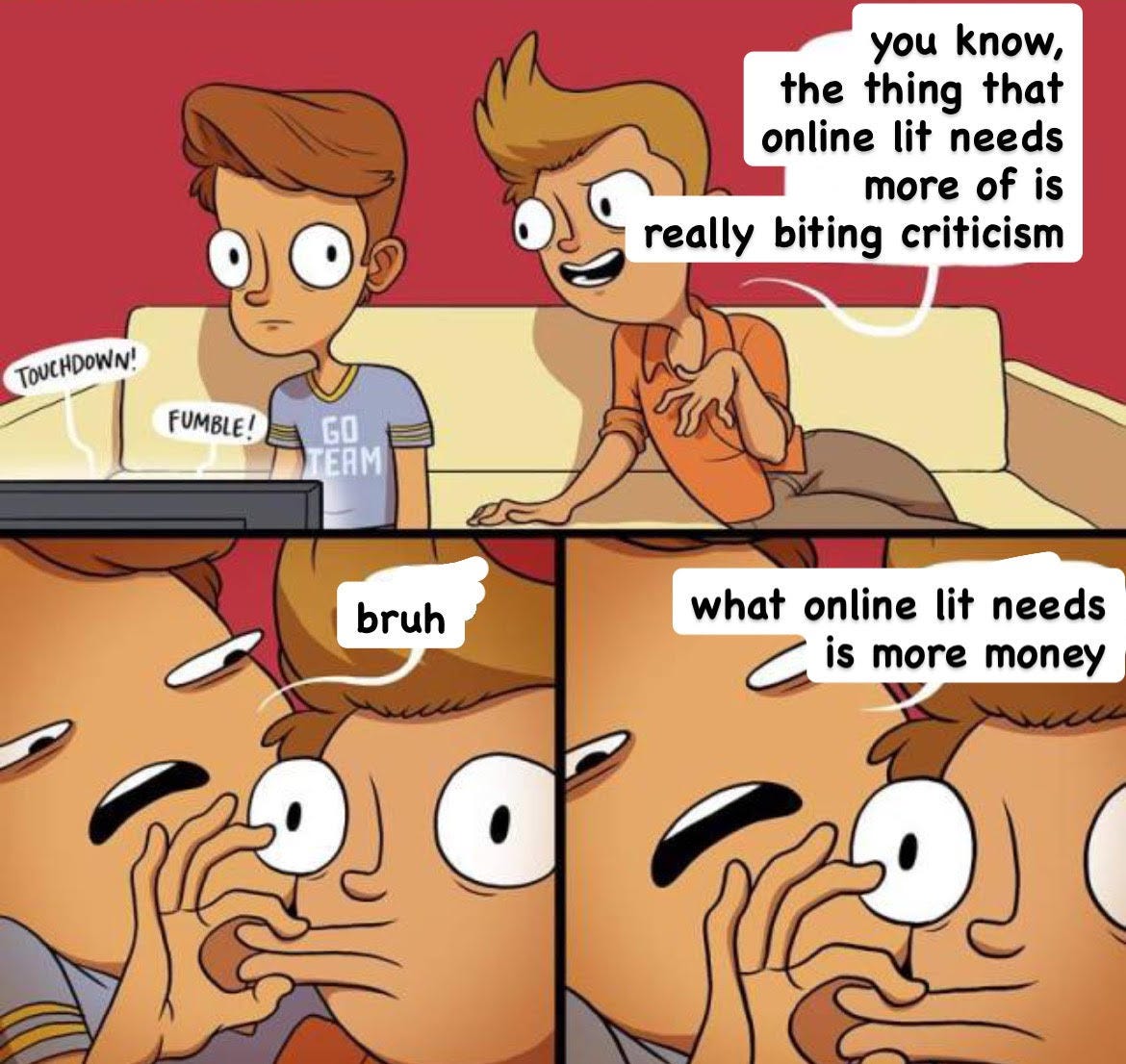
Let’s figure out how to get the CIA to financially invest in online lit.
Seriously.
Leave your ideas in the comments.
Thanks for reading talk about it! This post is public so feel free to share it.
Read my other posts about book reviews here:
How to write a book review!
·
July 11, 2024
I’m writing this post about how to write a book review because I want to inspire and encourage people to read more books and write more book reviews. Remember how I started that spreadsheet to link up authors who wanted their books reviewed with people who wanted to write book reviews
Book reviews are promotional tools
·
May 22, 2024

I’m not sure about you, but getting my books reviewed has always been kind of an ordeal. Asking friends and other writers to read my work and then take the time to write up an advertorial analysis (analytical advertisement?) can be awkward, and also it’s a big ask! Everyone is busy and probably already have other projects to work on. It’s nice when my p…
Comments
Nothing yet. Say the first thing.
Sign in to join the conversation.