
Thank you for reading yet another post about online lit on the talk about it substack. Say what you will about online lit. My love for this community is clear.
I’ve been thinking about writing this essay for a while now.
Yes, I’m using subheading in this essay and no I didn’t use AI to write this shit. I just think it’s funny to use subheadings to help steer the narrative here because this post is kind of a mess. They’re all going to end with a question mark as well. Just warning you.
Before I continue, we should define the term. According to the Cambridge English dictionary, gatekeeping is “the activity of trying to control who gets particular resources, power, or opportunities, and who does not.” I feel like this makes gatekeeping sound really impressive, like the gatekeepers have this crazy amount of power, and I’m sure it can be that way in some settings, particularly when money is involved. But in this essay I’m focusing mostly on gatekeeping in artistic communities not associated with major donors or large institutions.
We see this smaller scale of gatekeeping in a lot of communities, whenever there’s an in-group of experts or elders who share a stake in protecting their shared interest from novices or newcomers who could alter the vibes of their community, or who they deem as incapable of being part of the group. As a woman and a fan of Wu-Tang Clan, I’ve experienced this firsthand. It’s a meme, but there’s truth to wearing a band t-shirt and having to defend yourself to someone who wants you to name three songs to prove that you’re actually a fan. With a lot of niche communities, whether it’s a band or a game or a web forum, if you’re new to the scene you have to prove yourself.
When I was doing research for this essay, I looked into communities and gatekeeping and read about Usenet, a sort of early internet forum with well-written posts and news items. Because internet access was not widespread when Usenet was first established in 1980, the community was small and self-moderated. Usenet only saw an influx of new users once a year, in September when college freshmen would get internet access for the first time. And every September there was a short period of time when the site was frustrating for the established community members while the new users learned the etiquette and figured out how to use the site, trialing and erroring their way into the community, or deciding that the site wasn’t for them. Then in 1994, America Online and other internet providers began directing their users to Usenet upon sign-in and the site became overrun by people who were new at using the internet and did not take the time to learn the etiquette or how to participate on the site.
“A collectivist type anarchy can’t handle a massive influx of new members who aren’t on the same ideological page,” said David Fischer, an early adopter of Usenet (via Vice in 2015).
The floodgates had opened. Instead of dealing with new users in the way that they had grown accustomed to every September—providing instruction to the ones who were doing their best in earnest and condemning those who were fucking around and wasting peoples’ time—the elders of Usenet became wholly overwhelmed by the volume of new users and the functionality of the site deteriorated. Their gatekeeping efforts were not enough.
You’re probably familiar with the meme “Gaslight Gatekeep Girlboss.” I had to look up the source of the meme because I had heard it before but I didn’t know where it came from, only that it popped up within the last six years. I’m pretty sure I first heard it referenced in a Contrapoints video essay, and then it was everywhere. Apparently, it’s a cynical parody of “live laugh love.”
When I used to watch Law & Order: Criminal Intent, detectives Goren and Eames were always chasing very elusive killers who would leave clues that would make them question their memory and sanity. Eames was always saying, “I think we’re being gaslit.” Hearing this uttered on L&O was my first time encountering the concept of gaslighting outside of the film Gaslight (starring Ingrid Bergman—we had the movie on VHS and it got a lot of play when I was a kid) and I remember thinking, oh that’s cool, this piece of media is referencing another piece of media that I’m familiar with.
The point is, I feel like once the triple G meme hit the mainstream people started talking more regularly about gaslighting and gatekeeping (and I guess girlbossing too, but I don’t know what that is and I don’t really care). And don’t get me wrong, these terms are useful when it comes to describing and understanding complex social dynamics, but they can be overused and misused. Not every lie is an example of gaslighting. Not everyone who is particular about their hobby is gatekeeping.
Gatekeeping is one of those things that is supposed to be bad. But maybe it’s sometimes necessary?
Online lit is an unorganized group of individuals with a shared commitment to our interest of reading and writing literature. There is no centralized power. The only power that exists comes from the tastemakers, people like litmag editors and podcast hosts who help promote the ideas and idea-havers that they vibe with, who do have a certain amount of power, along with elders, the people with an established and devoted following.
We have flapped our gums on talk about it numerous times about how online lit is a low stakes endeavor. None of us are making any money, nor do we have the ability to unlock major opportunities for crossing over into the mainstream — but if you are/you do, I would love to hear more about that. Really.
Most of us are editing litmags and producing literary events because it sparks a certain kind of joy in our cold, bitter hearts. We do it because we like it. We’re being part of a community. It’s fun. But there is a certain amount of responsibility, to the people in the community as well as to the thing that we’re all supposed to be here for: the writing.
Online lit tastemakers have a responsibility to be discerning and only publish and promote quality writing. I know this conversation comes up every time a poem or a story goes viral because people hate it. Especially when the person who wrote it is a big time (lol) writer.
Gatekeeping can keep a literary community safe from bad actors:
people pretending to be someone they are not (for example, that creepy Atticus dude who would write about killing women writers and later started using pseudonyms and saying he was a Black woman to try to get publishing opportunities he felt he was entitled to)
plagiarists
people who pass off generative-AI as their own work, which is in itself a different flavor of plagiarism
people who hurt other people
Gatekeeping what gets published and promoted helps the cream rise to the top. Not everyone is producing amazing work, even people with big names. Having discretion about what gets platformed is a reasonable approach to publishing, and choosing not to work with someone based on the quality of their output is not the same as publicly shaming or manufacturing a whisper campaign. It’s also okay to not want to work with someone who you get bad vibes from.
Pushed to its limits, gatekeeping prevents a community from growing. The requirement of a cosign is inherently exclusive and can kill a literary community.
If the work is good, and the artist behind the work isn’t difficult to work with, it’s likely to find success with an audience even without an in-group’s approval.
Strict gatekeeping presupposes that community members aren’t smart enough to suss out bad actors on their own.
What is the rubric for entry into a community? What is the rubric for banishment? Banishing people without clear guidelines or stated rules is frivolously draconian.
What is the role of gatekeeping in online lit? Should editors and publishers be doing background checks on writers they work with? To what extent?
I’m gonna say that we probably don’t have to do that much. Online lit is an amalgamous space that is constantly in flux. There are no leaders, there are no rules. Anyone can start a litmag and form their own community. Good writing is likely to gain an audience without getting a cosign from an elder, the same way that a person can build a social media following on their own without getting a signed permission slip from a person who others deem to be in charge. This is not to say that this happens across the board, because playing the online lit game does require some amount of understanding of how the group functions. A person who wants to be part of a community but doesn’t put effort into becoming a community member probably won’t get the attention they crave from that community (unless they’re a narcissist and their narcissistic supply gets fed on negative attention). Remember that post I did where I was talking about the grinch? Lol.
You can’t stand on your mountaintop feeling sad that a group of people isn’t including you when you don’t try to learn the customs of that group and you don’t even attempt to play nice with that group. Communities consist of relationships between people. If you aren’t interested in fostering friendships with the people in the community and you just expect them to boost your content, I don’t know what to tell you.
We don’t all need to be friends in order to appreciate each others’ work, but I do believe that in smaller communities like this, and our little world of online lit is indeed small, it surely helps to not be an asshole.
In GROUP CHAT, a reality show via WhatsApp that I’ve been participating in for the past six weeks or so, we were discussing lit mags: which ones we read, which ones we’ve submitted to, and which ones we’ve been published in. I mentioned that I usually only send my work to places where I know the people who edit and run the show. I like working with my friends, and I also feel like it’s a waste of time to send work to a slush pile where thousands of others have also sent their writing to wither six months up to a year waiting for a response. I’ve done it in the past and I will perhaps do it again, but for the most part it’s just not for me. It’s not just that I’m impatient, but I like contributing to a conversation where I feel welcome and a part of. It feels nice and cozy. Another member of the chat said that was cool, and referred to it as being part of a scene. I liked that, the idea of having a scene. When I went on tour for my first book with Jesse Prado, I remember being in the car with him and Matthew Sherling and someone saying, “It’s like we’re the new Beats.” I loved that. The idea that right then and there we were making a movement, something we could document and reflect on later in our lives, felt really good.
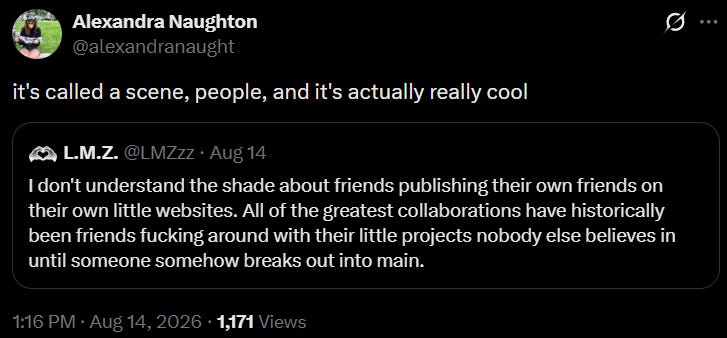
Writers hanging out with writers. Being part of an artistic community. These are the things I used to long for, and I’m so happy that I get to live that dream.
Our little literary scene is a framework that means different things to different people, but we’re painting in the palette that we love best: fiction, poetry, rhetoric, word play. I do what I do because I love it. I love reading good writing and being able to reach out to the writers themselves and telling them so. It’s also nice when my little endeavors connect with people and occassionally impress them. There is no better lift than getting a message saying “loved your new piece” from an artist I respect.
Is anyone ever truly canceled?
I would say gatekeeping and cancelations are one in the same insofar as the one being ousted makes the final determination of their fate. I was thinking last week about gatekeeping/canceling people in a historical context and my immediate impulse was to say I don’t know how normal it is for public callouts/cancellations to take place within communities. But after thinking for more than a minute I can say that yes it is pretty normal: excommunications within the Catholic church, Salem witch trials, Maoist struggle sessions. Nowadays, it’s easier to cancel someone, and the consequences are less harsh. Losing friends on social media is not the same as being maimed or killed, and people who get canceled can (and do) move on with new identities to other communities, or simply wait it out until they feel like enough people have forgotten or ceased to care about the cancellation.
I’ve been canceled a couple times on some personal grievance bullshit and I’m still here. I’ve also witnessed waves of major cancellations, some that have held, and some that escaped unscathed. Do I need to name names? I don’t think so, but anyone who remembers alt lit in 2014 knows what I’m talking about. The biggest cancelations are usually self-imposed, unless some actual horrific crime was committed. You can be put on blast within a community but whether or not you leave is up to you.
Cancelations are all in the mind. People in a community can try to get you to leave, but they need the majority on their side to make it stick.
In an interview with Barry Miles in 1969, John Lennon said, “That’s what we get told all our lives, what our limits are… People are limited into thinking they couldn’t run their own affairs. And what we’re trying to say is you are unlimited and you’re all geniuses…”
The biggest gatekeepers in our lives are our own self-imposed limitations. The only person who will really stop you from becoming part of an artistic community, if that’s something you want to do, is yourself. Yes, cliques exist, but you can always make your own scene. Unless you’re an absolute miser, you have the ability to form your own connections and push your own ideas forward. And then once you have that community, you can start asking questions like: how do we create a space that fosters creativity and unique perspectives while also being diligent about protecting our citizenry?
I think I’ve said enough. Tell me your thoughts.
Comments
Nothing yet. Say the first thing.
Sign in to join the conversation.