
There are loads of reasons to be excited about the up-coming FIBA U17 Basketball World Cup 2026. There are some amazing players to go along with some fantastic storylines to follow. Among them is if United States can win their eighth straight undefeated title.
And that actually raises a question I have been talking about for a couple of years now and the 2026 U17 World Cup will at least give some insight into it, if not answer.

Let’s go on a journey …
First off, let’s ask a question about development. What age would you consider is the most important for most youngsters to take the next step in their development - for them to go from just interested players into budding talents.
10 years old? 14? 12? Let’s go with 13. That seems like a good age to consider.
- - -
So in what year did players born in 2007 turn 13? Seems like such an easy question … in case your brain isn’t working, I will help. 2020. And what happened in 2020? Of course, Covid.
Covid and the aftermath took away a lot of chances to develop for the 2007 generation and probably even more the 2008-born players. And that was the case for most of the world as society really shut down in major ways.
Things did not really completely stay shut down in the United States however. While the Americans did shut down initally, the pandemic became very politicized over time with many questioning it altogether and wearing masks was even a debate: if you wore a mask you were considered a Democrat.
That meant also that basketball was still played - albeit with some mild restrictions. That in turn meant those 2007 and 2008 born Americans were still getting the usual development.
Before we keep going, let’s take a step back. Of course, the United States have never lost a game at the FIBA U17 World Cup - going undefeated in 2010, 2012, 2014, 2016, 2018 and 2022.
But let’s look at the Final of the 2022 U17 World Cup. The Americans were taking on Spain in Malaga, and the hosts were giving USA a real test. With a talented generation including Izan Almansa, Aday Mara and Hugo Gonzalez, Spain were actually leading 48-41 with 6 minutes left in the third quarter.
The Americans eventually turned up the pressure and surged ahead with a 21-3 run to lead 62-51 after 30 minutes. Cooper Flagg, Ron Holland, Jeremy Fears and Koa Peat were too much for Spain in the fourth quarter and USA won 79-67.
But the world was catching up to the Americans - especially if the opposing team had enough talent to keep up with the USA’s dominant depth.
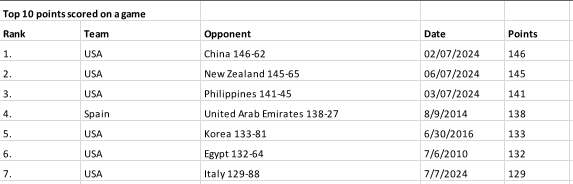
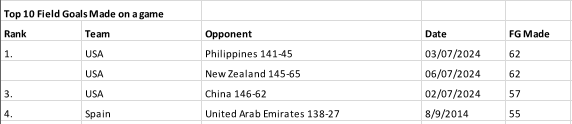
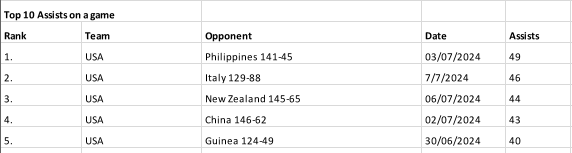
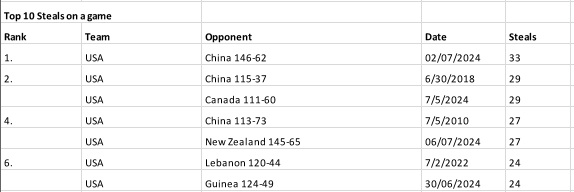
Fast forward two years, and the FIBA U17 World Cup 2024 in Türkiye gave us an entirely different picture. The United States raced from one record to the next to the next. The Americans had an average winning margin of 64.3 points.
A look at the top team single game performances in U17 World Cup history shows just how dominant the Americans were in Istanbul two summers ago.
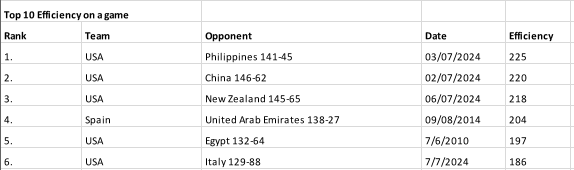
You might be asking: How does this fit in with the topic of this article?
The 2024 U17 World Cup was for the 2007-born generation. Remember the kids around the world who missed out on their important development years of 13 and 14 because of Covid. And the Americans who never really stopped playing basketball at length.
Was the Covid pandemic the reason the Americans dominated so emphatically in 2024? Of course, it’s impossible to say for 100 percent, but the arguments laid out are at least arguments as to why it may have happened.
That argument could gain traction depending on what happens at the FIBA U17 World Cup 2026. The eighth edition of the competition is for the 2009-born generation.
What is one major difference compared to 2024? The 2009-born players turned 13 years old in 2022 - when societies around the globe had really opened back up and life had gotten much closer to pre-Covid level. That means the 2009-born players were back to getting the much-needed training at that important age.
Many consider the 2009 generation a strong one around the world - looking at French players like Nathan Soliman and Aaron Towo-Nans, Nikola Kusturica of Serbia; Slovenia’s Lun Jarc, Ömer Kutluay from Türkiye, Luke Paul of Australia, the 2010-born Chinese duo Zhang Yizhaojie and Zhang Ziyi, DJ Gaines from Puerto Rico and Jokubas Kukta of Lithuania among others.
All this begs the final question. Will the FIBA U17 World Cup 2026 be closer to 2022 - where the rest of the world (or maybe Europe in particular) showed they are getting closer to the USA at the cadet level; or will the Americans be just as dominant as two years ago.
Should it be closer to 2022 than 2024, then that would strengthen the argument about Covid’s impact. Long term, this doesn’t mean much, maybe just fewer 2007 or 2008 born players reach senior national teams around the world. But it is at least a discussion point to consider for the FIBA U17 World Cup 2026.
Let me know your thoughts - leave a comment and we can discuss it
If you enjoyed this article, consider subscribing to Taking The Charge. Just click on that button above and you will not miss a post.
No posts
Comments
Nothing yet. Say the first thing.
Sign in to join the conversation.