
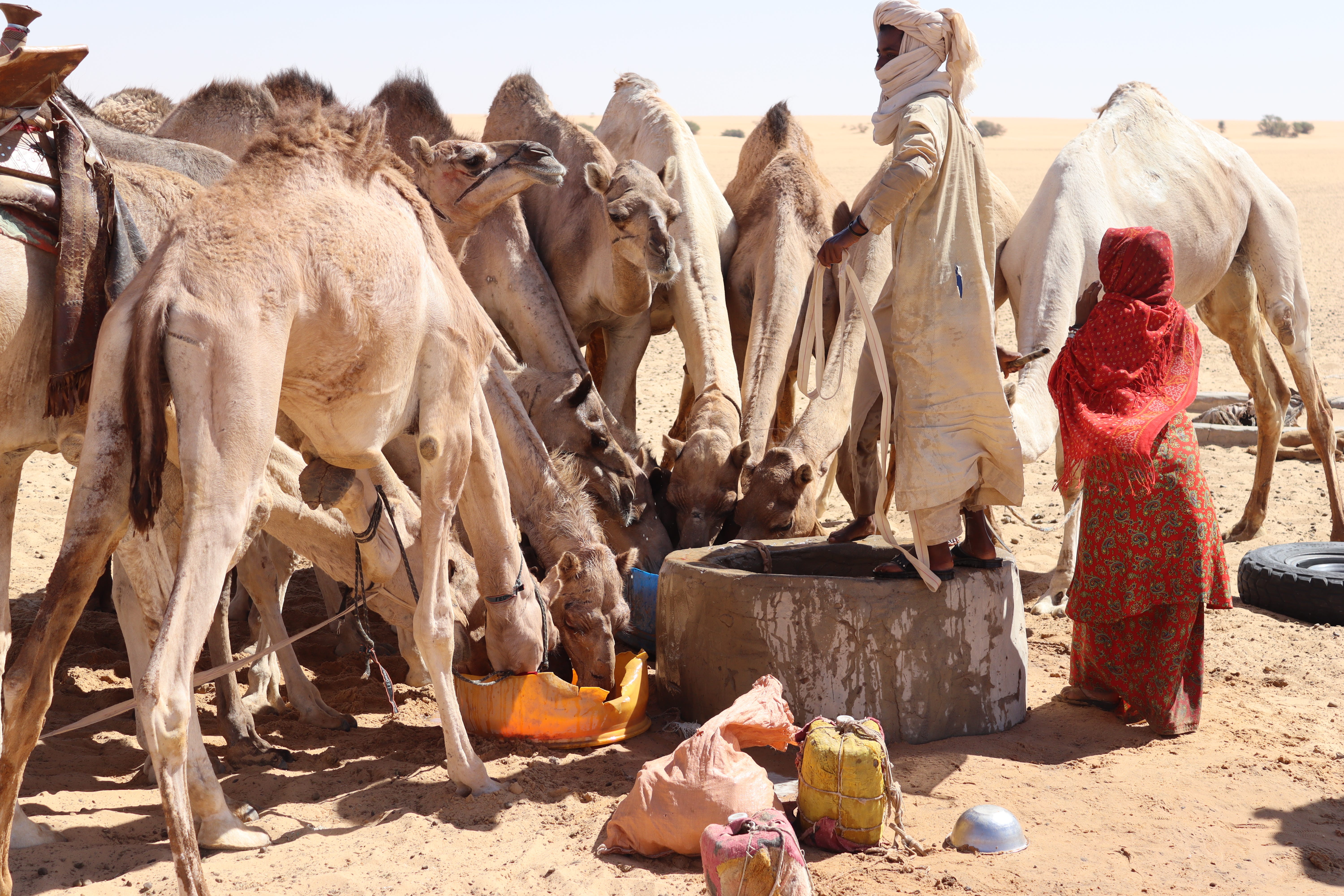
Herders water their camels from a well in Wadi Howar in the Gizu ecosystem in Sudan’s Sahara Desert (photo credit: ILRI/H.Sulieman).
‘. . . As the war in the Middle East grinds into its third month, catastrophe is unfolding across the world’s poorest, least stable countries. If hostilities continue beyond June, those confronting acute hunger will swell beyond 363 million people worldwide, an increase of 45 million compared with before the war, the World Food Program warned.
‘The danger is mounting absent the usual degree of international mobilization.
‘Four years ago, when Russia began its war on Ukraine, the global supply of fertilizers and grains was disrupted, prompting fears of hunger from sub-Saharan Africa to South Asia. But the pain was limited by $43 billion in humanitarian assistance marshaled by governments and multilateral institutions, according to data compiled by the United Nations. That campaign, which included emergency food aid, water and medical care, was led by $17 billion from the United States.
‘Last year, overall humanitarian funding dropped to $28 billion, and the United States contributed only $4 billion. Cuts are continuing. . . .
Humanitarian relief organizations now contemplate a surreal hierarchy of suffering.
‘. . . In Sudan, scene of the world’s most dire humanitarian disaster, some areas are suffering famine, and 41 percent of the population is acutely short of food . . .
nytimes.com | @NYTimes | @petersgoodman
+ The Iran War’s devastating butterfly effect: The effective closure of the Strait of Hormuz has increased the prices of critical goods as hunger rises in scores of poor and unstable countries—New York Times ‘The Daily’ podcast
The parasite couldn’t have come back at a worse moment.
‘The first thing you should know about the New World screwworm is that it isn’t actually a worm; it’s a fly. At the larva stage, it twists into the flesh of its host, devouring it from within. These wormlike maggots feed on all kinds of warm-blooded animals (the fly’s scientific name is Cochliomyia hominivorax, or “man-eater”), but they pose a serious threat to livestock, and to cattle in particular.
‘The second thing you should know about the New World screwworm is that it’s back. Last week, 60 years after the United States was declared free of the fly, the Department of Agriculture announced that it had found larvae in a three-week-old calf in rural Zavala County, Texas, not far from the Mexican border. Four more infected animals have since been identified across Texas and New Mexico: two calves, a goat, and a dog. The U.S. cattle herd is already the smallest it’s been since 1951 (in part because of drought), and the value of cattle is soaring. As meat-packers pay more for the few animals that remain, they’re passing those costs down the supply chain to beef consumers. To meet the demand, the industry will need to invest in new calves and build up the herd. But the White House’s mixed messages on tariffs has made farmers skittish, and the resurgence of a parasite that eats their animals alive may only make things worse.
‘Since the 1950s, the Department of Agriculture has been warding off the screwworm with a tried-and-true strategy. Workers raise batches of the flies themselves, sterilize them with radiation, and then air-drop them over affected areas each week. Wild flies mate with the sterile ones, slowly eroding the population over time. It’s one of those quietly effective taxpayer-funded programs that’s had an enormous impact in past decades: Before the sterile-insect technique repelled screwworms from the southern U.S., the pests had been costing cattle farmers tens of millions of dollars every year.
‘The insect population was eventually pushed south through Mexico and past the Darién Gap, the roadless rainforest on the border between Panama and Colombia, where it was held at bay until 2022. Then it began its march northward, speeding up in 2024, perhaps thanks to illegal cattle trafficking. The U.S. first closed its border to Mexican calves in November of that year, further reducing the size of the American herd and pushing up beef prices.
‘Sally DeNotta, a professor of veterinary medicine at the University of Florida, told me that because the flies have already made it to the U.S., they’re unlikely to be fully eliminated for “months to years.” Many hundreds of millions of sterile flies need to be dropped onto these screwworm populations each week to have an effect. The USDA began investing in production and dispersal facilities for sterile flies last year, but right now, the only place in North America capable of producing sterile flies en masse is a Panamanian facility that produces just 100 million a week. . . .’
The Atlantic.com | @TheAtlantic | @will_gottsegen
El Niño is “on our doorstep”, likely to worsen drought, intensify rainfall, and make heatwaves more likely in different parts of the globe, the UN’s World Meteorological Organization warns. The El Niño phenomenon happens when sea-surface temperatures warm in a vast stretch of the Pacific Ocean, running from the Pacific Islands to the coast of central and South America. WMO says there’s an 80% likelihood of a moderate to strong El Niño from June to August, with a strong possibility it could stretch into November. The last El Niño contributed to record global temperatures in 2024. The warnings put extra pressure on an overstretched global humanitarian system: Deepening conflicts and steep funding cuts have often put disaster preparedness and prevention in the backseat.
thenewhumanitarian.org | @NewHumanitarian
‘Contact tracing has emerged as a key hurdle to containing the Ebola outbreak in eastern Democratic Republic of the Congo (DRC). So far, around 380 caseshave been confirmed, with just over 4,500 of their contacts identified. The health authorities are following up on just over half of them, but that figure needs to rise to more than 90% “to get ahead of the outbreak”, the World Health Organization has warned. Taking a dive into the numbers, only about 12 people per confirmed case (not factoring in the suspected cases) have been traced, according to infectious disease expert Helen Branswell. By comparison (although a slightly unfair one), neighbouring Uganda has found around 44 contacts per its 18 confirmed cases. The mismatch is one indication of the difficulty of managing the Ebola response in a region facing ongoing conflict, and where the government and humanitarian authorities are distrusted. The death toll currently stands at 64 in DRC in an outbreak that may have started as far back as the beginning of the year.’
thenewhumanitarian.org | @NewHumanitarian
He is about to take SpaceX public—pushing other AI companies to do the same.
‘Elon Musk is about to set in motion a chain of events that will reshape the global financial order. For starters, when SpaceX formally goes public next week, he is all but guaranteed to become the world’s first trillionaire. His rocket company is targeting a valuation of $1.77 trillion, which would make it one of the 10 biggest companies in the world—bigger than Meta, Walmart, and, for that matter, Tesla.
‘All of this activity is less about colonizing Mars and more about providing the infrastructure for the AI boom: Musk wants to use his rockets to launch data centers into space, where there is abundant solar power to harvest. His rush to tap into the public markets seems to be pushing the other AI behemoths to do the same. On Monday, Anthropic filed confidential documents to begin the process of going public as early as this fall. And OpenAI is reportedly preparing to do the same any day now.
‘Anthropic and OpenAI, too, will likely be valued at $1 trillion or more, dwarfing JPMorgan Chase and Exxon Mobil. These will be three of the largest initial public offerings, or IPOs, in history—and all three may hit the stock market in the span of just a few months. It’s hard to overstate the effects this rapid succession of gargantuan IPOs will have on the American economy—think of it as dropping three boulders, one after the other, into a kiddie pool.
‘These companies are not going public because they are moneymaking machines. Consider that SpaceX, in the lead-up to its IPO, revealed that while it is seeking a nearly $1.8 trillion valuation, the company has lost $4.3 billion in just the first three months of 2026. OpenAI is also unprofitable, while Anthropic might barely post its first profitable quarter ever at the end of June. Yet the trio are set to become among the most valuable companies in the world because of a promise of unprecedented riches on the horizon.’
In a Securities and Exchange Commission filing, SpaceX wrote that in the long run, AI will eat the economy, and so its total revenue could be, in essence, equivalent to most of the U.S. GDP. Similar logic could be applied to OpenAI or Anthropic.
‘To create such all-powerful bots that could feasibly reshape the entire economy, AI firms have to build lots and lots of data centers. (Hence Musk’s excitement about putting them in space.) Whether in orbit or on Earth, they will be extremely expensive. OpenAI CEO Sam Altman has said he would like to build a gigawatt of data-center capacity every week—that’s as much power as a major city demands and would likely cost tens of billions of dollars every seven days.
The cost of all this data-center construction is likely why SpaceX, Anthropic, and OpenAI are now racing to go public.
‘. . . On top of that, many Americans will be forced to purchase shares of SpaceX—and likely Anthropic and OpenAI after that—whether they want to or not, and perhaps without even knowing it. That’s because many Americans passively invest their 401(k) and other retirement savings through index funds—large stock portfolios tied to indexes such as the S&P 500 or Nasdaq 100 designed to broadly track the market’s performance by pooling together the stocks of the biggest public companies. . . .
‘As soon as one of these companies is included in any of the major indexes, millions of Americans will automatically be purchasing its stock—in turn buoying the value of shares held by big institutional investors. You may soon have a personal financial stake in Musk conquering space and ChatGPT curing cancer. . . .
‘Of course, concerns that AI is a bubble rise and fall every few months. But through it all, SpaceX, Anthropic, and OpenAI have continued to embed their bots more deeply and broadly across the economy. By weaving itself into the finances of most businesses and households in America, the AI industry is quickly making itself too big to fail. . . .
This technology is so expensive to build that it must be world changing; and because it is world changing, we will spend any amount to build it.
theatlantic.com | @TheAtlantic | @matteo_wong
‘The latest Indicators of Global Climate Change report has been published in Earth System Science Data, the efforts of a team of over 70 scientists from 56 institutions across 17 countries. It found that human activities pushed global warming to 1.37 C in 2025, and that Earth will surpass 1.5C in about four years. Global greenhouse gas emissions are at an all-time high as of 2024, reaching 56.8 billion tons of CO2 equivalents.’ University of Leeds
numlock.com | @NumlockAM
Multiples
Niger Foodscapes
Arresting headlines
WHO, Africa CDC announce joint Ebola response plan: The World Health Organization (WHO) and the Africa Centres for Disease Control and Prevention (Africa CDC) today announced a joint plan to respond to the Ebola outbreak in the Democratic Republic of the Congo (DRC) and Uganda over the next 6 months. The plan aims to raise $518 million to help African countries and partners to strengthen outbreak response measures through November 2026 and aims to complement response plans already launched by the governments of DRC and Uganda—CIDRAP
New OMB rule could break science in the United States: What a new proposed rule from OMB [US Office of Management and Budget] could mean. . . . 1. Political appointees would decide which science gets funded, and peer review would be explicitly sidelined or ignored. 2. Grants could be canceled at any point, without warning, in the middle of ongoing work. 3. Researchers would have a harder time communicating their findings without pre-approval from the federal government—Your Local Epidemiologist
Comments
Nothing yet. Say the first thing.
Sign in to join the conversation.