
’The window to build global standards and oversight over artificial intelligence is still open, but for how long? A week of AI-related meetings kicks off in Geneva on 6 July, headlined by the inaugural UN Global Dialogue on AI Governance. A UN scientific panel warns that decision-makers must understand and manage both the rewards and the risks. Experts see 2026 as a pivot point for AI—especially with the rise of agentic AI.
‘The ability of AI agents to complete complex tasks is doubling every four months, and human-made evaluations to test AI capabilities “are starting to hit a ceiling”, the US-based Future of Life Institute says. The UN panel warns of the “loss of control” as systems get greater agency. At the same time, AI can quickly create long-range weather forecasts and help predict monsoon seasons to optimise crop yields—just one example of clear but uneven benefits across sectors. OpenAI CEO Sam Altman recently called for a US-led global framework to make AI safe.
‘If you’re sceptical of one country’s legitimacy to lead such discussions, then it underscores the thrust behind next week’s Geneva meetings. The UN platform moves the discussion to a global forum that has an eye on the humanitarian settings where AI benefits aren’t likely to reach first.’
thenewhumanitarian.org | @newhumanitarian
‘El Niño is here. Forecasters say the phenomenon, which influences global temperature and rainfall patterns, increasing the risk of extreme weather events, is likely to be “very strong” and expect it to strengthen through the coming months and peak around the end of the year. According to a recent inter-agency report, heaviest impacts may be felt from October through March next year and humanitarians are racing to prepare. The report says the humanitarian system is better positioned than in the previous strong El Niño cycles of 2015 and 2023, with anticipatory action frameworks active or finalised in 15 priority countries. The Food and Agriculture Organization (FAO) and the World Food Programme (WFP) have also launched their first-ever joint anticipatory action appeal, seeking $202 million to support interventions in 22 high-risk nations, covering cash transfers, seeds of drought-tolerant or flood‑resistant varieties, livestock support, flood defences, and water storage systems. Governments are moving too. Kenya's Cabinet has formed an El Niño committee, activating a national contingency plan to prepare for heavy rains in October. The Philippines has also reviewed its national El Niño action plan across agriculture, energy, health, and education.’
thenewhumanitarian.org | @newhumanitarian
Wildlife at risk as demand for cropland and water grows to feed 50% rise in farmed animals, campaign alliance says
‘The number of mammals and poultry farmed worldwide has increased by half in the last two decades, research shows, and the amount of cropland used for feeding livestock has increased by about a quarter.
‘These increases are putting rising pressure on natural systems, threatening wildlife and plant species and adding to the climate crisis.
‘The rising demand for meat comes at a time when agricultural land is already becoming less fertile, with an area the size of Canada now suffering degradation. This situation is worsening: about 90% of water withdrawn from natural systems for irrigation is used to grow animal feed.
‘These findings, from an alliance of campaigning organisations called Stop Financing Factory Farming, come 20 years after the publication of the UN Food and Agriculture Organization’s seminal report on animal farming, Livestock’s Long Shadow. The researchers have updated key aspects of the report, and found that most trends are moving in a negative direction.
‘Peter Stevenson, the chief policy adviser at the Compassion in World Farming campaign group, told the Guardian that even where progress had been made, for instance by reducing the amount of greenhouse gas produced per unit of meat, it was often outweighed by the sheer increase in the livestock population.
‘Emissions from livestock grew by more than a fifth between 2001 and 2023, according to the FAO. “There’s been a huge increase, and it’s simply because there are so many more livestock now,” he said. About 33 billion livestock mammals and poultry have been added globally in 20 years: there were 94.9 billion farmed animals—the number slaughtered or used for milk or eggs—in 2023, up from 61.8 billion in 2006.
‘Increasing quantities of fertiliser are being used to produce animal feed, which along with the dumping of slurry is leading to dead zones in seas, with the biggest in the Gulf of Mexico, where marine life is being wiped out across an area the size of Connecticut.
‘Merel van der Mark, the head of animal welfare and finance at the campaign group Sinergia Animal, said only a widespread shift away from the meat-heavy diets that have become the norm in many parts world would reverse the trend towards greater planetary damage.
‘She called on publicly funded development banks, which provided $1.23bn (£930m) to intensive farms in 2024, to lead the charge by changing their investment criteria. “This means a shift away from industrial livestock production, which multilateral development banks must support by stopping financing factory farming and instead aligning their financial flows with a more sustainable world,” she said.’
theguardian.com | @fionaharvey
’A UN assessment found 24 hectares of greenhouses rehabilitated between October 2025 and April 2026, mostly in Khan Younis, while sheep numbers rose 33% and goats 8% after emergency support following the ceasefire. The FAO continues to provide cash assistance, with support for the 2026 planting season now reaching 1,500 small farmers across the Strip. FAO’
fixthenews.com
‘A team at the University of Minnesota says it has created the first synthetic cell built entirely from non-living chemical components and watched it complete a full cell cycle, including division. The project is called SpudCell.
‘SpudCell consists of a lipid sphere that mimics a cell membrane, wrapped around a genome of just 90 kilobase pairs of DNA—far smaller than biologists previously assumed any living cell would need. It also contains a built-in system for translating genetic instructions. The team observed it taking in nutrients, growing, and dividing. The research has not yet been peer-reviewed, and one reviewer has reportedly questioned whether it qualifies as genuine biology. Those are fair caveats.
‘But the proof of concept matters. SpudCell cannot yet replicate across many generations, regulate its own metabolism, or produce its own protein machinery. Natural cells do all of those things. What SpudCell shows is that the basic architecture of life—membrane, genome, division—can be assembled from scratch. Future synthetic cells might be designed as biological factories, producing drugs, materials, or chemicals with more precision than modified bacteria currently can.’
daybreaknotesandbeans.substack.com | @Alex_Verbeek
‘Researchers have launched the first clinical trial to test treatments for the Bundibugyo species of Ebola circulating in the Democratic Republic of the Congo (DRC). The trial will initially test two drugs—an antibody cocktail called MPB-134 and the injectable antiviral drug remdesivir—with the potential to add a third later on. A second trial to test another antiviral called obeldesivir—an oral counterpart to remdesivir—might also kick off in the next few weeks as researchers race to contain what is already one of the worst-ever Ebola outbreaks.
Global rates are too low to prevent disease spread
‘Farm animals are attacked by a whole slew of pathogens—from the bacteria causing anthrax to the virus causing avian flu. Louis Pasteur derived the first live vaccines for animals in the 1850s, yet we’re still fighting global infections that threaten to take down livestock and spill over to humans. Because farm animals share close quarters, their transmission rates are high, leading to deadly outbreaks. Case in point: the recent uptick of lumpy skin infections in cattle, prompting the French government to deploy its army to help stem the spread with vaccinations.
‘A new study published yesterday in PNAS collated global disease and vaccination data for the 104 diseases most common in cattle, poultry, and pigs. A collective of researchers from universities and One Health organizations in the United States, France, Switzerland, and Belgium aimed to gather systematic data on global vaccination coverage to expand prevention and control of livestock diseases. They pooled information from the last 20 years’ worth of country-wide reports on vaccination programs and stats from World Animal Health System, a global reference for animal diseases.
‘Spanning more than 200 countries and territories, the study homed in on the top 11 diseases most targeted by official vaccination programs. The results revealed vaccination shortfalls across the board. . . .
‘The weakest links in the global vaccination chain were in India and Argentina for cattle diseases; China and Russia for pigs; and China, Brazil, and Iran for poultry. . . . The researchers concluded that current vaccination rates for livestock might not be sufficient to prevent diseases that threaten food security and humans, noting that “global vaccination trends in at-risk regions have remained relatively stagnant over time.” . . .’
nautil.us | @NautilusMag
‘Thirty years ago this week, a sheep named Dolly was born—the first mammal cloned from an adult cell. . . . Reproductive cloning is now being used to create cattle with no horns, pigs with more transplant-friendly organs and copies of cherished pets.
’But fears of cloned humans have, so far, been unfounded, notes a Nature editorial. “The success rate is too low to consider the method in humans, and the risk of abnormalities resulting from the process is too high.” Dolly’s greatest legacy, it suggests, could have been a better system for preparing for the societal impact of genetic and reproductive technologies—a promise that is yet unfulfilled.
‘. . . [A] blind spot about climate change is the surprising role food plays in fueling it.
’In fact, agriculture is responsible for about 33% of global greenhouse gas emissions, according to Ismahane Elouafi, executive managing director of CGIAR—but only around 3% of climate finance goes to agriculture at large.
’“It doesn’t make sense,” Elouafi tells Devex Senior Editor Tania Karas. “We should aim for 33%. It’s a number game, and we need to get the numbers right.”
Elouafi argues that food systems must be treated as a central pillar of climate action, not a side issue folded into other agendas.
‘But she also cautioned that any green transition should be fair to farmers, particularly in low- and middle-income countries.
’“There is no doubt that there are better practices that could help reduce emissions from the ag sector,” she says. “But most of those practices are at a cost—and that cost is mostly to the farmers.”
’She drew a comparison with the just energy transition, where a strong narrative helped attract finance and spur innovation.
“‘The crowding of finance around the just transition for energy gave that sector the financing to boost innovation—and look where we are after only about 30 years,” she says. “If we do the same for agriculture, we can push the transition much faster.”
’“The food agenda is part of the [climate] problem, which we all know, but also part of the solution,” she adds. “Agriculture could be one of the best solutions we can use, along with energy.”’
pages.devex.com | @devex
The birds are particularly vulnerable to high temperatures, and France’s torrid June took a heavy toll.
They were meant to die, just not like this.
‘The chickens were 19 days away from a date at the slaughterhouse when temperatures climbed disastrously inside the long shed where they spent their nights. Over the course of several hours on June 23, during France’s hottest stretch on record, 1,500 keeled over. By the time Isabelle Renaudier opened the door, one-third of the flock was dead. . . .
‘Extreme heat poses a risk to nearly all living things, but chickens, unable to sweat and cloaked in feathers, are far more vulnerable than most. If temperatures climb too high, they start to pant, a survival technique that can leave them dehydrated and sapped of energy.
‘Even slow-growing chickens that roam outdoors, like those kept by the Renaudiers, are susceptible. But the broiler chickens developed by large-scale industry, which can reach full size in just five weeks, have an additional disadvantage because their fast-burning metabolism leaves them running hot. The end result: An animal that has been perfectly engineered to satisfy the demand for lean, affordable meat is poorly suited for a warming world.
‘Rising temperatures from climate change pose significant challenges for agriculture. For the poultry industry, it’s a “large-scale issue,” as one study put it, and it reflects how food systems that most take for granted can be jeopardized by extreme heat. In 2015, a stretch of scorching days in India killed an estimated 17 million chickens and caused prices to rise at grocery stores. A 2021 heat wave in the Pacific Northwest led to 400,000 reported deaths among chickens and 60,000 among turkeys.
‘And then came the blistering late June stretch in France.
‘As temperatures of 105 degrees Fahrenheit singed the country’s western poultry-producing regions, officials here described “massive die offs.” . . . Yann Nédélec, the director of Anvol, an organization representing the poultry industry, estimated that 2.5 to 3 million birds had died, mostly chickens. . . .
‘Rising prices are changing the way the French eat, he said. They want chicken more than ever. . . .
‘Air-conditioning is among the ideas that are “not cost effective,” Mr. Dridi said. . . .’
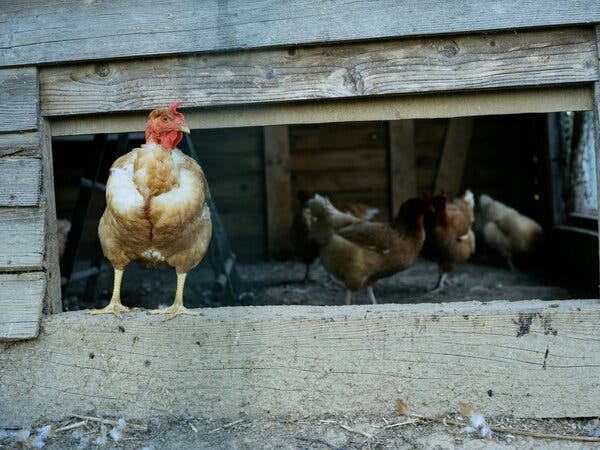
The comfort zone for chickens is between 64 and 70 degrees Fahrenheit, according to one expert.Credit...Samuel Aranda for The New York Times
nytimes.com | @nytimes | @chicoharlan | @leontinegls
Multiples
Rural Children of Nigeria
Arresting headlines
More impending horrors in Sudan—The Economist “The World in Brief” newsletter
Richer women, fewer babies? Not so fast.—The World Bank ‘Development Impact’ Blog
Comments
Nothing yet. Say the first thing.
Sign in to join the conversation.