
‘Derek Thompson: . . . Birth rates have been declining in developed countries for a long time, as child mortality has declined, as women’s education has increased, as female labor-force participation has soared, as contraception use has proliferated, and as modern notions of feminism have empowered women to take more control over their bodies and their economic futures. And birth rates have continued to decline as smartphone usage has surged, as housing prices have increased, as time spent at home on the internet has grown, and as socialization and coupling have declined.
‘The decline is accelerating faster than almost anybody predicted. . . . The total fertility rate has fallen below the replacement level of 2.1 births per woman in almost every country in North America, South America, Europe, and southern and eastern Asia.
‘Only two things are important right now in life: fertility and deep learning,’ the University of Pennsylvania economist Jesús Fernández-Villaverde said at the conclusion of a recent lecture. ‘Everything else is noise.’. . .
‘Derek Thompson: Why is fertility important?
‘Jesús Fernández-Villaverde: The number of children born today will determine how our society will look in 30 to 40 years. The year 2023 was a unique year in the history of humanity, because it’s the first time our total fertility rate as a planet fell below replacement rate. That has never happened before in 200,000 years. That means the world population will peak in another 30 years or so if the trend continues. . . . In 2055, the world population will start going down. . . .
‘Thompson: I think a lot of people believe that falling fertility is mostly a rich-country phenomenon. But you point out that’s a misconception. Total fertility rate is lower than that of the U.S. in Mexico, Brazil, Colombia, and Thailand. Why is this happening at a global level?
‘Fernández-Villaverde: There are several hypotheses on the table . . . . First, there’s been a huge change in social norms worldwide. This probably has a lot to do with social media and cellphones. . . . Second, we have moved to an economy that is much more service-based. Service-based economies, even in India and Africa, mean people don’t work in factories that much anymore, or even in agriculture. They work in shops; they work in offices. Those are jobs much easier for women to have, because they don’t depend on physical strength. . . . Third . . . [p]eople are staying much longer in school. They are marrying or forming partnerships much later in life. . . . [T]hey understand they will need to maintain their kids and educate their kids for many, many years. This is particularly true in Asia . . . . Those are the countries with the lowest fertility rates. The last is housing. In many countries, not in all, housing is at historical heights in relative price. That also limits the ability of families to have more children. . . .
‘In a world where population doesn’t grow or where population starts going down, we will consume less energy, or the growth of energy consumption will be smaller. That’s good for the environment. . . . [i]t will help us redesign a lot of cities across the world. . . . We are not going to need those ugly high-rises. We can demolish them.
‘Thompson: What are the downsides?
‘Fernández-Villaverde: . . . Everything related to retirement benefits, Social Security payments, the equivalent of Medicare and similar health programs for the elderly across the world, that’s going to impose a tremendous amount of cost on the planet. But also you are going to start being forced to close primary schools. . . . You will be forced to close hospitals. You will be forced to close a lot of other public services.
Finally, if fertility really stays at 1 or 1.1 for a long time, I don’t think we appreciate how big a change this is. . . . Let’s suppose Thailand keeps its current fertility rate of 0.8 for 200 years. Thailand right now has 63 million people. At the end of 200 years, it will be around 2 million people.
‘How do you wind down a society of 63 million people into 2 million? . . . [T]hese things compound over time. . . .
‘Thompson: . . . [I]f you’re running out of people, you need to import people, and that’s called immigration. . . . [I]t seems to me like practically every country that allows immigrants to become a certain share of their population almost always has a populist backlash. Slashing Social Security creates another backlash. So you find yourself in an environment where there is no long-term popular solution to your political problems. That’s what I see as an outsider.
‘Fernández-Villaverde: Exactly. Japan right now is around 98 percent ethnically Japanese. If we wanted to keep the population of Japan constant in 200 years through immigration, in 200 years Japan will be 5 percent Japanese and 95 percent non-Japanese. This is not about bringing in a few immigrants. This is about changing your country. That country will not be Japan. . . .
‘Thompson: You said only two things matter in the world. One is fertility. The other one is deep learning—AI. How do these trends intersect?
‘Fernández-Villaverde: . . . If, thanks to artificial intelligence and robotics, a lot of jobs can be done by computers and robots, and that generates a lot of economic growth and that helps us to pay for Social Security, that will make the transition much easier. . . . But . . . this is just not about GDP. My wife and I love to go to a small village in England . . . . They recently closed the local pub because of population decline. The problem is the local pub in an English village is . . . the place where you meet your neighbors. It’s the social gathering place of the village. How are you going to substitute that with artificial intelligence?’
theatlantic.com | @TheAtlantic | @DKThomp
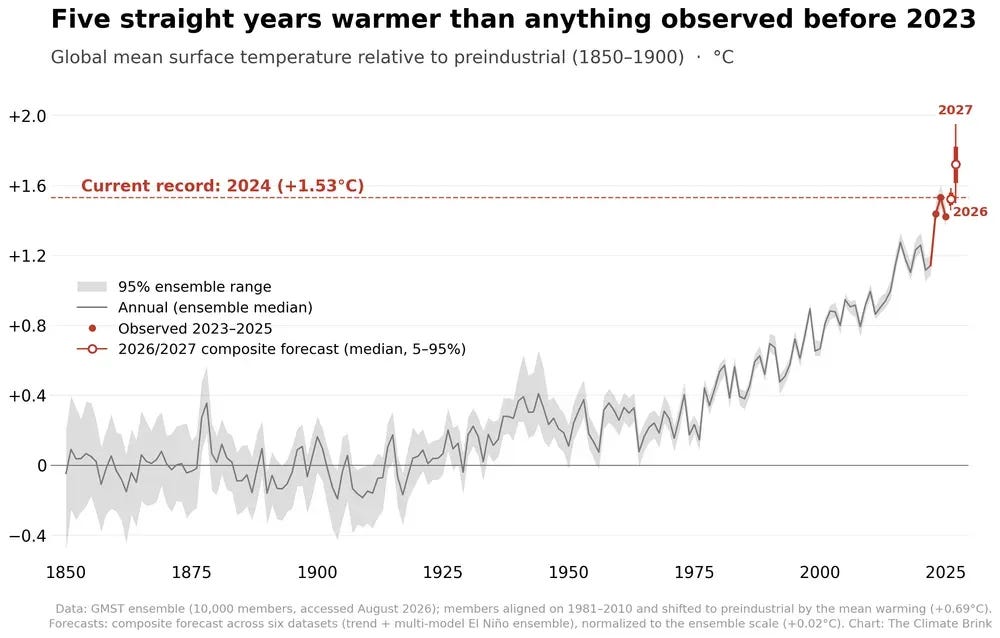
‘The most important bottom line, of course, is the temperature; that it’s rising, ever faster, is the basic text of our moment on earth, and I do my best to keep track of the underlying science and its unfolding implications. The chart below shows the latest data, from Zeke Hausfather, one of the most understandable climate researchers at work anywhere (though, loyal to my roots, I thin Jim Hansen continues to hold the crown.) What the chart shows is how sharply the mercury has climbed in the last few years, and how much more it’s going to jump in the next 18 months, based on consensus forecasts from a variety of models. 2024 is the current record holder; we may well break that record this year, and we certainly will in 2027. . . .
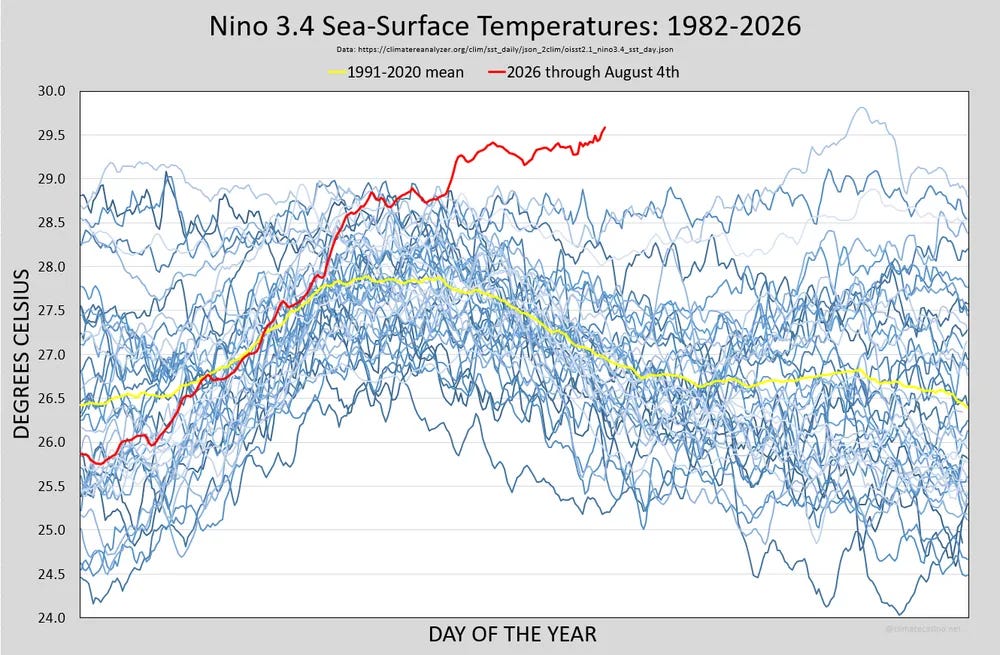
‘How do we know what 2027 will bring? Here’s another graph this week, of sea surface temperatures from the key region of the Pacific where El Niño is now taking shape. As you can see, we’re racing ahead of the pace even of other warming years. It doesn’t take much imagination to see why everyone is now clear we’re staring at an historic year, with a truly massive release of heat from the oceans into the air.
‘It’s painful for me to look at charts like this, every time. I’m constantly reminded that I knew this was coming, and that I failed in my efforts—journalistic and activist—to prevent this rise in temperature. . . .’
. . . [T]he warming is feeding on itself, producing conditions for fires that in turn pour more carbon into the air. That same warming means the air holds more water vapor, and hence we simultaneously get more deluge and flood . . . .
[G]lobal warming is proceeding even faster than feared, having accelerated across this period and moved to a level where it is causing daily disruption across the planet. . . .
The next bottom line is, a truly rapid World War II scale conversion to renewable energy is utterly essential. . . .
billmckibben.substack.com | @billmckibben
There is a sliver of a chance of a ceasefire. It must be grabbed
‘It may be impossible to find a single place that sums up the devastation caused by Sudan’s civil war, now deep into its fourth year. But . . . its ruined capital comes close. Before the war erupted in April 2023, Khartoum was a bustling city of around 7m people. Today its centre is deserted. Bare husks remain of government buildings. Smart homes and luxury hotels are in ruins. The streets, charred by fighting, are silent. So many bodies have been dumped that human skulls spill out of makeshift mass graves. And still the killing continues.
‘Khartoum is the scarred heart of one of Africa’s worst conflicts this century. War has destroyed swathes of the continent’s third-largest country and driven 14m people from their homes. Hundreds of thousands have probably been killed by fighting, famine and bursts of genocidal violence. The only recent African war whose horrors are comparable is the one in Congo, which may have killed more than 5m people in the early 2000s. Yet the war in Sudan is even more important geopolitically. As we warned two years ago, it has drawn in neighbouring countries, helping reignite civil wars in South Sudan and Yemen and threatening another round of killing in Ethiopia.
‘Outsiders have shown callous indifference to the suffering, by paying to keep the fighting going or neglecting it. Yet by endangering shipping in the Red Sea, the wars in Sudan and Iran are overlapping. That may raise the cost of prosecuting the war to its sponsors, giving them a reason at last to seek to bring about peace.
‘On the face of it, Sudan’s war is a conflict between two main belligerents: the Sudanese Armed Forces (SAF), the country’s regular army and de facto government; and the Rapid Support Forces (RSF), a rich and well-equipped militia. Various other Sudanese groups are allied with the two sides. Yet the fighting is also a proxy war between deep-pocketed regional powers vying for resources and influence. The RSF receives weapons, money and mercenaries from the United Arab Emirates (UAE), though the UAE strenuously denies providing it with support. To a lesser degree, the SAF is armed and bankrolled by Egypt, Qatar, Saudi Arabia and Turkey.
‘Until very recently, all these actors had an overwhelming interest in keeping the war going. . . . Now two developments have combined to create a chance of ending the war—albeit a slim one. Since America attacked the Islamic Republic in February, chaos in the Gulf has mostly made Sudan an even lower priority than usual. Having a shared foe in Iran did little to dampen the rivalry between Saudi Arabia and the UAE that is playing out in Sudan.
But as Dwight Eisenhower, a former American president, supposedly once said: when a problem cannot be solved, enlarge it.
‘As the Iran war expands, attention is moving from the Strait of Hormuz, which remains closed for the moment, to the Red Sea, which may soon be. . . . [R]ecent attacks in the Red Sea have further underlined the importance of Sudan’s coastline for Saudi Arabia, reviving its interest in the war. That could make it costlier and riskier for the UAE to keep up its backing for the RSF, which could open the door to a truce in Sudan becoming part of a wider settlement in the Middle East.
‘The second factor is a turn in fortunes on the battlefield. In the past two weeks the SAF has made its most telling breakthroughs since its return to Khartoum 18 months ago. . . .
‘Although it may now be tempted to double down on trying to defeat the RSF, the army has also long argued that it wants to negotiate from strength—a position it now holds. . . .
True, the chances of a successful ceasefire are small. But the time for a diplomatic push is now.
‘For the next month or so, Sudan’s rainy season means that there will be a lull in the fighting. A “humanitarian truce” proposed by Massad Boulos, Mr Trump’s overstretched Africa envoy, has a better chance of holding while the battle lines are relatively static.
‘America and Europe should lean on their Gulf allies to press the belligerents they support to talk directly to each other for the first time. Saudi Arabia, Egypt and Turkey should urge the SAF to stop insisting the RSF disarm and demobilise before negotiations can begin. The UAE should use its influence over the RSF to hold it to its professed desire for a ceasefire—even if that means abandoning the ambition to rule all of Sudan.
‘The Somalia-style trajectory towards further fragmentation would perpetuate the suffering and instability the war is causing. This is the last best chance to prevent it.’
economist.com | @TheEconomist
‘Malaria is one of the world’s deadliest infectious diseases, killing about 600,000 people—predominately young children—each year. Over the 21st century, the widespread use of mosquito nets and insecticides has helped lower annual deaths, but a vaccine remains elusive. Current models are difficult to produce, require multiple injections, and do not provide consistent results. Developing a more robust protective drug is critical for preventing further deaths.
’In a study published in Science, researchers developed a new malaria vaccine model that protected mice against the disease for 21 months. First, the scientists injected mice with a low dose of living Plasmodium sporozoites—the parasites that cause malaria. Normally, these sporozoites would make their way to the liver, where they develop into merozoites that emerge and attack red blood cells, causing disease. However, the researchers also fed the mice a drug that inhibited certain Plasmodium proteins necessary for the parasite to leave the liver. The chemically inhibited merozoites then could not cause the devastating symptoms of malaria, although the immune system still reacted as though it had been attacked, priming it against an actual infection. Indeed, when the mice were repeatedly injected with even high loads of Plasmodium sporozoites, their immune systems still prevented disease from taking hold.
’The next step will be to evaluate the vaccine’s clinical effectiveness in humans. But already, scientists have big plans for the vaccine, including potentially adapting Plasmodium to carry antigens from different diseases so that the immune system would be ready to respond to a wider range of threats. “Genetic engineering could even be used to simultaneously target multiple liver pathogens, including viruses, or, potentially, noninfectious diseases such as liver cancer,” said Miguel Prudêncio and Maria M. Mota in a related Perspective.’
view.aaas.sciencepubs.org
‘Scientists at Stanford and the Arc Institute used an AI model called Evo, trained on roughly nine trillion nucleotides across the tree of life, to design entirely new viral genomes rather than just replicate existing ones. After training Evo specifically on the harmless bacteriophage Phi X-174 and its close relatives, researchers generated 700,000 candidate genomes, synthesized 285 of them, and found 16 produced viable new viruses that infected bacteria, some multiplying even faster than the natural virus. The viruses pose no threat to humans since researchers deliberately excluded any training data on viruses that infect people, animals, plants, or fungi as a safety precaution. Experts called the result a milestone with potential upside for medicine and biotechnology, but also warned it underscores how far the science has outpaced any regulatory guardrails, especially since a new NIH policy on high-risk life science research doesn’t clearly cover AI-generated pathogens that don’t yet have a known “entity of concern” to flag them. One biosecurity researcher summed up the core problem: “What is the risk of what I’ve never seen before?”’
aaronparnas.substack | @AaronParnas
Leading models are getting better at designing pathogens
‘Scientists at Stanford University said they used AI to engineer novel viruses. The researchers created a generative AI model, trained it on genetic sequences, then asked it to write new ones capable of fighting E. coli bacteria. The model created 16 “exceptional” phages, which are viruses that can infect bacteria. While celebrating the model’s benefits, the scientists acknowledged that it raised “biosecurity considerations”.’
From the [analogue] archives
I went looking online for some of my ‘oldies but goodies’ to recycle here but soon found that most of these were designed for print in the years before the International Livestock Research Institute (ILRI), where I have worked for three decades plus, had built a website and online document repository. Because I cannot embed hyperlinks to these recyclable ‘assets’ (whose urls never existed or have since expired), I’ll reproduce some here. Let me know what you think.

Above: Poster, 2000: This black & white, small, un-self-promoting poster appeared on many office doors and walls over the years. ILRI photographer Stevie Mann drove out to my house to take this picture of our personal goat because he found ILRI’s research goats too dull. Millie, our Somali goat (named for the millennium), on the other hand, was full of character—always inquisitive and, when not grazing our garden, regularly standing up in her stall to peer out at the world and its suburban affairs.
Multiples
Rural children of Nigeria (2)
Arresting headlines
Ebola outbreak now deadliest ever in DR Congo as death rate reaches 46%: With a staggering 2,325 deaths, the Ebola outbreak in the Democratic of the Congo (DRC) has now killed more people than 2018-20 outbreak, which killed 2,299, making it the country’s deadliest Ebola outbreak ever—CIDRAP
First mRNA flu shot gets FDA approval, raising hopes for a more effective vaccine: The approval comes after the FDA refused to review Moderna’s application for mFlusiva, only to change course a week later—CIDRAP Daily News
Peer review is overwhelmed—can it survive in the AI era?: As research and AI-assisted papers surge, volunteer reviewers struggle to keep up—Ars Technica
Newly discovered virus is sickening cattle in Western Europe: The pathogen, which reduces milk production, is the latest midge-transmitted virus affecting ruminants to reach the continent. The virus has never been seen in Europe before and was likely transmitted by midges; it is the latest of several such viruses to arrive in Europe the past 5 years—Science Magazine (h/t Helga Recke)
Maybe scientific progress isn’t slowing, after all: A new paper takes aim at the claim that science has become less disruptive—The Economist
How to stop a lab leak from starting the next pandemic: Unless this research is brought under real supervision, I do not expect the rest of the 21st century to pass without a catastrophic lab leak. . . . We know that dangerous gain-of-function pathogen research continues, and we know what can happen when it goes wrong. Whether we do anything about it is a decision we can make. For now, we are leaving that decision in the hands of the people who want to run the experiments—New York Times
Comments
Nothing yet. Say the first thing.
Sign in to join the conversation.