
L’Argent is a conversation about aging, beauty, and the value time gives. In each installment, a woman reflects on identity, ritual, and self-image — and on what it means, now, to take care of herself.
This week’s installment is a little different.
Before her grandmother turned 104, Karen Geiger sat down to interview her about beauty, aging, and the life she lived. Today I’m sharing their conversation exactly as it was.
Enjoy.
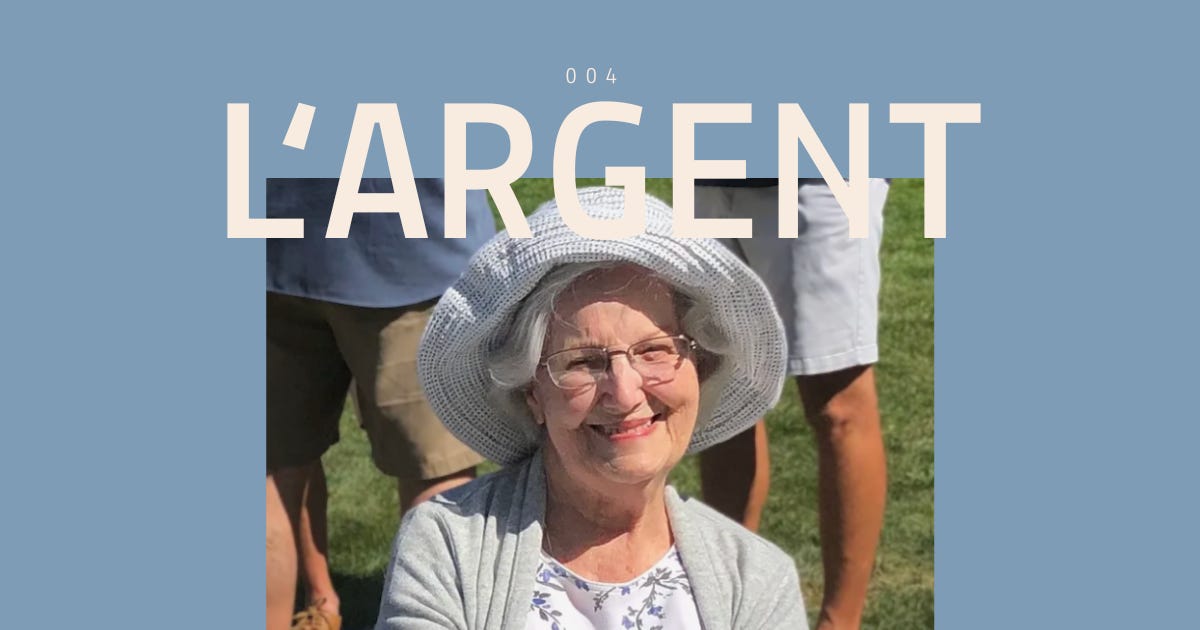
Behind the haze of Alzheimer’s and hearing decline, my Grandmother sat in her blue corduroy recliner, faded but familiar.
“Karen,” she exclaimed when I centered myself within her gaze. Relieved that she recognized me, I decided that this would be a good day to “interview” her. I’ve wanted to record the snippets of life that flit in and out of her memory, and there was no better time than three days before her 104th birthday.
“Gram, I want to ask you a few questions if that’s ok?”
She nodded and smiled, pointing at my steno notebook. “I’ll do my best. That’s all you can really do.”
And with that nugget of wisdom, the interview began.
Her exact words were, “Holy Moses! 104 — I don’t like the sound of that. Do you know anyone we can talk to?”
“There’s no need to hurry.”
Gram’s perspective on aging is one of resilience. She believes in doing what you can with what you have. Although the time lapse between today and her as a young woman has shrunk in her mind, her comments defy age. Unaware of the internet, social media, or the news, her wisdom transcended the closed-in space of her 12x20 room.
“We are a dead group, but at one point, we were more alive than we knew.”
“Now, the days are long. I like naps.”
“There’s no need to hurry.”
When I was a teenager, Gram’s makeup advice was to “run around the house a few times to get a natural flush.” She was not into beauty regimens, but as I sat across from her bare-skinned face, I wondered if I had more wrinkles than her.
“When you compare yourselves to others, that’s one thing, but think of all who compare themselves to you.”
“Don’t go out in the sun.”
“When one girl wore lipstick, we all wore lipstick. But if someone had a face-lift, it was frowned upon. Don’t mess with what you have.”
“When you compare yourselves to others, that’s one thing, but think of all those who compare themselves to you.”
In one sentence, she extolled the futility of comparison and the importance of appreciating one’s unique journey and experiences. Scattered throughout our conversation, these comments had me scribbling furiously.
“Is this an interview?”
“Yes,” I replied.
She sat up a tad straighter and leaned in. “I don’t think I’ll be much help, but what else?”
I asked about how to stay young in appearance, and the look of confusion that spread across her face wasn’t from dementia; it was a clear misunderstanding of why I would want to do such a thing.
“Don’t expect too much,” she said. “If your hair goes grey, you can always color it, but I suggest you let it go. Eventually, we all get them.”
Our regular 15-20-minute visit stretched beyond an hour, and she often circled back to the topic of friends. Although I tried to ask questions, those were never directly answered, but her comments in the in-between moments were brilliant.
“Look at each other and ask, ‘Are you doing ok?’
Check in on each other.”
“Look at each other and ask, ‘Are you doing ok?’ Check in on each other. If you don’t see them for a while, find out why.”
“I had fun with my girlfriends. When we were younger, we would be active, always playing, always going. We would find where the boys were and go there.”
“Older, we still got together, went to church, and had coffee.”
“We ran in a crowd. The group was the neighborhood. We stuck together.”
Minutes passed. I allowed the reminiscing of being young again to settle in her mind and heart. Her face changed when she talked of the “good old days.” I could almost see the time turning back in her eyes as if the cataracts were removed and the hippocampus pushed sepia memories into a technicolor movie in her mind.
The refracted vision of who I was in relation to others intermingled in our conversation. “Kids” carried the meaning of my children, her children, and generalized parenthood.
“We were strict. We didn’t cater to them.”
“You want them good, but not too good.”
“Everyone graduates, everyone grows.”
And then, she said something that goes against my nature.
“But there’s a limit.”
Had I been wrong all these years? Will my belief in the unlimited self be squashed in seconds? I prodded her on, but it was too late. The theme had elapsed, and she was moving toward something new.
“What are the kids up to?”
I regaled her with recent photos and updates and gave her prefrontal cortex a break. She looked down at my steno notebook.
“Is this an interview?”
“Yes,” I replied.
She sat up a tad straighter and leaned in. “I don’t think I’ll be much help, but what else?”
I held her hand and led her back to self-limits and life.
“You can do anything,” she went on to say. “No one can stop you but you.”
“There’s a place for everyone.”
“There’s a place for everyone. Find what you’re good at and use what you’ve got. But,” she paused, “Take the time to enjoy the little things.”
“You’re lucky. Just think of the people who don’t have what you have.”
“Don’t concern yourself with other people.”
“Always keep moving. There’s always something to be done.”
“Put away what you can. Save. You don’t need that much now, but you might need it someday.”
“Be natural,” she said. “Like you, be yourself. Your friends will like that best.”
Before I left, I leaned in and kissed her cheek, which is 50 years older than mine.
“Thank you, Gram, this was perfect. You’ve lived a lot of life in 104 years.”
“We did our best, Karen. That’s all we could do.”
“No regrets,” I said.
“Oh, no. Don’t have regrets.” She shook her head. “If you do one thing to please yourself every day, that’s good. Don’t go overboard. And,” she paused, “be nice. If you’re nice to people, they’ll be nice to you.”
“Come back and interview me again soon.” She blew me another kiss.
“Remember,” she said, letting go of my hand, “the less you do, the less you want to do. But, always do your best.”
Aging, honestly.
Thank you, Karen and Gram xx
No posts
Comments
Nothing yet. Say the first thing.
Sign in to join the conversation.