
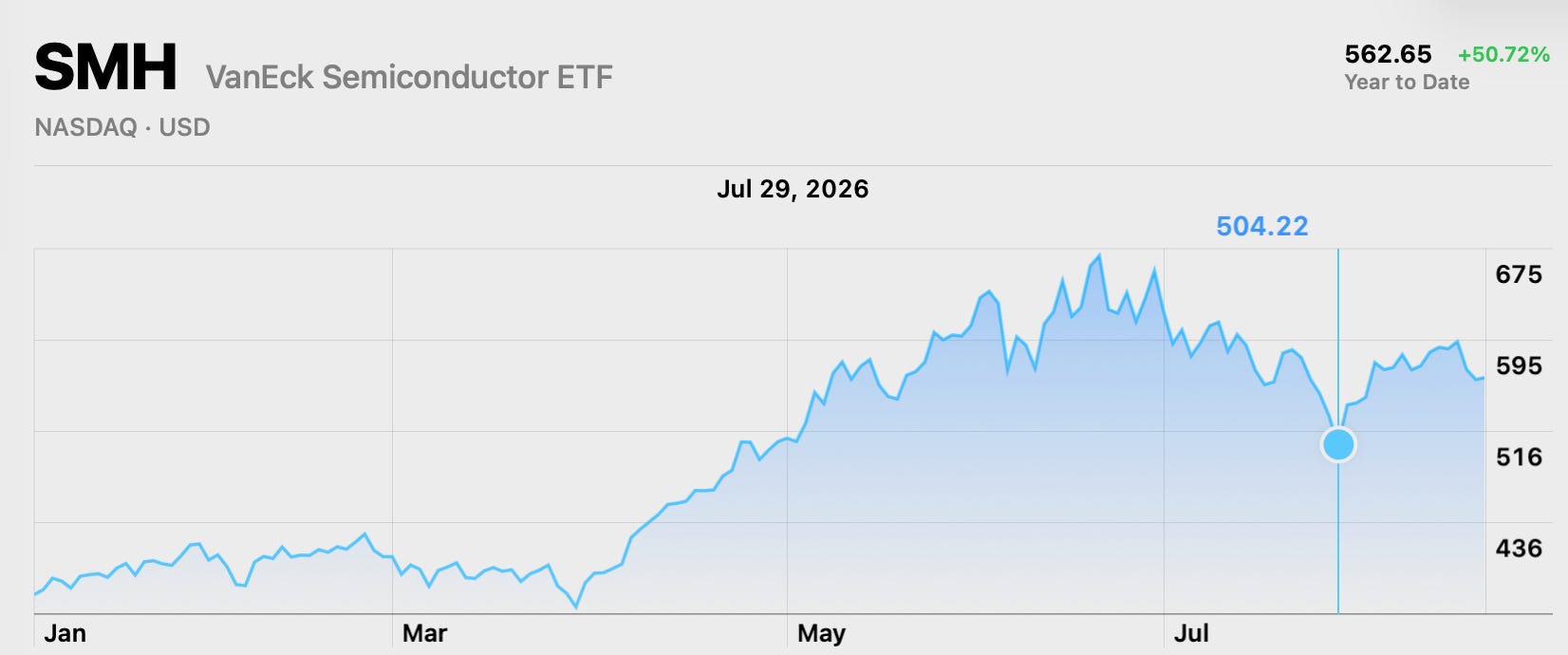
AI-related stocks staged a nice recovery from the late-July lows, when the Situational Awareness hedge fund dislocation triggered a wave of selling.
This week, though, brought another wave of choppy volatility amid renewed uncertainty over the Iran War and Scott Bessent’s Treasury Twist intervention, rising long-term bond yields, higher oil prices, and some disappointment over Anthropic’s latest numbers.
Famed investor Peter Lynch once said that if you spend 13 minutes a year on macroeconomics, you have wasted 10 minutes. Investors’ time, he argued, is far better spent studying the fundamentals of individual companies, since the economy and interest rates are too difficult to forecast consistently.
Geopolitics are similar. Timing President Trump’s moves is nearly impossible. He could decide to end the war, declare victory, and leave tomorrow, next week, or next month but eventually it will happen (I hope sooner than later). My base case is still that the Iran war ends at some point driving oil prices and inflation lower, which should take pressure off high bond yields.
Following Lynch’s advice, let’s set macro and geopolitics aside and focus on the fundamentals. Nearly all the recent data points on the AI theme remain strong, if not improving, in aggregate.
The one fly in the ointment was Anthropic’s latest ARR. Late Monday, Bloomberg reported that Anthropic’s revenue run rate had surpassed $65 billion. The number disappointed investors who wanted more and the report likely sparked the selloff in AI stocks the following day.
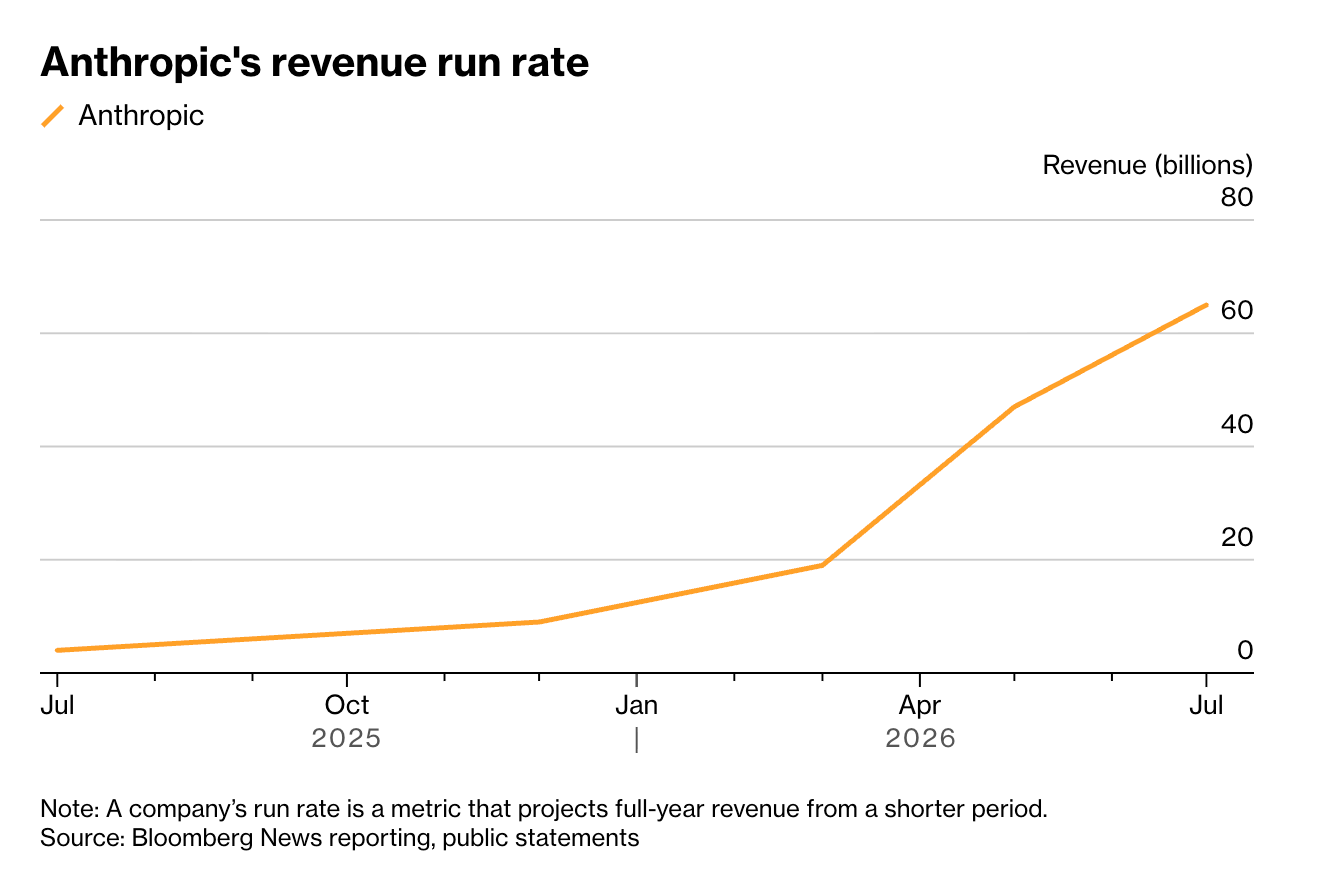
If you squint, you can see the growth rate line decelerate slightly from May through July. The market needs to calm down and keep its expectations within the realm of reality. You can’t extrapolate month-over-month growth acceleration to infinity. At that rate, Anthropic would end up consuming the entire world’s revenue. $65 billion is still a INSANE level of growth and should not be seen as disappointing by anyone.
Though, there may be another reason for the TINY downtick in Anthropic’s exponential growth rate in recent months: surging competition from OpenAI.
If you follow the top developers on X, there has been a huge positive sentiment shift toward OpenAI’s latest coding agent models. I would say slightly more of the top bleeding-edge developers now prefer OpenAI over Anthropic. If this continues, it should percolate through the rest of the mainstream corporate market over time.
It’s now showing up in the revenue numbers. On Wednesday, CNBC reported: “During the all-hands meeting on Wednesday, [OpenAI CFO] Friar showed employees a series of slides that said OpenAI’s revenue run rate is up 35% quarter to date, its enterprise revenue run rate is up 50% quarter to date and its AI coding and work product has hit 20 million weekly active users.”
I can confirm CNBC’s reporting that OpenAI’s total ARR is up 35% quarter to date. I can also report that the slide showed B2B ARR up MORE than 50% QTD, agentic weekly active users up more than 3.5x QTD, and API tokens per minute up 2x QTD. All four lines go exponentially higher following the July 9 launch of OpenAI’s GPT-5.6 Sol family of models.
Unlike Anthropic’s, OpenAI’s ARR growth line accelerates and goes VERTICAL through the back half of July and then into August rather than decelerating, showing much faster growth than in Q1 or Q2.
Users and developers clearly LOVE GPT-5.6. It seems likely in recent weeks OpenAI is taking share from Anthropic now.
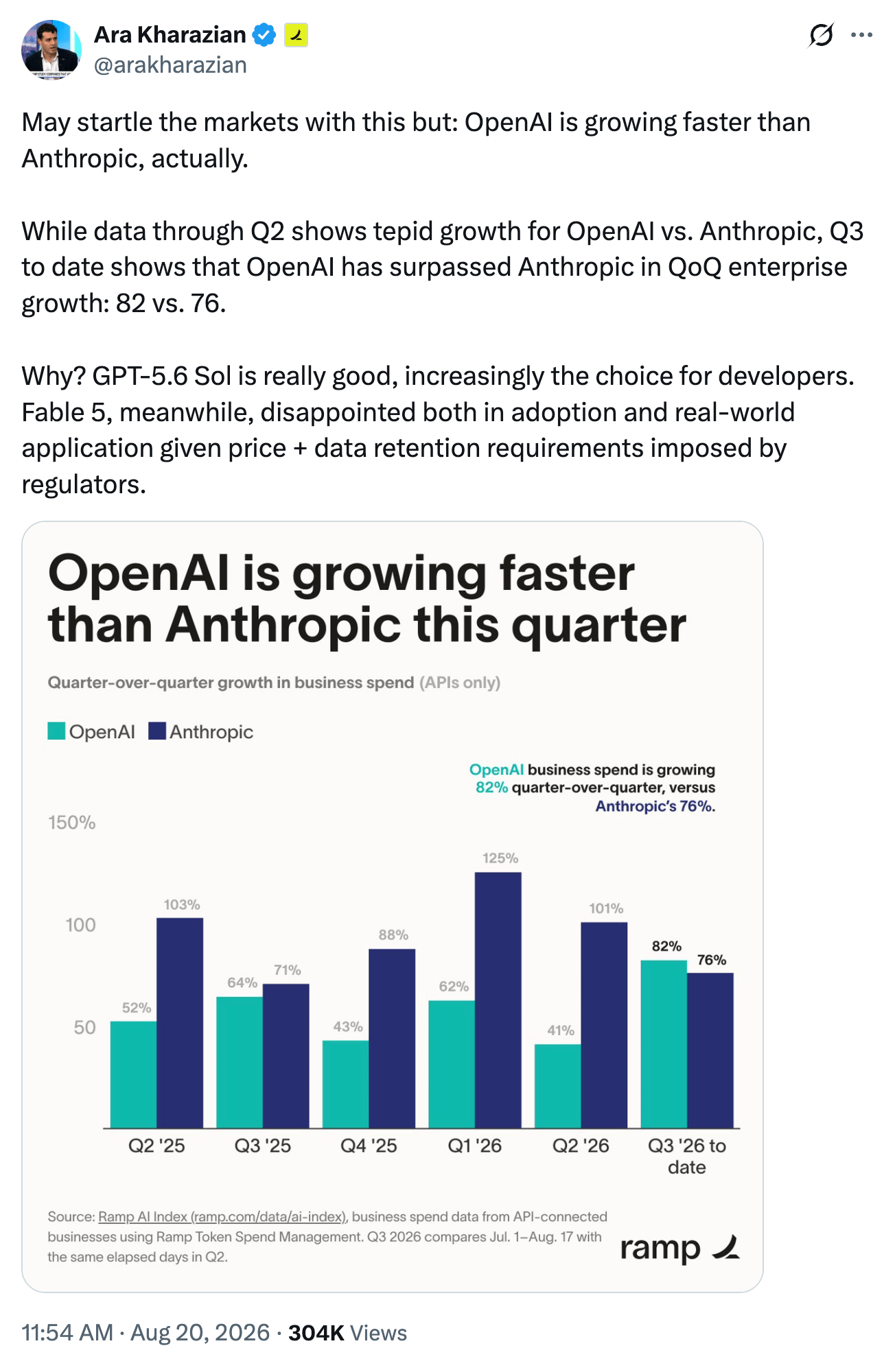
Ramp data shows this to be the case too. On Thursday, the lead economist at Ramp Economics Lab agreed that GPT-5.6 Sol is gaining traction. According to their data, which tracks corporate card transactions across more than 70,000 American businesses, OpenAI is growing FASTER than Anthropic this current quarter.
OpenAI is just getting started. In recent weeks, Sam Altman told staff internally “we are very close to meaningful RSI now” and that the company is a few “pretrains away from models capable of doing serious AI research.” He also said OpenAI will have a “very strong set of releases” over the next few months. I’m sure Anthropic has its own strong models ready to release in the coming months as well, around its IPO.
The race between to two frontier model leaders is going to be fun to watch. AI model capabilities are about to soar again. You know what that’s bullish for, right? Chip stocks.
Some other noteworthy positive AI data points:
1. In Stripe’s letter to investors about the OpenRouter acquisition this week, it was revealed that AI “token consumption [is] compounding at 9% per week YTD.”
2. Neocloud Nebius Q2 earnings:
“Q2 group revenue of $582.3 million, was up 454% year-over-year.”
“New pricing initiatives in early Q3 — such as our first-ever auction and short-term capacity deals — are showing promise. We see a price opportunity in the $40-50 million per MW range and we signed our first one this week.”
“expected payback period for the associated capex and related operating costs for Q2 deals is 1 year and 10 months, down from our two-to-three year payback period previously.”
“We could sell our entire 2027 capacity on these terms today. We are deliberately not doing so because we see higher value in retaining some capacity for immediate customer needs”
3. Applied Materials fiscal Q3 earnings:
“Everybody can see that there’s a gap between supply and demand DRAM especially, with AI as we’re expanding from training to inference to physical AI. Memory demand continues to go higher. And I’d say especially DRAM, this is going to be a very strong growth year for Applied .. And we continue to see strong growth in our DRAM business going into 27 .. we’re in all of these conversations with customers, they’re talking about multiyear growth and significant demand that we’re increasing our capacity to meet.”
“In the past three months, we have again made upward revisions to our revenue growth forecast for the year, and we are confident we will grow faster than the overall market as AI computing drives unprecedented demand for semiconductors. There is a large gap between demand and supply for advanced chips. To ensure our supply chain and field teams can support their ramps our largest customers are giving us longer term commitments and rolling eight quarter forecasts. This increased demand visibility gives us high confidence that 2027 will be another strong growth year for Applied Materials.”
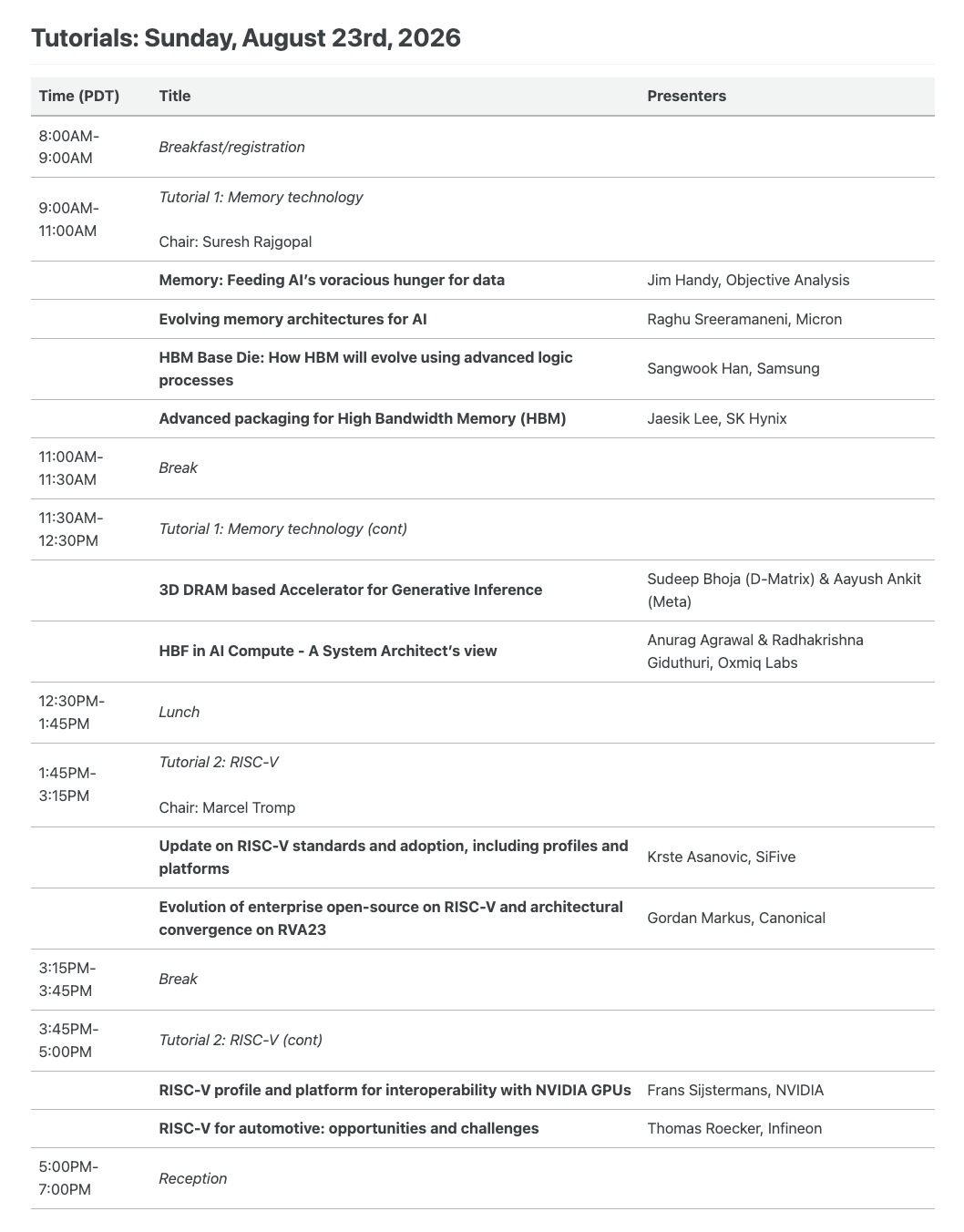
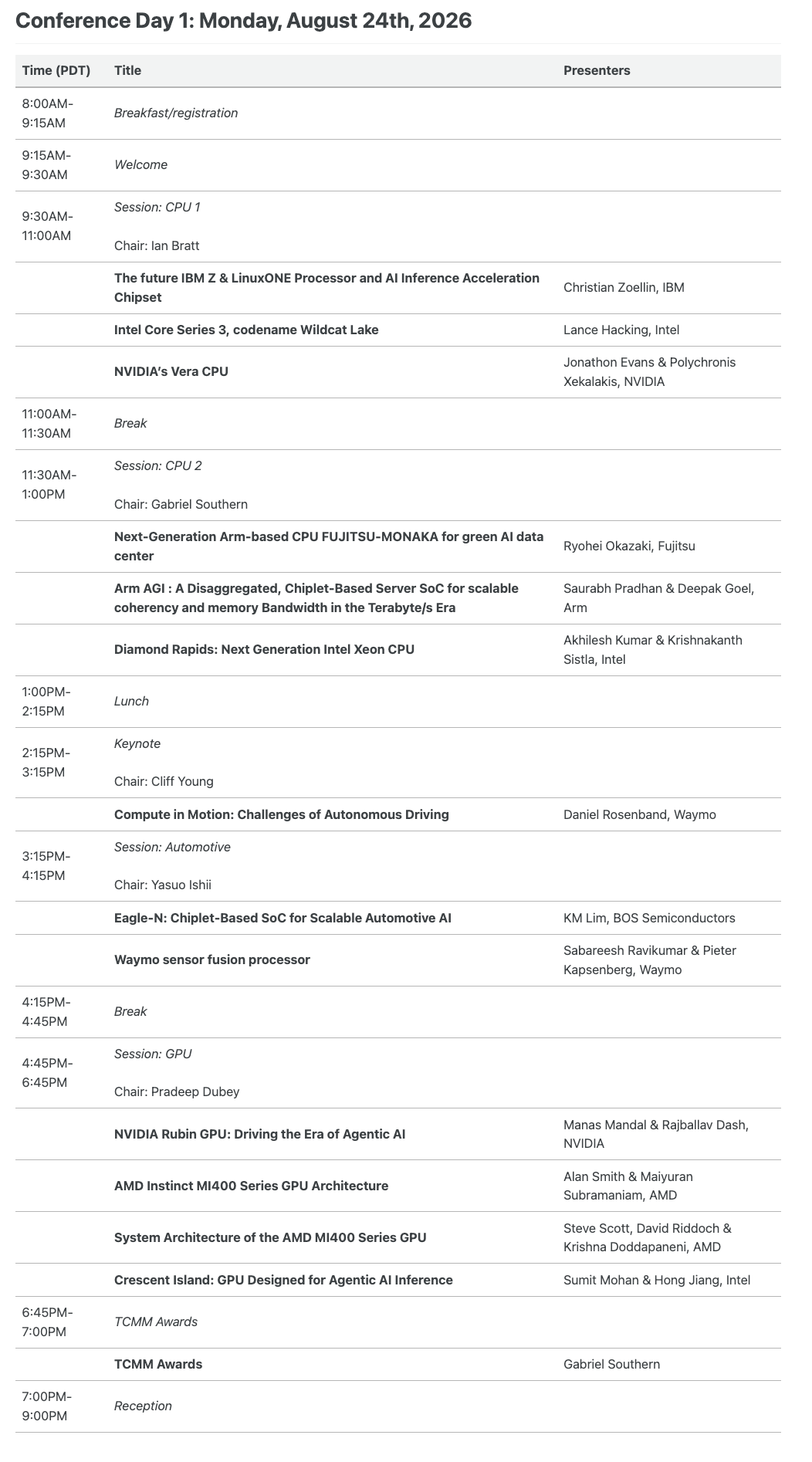
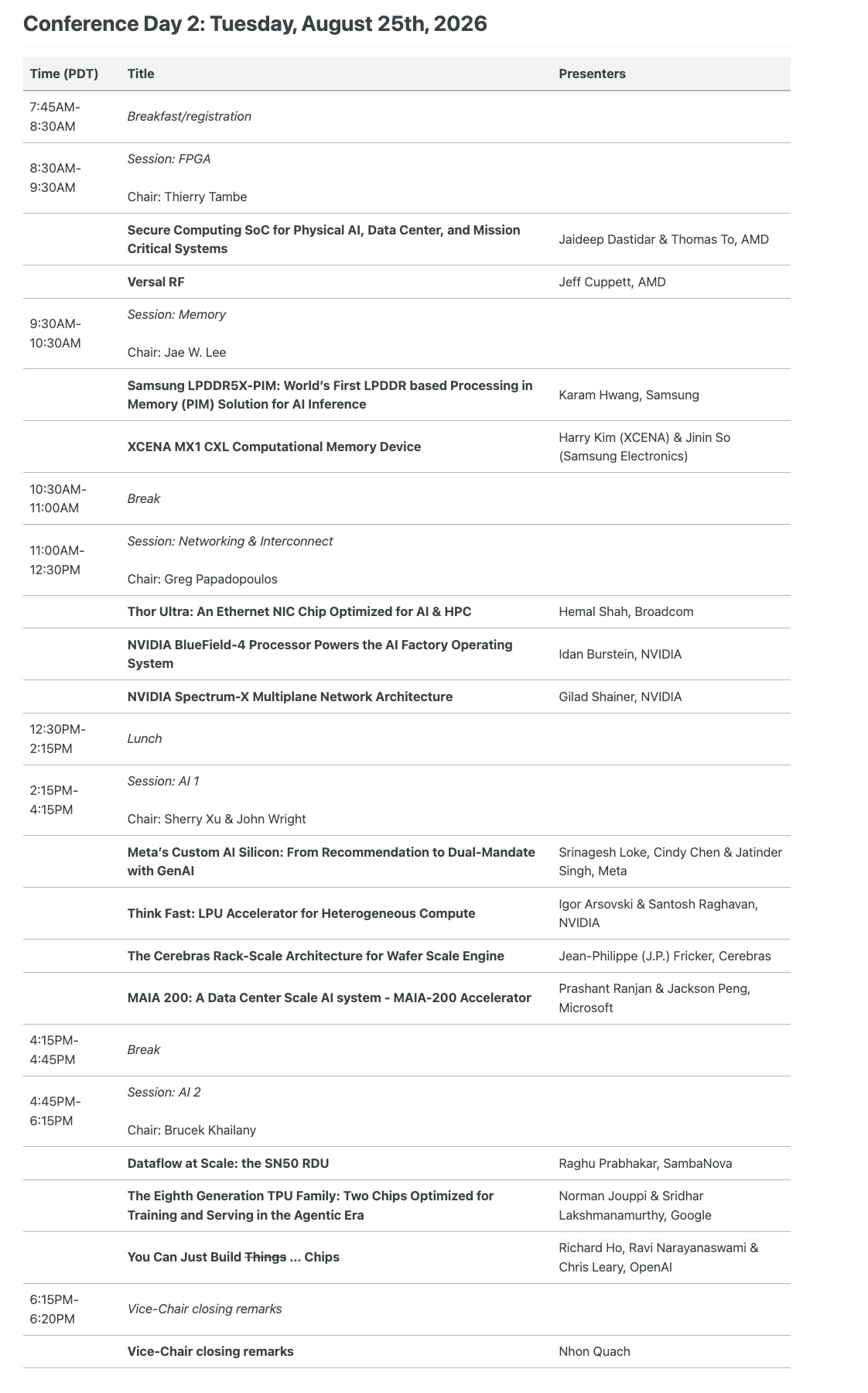
Note: I’ll be traveling to Silicon Valley next week to visit companies and attend the Hot Chips conference (which I hear is THE conference for learning about the latest semiconductor technologies and future chip trends — Nvidia, Intel, AMD, Samsung, and Google will all be there). If you’re going to Hot Chips, please do say hello. Check out the conference agenda below. It’s incredible. I’m looking forward to sharing all the important technical details and insights with you.
My schedule is packed and I’ll be prioritizing learning, meetings, and networking in the evenings, so I likely won’t formally cover next week’s Nvidia second-quarter earnings. I expect another strong quarter and outlook, much like the past few quarterly reports, given Jensen’s bullish supply-demand commentary of late and the surging demand for AI compute. I do intend to share some thoughts on Nvidia’s earnings in our subscriber-only real-time chat community on Substack.
Comments
Nothing yet. Say the first thing.
Sign in to join the conversation.