
The Ebola Bundibugyo outbreak in the Democratic Republic of the Congo and Uganda has entered a more dangerous phase — and it is doing so against a backdrop of geopolitical friction, funding disputes, and a global sporting event that is bringing millions of international travelers to North America beginning this week.
The risk to the American public, to travelers outside the outbreak region, and to ordinary airline passengers still remains low. Ebola does not spread like COVID, influenza, or measles. It is not efficiently airborne, and people are not considered contagious before symptoms begin. But low risk is not the same as no risk, and it is certainly not the same as a situation under control.
A critical four-week detection gap between the onset of symptoms of the presumed index case on April 25, 2026, and laboratory confirmation on May 14 allowed the virus to spread silently before any response could begin. On May 17, 2026, WHO declared the outbreak a Public Health Emergency of International Concern. The virus is now moving through a corridor of mining camps, crowded communities, strained hospitals, cross-border trade networks, armed conflict, burial resistance, and a contact tracing system that is reaching less than half the people it needs to reach. That is exactly the environment where Ebola becomes dangerous — not because it suddenly behaves like a respiratory virus, but because it exploits delayed detection, unsafe care, unsafe burial, and public health infrastructure that cannot keep pace.
The politics surrounding the response have become as complicated as the outbreak itself. Secretary of State Marco Rubio stated that WHO was “a little late” in identifying the outbreak, drawing a pointed rebuttal from WHO Director-General Tedros the following day. Critics have argued the characterization is difficult to square with the fact that the Trump administration withdrew funding from WHO, dissolved USAID, made cutbacks at the CDC, and is in the process of reducing the total health aid it provides to DRC and Uganda — the precise systems designed to catch outbreaks early. Rubio has strongly rejected those claims, noting that the U.S. has contributed more than $200 million through UN partners to the Ebola response. Some public health funding has been transferred to the State Department under a new “America First” agreement with DRC pledging $900 million over five years, though the changing program structures have added confusion to response efforts on the ground, according to people working in the region.
The timing could not be more acute. The 2026 FIFA World Cup is being held across the United States, Canada, and Mexico, with matches in 16 cities across North America. The tournament begins this week and is expected to draw millions of international visitors from regions with varying levels of Ebola screening. Secretary Rubio spoke directly with European Commission President Ursula von der Leyen, pressing the EU to do more to prevent Ebola spread ahead of the tournament. A State Department official said other countries “must do their part” and that “action is required now.” The United States, Mexico, and Canada issued a joint statement announcing aligned public health travel measures for individuals coming from African regions at greatest risk, stating the coordinated approach is designed to protect citizens and the millions of visitors, fans, athletes, and tourists expected during the World Cup while maintaining travel and commerce across their borders.
Public health experts, however, have warned that the U.S. has no unified public health coordination framework for the World Cup, that $625 million in federal funding is allocated for security with nothing earmarked specifically for public health or biosecurity, and that local health departments in host cities report receiving no additional federal resources. The CDC has not conducted a national risk assessment specific to the event.
The outbreak is still controllable. The response is still funded. The screening systems are still functioning. But the window is narrowing, the case count is accelerating, and the infrastructure gaps — both on the ground in eastern DRC and in the policy frameworks surrounding the world’s largest sporting event — are real. What follows is T.A.C.T.’s full assessment of where things stand and what the next thirty days will determine.
Before we go any further, if you haven’t yet joined as a paid subscriber, consider doing so now by entering your email and hitting subscribe. This is how we grow. And if you’re already a T.A.C.T. paid Substack subscriber, thank you for supporting independent media. We’re making this update free for everyone to read.
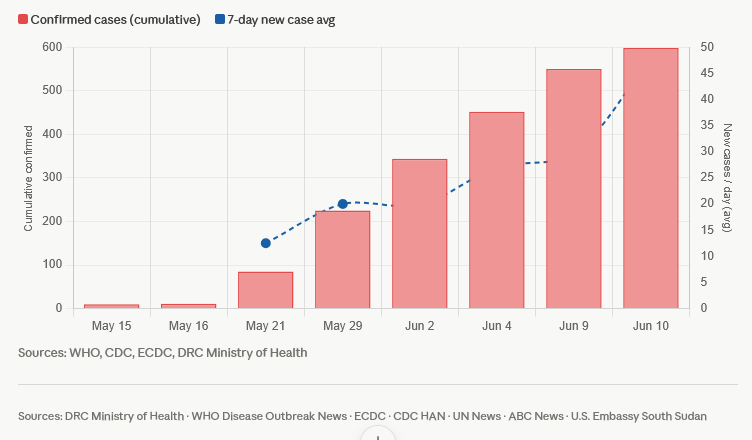
The official figures in the DRC, updated June 4th, report 452 confirmed cases and 82 confirmed deaths. As of June 9th, that increased to 550 confirmed cases, 101 deaths, and 94 suspected cases. On June 10th these numbers jumped even higher, with 598 confirmed cases, 115 deaths, and nearly 300 isolated. As we can see below, if we assume no changes to the rate of growth and no interventions to slow it down, in 30 days this could blow up to over 30,000 cases.
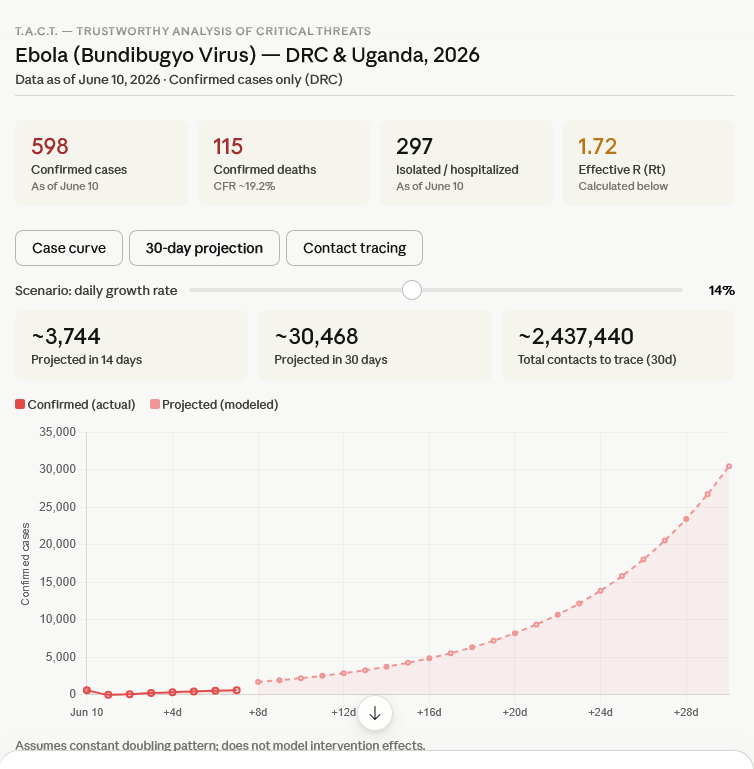
Transmission rate (Rt). Based on the confirmed case data — roughly 10 confirmed cases on May 15, growing to 598 by June 10 over 26 days — the implied average daily growth rate is approximately 14%, giving a doubling time of roughly 5 days. This corresponds to an effective reproduction number (Rt) of approximately 1.72, meaning each case is generating nearly two secondary infections on average. For context, an uncontrolled Ebola outbreak typically has an R0 between 1.5 and 2.5; the current trajectory is firmly in that range and accelerating.
30-day projection. If the current trajectory holds without meaningful intervention, the model projects roughly 3,200 confirmed cases by July 10. At 80 contacts per case, that translates to a contact database of approximately 256,000 individuals — a logistical undertaking that would strain even the most well-resourced public health systems on earth.
The range of outcomes, however, depends almost entirely on how quickly contact tracing improves.
In the best-case scenario — where containment efforts gain traction and daily growth slows to 5% — the outbreak would reach approximately 1,184 cases within 14 days and around 2,585 within 30 days. That is still a significant burden, but it is a trajectory that a scaled-up response could realistically manage.
In the worst-case scenario — where the virus continues to outpace containment and daily growth climbs to 25% — the numbers become staggering: roughly 13,500 cases within 14 days and nearly 483,000 within 30 days. To be clear, that outcome is unlikely given current response efforts. But it is not a number that can be dismissed. It is a reminder of what is at stake if this window closes.
The difference between those two futures is, in large part, contact tracing.
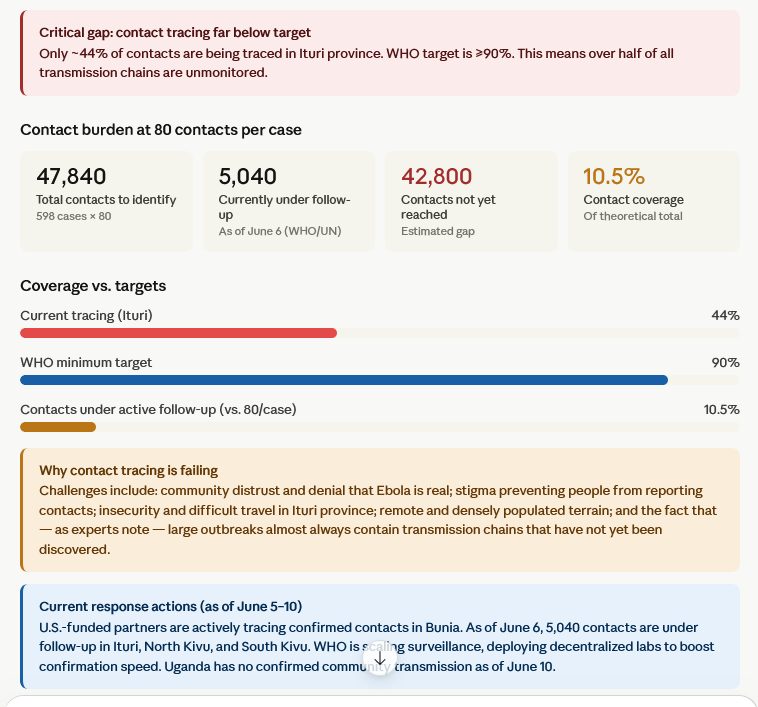
Contact tracing: the numbers. If we assume 80 contacts per infected person across 598 confirmed cases, that's a theoretical 47,840 contacts that need to be identified and monitored. As of June 6, only 5,040 contacts had been identified and were under follow-up across Ituri, North Kivu, and South Kivu provinces — roughly 10.5% of the theoretical total. The field-level picture is even starker: about 44% of contacts are being traced in Ituri, the main affected province, while WHO Director-General Tedros has said this figure needs to increase to about 90%.
Why tracing is falling short. Identifying every contact is difficult in an area where some people may not trust the authorities and others are in denial about Ebola being a real virus. It is also hard to travel between areas, especially in more remote or rural regions. There is also significant stigma around Ebola, causing people to be reluctant to report their contacts to health authorities. Experts also note that in large outbreaks, there are almost always transmission chains that haven't yet been discovered.
Uganda’s Ministry of Health dashboard says 14 imported cases, 5 local cases, 5 recoveries, 11 current admissions, 2 cumulative deaths, and 1 probable death as of June 9. No U.S. cases have been reported from this outbreak. CDC continues to assess the overall risk to the American public and travelers as low, but that low-risk assessment depends on containment continuing to function where the outbreak is actually spreading.
That is the central point: this is not a panic situation for the average person outside the affected region. But it is a serious global containment test. If aggressive case isolation, contact tracing, safe burial, healthcare-worker protection, and community trust fail, the outbreak can grow large enough that international exportation becomes more likely. Not because the virus has changed into an airborne threat, but because a larger outbreak creates more infected travelers, more exposed responders, more overwhelmed clinics, more missed contacts, and more opportunities for a symptomatic person to enter a travel network.
This outbreak is caused by Bundibugyo virus, one of the orthoebolaviruses that can cause Ebola disease in humans. It is not Ebola Zaire, the species behind the 2014–2016 West Africa catastrophe and the species targeted by licensed Zaire-specific vaccines and antibody treatments. That distinction is not academic. There is currently no approved vaccine for Bundibugyo virus disease and no approved Bundibugyo-specific antiviral or antibody treatment.
That means containment depends heavily on old-school Ebola control: identifying cases, isolating symptomatic patients, tracing contacts for 21 days, safely transporting suspected patients, protecting healthcare workers, conducting safe and dignified burials, decentralizing laboratory testing, and persuading communities to cooperate before fear and mistrust drive the outbreak underground.
WHO has called this outbreak a Public Health Emergency of International Concern. WHO has also assessed the risk as very high nationally, high regionally, and low globally. That combination is the honest framing. The global risk is still low, but the regional fire is serious and growing.

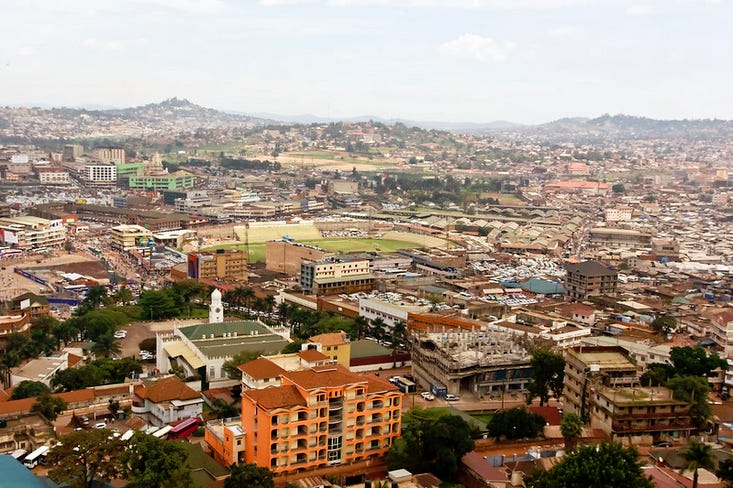
The outbreak is anchored in eastern DRC — specifically Ituri, North Kivu, and South Kivu provinces — but it has already breached international borders. Ituri remains the most affected province, accounting for 563 of the confirmed cases across 17 health zones, with North Kivu contributing 32 cases from seven health zones and South Kivu three cases. The virus has now reached Kampala, Uganda, a metropolitan center of over 4.4 million people — roughly 400 kilometers from the DRC border. European Centre for Disease Prevention and Control
That geographic leap is not an anomaly. It is a demonstration of exactly how this virus moves. The presumed pathway followed major public transit corridors — buses and shared taxis crossing informal border posts and traversing Uganda’s highway network directly into the capital. A virus does not teleport. It travels with people. Which means every bus terminal, roadside market, rest stop, and informal clinic along those 400 kilometers must be treated as a potential site of undetected transmission. WHO has confirmed there is no evidence of community transmission in Uganda so far, but the transit corridor between the DRC epicenter and Kampala represents a significant surveillance blind spot — one that official case maps do not capture. UN News
Standard maps only plot confirmed, lagging case locations. They do not show where an incubating person was three days ago, or where they are traveling now.
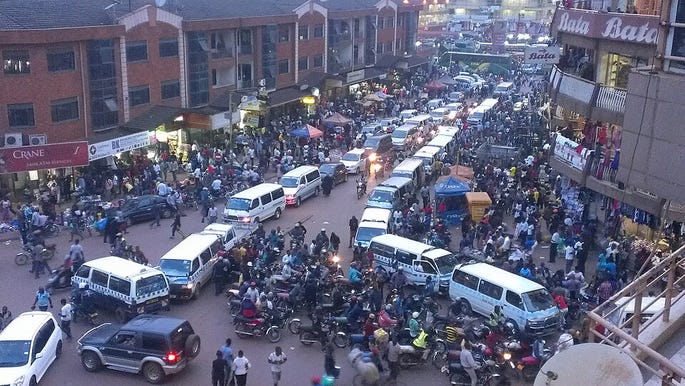
Even setting aside the transit corridor, Kampala itself presents a volatile environment for outbreak containment. The city’s daily movement depends on matatus — shared minibuses — and boda-bodas, motorcycle taxis, where physical proximity is unavoidable and passengers are entirely anonymous. Traditional contact tracing is nearly impossible in these environments.
The healthcare-seeking pathways compound the problem. In dense urban areas, a person with early Ebola symptoms — fever, fatigue, headache — will typically visit a local pharmacy, informal drug shop, or private community clinic long before reaching a designated isolation center. Each stop delays diagnosis while multiplying exposure to healthcare workers and other patients. By the time a cluster of cases is confirmed and isolated, the virus was already somewhere else one to two full incubation cycles ago.
Ebola is not airborne in the way that COVID, influenza, or measles are. Sitting near an asymptomatic traveler from an affected region is not a meaningful exposure. A person is not considered contagious before symptoms begin, and the primary transmission routes are direct contact with infectious body fluids — blood, vomit, diarrhea, and other wet secretions from a symptomatic or deceased patient. The highest-risk settings are household caregiving, healthcare without proper protective equipment, body-fluid cleanup, and unsafe burial practices.
Contaminated surfaces can matter, but context is critical. Studies have found Ebola virus can remain viable in drying blood for several days under controlled conditions, and on certain surfaces for longer. The practical rule for healthcare, transport, and household settings is simple: any surface contaminated by body fluids from a suspected Ebola patient should be treated as infectious until properly disinfected.
One point that deserves emphasis: the symptom most people associate with Ebola — dramatic hemorrhaging — is not the primary warning sign clinicians should watch for. In real outbreaks, the more actionable early signals are fever, profound weakness, vomiting, diarrhea, abdominal pain, and sudden decline. A patient does not need to be visibly bleeding to pose a serious transmission risk.
Dead bodies are one of the most dangerous and most underreported aspects of Ebola containment. Patients are often most infectious late in illness and immediately after death, when viral loads are high and body fluids are abundant. Traditional burial preparation — washing, dressing, touching, and transporting the body — can create direct, high-dose exposure to infectious material.
This is why attacks on burial teams are not just a security problem. They are an epidemiological event. When burial teams are driven out of a community, bodies may be handled by family members without protection, contacts scatter, and families begin concealing deaths. A single unsafe burial can seed a new chain of transmission that contact tracers may not find for weeks.
The outbreak is spreading through one of the hardest containment environments on earth. Eastern DRC is defined by active armed conflict, significant population displacement, informal cross-border trade, and gold-mining communities that draw mobile workers from wide geographic areas. A miner who becomes symptomatic in Mongbwalu may not go to an Ebola treatment center. He may stay in a camp, seek care from a local clinic, travel home, or be cared for by family. Each step opens new transmission pathways if symptoms have begun.
The outbreak is occurring in a context of humanitarian crisis, a remote and densely populated area, insecurity, and high population and trade movements. Field reporting indicates health workers in some epicenter areas have been operating with limited protective supplies, inadequate transport, and insufficient pay. CDC’s modeling suggests the outbreak likely began in mid-to-late February 2026 through an animal-to-human transmission event — meaning the virus had potentially been circulating for nearly three months before official confirmation on May 15. That four-week detection gap between the index case’s symptom onset and laboratory confirmation allowed the virus to establish deep roots before the response machinery could engage. WHOGood Morning America
CDC’s transmission model, published in the MMWR, found that with poor isolation levels of 20% and no other interventions, there is a 65% likelihood the outbreak exceeds 20,000 cases within three months. If 70% of patients entered isolation, only about one in twenty simulations projected an outbreak exceeding 10,000 cases within three months.
CDC’s incident manager Dr. Satish Pillai stated the actual isolation rate is unknown, but is considered to be on the lower end of the scenarios modeled. In plain terms: the response is currently operating in the danger zone of that projection. CDC warned that if large-scale and sustained public health interventions are not rapidly implemented, this outbreak could become as large as the 2014–2016 West Africa epidemic, which produced more than 28,000 cases and more than 11,000 deaths.
The model’s central message is not panic — it is math. Isolation percentage is destiny. The difference between a manageable outbreak and a historic one is largely determined by how quickly symptomatic people are found, isolated, and kept out of homes, mining camps, clinics, and transit networks.
Two separate risks must be kept distinct. The first — onboard transmission during flight — is low for an asymptomatic traveler. Ebola is not transmitted through the air, and a person is not contagious before symptoms appear. The second risk is the one that matters: the travel-network risk. Ebola’s incubation period ranges from 2 to 21 days, with an average of 8 to 10 days. An exposed person can feel well enough to board a domestic flight, cross a border, connect through a regional hub, and arrive in Europe, the Middle East, or elsewhere before symptoms develop. Once symptomatic in a new location, the response becomes a multi-country contact-tracing event.
Entebbe International Airport, 40 kilometers from Kampala, connects the transmission zone directly to the global aviation network. Nonstop routes reach Nairobi, Addis Ababa, Johannesburg, Cairo, Kigali, Doha, Dubai, Istanbul, Brussels, Amsterdam, London Gatwick, Mumbai, and others. There are no nonstop flights from Entebbe to the United States, but onward connections through European and Middle Eastern hubs are readily available.
The Air France diversion to Montreal illustrated the system’s vulnerabilities clearly. An Air France flight from Paris to Detroit was briefly diverted to Montreal because a Congolese passenger had boarded in error and was prohibited from landing in the US — CBP confirmed the passenger had boarded “in error.” That incident was not evidence of Ebola on a plane. It was evidence that boarding-gate enforcement can fail before any screening begins. CNN
On May 18, 2026, CDC issued an order suspending entry to the United States for foreign nationals who had been in the DRC, Uganda, or South Sudan within 21 days before arrival. U.S. citizens and lawful permanent residents who had been in these countries are permitted to enter but are rerouted for enhanced screening. Designated screening airports are Washington Dulles, Hartsfield-Jackson Atlanta, George Bush Intercontinental in Houston, and JFK in New York. Travelers without symptoms receive health monitoring instructions and have their contact information shared with state and local public health authorities for follow-up. Travelers presenting with fever or other symptoms are evaluated on-site by CDC public health officers.
WHO’s position on border measures carries an important caveat. Blanket travel restrictions can disrupt medical supply chains and push travelers toward unmonitored informal crossings — ultimately weakening containment at the source. The goal of layered screening is not to create a sealed perimeter, but to route travelers through monitored checkpoints, collect exposure histories, and ensure follow-up monitoring during the 21-day window.
Dr. Peter Stafford, a 39-year-old American surgeon working for a Christian missionary group at Nyankunde Hospital in eastern DRC, contracted the Bundibugyo virus while operating on a patient — believed to have been infected before the outbreak was officially declared. He was airlifted to Berlin’s Charité University Hospital, where he was admitted on May 20 after testing confirmed infection. His wife and four children, classified as high-risk contacts, were transported to Charité under the same strict protocols and quarantined in a separate section of the ward. Dr. Stafford and his family were discharged on June 7, with Charité calling his treatment a “significant therapeutic success.” Al Jazeera
His case warrants careful interpretation. It confirms that experimental antiviral therapy, combined with intensive supportive care in a high-resource isolation unit, can produce a positive outcome. It does not confirm that a broadly accessible treatment exists for Bundibugyo. A specialized isolation ward at one of Europe’s leading infectious disease hospitals is not equivalent to a strained treatment facility in Ituri Province, where patients often arrive late and resources are limited.
Several candidate therapies are under evaluation — including remdesivir, the antibody candidates MBP134 and maftivimab, and obeldesivir for post-exposure prevention — but none are approved specifically for Bundibugyo virus disease, and no approved vaccine currently exists for this strain.
Travelers should avoid nonessential travel to affected areas, particularly provinces in eastern DRC with confirmed cases. Anyone who must travel should avoid contact with sick individuals, body fluids, healthcare settings treating suspected cases, burial ceremonies involving physical contact with the deceased, traditional healers managing unexplained fevers, bushmeat, bats, primates, and environments with potential bat exposure such as caves and mines.
Anyone returning from affected areas should self-monitor for symptoms for 21 days. If fever, severe weakness, vomiting, diarrhea, abdominal pain, unexplained bleeding, or other concerning symptoms develop, the correct action is to isolate and contact public health authorities or a healthcare facility before arriving — not to walk unannounced into an emergency department. Advance notice gives facilities the time to prepare isolation protocols, routing, protective equipment, and testing procedures. For people with no travel to affected regions and no direct exposure to a sick or deceased Ebola patient, the risk remains very low.
The most important indicators going forward are not total case counts alone. T.A.C.T. is tracking whether contact tracing in DRC can rise from its current 44% toward the 90% WHO has identified as the minimum effective threshold; whether isolation of symptomatic patients approaches the levels CDC modeling identifies as the turning point; whether healthcare worker infection rates increase; whether community mistrust and burial team attacks continue; whether Uganda’s case profile shifts from imported to locally sustained; whether cases appear in major regional transit hubs; whether experimental therapies enter controlled field trials; and whether the response funding already committed — over $200 million from the U.S. alone — reaches the ground fast enough to matter.
The outbreak is still controllable. But as TACT’s model and the CDC’s slightly older model makes plain is that the trajectory right now points in the wrong direction. Control is a daily operational race between a mobile virus and an underfunded, overstretched response trying to track 100’s of transmission chains.
If you haven’t yet joined as a paid subscriber, consider doing so now by entering your email and hitting subscribe. This is how we grow. And if you’re already a T.A.C.T. paid Substack subscriber, thank you for supporting independent media. We’re making this update free for everyone to read.
Comments
Nothing yet. Say the first thing.
Sign in to join the conversation.