
Yesterday was a tough day for Semis and ASML in particular. The China DUV news really put a lot of pressure on prices. I believe the sell-off, based on this news is overblown. We are talking 5 machines in 2026 and 20 in 2027. And the machines China is building land at the bottom of a performance band Chinese fabs were already legally allowed to buy from ASML.
In this article I will explain what happened and what it does to earnings (including a worst-case model at the end)
First things first, what actually happened?
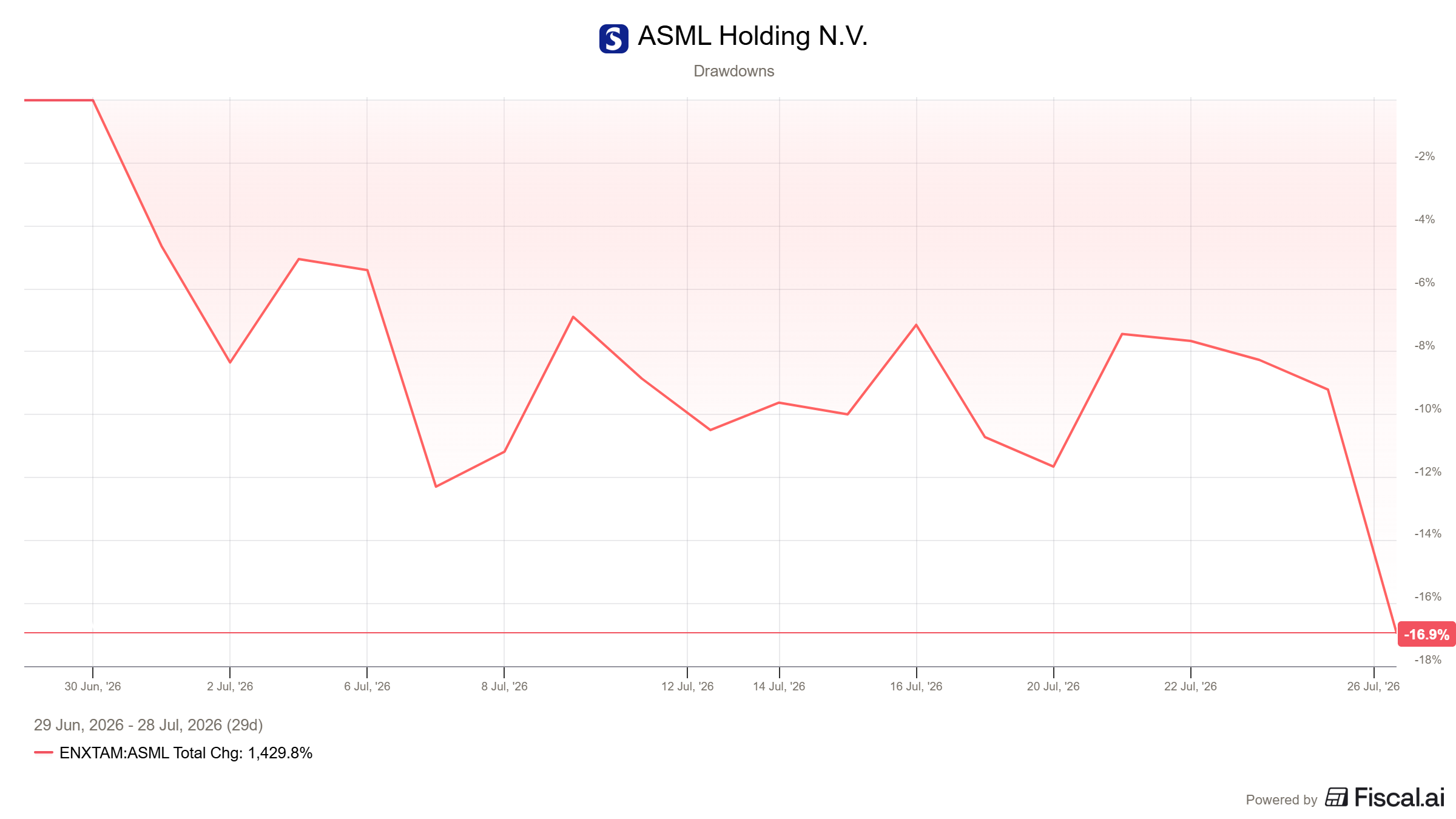
Yesterday ASML’s shares plummeted on the news that China is now ‘‘mass-producing’’ (notice the quotes) DUV machines. Shares fell from almost €1600 to now below €1400, so down close to 12% in just 2 days.
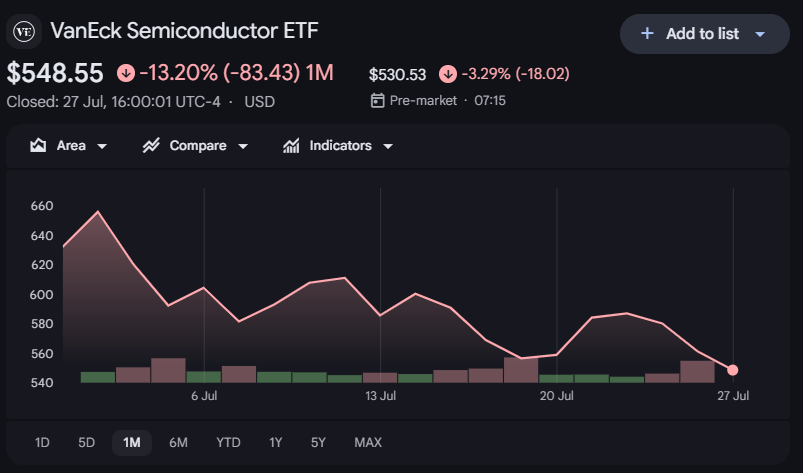
The overall semiconductor sector also showed a lot of weakness following the news and is down almost 20% in just the last month and 8% since yesterday.
Here are the key point of the actual report:
China has begun manufacturing domestically developed immersion deep ultraviolet lithography machines (DUV from now on).
Shanghai Aishengna Electronic Technology Group. A state-owned company that, per Reuters, absorbed teams from both Yuliangsheng and SMEE is the company responsible for the domestic DUV production
The system still lags on performance and reliability and needs further testing before mass production
Production will be limited initially, with about 5 DUV machines this year and roughly 20 in 2027
Immersion DUV machines, which print circuit patterns onto silicon wafers, are the most advanced lithography tools available to Chinese chipmakers after restrictions cut off access to extreme ultraviolet lithography (EUV) systems
I think the two main takeaways here are simple: the very limited amount of machines that are likely to be sold in 2026 and 2027 (not mass production) and the fact that they still are behind on performance compared to ASML.
It is totally unclear if the Chinese DUV machine will deliver a chip yield that comes even close to, let alone above the machines from ASML. If the yield is not on par, the speed of adoption would be very capped in my opinion.
The threat is real though, China advancing to actual production should not be underestimated. But that does not mean the impact on ASML is huge per se. We should also not forget that ASML is already restricted from selling most of their DUV immersion machines to China.
As Dylan Patel quoted and i wholeheartedly agree with Semianalysis here:
Therefore, the DUV tools that China is producing displace revenue ASML already lost to export controls. A tool ASML cannot legally or physically supply being built locally does not subtract from a sold-out order book
The important distinction to make here is that no all DUV machines are alike.
With lithography there are two things that matter the most:
There is no workaround for lithography in chip manufacturing
Shorter wavelengths print finer lines
DUV is roughly 28nm-class where EUV does 7nm and below. That does not mean that you can’t still make 7nm chips with DUV. You do it with multi-patterning: split a dense pattern across two or four exposures and then stitch them together. Sounds good and all, but it means more masks, more process steps and longer processing time which simply leads to less capacity out of the same fab. And alignment error accumulates with every extra exposure.
A fab does not run one scanner, it runs a whole fleet and a single chip layer stack gets printed across multiple of them. The tool alignment is incredibly precise and comes down to just a few nanometers. And if the scanner does not match the required fleet performance, there is no place for it, regardless of the price or discount you get.
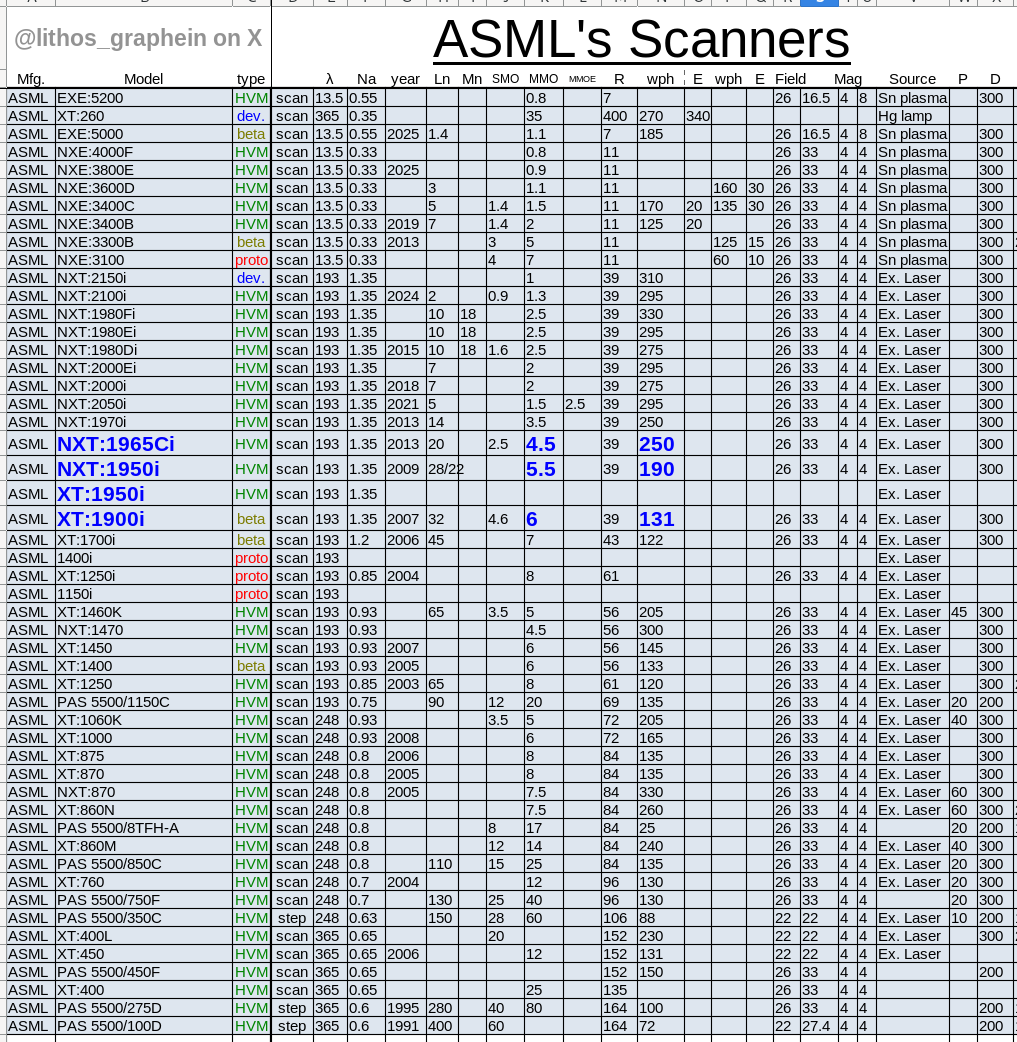
Now let’s do some comparisons, and I found just the right overview to do that with. Lithos Graphein posted this overview on X yesterday.
Now look at the entry point for anyone wanting to get in at 28nm….
The floor is the XT:1900i model and the NXT:1965Ci is the ceiling of what any Chinese fab can legally buy from ASML today.
The numbers are unclear but the best estimates put the Chinese machines closest to NXT:1950i-class performance at 5.5nm overlay at 190 wafers per hour. ASML started doing that in 2009, 17 years ago….
ASML’s current frontier immersion tool does 1.3nm overlay at 330 wafers per hour, with a 1.0nm machine in development. So the gap is roughly four times on overlay and nearly double on throughput.
In layman’s term this means that these ‘‘new groundbreaking mass-produced’’ Chinese tools land at the BOTTOM of a band China was already allowed to buy.
A lot of people commented that the moat ASML once had is now gone. I fully disagree with this (very unnuanced) take and the reasoning is actually quite simple.
If cheaper DUV tools would break ASML’s position, then why did Nikon and Canon not break the moat before? Nikon also builds ArF immersion scanners and Canon sells i-line and KrF tools.
Neither of them put a meaningful dent into ASML position in the last 15 years. And the reason why makes perfect sense. The customers in the market are fully aligned with ASML’s machines and have done everything need to run them and incorporate them in their own facilities. Breaking years of making their production process compatible, years of training employees and building processes and systems could be thrown out of the door if they were to integrate a slightly cheaper but totally different machine.
I really doubt 5 or even 20 machines from some reason are the reason the moat is now gone. The thing is, it was never about ‘‘nobody else can build a machine like ASML’’. Nikon and Canon already did it.
The real moat is that a lithography tool only has value if it meets a spec the entire installed fleet is already matched to. Overlay, throughput, defect rate, uptime. All of these conditions have to hold under real production conditions, for years, with a service organization behind it. China is still VERY far from reaching that point.
A quick note: this newsletter is completely reader-supported. If you’re getting value out of these posts, the best way to help me keep it going is to subscribe. Free subscriptions are always welcome and help the community grow. If you’re in a position to chip in for a paid tier, it directly funds the time that goes into this writing. Either way, thanks for being here.
Eventually the thing that matters the most, is how will this affect ASML’s share price in the long run. To find that out, we have to make some assumptions.
What we know:
5 machines in 2026
20 in 2027
What we do not know:
Will it replace ASML’s demand?
How many machines will they sell in 2028 and beyond
So let’s go for a bit of worst case scenario here with the following assumptions:
All these new Chinese models replace ASML’s machines, 1 for 1
Price of a DUV machine we will guestimate around €60M, which is close to ASML's actual average for advanced immersion tools, especially the lower end which these machines form China would target.
Chinese machines sold in 2028 (40), in 2029 (55) and in 2030 (70). This really is a worst-case scenario.
60% gross margins, 15% tax and 1% buybacks
EPS numbers are my own estimates
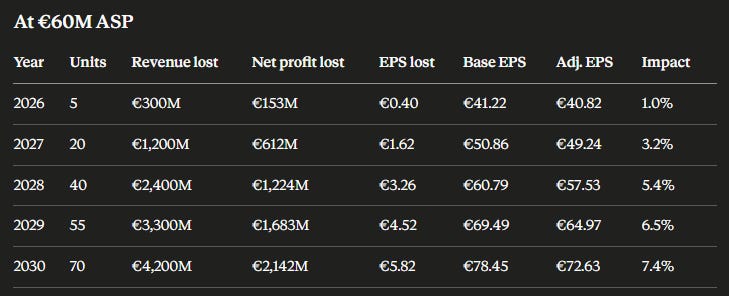
Cumulative that means 190 machines, leading to €11.40B revenue, €5.81B net profit and €15.61 EPS.
This is how that look in EPS impact towards 2030.
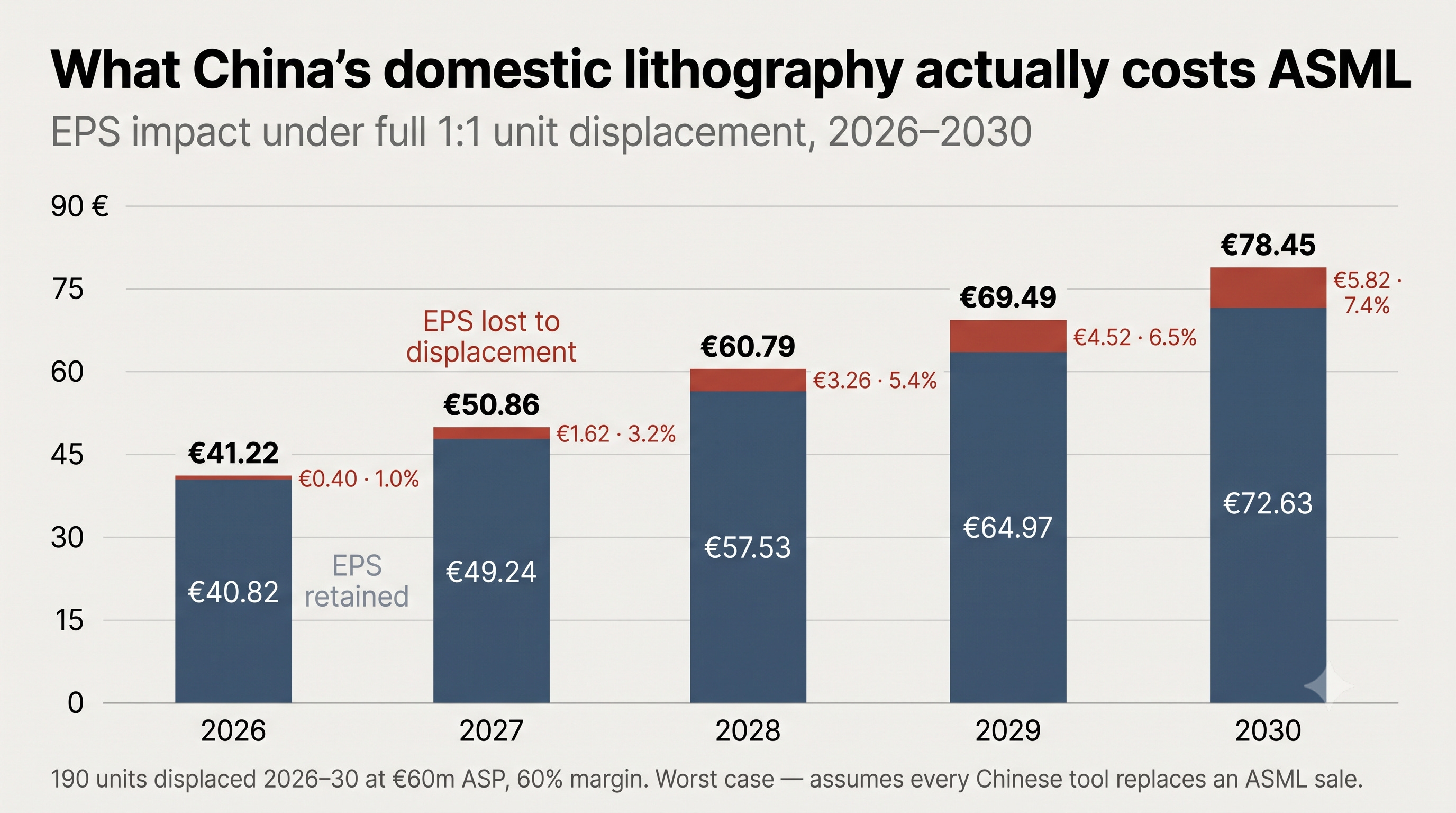
The most important thing to keep in mind here. This is really a WORST-CASE scenario. This math is only defensible if you accept the 1-1 displacement story, which I do not defend. This is merely an indication of what could happen if everything goes wrong.
In reality, ASML is sold out for 2026 and 2027 and the same will likely be the case for 2028. So near-term impact, and likely long-term impact should be a lot lower.
So the worst case scenario would justify a 7.4% decline, ASML is down 12% as we speak. The market is now pricing something close to full displacement off a report of five machines.
The thing that actually has me worried is the damn MATCH act. That would fully lock ASML out of China by law, not because of policy.
The MATCH act would do 3 things:
It would ban immersion DUV sales to anywhere in China, not just to specific companies
It also bans servicing and spare parts on machines ASML already sold there
Forces the Netherlands to match within 150 days, or the US applies the rules to ASML directly
China’s revenue is declining but still meaningful. China revenue fell from 19% in Q1 to 14% in Q2, but management still guides China to around 20% of total net sales for the year. A full ban would still hurt.
ASML still services hundreds of machines sitting in these Chinese fabs, and that service revenue is recurring, high-margin and fast-growing. The MATCH Act goes after that annuity.
This still hangs over the ASML thesis and that would actually hurt them. Unfortunately timing is very unclear here. No date on when US Congress wil vote on the bill.
Purely looking at the numbers the sell-off is overdone. But I think this sell-off is not based on the actually numbers. I think investors are now considering ASML’s moat to be under pressure and therefore a low multiple should be applied ( I disagree).
ASML was trading around a PE of 60, and a forward PE of 30. Nothing wrong with that, as those multiple are justified for a company growing as fast ASML does and the very strong market position they have. But with yesterday’s news, forward multiples just went down.
This feels more like a rerating based on sentiment and a (possibly) declining moat than it is on the actual impact on their financials.
For me, the numbers are what matters. And as long as I don’t see China actually mass-producing machines, on par with ASML’s machines, I am not worried.
Let’s keep watching that MATCH Act closely though.
That’s it for now.
I would love to hear your thoughts on this whole DUV debacle. What do you think? Overblown reaction or not?
Until the next one!
Cheers,
TacticzHazel
Disclaimer
The content I share is for educational and informational purposes only. It should not be considered financial, investment, or trading advice. All opinions expressed are personal views and are not guarantees of future performance. Investing involves risk, including the potential loss of capital, and past results do not indicate future returns.
Before making any investment decisions, you should conduct your own research or seek guidance from a licensed financial advisor. I am not responsible for any financial outcomes resulting from actions taken based on the information provided.
By engaging with this content, you acknowledge and agree that you are solely responsible for your own investment choices.
Comments
Nothing yet. Say the first thing.
Sign in to join the conversation.