
It was that time of the quarter again. The ‘‘Superinvestors’’ graced us with their 13F filings. I’m sure you’ve all seen the posts and videos already if these filings interest you, so I’m taking a different route.
First, I’ll give you a high-level summary of the major trends I saw in these filings, and then I’m gonna give you 7 examples of stocks that everyone seems to have scrolled passed in these filings.
Before we start, I want to reiterate that you should NEVER mindlessly follow the moves you see in these filings. I personally never copy them. I only use them for idea generation. And the reasoning for that is quite simple:
The superinvestors have a completely different goal than most retail investors. For them, it’s mostly about long-term wealth generation in a stable, relatively risk-averse way. They aren’t focused on maximizing profit alone, but also on limiting downside.
The second reason is most obvious: these 13F filings are at least 45 days old. The moves they made are outdated and may have been reversed today.
The trades shown in these filings are only their US holdings; some superinvestors have broader portfolios with assets around the world.
Because they manage such large sums of capital, many companies are out of limits for them. There isn’t enough liquidity.
Last but not least: it never shows WHY they made a move, and it also doesn’t show short positions. Did they rotate? Was it a paired trade? Finding out why they made certain moves is almost impossible, and therefore you should treat them as such.
The main website I use to track the 13F filings is Dataroma. Free to use.
Top buys this quarter still mostly include the mega-caps: Microsoft, Meta, Visa, Amazon and Alphabet. I don’t think there’s anything to be learned here, as these companies are also in the ‘‘most sold’’ list. This is basically trading activity in the large caps, and I see it each quarter. These are also the ‘‘top owned’’ stocks, so it makes sense they see the most activity.
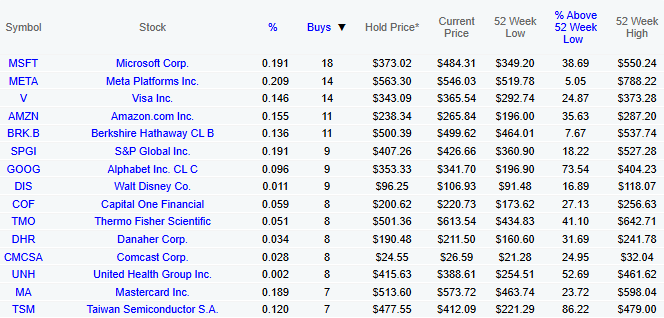
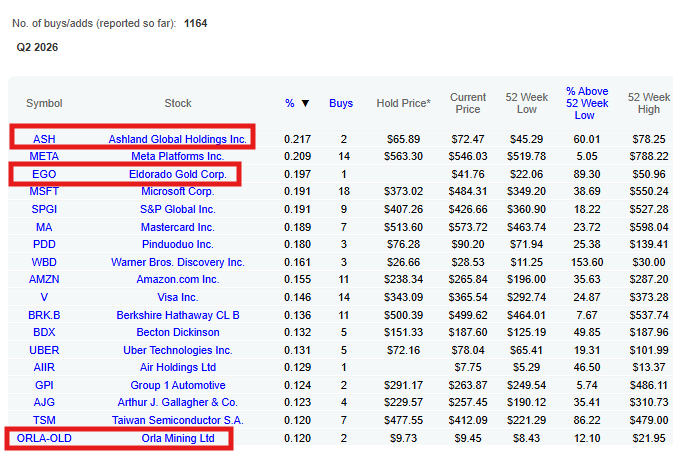
Looking at the top buys by % I noticed something else:
Ashland Global is a premier specialty materials company, and Eldorado Gold is a Canadian company that owns and operates gold mines in Turkey, Greece, and Canada. Also high on the list was Orla Mining, a major senior gold producer.
The Berkshire Hathaway filings showed one of the most aggressive quarters in years. Berkshire nearly tripled its stake in Alphabet, plus they added to Delta, Lennar, Macy’s, and NYT. I can’t say I’m the biggest fan of the last three, but I really like Alphabet.
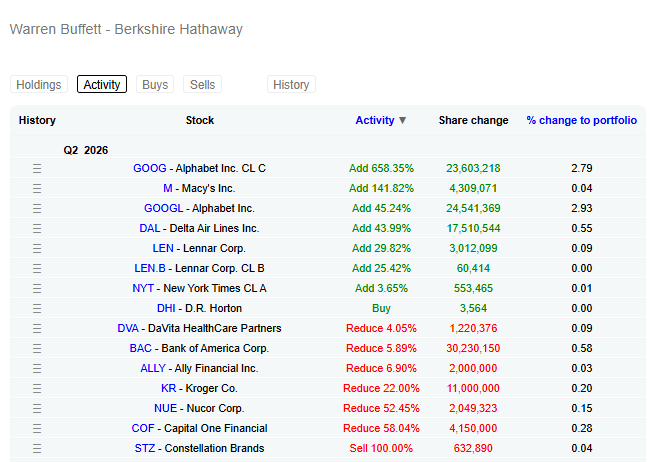
Interestingly, other big names like Pershing Square, Altimeter, and Druckenmiller’s Duquesne all sold out of their Alphabet positions.
In Q1, there was a noticeable trend: Nvidia, Altimeter, and Appaloosa all loaded up on names like CoreWeave, TSMC, and semis. In Q2, the reserve seemed to take place. (Tiger Global cut Nvidia, TSMC, Microsoft, and Meta all in the same quarter). And Nvidia barely made a move. So the enthusiasm for these names was less than in Q1.
The lack of enthusiasm seems to correlate with the love for “boring “ compounders. Berkshire bought Delta, Lennar, and Macy’s, all beaten-down names. Ackman added to names like Visa, Mastercard, and he’s back in Netflix. Tepper rotated out of Micron into industrials and consumer cyclicals
So this is a trend I see across the board: toll-booth names and strong cash-flow-generating companies are back in favor.
Not too much. Again, these filings are old. A lot has happened since: the war in Iran, the new Fed Chair, rising bond yields, and possible inflationary pressure.
It makes sense for the rotation into boring compounders to continue, but we will only know once the new filings are out.
Semis and memory have pulled back significantly, so maybe Superinvestors see a bit more value there, too.
I started by reviewing the filings of my favorite Superinvestors. Most of these funds have strategies that align with my own. They don’t hold a million different names and usually lean more toward buy-and-hold. Druckenmiller is the exception, as he is more theme-driven and rotates fairly quickly.
Here is my shortlist of funds I like to follow a bit more closely:
Dev Kantesaria - Valley Forge Capital Management
Chris Hohn - TCI Fund Management
Stanley Druckenmiller - Duquesne Family Office
Warren Buffett - Berkshire Hathaway
Pat Dorsey - Dorsey Asset Management
Christopher Bloomstran - Semper Augustus
Altacapital
AKO Capital
David Tepper- Appaloosa Management
A few things that stood out to me:
Alex Roepers added Ashland Global Holdings to his portfolio, making it a 17.5% Position.
David Tepper’s Appaloosa Management made a big bet on TSMC, adding 25% more even at these levels (which I think are actually quite attractive). Druckenmiller did the same, making TSMC his second largest position.
Lee Ainslie: Slightly reduced his Nvidia position, only to add 50% to his AMD holding.
Li Lu, who is seen as one of the better value investors, added to Pinduoduo. And let’s be honest, that’s not a stock that’s loved right now.
Pat Dorsey added to Booking Holdings, SPGI and Applovin. Value at a discount?
Terry Smith opened new positions in Uber and Mastercard ( both around 5% of portfolio)
Prem Watsa, who runs Fairfax Financial, made two big bets: Orla Mining (21.55% now) and Eldorado Gold Corp (new position at 16%)
Howard Marks: Added to Sea Limited, a company I own myself and really like here
All of the moves I highlighted deserve a bit more research, but that’s not for now. Because I also saw 7 funds making some very interesting bets in names that aren’t talked about that much right now.
First one is Christopher Bloomstran with his bet on Builders Firstsource ($BLDR)
Builders Firstsource is a company that’s been on my radar for a long time. I did a fairly extensive X thread on them last March, but they have been on my radar since 2021. I initially held a position, sold it, and ran it up over 100%, but I ended up selling in 2024.
Builders FirstSource is a large materials supplier for the construction industry, and it’s located in the US. Think of them like a hardware store or a specialized distributor, but with a big focus on large industrial clients.
After COVID, the stock went ballistic, going up almost 1700% in 4 years. Since then the stock has fallen close to 70% from the top. But underneath, this is still a very well-managed company.
BLDR is a classic “good business, bad cycle” setup. BLDR doesn’t do well during periods where housing demand is depressed, and that’s exactly what’s happening now. But if you have a long-term horizon, now might be a great time to follow Christopher Bloomstran and his bet on BLDR.
Housing demand moves in cycles, and usually it’s a good idea to buy companies like BLDR in downcycles. Keep in mind, however, that they missed Q2 earnings, cut 2026 guidance, and just took a wave of price-target cuts. So momentum is not working in your favor right now.
Bloomstran’s reported price is $70.65, which is around the price BLDR trades today.

Viking Global Investors bought the second names most investors missed, this is a bit more well-known, but definitely not popular right now.
Comments
Nothing yet. Say the first thing.
Sign in to join the conversation.