
This post continues a series of pieces that provide background to a group of decision-forcing cases that will, in the very near future, appear in the pages of The Tactical Notebook.
On 27 August 1916, the Kingdom of Romania entered, on the side of France, Russia, Serbia, and the British Empire, the First World War. In response to this surprise, the Central Powers cobbled together a pair of polyglot field forces that, within three weeks of the onset of the crisis, proved able to invade the homeland of their new enemy.
From the north, the German Ninth Army, made up of German and Austro-Hungarian forces, crossed the Carpathian Mountains. From the south, Army Group Mackensen (made up of Bulgarian, Austro-Hungarian, and Turkish elements) attacked along the Black Sea Coast. In keeping with their time-tested customs, the Germans provided the latter army group with its commander (Field Marshal August von Mackensen), general staff officers, technical services, and ‘corset-stays’ (German combat units that served to stiffen the fabric of allied formations).
Like other armies that fought on the continent of Europe at the time, the German armies invading Romania were supplied almost entirely by railroad. This presented problems for the Ninth Army, which, having fought its way through the Carpathians, now found those mountains standing between itself and its logistical lifeline. In particular, a defile called the Iron Gate stood at the intersection of the Danube River and the railroad that ran from Budapest (a major supply center for the Central Powers) to the Romanian capital of Bucharest.
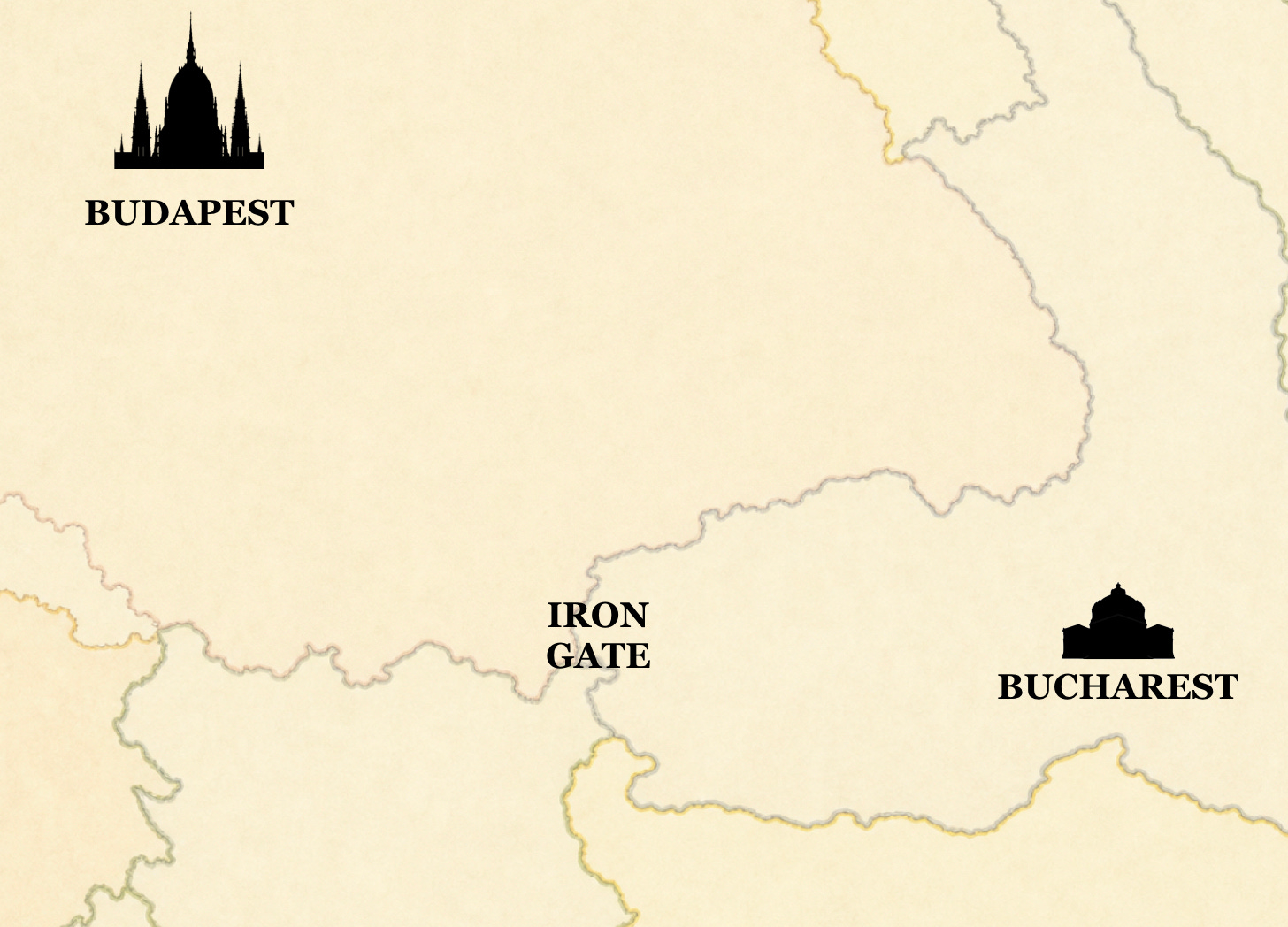
The Romanians knew well the importance of the Iron Gate, and had, as a result, taken steps to keep it out of enemy hands. They placed fortifications of the coastal variety, with heavy guns pointed towards the south and west, made it difficult for the Bulgarian forces on the far side of the Danube to cross that river. It also prevented enemy gunboats from using the river as a highway. The Romanians also deployed an infantry division that, while poorly equipped by the standards of the day, served to block the northern route into the defile. At the same time, the Romanians did little to protect the Iron Gate from enemies coming from the east.
To exploit this vulnerability, one of the component German infantry divisions of the German Ninth Army organized an unusual task force. Known as both Abteilung (Detachment) Picht (after its commander) or Sturmgruppe Picht, this ‘operational maneuver group’ avant la lettre consisted of
an ordinary infantry battalion
cargo trucks borrowed from the divisional supply column
two truck-mounted anti-aircraft guns
linemen and radio operators from the divisional signal unit
a handful of horsemen from the divisional cavalry regiment
Making use of the road that ran beside a railroad track, and profiting from the slow decision cycles of the Romanian leaders in the area, Sturmgruppe Picht required less than two days to reach the eastern defenses of the Iron Gate. Once there, it lost no time in capturing a coastal defense fort from its undefended landward side. This, the Germans set up an ambush for the Romanian reaction force that, thanks to the work of their wiretapping service, they knew would soon arrive.
When the Romanians proved unpunctual, Captain Picht made use of the lull in fighting to capture Turnu Severin, a nearby town of 24,000 inhabitants. There, after taking hostages to ensure the good behavior of local civilians, he set up his defenses. The next morning, four Romanian battalions attacked. On the second day, the better part of a Romanian division attacked. While both attempts failed and the bodies of dead Romanians littered the outskirts of the town, they put enormous strain on Sturmgruppe Picht. In particular, the German machine guns had been worn out beyond immediate repair, one of the two anti-aircraft guns had been knocked out, and stocks of ammunition were running low.
At the point in time when it seemed that Sturmgruppe Picht would soon have to throw in the towel, reinforcements arrived from both ends of the Iron Gate. On the eastern end of that defile, the German bicycle brigade of Baron von Quadt, which had been dispatched from the Ninth Army in response to Captain Picht’s request for help, struck one flank of the Romanian position. In the west, an Austro-Hungarian brigade exploited a gap in the disposition of the Romanian formation to appear on the other side of that formation. With powerful enemies on both sides, the Romanian division fled towards Bucharest, leaving the Iron Gate, and thus the new supply route of the Ninth Army, firmly in the hands of the Central Powers.
Sources
Bruce Ivar Gudmundsson On Armor (Westport: Praeger, 2004) pages 19-23
Bruce Ivar Gudmundsson Readers’ Companion to On Armor (Blogspot) Chapter 2
Related Reading
No posts
Comments
Nothing yet. Say the first thing.
Sign in to join the conversation.