
I consider putting myself out there to be the most embarrassing thing on earth. I was always drawn to writing from an early age because it offered an illusion of protecting myself. I could place myself behind the identity of writer and I could create characters to place my truths behind.
The truth is the book won’t save you. I’ve heard other writers say this, and I’ve started saying it myself. I’ve taken it to mean writing won’t make me existentially happy anymore than my anti-depressants do. It will help, but it’s only a part of the puzzle. Yet it has also come to mean another thing to me, which is that the book is something that you can’t hide behind. If you want it to exist in the world, you have to put yourself out there on such a level that you become completely transparent.
Part of this is just writing 101: the writer has to learn how to get out of their own way. The craft of writing is making the writer disappear—hence the illusion of protection. Yet, the writer is never safe. The writer is the one subject to the nakedness, rejection, and vulnerability. This is why it’s terrifying to put yourself out there.
I was selectively mute as a child. It’s a rare childhood anxiety disorder marked by a severe inhibition to communicate in certain settings. At home, I was completely “normal.” I had friends in the neighborhood, and got along with my sister and parents. I had a happy childhood.
But at school, and in other situations, I shut down. I refused to speak, using hand gestures or clicking noises to communicate. I even spoke in a distinctly different, smaller voice when frustrated teachers would finally goad it out of me, like a tiny “yes” when I conceded I had to use the bathroom.
The mutism persisted well into high school. I existed so much in the background of my own life that when I was voted “Most Shy” in the yearbook superlatives—as a friend on the inside informed me—one of the popular yearbook staffers had made the executive decision to switch me out for (ironically) a “more prominent” shy person that people actually knew went to the school.
I don’t know why I didn’t talk. I suspect I am probably neurodiverse—but I’m also an elder millennial—so my parents diagnosed it as “shyness.” I also think it’s connected to my transness. In my earliest memories, family members are correcting me on my gender while I insist that I’m a boy. I can still feel the panic of being told I’m wrong about something I understood about myself so fundamentally. It created a distrust in myself. I’ve known I was a trans since I was a child, but without the words for it, perhaps I learned it was safer to say no words at all.
I needed a therapist. Instead I discovered the magic of books. I’ve always thought books could save me. I loved escaping into other people’s heads, and becoming the writer, in a way. Or the writer was me, somehow. And I could become the main character in my story: the boy, the author, and the hero. I wanted to become a writer from the earliest age.
My mother took me to the library every week. She used to tell me a story where she was mad at me as a toddler, because I was running around, darting in between the stacks and giggling loudly. I always loved hearing this story, because I don’t remember ever being this free as child, breaking the rules without care.
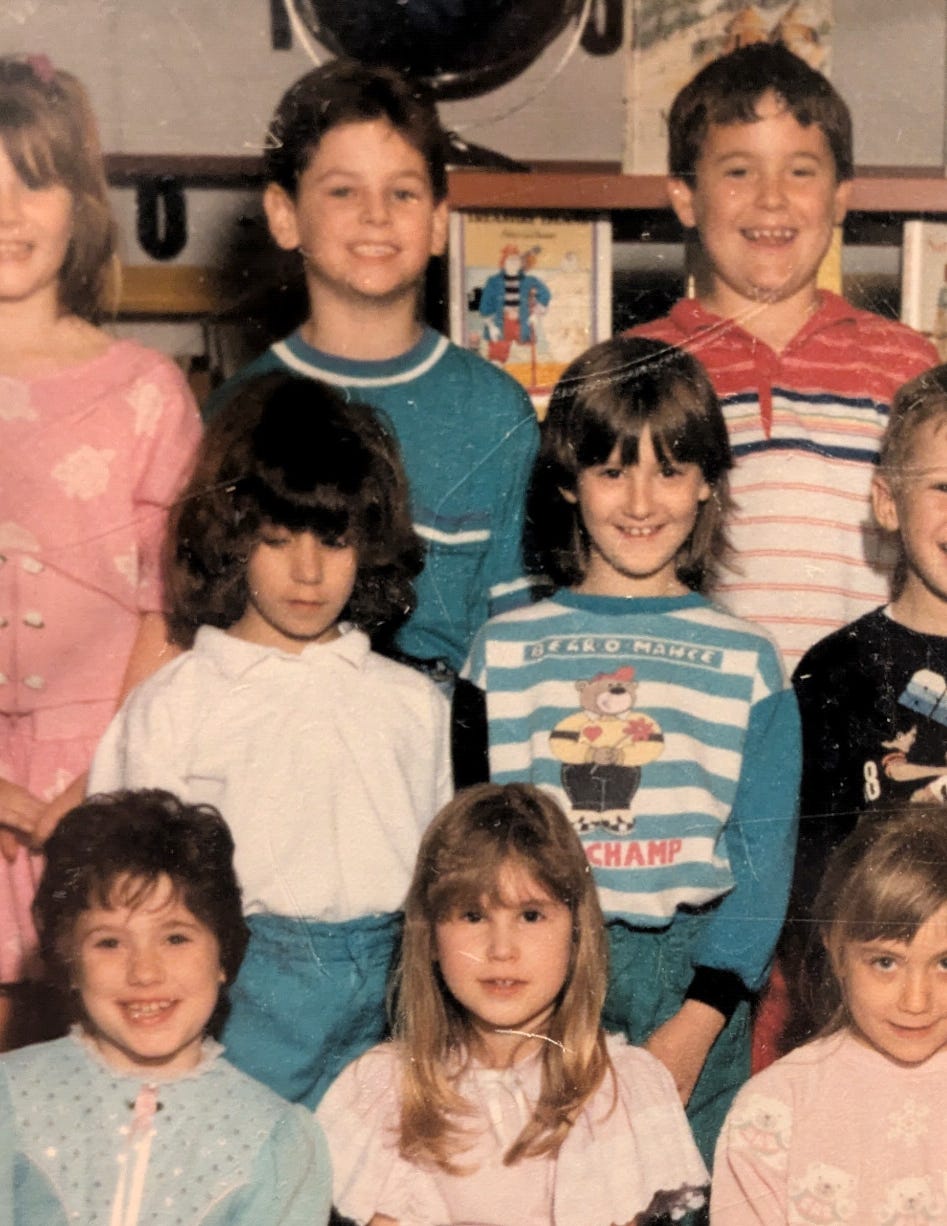
Here is a picture of me in grade school on class picture day, looking down, trying not to exist in front of the camera:
Adults were constantly giving me generic platitudes I had no idea how to use. “Make them laugh with you instead of at you” is the standard sitcom advice for bullied kids. Just put yourself out there! SMILE! Everyone is just as afraid as you! Pretend they’re naked!
Eventually I grew up and began to talk. The childhood anxiety showed up in other ways in my life, like perfectionism and rejection sensitivity dysphoria. Putting myself out there haunted me in the way that it seems to haunt all of the burned out former gifted and talented kids. It seemed like my fate to exist in the background of my own talents.
What I’ve learned is this: the illusion is in putting yourself out there. When you’re in front of others, people can no longer see you. You can project anything, and they will believe you. It is something you can hide behind.
I’ve seen people announce on stage that they’re nervous, which I wouldn’t have noticed until they called attention to it. From the audience, people are in their heads. Their nervous about what they’re reading, or they’re nervous about someone else in the room, or they’re numb from booze. Your nerves are invisible.
In other situations, I’ve had people nervous to talk to me, nervous for me to read their work, or nervous to pitch their work. When I recognize this nervousness in others, it becomes transparent in a way that I only ever see my own. I wish there was a way I could tell them, you have no reason to be nervous around me, but the platitudes won’t work, I know. You have to learn it for yourself.
Unfortunately, I’ve learned I can put myself out there the hard way, through practice and exposure therapy. I’m also afraid of flying on planes. Once, I had a therapist tell me I should join an exposure therapy group for people who are afraid of flying, who take short flights together to overcome their fear. I scoffed at the idea at the time, thinking it to be the most unserious idea anyone had ever suggested to me. I would never die therapeutically. But as it turns out, this is the way.
Putting yourself out there requires continuous exposure therapy. I’ve awkwardly introduced myself to so many writers, pitched myself to so many editors, and spoken in front so many people, that while it does still scare me, I’ve come to “trust the process.” The worst things probably won’t happen.
What is the worst thing that even would happen? Everyone laughs at me. Everyone hates me. Everyone feels bad for me. I realized I am afraid of having a panic attack in front of people. I realize many of my worst childhood memories were only panic attacks, as I was shaking, sweating, with my heart and mind racing, wondering how everyone else was just able to eat lunch casually and make friends.
There is your rejection sensitivity dysphoria and then there is reality. No one cares about anyone else that much. And if you do manage to trigger a few “haters,” then you are doing something right and you should keep following the instinct, because again, the first thing you need to understand is no one ever cares.
When TBQ began getting buzz, people wanted to interview me. Some news station in Chicago wanted me on the morning segment. Immediately, my childhood insecurities came roaring back in ways that surprised me. I felt shame that other writers would be thrilled with the opportunity to speak, while I was questioning whether I could even physically survive the ordeal of being asked questions. I had never imagined my dumb idea making it to a second issue, and now I had to decide whether to put my name and face on it as well.
So I decided it my chance to be brave and discover myself, just like they taught me on television. Instead, everything went wrong. All of my worst fears were realized on live television.
I was visibly, uncomfortably nervous on the Zoom, with my voice shaking. Despite giving them they/them pronouns, I was deadnamed and misgendered several times. My kid, who was a toddler, darted into the room during the segment giggling. I’m certain my mother’s ghost sent him to pay me back for the library. The host asked him if he liked Taco Bell.
The duo is known for creating absurd and viral moments for bleary-eyed viewers slogging through getting ready for work in the morning. I was unsuspecting as the hosts tagged teamed me in good cop/bad cop interview. I was not on television to talk about my work and literary ambitions. I was there as bait. The segment devolved further as the hosts tried to get something humorous going, as I realized they didn’t actually understand the magazine and were making fun of me.
“These poems don’t even rhyme!” one of the hosts joked.
What can I say? Sometimes the airplane does plummet to your death. But I learned something, and I do recommend dying as therapy. Even though it was a nightmare, I had accomplished something huge. I didn’t realize it at the time, but it was oddly healing. You have to do something that scares you. Get it over with. Jump in.
I was recently on a panel at AWP about brand building. Lexi Rosen of Silly Goose Press invited me, and I encourage you to check out her work, which is so inspiring and fresh. The panel was about building voice as an editor for your magazine. Creating a brand, a presence, a voice, a character—all of it comes from the same creative energy.
My agent said TBQ is like my drag voice, while I was—ironically—asking her for advice on how I should put myself out there as a writer. On social media, I’m starting feuds with the Paris Review, intimidating the New Yorker, and being the voice of the most prestigious literary magazine in the world. But in real life, I’m still figuring it out. Make it a character. Get something to hide behind. Make them laugh with you.
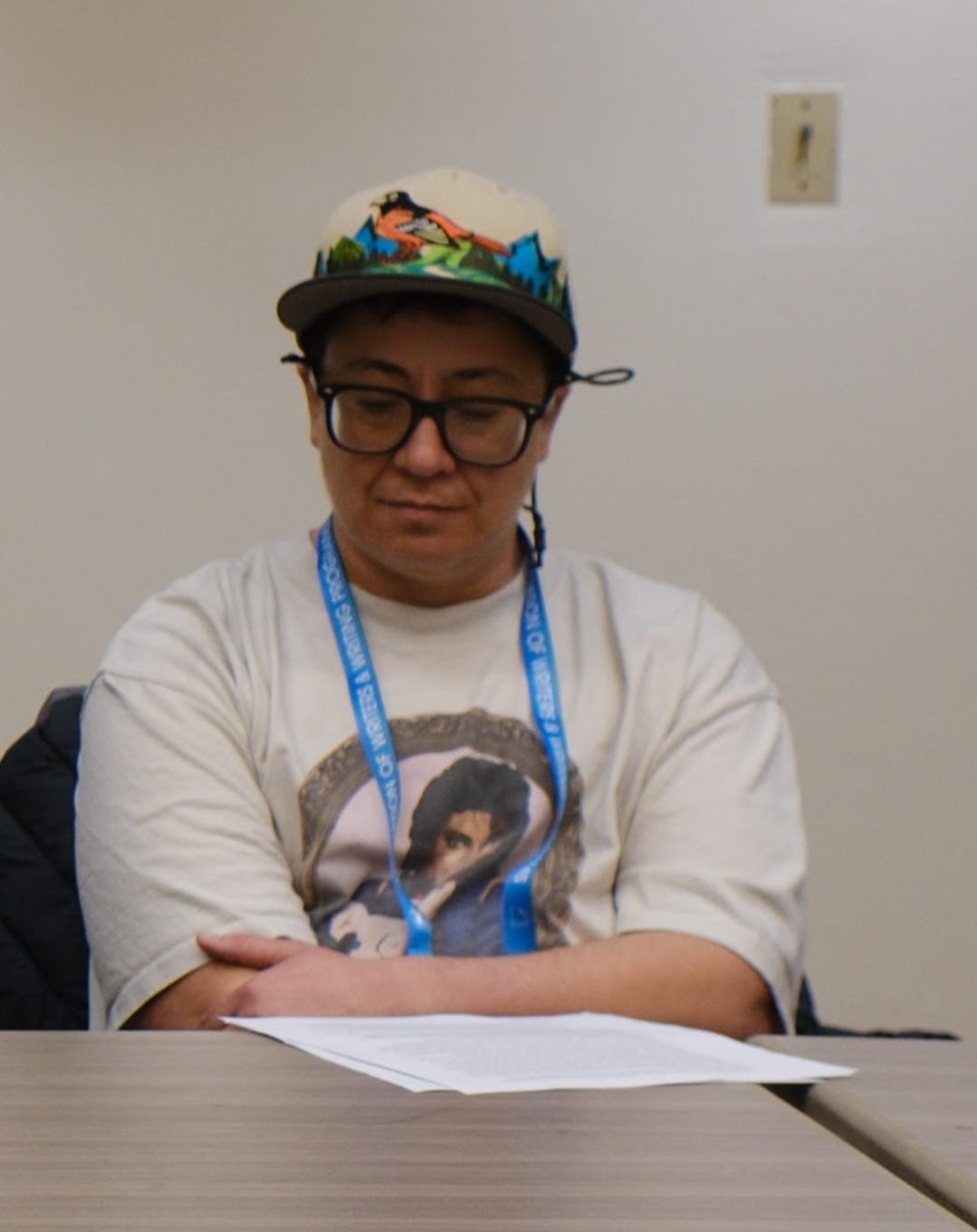
After the event, Lexi sent me an email with pictures, which I opened with trepidation and fear. I am getting better at looking at pictures of myself with kindness, and I instantly recognized myself as a child, trying to preserve myself.
Here I am, giving professional writing advice, in brace position, just like the flight attendants advise in the pre-flight drill.
I’m not really sure I can answer the question of “how” to put yourself out there. I’m still learning. For myself, I can only answer the “why” I put myself out there. Do it because it scares you. Do it for your inner child. There’s still so much time for you to figure it out. It’s not your fate in the end.
You are the writer. You are the main character. You can make it up at any point. It’s an illusion you can step through. Make yourself transparent, and it can’t hurt you. It just moves right through.
No posts
Comments
Nothing yet. Say the first thing.
Sign in to join the conversation.