
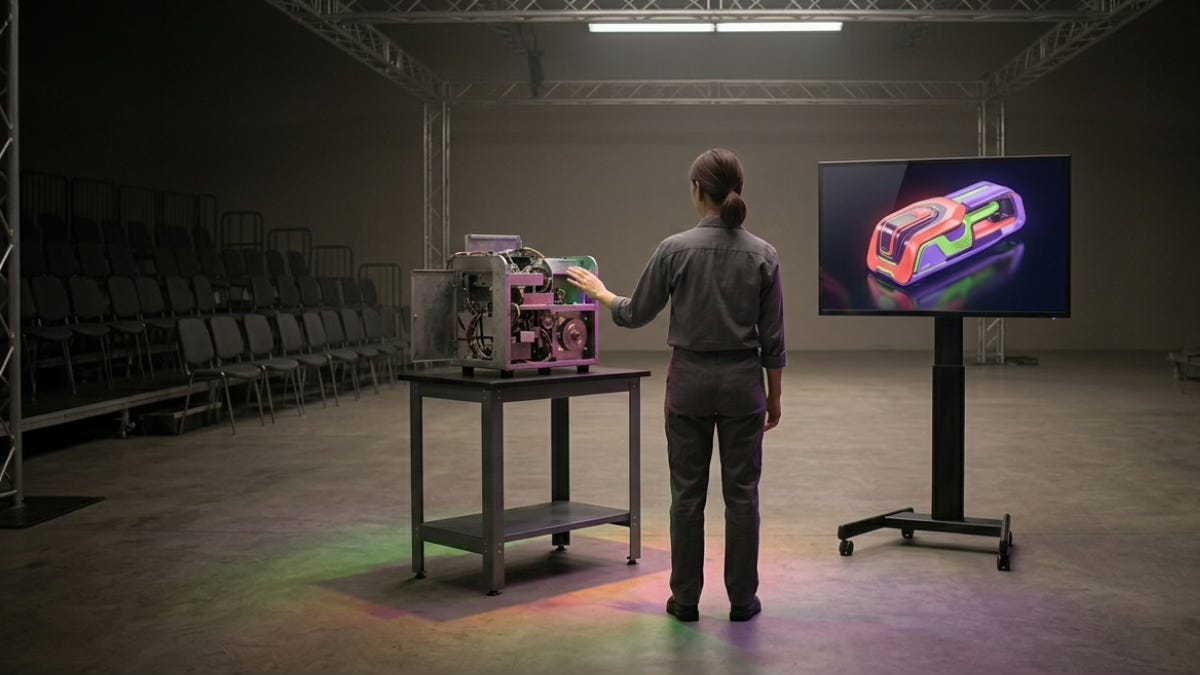
A few years ago I sat in a conference room in the Techstars building with the highest concentration of raw intelligence I have ever been in a room with (since my Northwestern days if I’m being fair). Engineers and scientists with the kind of brain horsepower that makes a meeting feel physically denser than the air around it. The work in front of us was the kind of problem I had spent my career hoping someone would actually take seriously.
We were going to build a language model that could be trained by linguistic and behavioral science experts—real ones, the kind who had spent careers studying how systemic bias actually manifests in language, in performance review patterns, in the structure of who gets promoted and who gets pushed out. The thesis was straightforward and, to anyone who had bothered to understand the underlying science, obvious. The data we were going to train on—every corporate communication, every performance review, every internal channel—contained the same gender, racial, and age biases that had always been there. Anyone who thought “bias” was a word invented in 2020 had not been paying attention for the prior fifty years. The biases were in the data because they were in the workplaces, because they were in the people, because they were in the history. Scaling a language model trained on that data without intervention was going to scale the biases. This was not a political claim. It was an engineering claim. The room understood that. The algebra brains and the language brains spent days on the initial architecture document, slowing down enough to understand each other’s discipline well enough to build something neither could have built alone. We spent years progressing from there. We learned. We iterated. We watched the thing get better.
And then we ran out of money.
Not because the technology failed. The technology worked. Not because the customers did not need it—they desperately did, both for the reason that should have been enough on its own (it was correct, it would have made workplaces measurably better, it would have caught real harm) and for the reason that any CFO could have signed off on (reduced churn, improved performance, protection against the wave of class action exposure that anyone with eyes could see building). We ran out of money because our technical achievement came at the same moment the country decided that the word “woke” was bad and that any work adjacent to the science of bias was now politically toxic, and the funding apparatus responded to that narrative shift in less than a year. The boards that would have funded the work in 2019 had a better story to invest in by 2023. The better story was that AI was going to let them fire half the company and route the margin savings into their own pockets. No one stepped back to ask whether that story was real, whether the technology actually did what the story said it did, whether the savings would materialize or the productivity would survive or the customers would notice. The story was profitable to underwrite. That was enough.
The team disbanded. Every one of those people—one of the most extraordinary groups of builders I have ever had the honor of working with—is now somewhere bigger, on a worse team, trying to survive the next round of layoffs or hunting for another way to keep a roof over their family. The skill that team had—the ability to actually wield a technology, to know what it could do and what it could not, to slow down enough to build it correctly—is not a hireable skill in 2026. We reward sellers now. We do not reward builders. We barely tolerate them.
That is the room I want you to keep in your mind for the rest of this essay. Because the question I am writing toward is whether any room like it can survive what is coming next.
Here is what I think happened to all of us, without anyone announcing it.
We narrowed the word “technology” until it stopped meaning the thing that works and started meaning the apparatus around it that convinces you it will work. The press release is technology now. The valuation is technology. The keynote, the demo staged to hide what the demo cannot do, the roadmap with milestones spaced to match the fundraise rather than the engineering—all of it gets called technology, and the actual machine, the actual science, the actual claim that something is true about the world, has quietly become the least important topic in the room.
This is not a complaint about hype. Hype is downstream of it. This is a claim about what the word means now, and who benefits from the meaning.
The redefinition is not neutral. It is extractive by design. When “technology” means capability, the people who win are the people who can show you the thing working. The engineers. The scientists. The room I just described. When “technology” means persuasion, the people who win are the people who can convince you fastest, and those are rarely the same people. The redefinition transfers the reward from the builder to the seller, from the lab to the cap table, and it does so under cover of a word everyone still thinks means what it used to mean.
I have spent my career inside the part of this that is reasonable. Technology that cannot get funded does not get built. Selling is real, and good selling has always been part of bringing a real thing into the world. What I am describing is something worse than salesmanship. It is the moment the selling stopped being in service of the thing and the thing started being in service of the selling. Once that inversion happens, understanding the technology becomes optional. I have watched this for twenty years: not understanding the technology becomes a competitive advantage. The person who has not slowed down to understand what the thing is can promise anything. The person who understands it is burdened by the truth.
There is one move I refuse to be quiet about anymore, because it is the mechanism by which a genuinely wonderful technology got turned against the people it could have served.
The dominant narrative about AI was never augmentation. It was always replacement. Human versus machine. The machine that does your job, writes your essay, produces your analyses, makes you redundant. That framing did not arise because it was the most accurate description of what large language models are—they are, at their best, extraordinary generation and reasoning tools that add enormous value to a person who knows how to wield them. The framing arose because versus is what justifies the concentration.
If AI augments people, the value disperses—to the worker who gets more capable, the small business that punches above its weight, the customer who gets better service. Dispersed value is hard to capture. But if AI replaces people, the value concentrates, because now the technology is a substitute for labor, and whoever owns the substitute owns the savings. The “versus” is not an observation about the technology. It is a business model.
And the business model is what poisoned the well. AI as a technology could be adding enormous value right now—is adding it, in the seams, wherever someone ignored the narrative and just used the tool to be better at their work. But the dominant story made it a threat instead of a gift, made it a thing done to workers and customers rather than for them, and in doing so it spent down the public trust that the technology needed in order to take root as the good thing it actually is. The capitalists who could not be bothered to understand it killed the best version of it through sheer incurious greed. They reached for the most extractive application available—fire more people—because it was the one they could see, and they called that vision.
There is a depth axis underneath this I want to name, because once you see it the rest of the argument falls into shape.
The first wave of computing encoded our logic—algorithms, databases, queries—running the formal reasoning humans had already worked out on paper, just faster. The second wave encoded our language: AI models how words relate to other words across the vast accumulated record of how humans use them. The third wave now on the horizon is quantum, and quantum reaches into the physics underneath both. Algebra is a human invention. Language is a human invention. Physics is what was there before we showed up, and quantum mechanics is the layer of physics that does not behave like anything our brains evolved to handle—qubits that hold two states at once, particles entangled across any distance, behavior that contradicts everything your intuition tells you about how objects work.
Each wave reaches one layer deeper into what is actually real, and each wave is harder to understand than the last because we are running out of human-intuitive scaffolding to lean on. The apparatus that misread AI through a software lens was misreading something one layer deeper than algebra. The same apparatus, applied to quantum, will be misreading something two layers deeper, in a substrate that does not even pretend to behave like everyday objects. The damage scales with the depth. The room that could not slow down enough to understand a language model is going to encounter something that does not work the way anything they have ever encountered works, and they are going to do the same thing they did before. They are going to find a narrative they can sell, decide that is the technology, and price the rest as detail.
If you want to see the redefinition operating in real time, look at the autonomous car.
Fully self-driving vehicles have been roughly three years away for roughly thirty years. The promise has been refreshed by every major automaker and a generation of startups, financed by billions in capital, and validated by demonstrations carefully staged on routes the demonstration designers controlled. I have spent meaningful chunks of my career inside this industry, and the gap between what the marketing said and what the technology could actually do, on a normal road, in normal weather, with normal humans and animals in it, has been the open secret of the field for as long as I have been in it.
The progression of the car maps the progression of computing almost exactly. We first turned cars into computers—the modern vehicle’s electrical system is more complex and more valuable than its engine ever was. Then we layered language and pattern recognition on top: machine learning, computer vision, sensor fusion. Some of this works remarkably well. Adaptive cruise control is real. Lane-keeping is real. Highway autopilot under good conditions is real.
What is not real, and what no one credible can tell you a date for, is the last mile. Reading a hand-made detour sign in heavy rain. Distinguishing a plastic bag blowing across the road from a small child running across the road. Interpreting the body language of a dog at the curb to know whether it is going to bolt. These are not edge cases. They are the actual conditions under which a car operates in the real world, and the perception required to handle them robustly is not a matter of more data or bigger models. It is, at depth, a real-time physical-world reasoning problem that the current substrate is not solving.
There is a serious argument that getting there requires the third wave—that the perception the road actually demands needs computational substrates we do not currently have, and quantum approaches may be part of what closes the gap. May. The frontier is still pushing outward. We do not yet know whether quantum is enough, or whether the perception problem will demand a substrate we have not invented yet.
But here is what I do know. The autonomous car was promised to you by exactly the apparatus this essay is about. The cars are not here. No one is being held to account for thirty years of broken delivery. The same apparatus is now promising you AI agents that will run your business, and the agents are not here either, and no one will be held to account for that either. And the same apparatus will soon turn its attention to quantum, a technology even harder to understand than neural nets, with longer timelines, deeper physics, less intuitive payoffs—and it is going to do the same thing it has done every time. It is going to find a story it can sell, decide the story is the technology, and price the rest as detail.
The question I find myself asking, and that I have not heard asked clearly enough in public, is whether the investor class that exists in 2026 is still capable of bringing a frontier technology to market without destroying it.
I do not mean this as a slur. I mean it as an honest empirical question, and I want to be on the record with my answer before the evidence arrives.
In the 2000s, I believed they were. I worked in and around industries where the capital understood that real things took time, that the people building had to be respected enough to be listened to, that the difference between a promising technology and a delivered one was years of patient engineering. The funding apparatus had not yet been entirely captured by the people whose only skill was capturing it. There were grown-ups in the rooms. Some of them had built things themselves. They knew what they did not know.
I do not believe this anymore. I have watched, for the better part of two decades, what is actually rewarded in technology markets, and it is not building. It is selling. It is not patience. It is momentum. It is not understanding the technology. It is the confidence to promise outcomes the technology cannot deliver, on timelines the physics cannot accommodate, to audiences who have been trained to mistake confidence for competence. The class that should be allocating capital toward the frontier has, in my honest assessment, lost the ability to evaluate the frontier. They cannot tell a real founder from a polished one. They cannot tell a real demo from a staged one. They cannot tell a thirty-year science problem from a six-month sales cycle. The people who could tell those things have, by and large, been pushed out of the rooms or have stopped being heard in them.
This brings me to the live wire I want timestamped, in May of 2026, before the tape plays.
The AI public offerings are here, soaking up the media oxygen, and the structure of what is about to happen is not a mystery to anyone who has watched the prior decade closely. The gains have already been captured. They were captured in private markets, where the apparatus that authored the narrative also held the equity, and where the public was not invited. The public offerings are not a distribution of upside. They are a transfer mechanism for the downside. When conviction outruns physics, and it will, the losses do not land on the people who sold the story. They land on the retail accounts and the pension funds and the index holders who were told this was the future and were never given a real seat at the table where the future was being priced. We have stopped sharing gains. We have not stopped socializing losses. That is not a forecast. That is the shape of the last fifteen years of technology finance, and the AI cycle is the most expensive version of it we have run yet.
Meanwhile, behind the noise of the AI offerings, the quantum narratives are being pre-loaded with exactly the same machinery. The valuations are already orders of magnitude ahead of the revenue. The story is being staged for the next exit window, on a substrate even harder to evaluate than neural nets, in a public that is about to be exhausted by the losses from the wave currently breaking. The apparatus is not chastened by what is about to happen with AI. The apparatus is already past it, building the next narrative, on the next timeline, divorced from the actual technology and its actual capabilities, exactly the way they did it last time and the time before.
I am not predicting an outcome. I am saying the outcome is already visible in the pattern, and we are about to watch the public absorb it in real time over the coming year. I am also saying, on the record, that the people who would have to bring quantum to market honestly—who would have to slow down enough to understand it, fund the rooms that can actually build it, hold themselves to a standard the physics will recognize—have demonstrated, repeatedly, across at least two prior frontiers, that they have no interest in doing so. They have a better business model now. The better business is the narrative, the round, the offering, the exit. The technology was never the point.
What I grieve most isn’t the stolen wealth though. What I actually grieve is the room. That Techstars conference room. The team I described at the top of this essay, and the hundred other teams like it that I know exist, scattered across labs and small companies and quiet groups inside larger ones, where the algebra brains and the language brains and now the physics brains have to be able to sit together for years, listening hard, slowing down, building something that is actually real and valuable. Those rooms still exist. They are full of extraordinary people. They are not the problem. They have never been the problem.
The problem is that the apparatus surrounding those rooms no longer believes the rooms should be protected, no longer remembers what showing looks like, no longer knows how to wait for a thing to become what it is before deciding what it is for. The apparatus has spent the public’s patience like it was free, on demos and rounds and headcount cuts, and the patience is running out, and when it runs out the rooms lose the only resource long-horizon science actually needs—the public’s willingness to believe that something difficult and slow is worth waiting for.
I felt wonder once, at twenty years old in a Northwestern lecture hall, watching a professor explain that the same equation governs the motion of galaxies and the motion inside a single cell. I have spent twenty years in practice and have never once encountered that wonder in a funding meeting. Not once. I have watched the apparatus stand in front of technology after technology that could, if anyone had bothered to slow down and understand it, have served real people in real ways—made medicine, made fairer workplaces, made cars that did not kill children, gave overworked mothers Rosie, made the world durably better—and I have watched the apparatus ask only one question.
How many people can we fire with it.
They got away with calling that question “technology” because they were the ones who got to define what the word means now.
I don’t blame society, and I don’t blame Gen Z specifically, for their rising anger and refusal to use AI. That refusal is a rational response to what they have watched the apparatus do with it. I blame the funding apparatus for ruining what should have been a wonderful new frontier through willful blindness.
✦ ✦ ✦
And now for my closing ritual: Thesis & Texture
Each week, I end with two book recommendations. One that sharpens how we think about technology, capital, and power. Another that holds what systems can’t: the texture of being human.
The Thesis: Material World by Ed Conway — a journalist’s investigation into the six raw substances (sand, salt, iron, copper, oil, lithium) that the entire digital economy quietly rests on. It is the best recent corrective I know to the redefinition this essay is about, because it returns relentlessly to the physical, demonstrated, dug-out-of-the-ground reality beneath the narratives we mistake for technology. Conway makes you feel how much of what we call “tech” is actually a story told on top of chemistry and geology that nobody in the keynote wants to think about. Read it and the word starts meaning the thing again.
The Texture: Remarkably Bright Creatures by Shelby Van Pelt — a novel narrated in part by Marcellus, a giant Pacific octopus living out his last days in a small aquarium, watching the humans around him and noticing what they cannot quite see about themselves. It is one of the warmest and most observant books I have read in the last several years, and it is also, quietly, about exactly what this essay grieves. Marcellus is the intelligence the apparatus around him never quite recognizes—brilliant, patient, doing careful work in a glass tank while the people responsible for him miss most of what he actually is. Van Pelt’s gift is that she does not let that grief curdle into bitterness. The humans in the book mostly mean well. They just have not slowed down enough to see what is in front of them. The book is about what changes when one of them finally does.
No posts
Comments
Nothing yet. Say the first thing.
Sign in to join the conversation.