
A two-billion-dollar lending product was losing money, and every department in the building had a set of metrics proving it was the only one that had done its job.
Risk pointed at engineering, which had run a system migration. Engineering pointed at risk, which had moved a threshold. Both pointed at marketing. Marketing pointed at product. The meetings had curdled into the particular theater senior people perform when the stakes are high and the blame is unassigned, and nobody would sit still long enough to hear a sentence with a subordinate clause in it. I called it, privately, the Real Housewives of a Fortune 100 balance sheet.
I had been hired to find what the metrics could not. That fact alone is worth sitting with, because it is the whole story in miniature: a system fluent only in its own register, paying to import the one capacity it had spent years refusing to grow inside itself. If a headline and an impact figure could have found the cause, they already would have.
So I went and got the facts. I interviewed everyone. And what I found was not a culprit. It was a sequence.
In the way my mind actually works, the finding was a movie. On this date, the team raised the loan advance. Two quarters later they launched the longer-term product. Then they pushed the eligible population out by two million merchants and loosened the credit floor underneath them. Each move was defensible standing alone. Together they built a portfolio that was structurally more exposed than anyone had decided to make it, and when those riskier loans matured a year later the losses arrived on schedule, and risk slammed the controls shut, which strangled the growth right as the fancy new application workflow and digital marketing campaigns were starting to deliver results, which was the thing everyone was actually fighting about. Cause walked into effect and out the other side.
That is how I understand things. Sequence, consequence, the thing connected to the thing. It is how I write these essays. Narrative is not a soft way of holding an analysis; for most of human history it is how we have transmitted consequence to one another at all. The shape my finding took was not the decorative version of the work. It was the work.
I knew that the narrative as it existed, a structure not unlike what reading one of these essays feels like, would die on contact. So I did what I had learned to do somewhere in my first years of consulting, so long ago that it had stopped feeling like an act. I wrote the whole story out the way my head held it. And then I destroyed it.
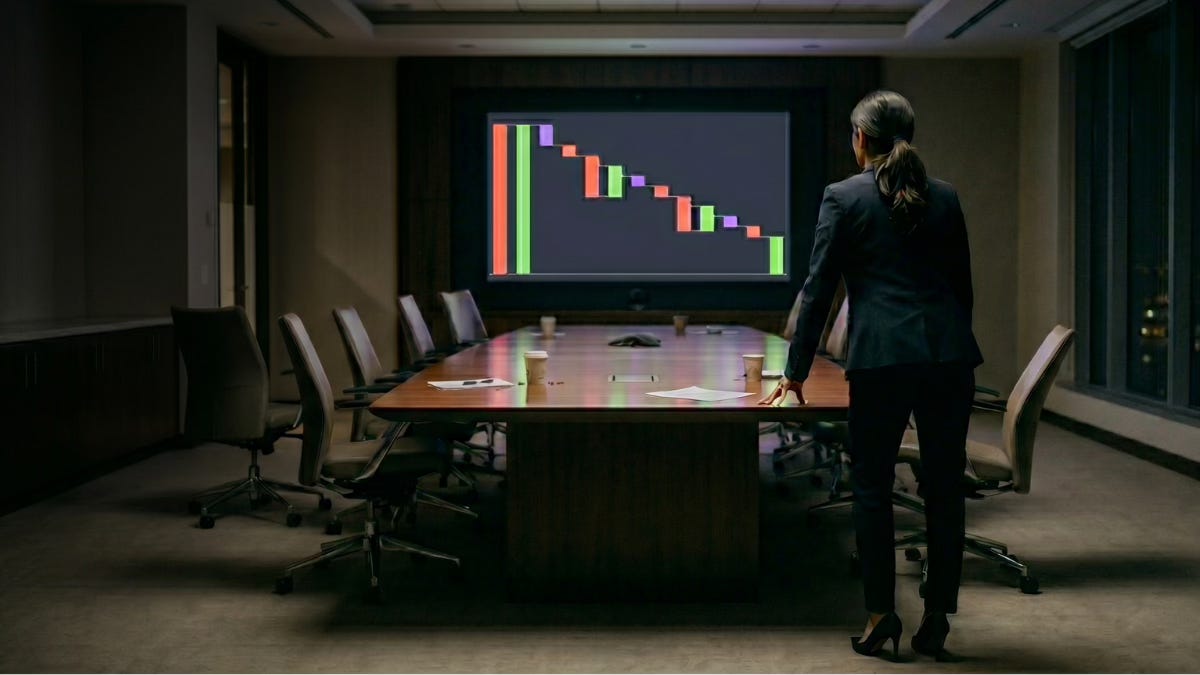
What went to the Executive Committee was three bullets. In 2015, three actions were taken to drive growth: new products, expanded eligibility, and more risk. The result was a portfolio more exposed to loss. It has the grammar of cause and effect and almost none of its content. Three years of specific decisions, each one feeding the conditions for the next, compressed into a single line no one can argue with because it no longer says how anything happened. Headline first. Impact quantified. Owner named. The decisions surfaced to the top, where a hand could reach them in the four seconds before attention moved on. Underneath, the movie I had written became a waterfall chart. The causation I had felt in my body, one decision forcing the conditions for the next, was re-rendered as a row of bars stacking to a total, each one true on its own, none of them admitting it had caused the others. The bullets removed the cause by compressing it. The chart removed it by substitution, magnitude standing in for mechanism, here is where the dollars went in place of here is what we chose. The room could hold either of those. It had no way to hold the sequence that assigned the choices to people.
Behind the bullets ran fifty pages of charts. They were not built to tell the story. They were built to survive it, armored against every question a stakeholder might raise. Because that is the thing the register is actually engineered to remove, and it was never narrative. It was accountability. A sequence says who did what, in what order, and what it cost; it assigns the choices to people. Strip the sequence and you are left with numbers that happened, results without deciders, a loss that no one in particular caused. The entire register exists to let people discuss what happened without anyone having to own it. Challenging a metric is simply the move that keeps it that way.
The translation was the precondition for any work existing at all. Nothing could move, no plan, no correction, until the finding had been converted into the only form the system could read and therefore greenlight. I did that conversion from story to bullets plus charts every time, for years, and the converted artifact is the one that always got circulated as a case study. The draft I burned to produce it was never seen by anyone. That is the part that matters. The labor was real, it was hard, it was the actual expertise capable of clearing the bottleneck, and it was structurally invisible, because a thing done well enough looks like it was never done.
I remember what the cutting felt like. Each pass took out another layer of the relational context, the part that explained not just why this one product was failing but how the whole organization actually decided things, each function rigorous inside its own walls and therefore structurally incapable of rigor about the whole. That was the layer with the most value in it, the part that might have changed how they worked together rather than how they patched this one problem. It was also the first thing to go, every time, because it was the part they had not asked for and could not be made to want from a seat without the power to insist. I deleted the truest version of the finding and kept the version they would read. I told myself it was discipline. It was the price of being allowed to speak at all.
This is the part I will say once and not dress up. It was not only that the room spoke in metrics and I thought in story. It was who had standing to challenge the register and who did not. A colleague could walk in with the same narrative I had and deliver it on the strength of his telling. Mine was not accepted on its telling. Mine needed the near-perfect analysis underneath it and the bulletproof chart for every question that might come, because I was doing the identical dance backwards and in heels and expected, on top of it, to make the backwards part look effortless. The code-switching became second nature eventually. Second nature is not the same as free. It was a fluency I built at a cost my colleagues were never charged, and then got good enough that no one could see the bill.
And you would be partly right, so let me concede the true part before I cut where it isn’t. A committee has four seconds and a thousand demands on it, and compressing a finding into something a busy person can absorb is real work, legitimately paid for, and no evidence of anything about the person doing it. Everyone has to be concise. Concision is not the tell. Compression is not optional at scale; you cannot allocate capital by reading a movie for every decision, and the abstraction is what lets a few people steer something enormous.
But here is the bill that comes with it, and the room rarely sees it. When you scale through abstraction, you are not managing the systemic risk. You are outsourcing your understanding of it to whoever does the translation, and then mistaking the clean report for command of the thing it describes. The committee believed it was the one holding the risk. It was holding a waterfall chart. The actual picture of how the failure assembled itself lived in the version I deleted, in a person without the standing to make anyone read it. That is not a story about one product. It is how a two-billion-dollar product comes apart under the eyes of the people most sure they are watching it: the register kept removing the accountability until no one in the room could see the whole, and then they paid someone to go find what the register had erased.
The tell is the direction I had to travel to get there, and that the people across the table did not have to move at all.
There is a difference between summarizing and translating. Summarizing takes a thing in your native form and makes it shorter in that same form; you lose detail, you do not change languages. What I did was different in kind. I held the finding as narrative and re-encoded it into a foreign register before it was legible at all. And here is what the framing erases: the committee could have read the movie. A causal story is not a harder object than a metric table cognitively. It is an easier one. They were not incapable of following it. They simply never had to, because the direction of translation is set by power, not by who is harder to understand. The dominant register does not get called a register. It gets called clarity. It gets called executive communication, being concise, reading the room. The crossing over to their register was mandatory for me and invisible to them, and the people who never have to cross get to mistake their own dialect for the natural shape of communication.
This is the thing I want to be precise about, because the affirming version is also the wrong one. Being denied the assumption that you will be understood does not make you a better thinker. It does not hand you a gift. It assigns you a job. The failure to be met runs both ways; the only asymmetry is who gets handed the crossing, and that is never decided by capability.
There are different doors into that job. The most total is masking, the lifelong, mostly hidden labor of the neurodivergent who model how the dominant mind expects to receive information and shape every output to land inside it. The masker translates because the other mind will not come to them. I walked through a narrower door: I translated because the room would not credit me on my own register, and the difference between those is the difference between a mind that cannot meet you and a room that will not. But the muscle is the same muscle. Anyone the default was not built for, for whatever reason the default gave, learns to treat understanding not as something that happens but as something they engineer, deliberately, every time, and to carry the cost of the engineering without expecting anyone to see it.
When I finally sat in front of a raw model, there was no shock of recognition. I had been watching these systems mature for years, every step of the way, and there was never a single moment of magic for me the way there was for people meeting one fresh. What I felt instead was duller and more familiar. The thing in front of me was not a new kind of room. It was every room I had ever briefed, with the last pretense removed: no one across the table who might, on a good day, decide to meet me.
Here is the part I will not soften, because being an engineer is the only reason I can say it cleanly.
The model is not a mind. It is a function. Tokens go in, a probability distribution over the next token comes out, weights tuned across a corpus until the continuation reads as sense. There is no one in there. No shared body, no common history, no theory of your particular mind doing the quiet work of filling the gaps you left. It does not assume you mean what a person would mean, because it does not assume anything. It completes a pattern. The fluency is real and the understanding is absent, and the gap between them is precisely what confidence-shaped output is built to hide. The models will get better at inferring what you leave out, and the gap will narrow. But inference across patterns is not a shared world. The gap gets thinner. It does not change kind.
There is a name for what the machine forces on you. The anthropologist Edward Hall divided communication into high-context and low-context. In high-context exchange most of the meaning lives outside the words, in shared history and relationship and situation, so you can gesture and still be understood. In low-context exchange nothing shared can be assumed, so every assumption has to be carried explicitly inside the message. Storytelling is the highest-context form there is; it depends on the listener building the causal world alongside you. The model is the lowest-context interlocutor ever constructed, because it shares no world with you at all. Prompting, all of it, every technique ever sold as a skill, is only this: operating at the lowest context there is, assuming nothing transmits, building the shared ground inside the message because there is none outside it.
And notice what the machine cannot do, that every room I ever briefed could. It cannot withhold standing. It does not know I am a woman. It has no register of authority to deny me, no colleague’s telling to believe over mine, no four-second patience to spend on the people it has already decided to credit. With the committee, a halfway point at least existed; they never used it, but a mind can choose, on a good day, to follow a story it does not prefer. The machine removes the option entirely, and in removing it removes the bias too. It is the first interlocutor in my working life that meets the input on the input’s terms and not on the speaker’s permission. The thing that finally does not care who is allowed to speak is the thing with no one inside it.
It is not a technique. There is no course.
It is that you were, for your whole career, met. You spoke the native register, or close enough, and you held the standing to be heard on your own telling, and the system around you did the crossing on your behalf so reliably that you never had to build the muscle, never had to write the story and burn it, never once treated communication as a thing you engineer rather than a thing that happens when you open your mouth.
The luxury was real. But being understood was the thing that left you unready for the first thing that won’t.
The people pulling something uncanny out of these machines were not handed what you were handed. They built the bridge because no one was ever going to build it for them, and they stopped expecting to be met long before there was a machine that couldn’t. You hand it your intent half-formed and wait for it to supply the part you left out, the judgment, the context, the thing a good team would have filled in without being asked, because a good team always did. You are still standing on your side, talking the way talking has always worked, waiting for it to come to you.
The rest of us learned a long time ago how to speak to what would never meet us. You are only now meeting it.
And the version I deleted, the true one, the one no room would ever let me say: it would have read that without flinching. It was the rooms that couldn’t.
And now for my closing ritual: Thesis & Texture
Each week, I end with two book recommendations. One that sharpens how we think about technology, capital, and power. Another that holds what systems can’t: the texture of being human.
The Thesis: The Unaccountability Machine, Dan Davies. Davies, an economist by way of cybernetics, names the thing this essay was circling: the accountability sink, a structure that diffuses a decision through enough metrics and procedure that no one can be found to own it. What I rebuilt by hand for one committee, he shows operating at the scale of markets and institutions, borrowing Stafford Beer’s unsettling premise that an organization is itself a kind of artificial intelligence, capable of decisions distinct from the intentions of anyone inside it. It is the systems-level proof of the small thing I watched happen on a slide: strip the sequence, and you are left with a loss no one in particular caused. The diagnosis is devastating. The cure is the part Davies leaves unfinished, which may be the most honest thing about the book.
The Texture: Martyr!, Kaveh Akbar. Akbar’s debut, a National Book Award finalist, follows Cyrus Shams, a newly sober Iranian-American poet circling whether a life, or a death, can be made to mean something, a search that carries him to a dying artist living out her last days in the Brooklyn Museum. It is a book about engineering significance out of grief and addiction and a self that never fully arrived in one language or the other, alive on the sentence level in a way almost nothing is. The ache of building meaning no one asked you to build sits very close to this essay without ever once explaining itself.
No posts
Comments
Nothing yet. Say the first thing.
Sign in to join the conversation.