

It’s a near-universal assumption in fine-tuning: feed the model more examples, get a better model. One of the most persistent failure modes in practice tells a different story.
In a recent study, researchers trained two versions of the same base model. One was fine-tuned on 12,000 examples. The other used just 3,472. The smaller dataset won — and not by a small margin. It beat the larger one by close to ten percentage points.
The takeaway upends a common assumption: raw data volume isn’t what drives performance. What actually matters is whether the model has seen enough examples of every task it’s expected to handle.
Picture a model built to pull structured details out of text — things like birthdates, places of birth, nationality, and aliases, extracted from biographical passages.
After training, it hits 95% accuracy. By every visible measure, it’s ready to ship.
Then, a few months into production, complaints start rolling in. The model keeps missing aliases. It stumbles on nationality. Meanwhile, birthday extraction is essentially flawless.
The model isn’t broken. The data is.
Digging into the training set reveals the problem: over 100,000 examples covering birth years, but barely 1,400 examples involving aliases. The model learned what it saw most and largely skipped what it barely encountered — not because it couldn’t learn aliases, but because it was never given a fair shot at learning them.
This is the long-tail distribution problem in action. A handful of categories dominate the dataset while many others are left with scraps.
This kind of gap often stays invisible because teams lean on aggregate accuracy scores to judge model quality.
Most evaluation pipelines default to micro-F1, which weights results by how often each category shows up. Frequent classes drive the score; rare ones barely register.
A more honest metric is macro-F1, which treats every category equally regardless of how often it appears.
When micro-F1 looks great but macro-F1 lags well behind, that gap is usually a signal: the model is facing the common cases and quietly failing the rare-but-important ones.
This is where a lot of production headaches start.
The default reaction to a performance drop is to gather more training data.
That instinct rarely solves a distribution problem.
If one category makes up 77% of the dataset and another makes up just 1%, doubling the entire dataset only doubles both counts — the imbalance stays exactly the same.
The already-dominant class gets even more dominant. The rare class is still starved.
This is precisely why the bigger 12,000-example dataset underperformed the smaller one. The 3,472-example set wasn’t just smaller — it was deliberately built so every output category had adequate coverage.
The lesson: balance beats size.
The research points to a practical rule of thumb worth internalizing:
A model generally needs roughly 1,000 examples of a given class before it can learn that class with any reliability.
This lines up with separate work by Zeyuan Allen-Zhu and Yuanzhi Li on how language models store knowledge, which found that models typically need on the order of 1,000 exposures to consistently retain and recall a piece of information.
The exact figure shifts depending on the model, the task’s difficulty, and data quality. But the underlying principle holds steady: below some minimum number of examples, a model simply can’t learn a category well — no architecture choice, optimizer trick, or training hack will compensate for that gap.
This reframes the central question teams should be asking. Instead of:
“How much training data do we have?”
The better question is:
“Does every category we actually care about have enough examples?”
These are not the same question, and the difference matters.
Once teams recognize they’re short on examples for rare classes, synthetic data looks like an obvious fix. Large language models can churn out thousands of labeled examples cheaply and quickly.
But synthetic data brings its own problem.
Generated examples tend to be too clean — too obvious, too unambiguous. The boundaries between classes end up looking sharper than they ever are in messy, real-world data.
Train a model exclusively on synthetic examples and it develops overconfident decision boundaries. It looks great on synthetic test sets and falls apart on actual production traffic.
One study found a model trained purely on synthetic data scored 92% accuracy on synthetic test data but dropped to just 81% on real-world data. The model hadn’t learned reality — it had learned a sanitized stand-in for reality.
Researchers found a fix that doesn’t require abandoning synthetic data altogether.
Rather than generating brand-new examples from scratch, they took existing labeled examples, deliberately flipped the label, and asked an LLM to make the smallest possible edit that would justify the new label.
The result: examples that sit right on the decision boundary — the genuinely ambiguous, hard-to-call cases that real users produce constantly. These “boundary-hard” examples teach the model exactly where the lines blur.
Synthetic data built this way looks much more like production data and noticeably improves how well the model generalizes.
Models trained on a blend of real data and this refined synthetic data came within 1.5 percentage points of models trained on real data alone, while also holding up better across different domains.
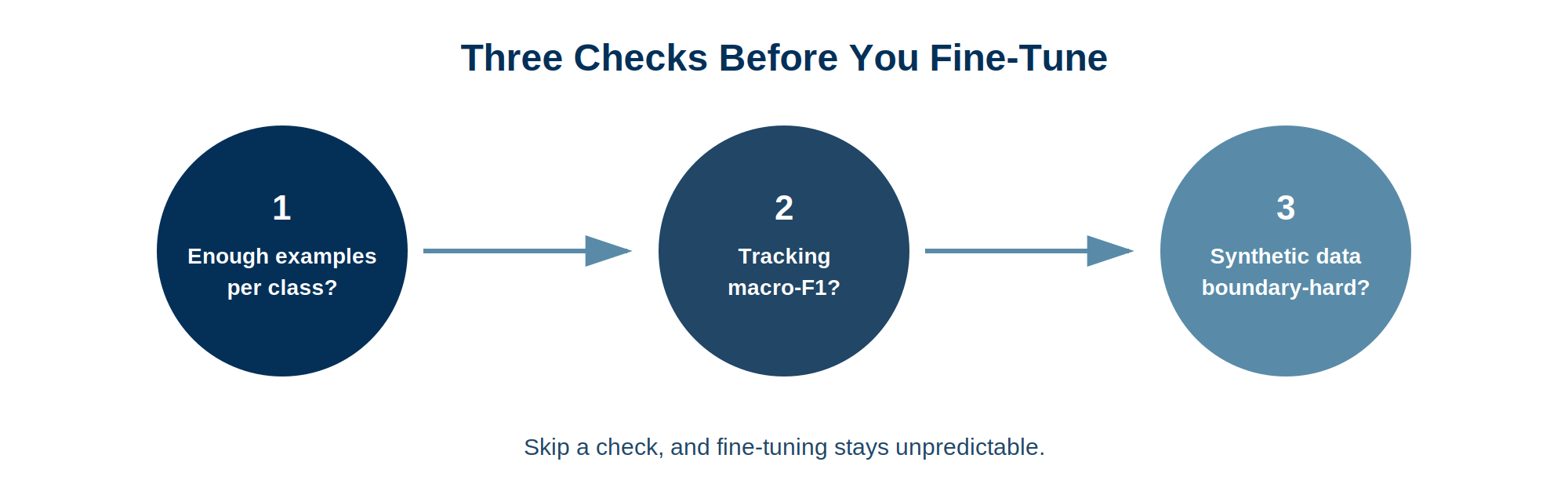
Before touching learning rates, LORA configs, or architecture choices, run through these three checks:
1. Does every class have enough examples? If a category doesn’t have roughly 1,000 solid examples behind it, don’t expect the model to learn it reliably.
2. Are you tracking the right metrics? Watch macro-F1 alongside micro-F1. A strong aggregate score can mask serious failures hiding in rare but critical categories.
3. Is your synthetic data actually realistic? If synthetic examples look cleaner and more separable than real data, refine them into boundary-hard examples before they go anywhere near training.
Fine-tuning often feels like a black box because its failures look like model problems. Teams assume the model can’t handle edge cases, struggles with specific categories, or just doesn’t generalize well.
More often than not, the model is doing exactly what its training data taught it to do. The real issue is that certain categories never had a fair number of examples to learn from in the first place.
Good fine-tuning has less to do with architecture and more to do with data design: give every important class sufficient representation, judge performance with metrics that don’t hide weak spots, and build synthetic examples that reflect real-world messiness rather than an idealized version of it.
Get that right, and fine-tuning stops feeling unpredictable — and starts performing the way it should in production.
Read the complete article on synapt
Authored by Priyankaa A, Rayani Aravind, Founding PMM, Synapt AI.
.
No posts
Comments
Nothing yet. Say the first thing.
Sign in to join the conversation.